Oldest Hebrew Mention of Jerusalem Found on Rare Papyrus from 7th Century BCE

Reference to consignment of wineskins “to Jerusalem” appears on 2,700-year-old First Temple-era scrap believed plundered from Judean Desert cave

By Ilan Ben Zion

p42714401
A First Temple-era 2,700-year-old papyrus bearing the oldest known mention of Jerusalem in Hebrew.

A rare, ancient papyrus dating to the First Temple Period–2,700 years ago–has been found to bear the oldest known mention of Jerusalem in Hebrew.

The fragile text, believed plundered from a cave in the Judean Desert cave, was apparently acquired by the Israel Antiquities Authority during a sting in 2012 when thieves attempted to sell it to a dealer. Radiocarbon dating has determined it is from the 7th century BCE, making it one of just three extant Hebrew papyri from that period, and predating the Dead Sea Scrolls by centuries.

Warsaw’s Jewish Theater Finds Temporary Performance Spaces

The historic company faced eviction since June when its landlord blocked access to the theater.

JTA

800px-teatr_zydowski
The Warsaw Jewish Theater building (photo: Tadeusz Rudzk)

WARSAW, Poland–The Jewish Theater in Warsaw has found new temporary venues with the help of two government ministries.

The historic company has faced eviction since the beginning of June, when its landlord, looking to build a new high-rise on the site, blocked access to the theater.

At a news conference this week, the theater unveiled plans to launch a new season on Thursday at two temporary sites, the Club of the Warsaw Garrison Command and the home of the Warsaw Chamber Opera.

Romania to Open First State-Run Jewish Museum

Set to open in Bucharest in 2018, the museum will focus on Europe’s third-largest Jewish community before the Holocaust

AFP


An honor guard soldier stands during a ceremony at a Jewish cemetery in Bucharest, Romania in February 2012, next to a monument bearing the names of Romanian Jewish refugees killed in 1942 aboard the SS Struma. Around 792 people drowned after the ship was struck by a Soviet torpedo (AP Photo/Vadim Ghirda)

Romania, which denied its role in the Holocaust for years, is to open the first state-run museum dedicated to the country’s Jewish community, once one of the largest in Europe before World War II.

The museum, due to open in 2018 in the capital Bucharest, will focus on the persecution of Jews and the Roma, said Alexandru Florian, the director of the National Institute for the Study of the Holocaust.

Cultural Historian Violeta Davoliūtė: Deportations to Siberia Were Lithuanianized, Catholicized

diskusija-apie-radikaliojo-nacionalizmo-nuotaikas-lietuvoje-51388c8860434-694x480

by Jūratė Juškaitė
manoteises.lt

Historians reckon about 17,000 people were deported from Lithuania during the first Soviet occupation. Cattle cars were sent deep into Russia from June 14 to June 18, 1941, and many of the deportees didn’t survive the first winter. Most people in Lithuania know these facts well, but June of 1941, often called the tragedy of the Lithuanian people, isn’t all that Lithuanian.

Research recently performed by cultural historian Violeta Davoliūtė soon to appear in the book “Population Displacement in Lithuania in the Twentieth Century” (Brill, 2016) attempts to bring the experiences of deported Lithuanian Jews back into collective memory regarding those days in June. The researcher says the narrative of deportations formed during the push for Lithuanian independence in the late 80s and early 90s contained ethnocentric elements and was often too “Catholicized.” Although the official politics of memory seem complicated if only for the widespread “Jewish Communist” stereotype, Davoliūtė says these and similar stereotypes have failed to divide this group of deportees, which is a tight-knit community based on shared experience.

In a recent discussion historian Dr. Arvydas Anušauskas was the first to call the 1941 deportations multiethnic. Why are they called this?

Ethical Will of Leonidas Donskis: Kaddish for Butrimonys

img_17_105
photo courtesy Milda Jakulytė-Vasil

In line with the expressed wish of the recently deceased Lithuanian philosopher and author Leonidas Donskis, a group will assemble in the Lithuanian town of Butrimonys Sunday, October 23, to say kaddish for the Jewish community murdered there in 1941.

“I would be happy, if while I am still alive, something similar would happen in Butrimonys… I feel a moral obligation to say kaddish there with Jews,” Donskis said in an interview on Delfi TV on July 31, 2016. The interview in Lithuanian is available here.

Kaddish will be performed by Lithuanian Jewish opera soloist Rafailas Karpis.

Time: 3:00 P.M. to 4:00 P.M., Sunday, October 23, 2016
Location: Jewish mass grave site in Butrimonys, Lithuania

Israeli Antiquities Chief Equates UNESCO with ISIS

EID
A March 31, 2016 picture shows the remains of the Temple of Bel’s “Cella” in the ancient Syrian city of Palmyra, blown up by Islamic State jihadists. (AFP/Joseph Eid)

by Ilan Ben Zion

UN cultural body’s resolution on Jerusalem akin to jihadist group’s destruction of Palmyra, says Yisrael Hasson

The director of the Israel Antiquities Authority slammed UNESCO on Wednesday for its resolution on Jerusalem holy sites, comparing the UN cultural body to Islamic State jihadists.

Speaking at the opening of the new IAA headquarters in Jerusalem, director Yisrael Hasson said the resolution adopted last week and confirmed on Tuesday put the UN organization in the same league as ISIS jihadists who have destroyed and looted hundreds of archaeological sites in Syria and Iraq to fund their caliphate.

Four Arrests in Beating of Rabbi in Ukraine

photo_2016-10-07_18-06-51
Mendel Deitsch is in serious but stable condition after a violent assault earlier this month.

Ukrainian police arrested four suspects, two of them minors, in connection with the brutal assault of Rabbi Mendel Deitsch in the Ukrainian town of Zhitomir earlier this month.

Deitsch, who serves as Chabad Lubavitch emissary to the former Soviet Union, remains in serious but stable condition at an Israeli hospital after a group robbed and beat him in the early hours of October 7.

According to reports in Ukrainian media, two males and two females from the Carpathian mountain region attacked Deitsch outside Zhitomir’s main train station, a chabad.org press release reported.

Anti-Semitism on Steroids

Pasaulio žydų kongreso prezidentas S.R. Lauderis pavadino UNESCO balsavimą dėl Jeruzalės “antisemitizmu, kuris stiprėja nuo steroidų”

World Jewish Congress president Ronald Lauder has characterized a UNESCO resolution on Jerusalem as “anti-Semitism on steroids.”

The UNESCO resolution appears to deny Christian and Jewish ties to the city. Lithuania voted against.

Israel has frozen ties with the UN agency following the vote.

jerusalem-temple

WJC president Lauder condemned the resolution on Jewish holy sites and called it shameful, but cautioned against taking the Palestinian-initiated resolution too seriously, since there is no argument about Jewish ties to Jewish holy sites in the city.

“What happened today in Paris is anti-Semitism on steroids. It is a total travesty and an insult to the Jewish people to pretend that the holy sites in Jerusalem are only Muslim sites, and to ignore the fact that Temple Mount was already the holiest place of Judaism well before the advent of Islam,” Lauder declared.

Israel Freezes Ties with UNESCO

Baltic News Service reports Israel has frozen ties with UNESCO, the United Nations Educational, Scientific and Cultural Organization, following the adoption of two resolutions on occupied East Jerusalem in the run-up to an important vote next week. In a letter to UNESCO director-general Irina Bokova, Israeli education minister Naftali Bennett accused the organization of ignoring millennia of Jewish ties to the holy city and of supporting terror in this manner. He added the Israeli National UNESCO Commission had been instructed to cut all ties with the international organization.

NGO Monitor, an organization which monitors the activities of anti-Israeli and pro-Palestinian NGOs, issued a statement on related activities in the Security Council the day after UNESCO adopted the controversial resolution:

“NGO Monitor’s research has focused on the disproportionate political impact of Israeli NGOs and the role of funding provided by European governments. From this perspective, we note the debate over and political responses to the presentation by the director of B’Tselem [the pro-Palestinian Israeli Information Center for Human Rights in the Occupied Territories ] at a UN Security Council special session (convened by Egypt, Malaysia, Venezuela, Angola and Senegal) on Friday October 11. In this highly politicized statement, he implored the UN to take ‘decisive international action’ against Israel, and made no mention of Palestinian terror attacks or incitement. This event highlights the ways in which influential NGOs distort reality for ideological objectives and contribute to international political campaigns against Israel, under the façade of human rights, bypassing Israel’s internal democratic processes.”

Mini-Limmud 2016

The LJC and the EJF Mini-Limmud educational conference on Judaism will take place November 25 to 27, 2016, at the Trasalis resort and spa in Trakai near Vilnius, Lithuania. Participants must register between October 19 and 28. For more information contact Žana Skudovičienė, telephone +370 678 81514, email mini.limmud@gmail.com

Happy Sukkot!

sukkot-lzbSukkah at Bagel Shop Café on central Pylimo street in Vilnius

Sukkot, the Jewish feast of tents which is often translated in English as the feast of tabernacles, begins on the evening of October 16 this year, or Tishrei 15 on the Jewish calendar. A booth is built for Sukkot called a sukkah where for seven days the family has dinner, children play and as much time as possible is spent. That’s how it works in warmer climates, and today there are sukkah houses outside homes across Israel. Many Jews build the shelters in their yards or even on apartment balconies.

Why spend time in temporary shelters? The answer comes from Leviticus (Vaikra) 23:42-43: “Ye shall dwell in booths seven days; all that are Israelites born shall dwell in booths: That your generations may know that I made the children of Israel to dwell in booths, when I brought them out of the land of Egypt: I am the Lord your God.”

It’s traditional to place the four species or arba minim in the tent or booth during the holiday. These are the etrog (a specific kind of citrus fruit), and branches from palm trees, willows and myrtle trees. Leviticus 23:40: “And ye shall take you on the first day the boughs of goodly trees, branches of palm trees, and the boughs of thick trees, and willows of the brook; and ye shall rejoice before the Lord your God seven days.” The branches and fronds are traditionally used to decorate the booths and waved during the holiday.

Jews often take their evening meal in the shelter and recall the flight of their people from Egypt. However you choose to celebrate the holiday, the Lithuanian Jewish Community wishes you and your family a happy Sukkot!

sukkot3

Israeli Embassy to Present Awards to 3 Lithuanian Righteous Gentiles in Kaunas

The Israeli embassy in Vilnius is holding a ceremony to honor and award three Righteous Gentiles October 21 in Kaunas. The ceremony will confer the Yad Vashem title of Righteous among the Nations upon Antanas Blažaitis (1897-1949), his wife Adelė Blažaitienė (1903-1988) and their daughter Valentina Eugenija Blažaitytė Liutikienė (1927-1993). The Yad Vashem medals and certificates are being awarded posthumously and will be accepted by their children, grandchildren and great-grandchildren. The ceremony is scheduled for 1:00 P.M. on Friday, October 21, at the Kazys Grinius Pre-Gymnasium, Šiaurės prospect No. 97, Kaunas. Those who wish to attend should contact the Israeli embassy before October 20, telephone +370-5-2502510, fax +370-5-2502555, email press@vilnius.mfa.gov.il

The Junta, the Park, and the Sukkah: A Lesson in Community Architecture

building-windows-e

by Andres Spokoiny

We’re more affected by architecture than we might want to believe. The built environment conditions our thoughts and behaviors. Every building sends a message.

Totalitarian regimes know this well; they often have explicit architectural doctrines. Stalinist architecture favored monstrous, colorless buildings, exalting the collective over the individual. Creating monumental structures for Nazi rallies, Albert Speer evoked submission, aligning the crowd toward a single leader, rather than fostering talk among the people.

I have personal experience with totalitarian architecture. Argentinean juntas didn’t build huge buildings (mostly because they embezzled the money allocated for that), but they did renovate many Buenos Aires squares and parks. One of the most emblematic is Plaza Bernardo Houssay, tucked amid University of Buenos Aires buildings. The junta redesigned this space to make it impossible for students to stage demonstrations. The square was filled with irregular steps and levels. A water basin and a new church were built to leave no room for large crowds on the lawn. Beautiful art nouveau benches were replaced by uncomfortable concrete seats, placed so as not to face each other. Ancient jacaranda trees were uprooted, making it unappealing for students like me to fraternize under the baking sun. The traditional Spanish square, which serves as a focal point for diverse people to meet, chat, play dominoes, and philosophize, was no more.

The Jewish people is not particularly known for its architectural exploits. Our most important building in the world is a patched-up, badly eroded wall. Yes, there are great individual Jewish architects, but as a people, words are our forte — not bricks. As we celebrate Sukkot, however, suddenly Jews are forced to become architects. And it’s worth asking: if a building always sends a message, what does the sukkah tell us?

Lithuania Stands with Israel in Battle over Temple Mount at UNESCO

temple-mount-and-wailing-wall

UNESCO, the United Nations’ Educational, Scientific and Cultural Organization, gave preliminary approval to a resolution which denies Judaism’s two most holy religious sites, the Temple Mount and the Western Wall, are Jewish in a 24-6 vote Thursday.

Prime minister Benjamin Netanyahu slammed the vote stating: “The theater of the absurd continues at the UN.”

“Today UNESCO adopted its second decision this year denying the Jewish people’s connection to the Temple Mount, our holiest site for more than 3,000 years,” he said. “What’s next? A UNESCO decision denying the connection between peanut butter and jelly? Batman and Robin? Rock ‘n’ roll?”

Twenty-six nations abstained from the vote and two were absent.

The six countries who voted in support of Israel were Estonia, Germany, Great Britain, Lithuania, the Netherlands and the United States. The resolution specifies Jerusalem is holy to three religions, but that the Temple Mount is exclusively a Muslim holy site.

Full story here.
jpost

Sara Lapickaja Has Died

Netekome Saros Lapickajos

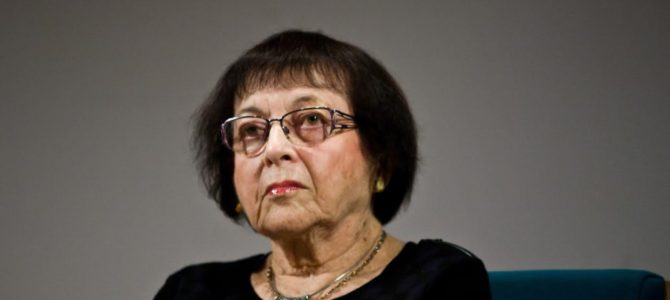
Following prolonged illness Sara Lapickaja, 79, died in Ashdod, Israel, on October 11, 2016. An active former member of the Lithuanian Jewish Community, she was also a Yiddish language and literature expert and a held a doctorate in philology. The Lithuanian Jewish Community express our deepest condolences to her surviving family and relatives.

Sara Lapickaja was born in Kaunas on June 14, 1938. She and her 10-year-old brother managed to escape the Holocaust and flee to Russia without their parents, where they were sheltered at an orphanage in the Kirov oblast. Lapickaja was in the first class of the Vilnius Jewish School in 1945, but the school was shut down within several years and she transferred to a Russian school, then graduated from the Vilnius Music School where she received a degree in choir conduction. She taught high school in Vilnius and Kaunas until 1988 while devoting much of her energy to the Jewish community, setting up an amateur volunteer choir which she conducted and helping establish the Jewish kindergarten in Vilnius, among other things.

In 1988 with help from the Lithuanian Jewish community she travelled to Israel on a Soviet passport to study at Bar-Ilon University. In Israel she devoted herself to Yiddish language and literature and earned a master’s degree, then furthered her education in St. Petersburg, Russia, where she successfully defended her doctoral thesis, “Ber Gelpern: Editorial and Educational Work” in 1997. She taught Yiddish language and literature in Israel for many years at Bar-Ilon and other institutes of higher learning.

She had a deep and significant relationship with Vilnius’s famous writer Abraham Karpinovich who wrote in Yiddish. They often attended conferences together, including in Vilnius. Karpinovich devoted much of his creative fervor to Jewish life in interwar Vilnius and after his death in 2004 the Vilna Gaon State Jewish Museum set up a special room in his name containing much of his archives and other items.

Everyone who knew Sara loved her and we will remember her goodness, sincere and open nature and her goal of being useful to her people.

Let her rest in peace in the Land of Israel.

Panevėžys Jewish Community Visits Auschwitz, Birkenau

Panevėžio miesto žydų bendruomenė lankosi Aušvico ir Birkenau koncentracijos stovykloje

There were many events to commemorate the Holocaust in September at the Panevėžys Jewish Community. In August members of the Panevėžys Community took part in ceremonies marking the anniversary of the destruction of the Jewish communities of Biržai, Kupiškis and Rokiškis.

The series of commemorations of victims ended on September 30 with a trip to Poland where Panevėžys Jewish Community members visited the Auschwitz and Birkenau concentration camps.

During the trip Panevėžys Jewish Community members heard many tragic stories about the events of the World War II era. The tours of the death camps Auschwitz and Birkenau deeply affected children and parents. Over 1.5 million Jews, Russians, Roma and people of other ethnicities were murdered there. The Nazis murdered prisoners in the gas chambers and burnt the bodies of their innocent victims in the furnace.

Condolences

Lev Služman, Kaunas Jewish Community and Social Program Department member, left this world on October 9. He was born October 1, 1928.

Our deepest condolences to his friends, family and loved ones.

Condolences

Vilnius Jewish Community and Social Program Department member Chaim Mauša Kaplan passed away on October 8, 2016. He was born September 17, 1923. Our deepest condolences to his relatives and loved ones.

The Nazi Hunter: Holocaust Collaborators Can No Longer Be Excused

warsawghetto061016
German soldiers search the belongings of Jews rounded up in the Warsaw ghetto after the uprising in 1943. This year Europe remembers the 75th anniversary of the beginning of the Holocaust (Getty)

By Efraim Zuroff @EZuroff
Thursday, October 6, 2016

Dr Efraim Zuroff is one of the world’s foremost Nazi hunters, as well as a renowned Holocaust historian.

Here, in his first article for talkRADIO, he talks about the widespread refusal to admit the Nazis didn’t act alone

This summer and autumn, we mark the 75th anniversary of the beginning of the systematic murder of European Jewry by the Nazis and their local collaborators in the areas which were then part of the Soviet Union.

The murders were carried out individually by shooting, and the names of places like Ponar, Fort IX, Rumbula, and Babi Yar became bywords for Holocaust atrocities.

Although the historical record of these crimes is crystal clear, and the identity of the perpetrators well-known, the new democracies of Eastern Europe are having great difficulties in admitting that it was not only Germans and Austrians who carried out these atrocities, but that their nationals also played an important role in implementing the Final Solution.

Rabbi in Ukraine Assaulted

On October 7 the National Coalition Supporting Eurasian Jewry’s representative in Kiev Ilya Bezrychko reported a Chabad rabbi in the western Ukrainian city of Zhitomir had been beaten severely. No motive for the attack is known.

Rabbi Mendel Deitsch, an emissary in France and Israel, was assaulted at the city’s central train station early Friday morning, October 7. Media reported that the rabbi remained in hospital after undergoing surgery.

NCSEJ pledged to monitor the situation and issue updates about any new developments in connection with the attack.

ncsej.org