
Holocaust

Condolences

With great sadness we report the death of Arie Ben-Ari Grozdensky on July 29. He was born in 1946. He was chairman of the Association of Lithuanian Jews in Israel, a member of the Lithuanian Jewish Community, a long-time supporter of the Litvak community and a member of the board of the Goodwill Foundation. Born and raised in Lithuania, Grozendsky and family were able to repatriate to Israel in 1972. He was a tireless defender of Litvak heritage and proponent of Holocaust justice and remembrance. His grandparentsm uncles and cousins were murdered in the Alytus region in Lithuania.. The Lithuanian Jewish Community and chairwoman Faina Kukliansky extend our deepest condolences to his wife Bella, children, grandchildren, many friends and the entire Litvak community. May his memory be a blessing.

Voices of the Departed

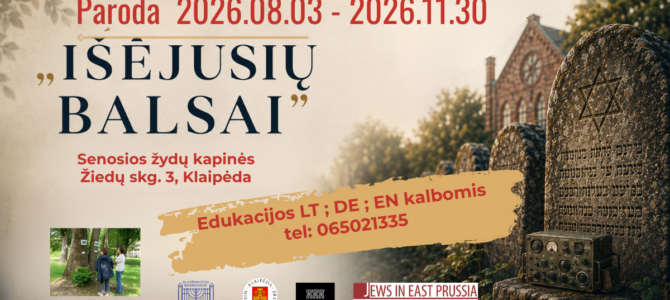
Voices of the Departed

The Klaipėda Jewish Community will hold a ceremony at the old Jewish cemetery there to name the names of 1,225 people buried there and to unveil a monument to the lost Jewish community and lost Jewish graves. Ruth Leiserowitz will speak about the history of Jewish cemeteries in Klaipėda, formerly known as Memel. The Jewish actors troupe Shatil will perform as well.

Time: 4:00 P.M., July 30
Place: Old Jewish cemetery, Sinagogų street no. 13, Klaipėda

Remigijus Žemaitaitis Loses Appeal

Remigijus Žemaitaitis Loses Appeal

Remigijus Žemaitaitis has lost his appeal at a Lithuanian appellate court on his conviction of sowing ethnic discord against Jews and Holocaust trivialization.

Member of parliament Remigijus Žemaitaitis made a series of anti-Semitic statements on facebook and elsewhere several years to launch his party Nemuno Aušra [Nieman River Dawn]. He accused Jews of carrying out a Holocaust against Lithuanians following Soviet occupation of the country, among other things. The appeals court in the latest ruling found Žemaitaitis had engaged in a form of Holocaust trivialization by comparing the Holocaust to Soviet crimes and by using dehumanizing language to describe Jews.

In a separate case earlier Lithuania’s Constitutional Court ruled Žemaitaitis’s statements on facebook and to media violated his oath of office as an MP and constituted a gross violation of the Lithuanian constitution.

The appeals court reiterated the earlier verdict against the Lithuanian MP and increased the fine levied against him from 5,000 to 10,000 euros.

Holocaust Commemorations in Šiauliai and Kužiai

Holocaust Commemorations in Šiauliai and Kužiai

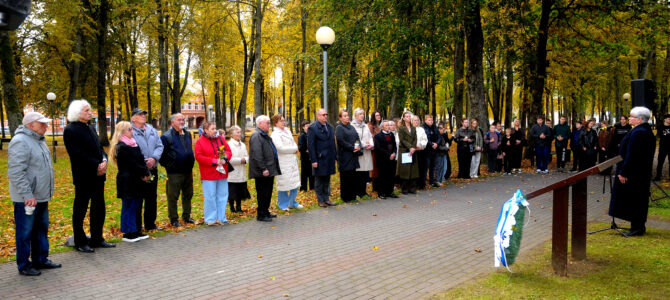
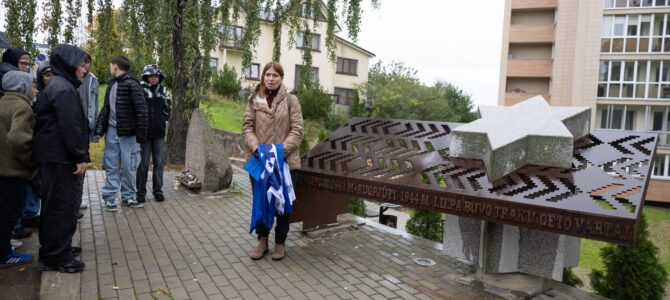
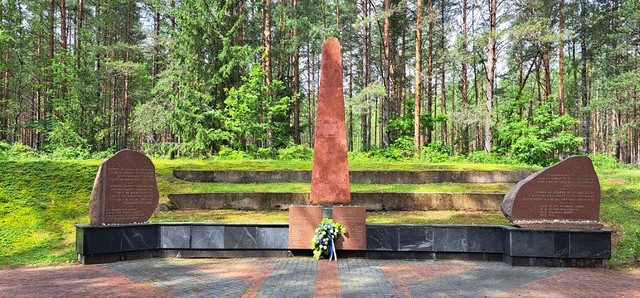
The Šiauliai District Jewish Community commemorated the establishment of the Šiauliai ghetto 85 years ago, its liquidation several years later and Holocaust victims buried at the mass grave in Kužiai on July 20.

The International Commission to Assess the Crimes of the Nazi and Soviet Occupational Regimes in Lithuania organized the procession to the Kužiai mass grave in the Luponiai Forest.

Šiauliai District Jewish Community chairwoman Rašella Galinienė addressed the gathering at the ghetto site in central Šiauliai and Choral Synagogue cantor Shmuel Yaatom performed kaddish. Šiauliai deputy mayor Justinas Švėgžda also spoke about the need to keep memory alive.

The commemoration continued indoors at the Chaim Frankl villa where Lithuanian Jewish Community chairwoman Faina Kukliansky spoke about how her mother, an inmate at the Šiauliai ghetto, was marched with other prisoners to Radviliškis, where they were put on trains and sent to different concentration camps. Her mother was sent to the Stutthof concentration camp in what is now Poland surviving against all odds the barbarity of the camp.

Ukmergė Jewish Community Planning Holocaust Commemoration for Early September

Ukmergė Jewish Community Planning Holocaust Commemoration for Early September

The Ukmergė Jewish Community is planning a series of events on Sunday, September 6, to remember the victims of the Holocaust in Pivonija Forest. A ceremony will be held in the forest at one or more the mass graves, followed by the opening of an exhibit on Righteous Gentiles and a presentation of a new web site about the Jews of Ukmergė (Vilkomir).

Tentative program:

12:00 noon Commemoration of victims in Pivonija Forest
1:00 P.M. Righteous Gentiles exhibit opening at Tolerance Center, Ukmergė
1:30 P.M. Presentation of web site on Jews of Vilkomir, Tolerance Center, Ukmergė

Natalja Cheifec on Tisha b’Av

Natalja Cheifec on Tisha b’Av

Natalja Cheifec continues here internet lecture series and discussion club with a presentation of Tisha b’Av, which starts at sundown Wednesday. Log on and find out why this is the saddest holiday in Judaism, what this date on the Jewish calendar commemorates, why this fast day is different from others and the various stories and traditions associated with Tisha b’Av. Natalja will also discuss what fast days mean in general in Judaism., Everyone interested in Jewish culture, customs and religion is invited. To receive zoom credentials, click here.

Time: 6:00 P.M., Wednesday, July 22
Place: internet

Šiauliai Regional Jewish Community Marks Ghetto Anniversaries

Šiauliai Regional Jewish Community Marks Ghetto Anniversaries

July 15 was the 82nd anniversary of the liquidation of the Shavl ghetto. In July of 1941 two ghettos were set up in the northern Lithuanian city to imprison around 6,000 Jews from there and surrounding locations. Thousands were tortured and murdered there. By Himmler’s order the ghetto was renamed a concentration camp in 1943. From July 15 to 19, 1944, the 3,000 or so survivors were sent to Dachau and Stutthof concentration camps where the majority were murdered and the Shavl ghettos were closed.

Members of the Šiauliai Regional Jewish Community gathered at the stone stele marking the entrance to the ghetto to remember both anniversaries on July 15 with a minute of silence, flowers, stones and candles to remember the victims.

This was followed by a film at the Povilas Višinskis Public Library. Professor Hektoras Vitkus from Klaipėda University spoke about the prevailing circumstance when the Nazis set up the two ghettos in the Lithuanian documentary. He said the city had a population of about 14,000 Jews on June 26, 1941.

The testimony of late Holocaust survivor and author Markas Petuchauskas was then presented. His testimony is well known in Lithuanian Holocaust historiography and the Holocaust Museum in Washington, D.C., and the Vilna Gaon Jewish History Museum in Lithuania both conserve recordings of his testimony.

The Dreyfus Test: Is Europe Failing Again?

The Dreyfus Test: Is Europe Failing Again?

Photo: Moshe Kantor, president, EJC, courtesy EJC.

by Moshe Kantor

Society is again being tested on whether it can distinguish legitimate political disagreement from collective hatred directed at an entire people.

On July 12, Europe marks Alfred Dreyfus Day, commemorating the French Jewish army officer whose wrongful conviction for treason became one of the defining symbols of modern antisemitism. More than a century later, Europe likes to believe that the Dreyfus Affair belongs safely to history, a reminder of prejudices overcome and lessons learned.

Nonetheless, the uncomfortable truth is that while the language has changed, many of the underlying patterns have not.

The challenge facing European Jews today does not resemble the antisemitism of the late nineteenth century. It is rarely expressed through crude racial theories or open declarations of hatred. Instead, it increasingly arrives wrapped in the language of politics, activism and social justice. The result is not always easier to recognize, but it can be just as damaging.

Condolences

Malkelis Bliacheris has died. He was born in 1935. He was a member of the Lithuanian Jewish Community and a client of the Saul Kagan Welfare Center. Our deepest condolences to his surviving family and friends.

Israeli Ambassador Visits Šiauliai

Israeli Ambassador Visits Šiauliai

Israeli ambassador to Lithuania Shelly Hugler Livne visited Šiauliai last week where she toured Jewish sites and met with the Šiauliai Jewish Community. The ambassador visited Righteous Gentiles Square, the site of the Jewish ghetto during the Holocaust, Chaim Frankl’s villa and the home of the Venclauskas family. She also discussed current events and plans for the future with members of the Šiauliai District Jewish Community.

From the Other Side of the Photograph

From the Other Side of the Photograph

Photo: celebrate. My grandfather, Jonas Noreika, is in the third row. My mother, then two years old, is among them. Source: Silvia Foti, The Nazi’s Granddaughter (Regnery History, 2021).

by Silvia Foti

An open letter to Liam, on his bar mitzvah

Dear Liam,

You do not know my background and what I carry, as I know your background and your family history. You barely know me, and there is no gentle way to tell you who I am. I read about you in an article your cousin Grant Gochin published in The Times of Israel, about your family and mine. I am writing to a boy I have met just once, for a singular moment, at your cousin Grant’s home, to bless you shortly after the day you were called to the Torah and became a man. I am the granddaughter of the man whose orders helped empty your family’s world of Jews.

My grandfather was Jonas Noreika. He governed the Lithuanian district of Šiauliai, where the town of Papilė lies. He signed orders that confined its Jews and gave away what was stolen from them. Your family was murdered inside the system he ran. Tsile Gochin, the sister of your great-grandmother Sarah, was one of them. My grandfather bears responsibility for her murder, and that of your cousins, relatives, friends and neighbors.

Rabbi Visits Ukmergė

Rabbi Visits Ukmergė

Rabbi Harry Pell whose family roots lie in Ukmergė (Vilkomir) visited the Ukmergė Jewish Community recently. Pell teaches Judaism and Israeli studies in the United States and also works as a chaplain in the armed forces.

Ukmergė Jewish Community chairman Artūras Taicas provided Pell a tour of Jewish sites in the town and they spoke about Jewish history and heritage there. They also sampled imberlakh at a local restaurant.

Šiauliai District Jewish Community News

Šiauliai District Jewish Community News

Last weekend Goodwill Foundation co-chairpeople Rabbi Andrew Baker and attorney and Lithuanian Jewish Community chairwoman Faina Kukliansky visited the Šiauliai District Jewish Community, where they discussed the local LJC affiliate’s activities and on-going projects, and shared ideas for future cooperation.

The Law Lithuania Froze in 2000

The Law Lithuania Froze in 2000

by Grant Arthur Gochin

In 2000 the Lithuanian parliament or Seimas voted to make the 1941 declaration a legal act of the state, then reversed itself within a week. In 2026 the demand to finish the job is back.

On June 19, 2026, the Lithuanian parliament hosted a conference which reconstructed June of 1941 without the Jews murdered during it. I documented that event in They Rewrote History before Our Eyes. The conference was the visible, scholarly face of a longer project. Its legislative face is older, quieter, and now on the move again.

On September 12, 2000, the Seimas adopted a law recognizing the Provisional Government’s June 23, 1941 declaration, Restoration of Independence, as a legal act of the Republic of Lithuania. The vote was 48 in favor, none against and three abstentions, and the official record lists it among laws adopted rather than draft legislation (Seimas record, September 12, 2000).

The declaration that law would canonize carries a list of signatory ministers. One of them is the minister of communal economy, the architect Vytautas Landsbergis-Žemkalnis–father of Vytautas Landsbergis, who chaired the Seimas in 2000.

They Rewrote History before Our Eyes

They Rewrote History before Our Eyes

by Grant Gochin, June 24, 2026

Lithuania condemns Russian falsification of history. On June 19, its own parliament provided the screen for another falsification.

Holocaust revisionism was not whispered in a corridor of the Lithuanian parliament. It was projected onto the wall of the Hall of the Act of 11 March.

On June 19, 2026, the Seimas hosted an international conference marking the eighty-fifth anniversary of the 1941 Lithuanian uprising. The official announcement promised a discussion based on “sources and historical analysis,” rather than later stereotypes. The program listed the speaker of the Seimas, senior politicians, members of parliament and historians. This was not a private gathering in a rented hotel room. It carried the location, publicity and institutional prestige of the Lithuanian legislature. (Seimas conference program)

One presentation was delivered by Roman Kuzmyn of Lviv Polytechnic National University. Its subject was the supposed similarities and differences between the 1941 uprisings in Lithuania and Western Ukraine.

Remembering the Garage Pogrom 85 Years On

Remembering the Garage Pogrom 85 Years On

On Monday the Kaunas Jewish Community held a public commemoration for the victims of the Lietūkis Garage massacre in Kaunas. Although the exact number of victims remains unknown to this day, it’s believed around 50 Jewish men were rounded up and then tortured to death at the automobile repair cooperative before the German army had taken control of Kaunas, Lithuania’s provisional capital.

The mass murder attracted spectators, mainly Lithuanians but also Wehrmacht soldiers and officers. It happened on June 27, 1941. Firehoses were forced down the throats of many of the victims, bursting their stomachs and intestines, leading to death. Those who survived the various tortures were murdered with crowbars. The corpses were piled up in the parking lot and one of the perpetrators climbed on top and played a Lithuanian song. Some witnesses said it was the Lithuanian national anthem.

The commemoration took place at the site in Kaunas with a commemoration in the evening at Vytauts Magnus University there. Both commemorations featured live music, including accordion music at the mass murder site.

Kaunas Jewish Community chairman Gercas Žakas spoke at the commemoration at the site, as did Israeli ambassador to Lithuania Shelly Hugler Livne. The latter decried the world turning its collective back on the lessons learned from the Holocaust. Also attending were the American, German, Estonian and French ambassadors.

Keeping Memory Alive

Keeping Memory Alive

A small group marked the 85th anniversary of the beginning of the Holocaust in Lithuania at the Ponar Memorial Complex yesterday.

The Holocaust began in late June of 1941. Withing a few months about 95% of all Jews in Lithuania had been murdered.

Writer and director of the Vilna Gaon Museum Sergejus Kanovičius said: “Words can never express our respect for those who were murdered as well as prayer does. Their memory will always live in our hearts.”

Lithuanian Jewish Community chairwoman Faina Kukliansky said: “Those gathered here today are the people who don’t need salutes from an honor guard or ceremonies planned in the finest detail in order to understand that the massacre of Jews begun 85 years ago was a tragedy for all of Lithuania, not just for our people.”

Israeli ambassador to Lithuania Shelly Hugler Livne said it was horrible people hadn’t learned from the painful lessons of history. She said the ever-growing anti-Semitism around the world happening today was the best proof of that. Hugler Livne said it was said to see the world going down the same road again.

The Tragedy in Palanga 85 Years Ago Must Not Be Forgotten

The Tragedy in Palanga 85 Years Ago Must Not Be Forgotten

by Mindaugas Surblys

Today we commemorate the men and young men of the Palanga Jewish community who were murdered in Birutė Park in Palanga in 1941. Palanga Jewish Community chairman Vilnius Gutmanas, Palanga deputy mayor Rimantas Mikalkėnas, Palanga municipal culture department director Robertas Trautmanas and members of the community lit commemorative candles and placed commemorative stones.

The army of the Third Reich occupied Palanga on June 22, 1941, and by June 26 all of the town’s Jews had been locked up inside two synagogues, mothers, children and the elderly in one and men and young men in the other. The 106 males were taken on June 27 to Birutė Park and murdered, along with 5 Lithuanians accused of collaborating with the Soviet government. The remaining 300 or so women, children and elderly were murdered on October 11 and 12, 1941, in the Kunigiškiai forest.

The males were exhumed in July of 1958 and moved to the Palanga city cemetery, where a single marker marks the mass grave.

Memory lives so long as we remember.

Chairman Gutmanas said: “Eighty-five years have passed but time is powerless to erase our pain. People who had families, dreams and lives were silenced forever. They were murdered because of their origin. It is our duty today not just to commemorate them, but not to allow their stories to be forgotten.”

Holocaust Testimonies in Palanga

Holocaust Testimonies in Palanga

The Palanga Jewish Community and the Jonas Šliūpas Museum invite you to attend Lithuanian-American historian and journalist Ina Navazelskis;s presentation “Voices from the Blood-Lands” which includes eye-witness testimonies of the Holocaust and World War II. Ina worked at the US Holocaust Museum in Washington, D.C., for 25 years, soliciting oral testimonies from over three hundred witnesses and Holocaust survivors. She focused on Eastern Europe and especially the Baltic republics in her work, even writing a book about the period between 1990 when Lithuania declared independence from the Soviet Union and the attempted coup in Moscow in the fall of 1991. The presentation includes testimonies from Poles, Jews, Lithuanians, Germans and others. The presentation is free and open to the public, but the organizers ask that you register beforehand by calling +370 612 86114 or by sending an email to j.sliupo.muziejus@lnm.lt. Palanga Jewish Community chairman Vilius Gutmanas will also speak at the event. A discussion is planned after the main presentation.

Time: 5:00 P.M., Wednesday, July 15
Place: Jonas Šliūpas Museum, Vytauto street. no 23a, Palanga