The Sabbath begins at 6:18 P.M. on Friday, October 16, and concludes at 7:10 P.M. on Saturday in the Vilnius region. Sabbath candles should be lit and prayers recited at 6:00 P.M. and completed before sunset at 6:18 P.M.


The Sabbath begins at 6:18 P.M. on Friday, October 16, and concludes at 7:10 P.M. on Saturday in the Vilnius region. Sabbath candles should be lit and prayers recited at 6:00 P.M. and completed before sunset at 6:18 P.M.
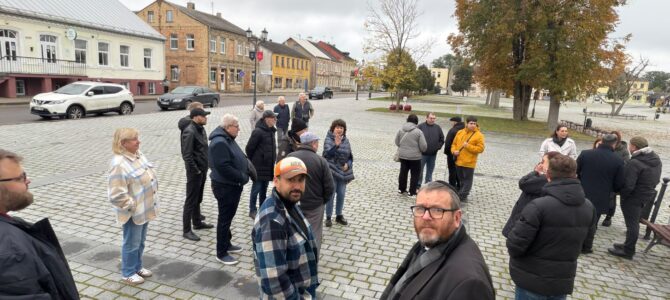
On Sunday descendants of Jews from Žagarė who live now in Šiauliai, Vilnius and other Lithuanian towns and cities gathered in front of the statue to Rabbi Israel Salanter aka Yisrael ben Ze’ev Wolf Lipkin along with Shimon Pesach from the Israeli embassy and Rabbi Kalev Krelin.
This is an annual event. On the first Sunday in October they come together to remember the Jewish history of Žagarė, to honor the Jews who lived here and to preserve their memory. Participants also visited the mass murder sites in Naryškinas Park and at the old Jewish cemetery.
The meeting then moved on to a local café where the discussion continued.
Natalja Cheifec continues her internet lecture and discussion series with a presentation of Jewish views on gossip and cursing, based on Chafetz Chaim’s book The Will to Live. What are the consequences of foul language? What is slander and gossip? How can staying silent lead to a longer life, and when is it absolutely forbidden to keep silent? Tune in and find out. To receive zoom credentials, click here.
Time: 6:00 P.M., Thursday, October 15
Place: internet
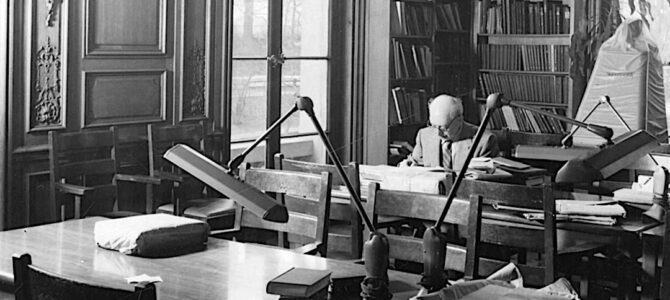
Photo: YIVO reading room at 1048 Fifth Avenue, ca. 1958. (YIVO Institute for Jewish Research)
by Andrew Silow-Carroll October 11, 2026
Kalman Weiser’s new history follows the institute from Vilna to New York where it had to preserve a vanished world and cultivate a future.
When YIVO was founded in Vilna in 1925 its mission was to study a living people.
The Yidisher Visnshaftlekher Institut was meant to be a national university for Jews scattered across Eastern Europe and increasingly the world. Its scholars studied Yiddish language and literature, but also Jewish sociology, psychology, history and contemporary life. YIVO was interested in how Jews actually lived and in helping them navigate modernity.
When the Nazis destroyed much of that world, YIVO’s surviving caretakers were forced to ponder how and why to keep their efforts going in a new world haunted by unimaginable loss.
Their efforts are explored in Kalman Weiser’s new history “Yiddish Scholarship Comes to America: The YIVO Institute at 100.” After World War II a relocated and heartsick YIVO had to become a guardian of a nearly vanished culture, a rescuer of its texts and artifacts and an institution which could somehow make that culture meaningful to Jews who were rapidly shedding Yiddish and embracing a distinctly American, English-speaking identity–all simultaneously.
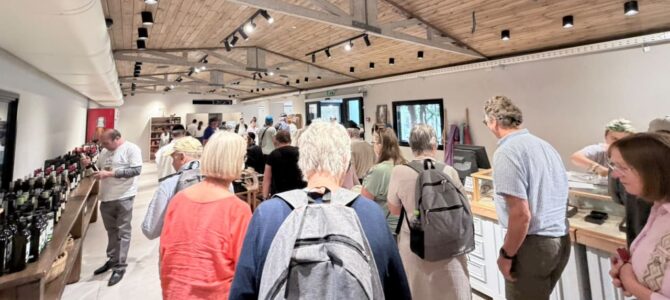
Photo: Christians visiting a West Bank settlement during the International Christian Embassy’s annual conference. Courtesy International Christian Embassy
ICEJ visitors turned purchases into a show of solidarity as Ireland and the Netherlands enforce new restrictions, and Norway weighs a broader trade ban.
by Gabriel Colodro, Media Line, October 13, 2026
“This piece of legislation written by the Irish parliament shall not stand,” said Paul Coulter, national director of the International Christian Embassy Jerusalem (ICEJ) in Ireland, as he held up a copy of Ireland’s new law restricting imports from Israeli settlements. Then he tore the document up in front of the camera.
The gesture came during an ICEJ visit to Israeli communities in the West Bank, also known as Judea and Samaria, where Christian visitors traveled through Samaria, Gush Etzion and Efrat and were encouraged to shop at local businesses. The tour organized during ICEJ’s annual Feast of Tabernacles gathering in Jerusalem was intended as a direct response to a growing set of European measures restricting trade in products from Israeli settlements. Some of those measures are already in force; others are still just proposed legislation.

Last week Lithuanian Jewish Community chairwoman Faina Kukliansky visited the Martynas Mažvydas Pre-Gymnasium in Vilnius and held an open-format discussion with students there in a tent erected outside the school. The students and the chairwoman spent several hours in the sukka discussing Jewish life after the Holocaust and today, the importance Judaism places on learning, artificial intelligence and its influence on our opportunities, as well as a number of other topics.
We’d like to thank sincerely the teachers for their invitation to come and speak and for their attention to Jewish history and identity. Likewise we are grateful to the wonderful students for their interest, keen questions and the delicious latkes they served. True friendship begins when we have the courage to question, listen to and recognize one another.

The Sabbath begins at 6:35 P.M. on Friday, October 9, and concludes at 7:26 P.M. on Saturday in the Vilnius region. Sabbath candles should be lit and prayers recited at 6:17 P.M. and completed before sunset at 6:35 P.M. Monday, October 12, is Columbus Day.
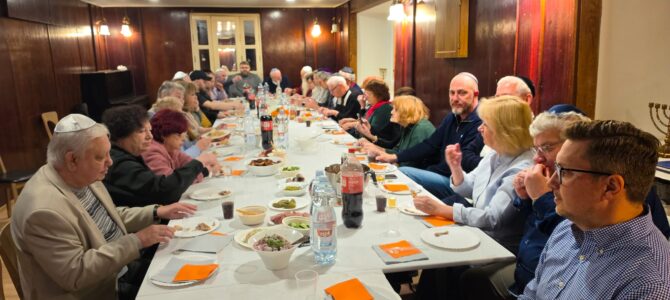
The Šiauliai Jewish Community held a special Sabbath dinner also celebrating Simchat Torah last Friday. The dinner party included guests from Germany.
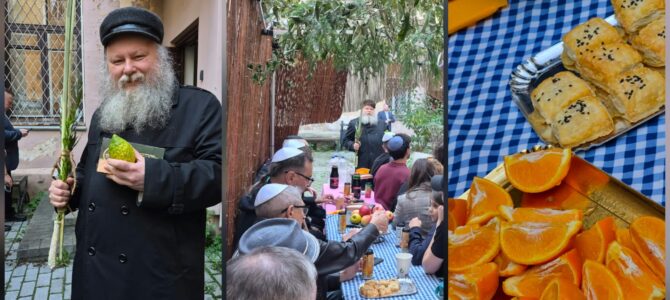
The Lithuanian Jewish Community celebrated Sukkot Thursday in the courtyard shared with the Litvak Identity Museum of the Vilna Gaon Jewish History Museum in Vilnius. Cantor Shmuel Yaatom from the Choral Synagogue performed the prayers. A great big thank-you to all who came and made the event a success.
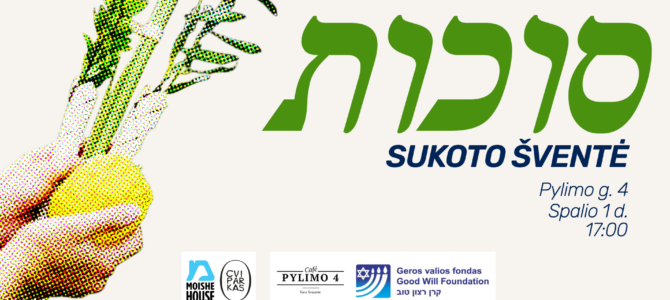
There will be a joyful gathering for Sukkot in the courtyard of the Lithuanian Jewish Community and the Litvak Identity Museum of the Vilna Gaon Jewish History Museum on Thursday at 5:00 P.M. Cantor Shmuel Yaatom is master of ceremonies. Registration is required by clicking here.
Come enjoy, sing and sample the hot food and drink in the sukka. All are invited. Entrance is free. Organized by the Art of Shabbat, Moishe House Vilnius, Cvi Parku“and the Pylimo 4 Café.
Time: 5:00 P.M., Thursday, October 1
Place: Pylimo street no. 4, Vilnius
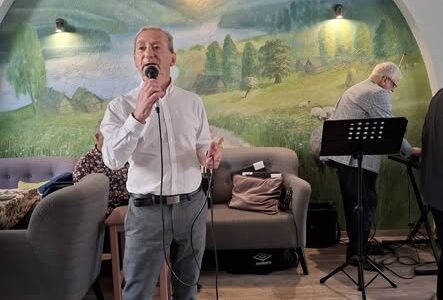
The Kaunas Jewish Community and chairman Gercas Žakas have shared a number of snapshots from the Kaunas Community’s Rosh Hashanah or Jewish New Year’s celebration held recently.
Dear members,
During our on-going celebration of the High Holy Days, we invite you to come celebrate with us. The Lithuanian Jewish Community has planned a fun evening called From Rosh Hashanah to Simchat Torah in order to spend time with you. The Jewish song and dance ensemble Fayerlakh will provide song and dance and the audience is invited to join in.
Places are limited and registration is required by 12 noon on October 2 by sending an email to zanas@sc.lzb.lt.
Time: 5:00 P.M., Sunday, October 4
Place: Lithuanian Jewish Community, Vilnius
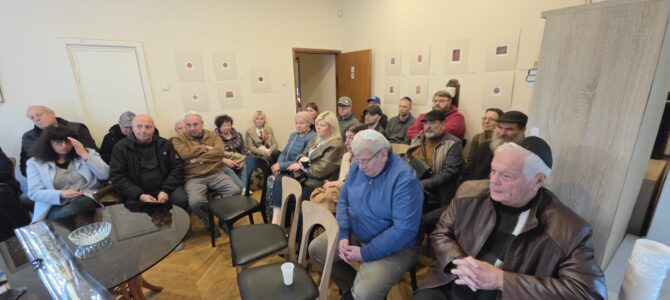
The Šiauliai Jewish Community gathered Monday to celebrate Sukkot. The event was attended by a special guest: Rabbi Shalom Kaplan, the rabbi at both the Beit Izrael synagogue in Jurnala, Latvia, and the Birkat Baruch synagogue in Jerusalem. The rabbi gave a presentation on the history, traditions and meaning of the holiday of Sukkot, and shared his knowledge of and insights into the special significance Sukkot holds. The entire Community was grateful for the opportunity to learn more together and grow stronger as a community.
Hag Sukkot sameach!

Natalja Cheifec continues her internet discussion club and lecture series with a presentation about Sukkot, one of the most important Jewish holidays.
Sukkot, aka the Feast of Tabernacles, is one of the happiest and best holidays for family meals, visiting friends, talking, sharing things from your life and taking joy in life. Learn about the origins and traditions of this holiday. Learn why Jews dwell in the sukka booth for a week and what it signifies, and what the four species mean.
To register and participate, click here.
Time: 6:00 P.M., Thursday, October 1
Place: internet
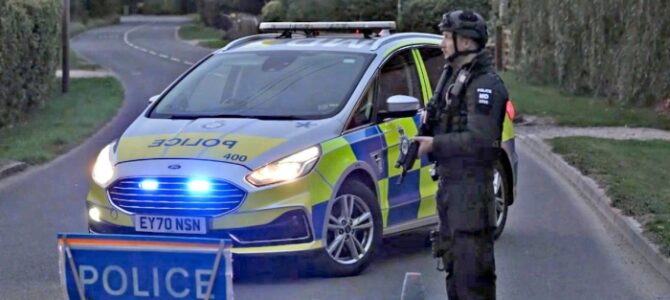
Update: Scotland Yard’s Counter Terrorism Policing released all five suspects on police bail and intimated the three white vans in question were not carrying bombs or explosives of any kind. Other investigators, members of the cabinet and MPs said the investigation has become extremely complex.
Five terrorism suspects arrested about a half mile away from the main runways of the Fairford Royal Air Force Base in Gloucestshire, England, appeared to be of Middle Eastern descent, according to a farmer who alerted police of suspicious activities in front of her house on early Sunday morning.
The farmer told the British tabloids she and another person were returning home from a party just after midnight and were unable to get into her driveway because it was blocked by vans. She turned around and left, when she saw “a large group” of men wearing masks and balaclavas flee in front of her headlights into woods and fields near her home. She told the newspapers they appeared to be of Middle Eastern origin. BBC reported national counter-terrorism police told them all five men are British subjects who lived in London. The female farmer told SkyNews there had been more than the five arrested, she saw between 8 and 10 men.
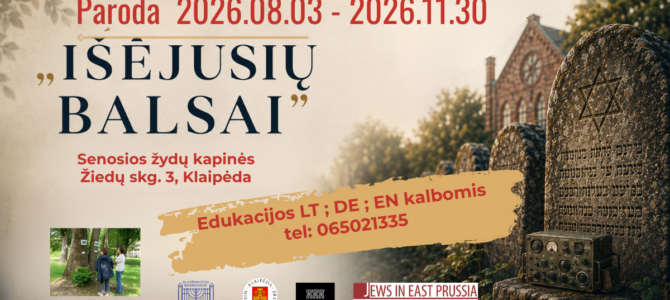
The Klaipėda Jewish Community invites the general public to tour the exhibit Voices of the Departed before the exhibit ends November 30. The exhibit highlights the old Jewish cemetery in the Lithuanian port city, and the cemetery hosts the exhibit. It’s located at Žiedų alley no. 3, Klaipėda. Tours are available in Lithuanian, German and English. For more information, call 0 650 21335.
The Sabbath begins at 7:20 P.M. on Friday, September 25, and concludes at 8:01 P.M. on Saturday in the Vilnius region. Sabbath candles should be lit and prayers recited by or before 6:52 P.M. and completed before sunset at 7:20 P.M. Sukkot also begins at sunset on Friday. Simchat Torah begins Friday, October 2, at sunset and concludes at sundown on Sunday, October 4.

Sukkot begins Friday, September 25 at 6:52 P.M. The festival of Sukkot–literally meaning booths, tents, tabernacles–is celebrated for seven days in Israel and eight days in the Diaspora, starting on the fifteenth day of the Hebrew month of Tishrei. It leads on to Simchat Torah celebrated for two days outside Israel, this year starting at sundown on October 2. Sukkot is one of the three festivals during which Jewish men were required to make pilgrimage to Jerusalem in the times of the Holy Temple. The Choral Synagogue in Vilnius has set up a sukka for members of the Community.
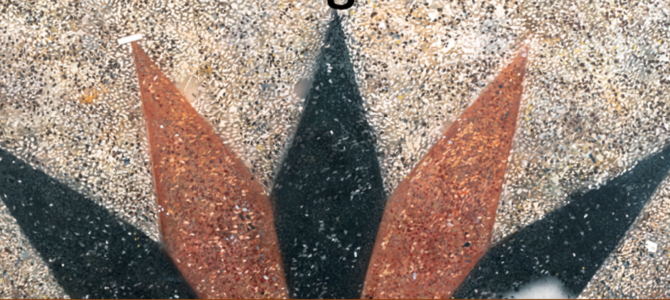
We know the Great Synagogue in Vilnius was mainly subterranean, because of Christian restrictions limiting the height of houses of prayer of other confessions. Until now, we only had period illustrations of the interior, lost when the shul damaged by Nazi bombardment was demolished by the Soviets in the 1950s. For about a decade now archaeologists from the Israeli Antiquities Authority in cooperation with Lithuanian archaeologists from the Department of Cultural Heritage have been excavating the Shulhoyf, and last year, directed by Jon Seligman of the Israel Antiquities Authority (there from 205) and Justinas Račas and Zenonas Baubonis of the Lithuanian Cultural Heritage Salvage Group (at the dig since 2018), they reached the floor of the main hall and uncovered most of the meter-high bimah, the central point in the main hall.
Their discoveries have inspired an exhibit of artworks by Lithuanian Eglė Ridikaitė called Depositions at the St. George the Martyr Church, K. Sirvydo street no. 4, in Vilnius, which opened May 14 and runs till October 3. Admission is from 5 to 10 euros and is payable by card only.
“Eglė Ridikaitė’s exhibition, through an unexpected artistic gesture, weaves together sites of faith, painful historical experiences, and a sense of present vulnerability. With striking clarity, serenity, and simplicity, Depositions unfolds as a silent yet conceptually dense narrative about the city. It invites us to experience, simultaneously, the layered histories of prewar Jewish and Christian Vilnius, while tracing processes of survival and extinction, life and its erasure in memory.