
Alfonsas Bukontas died September 23. He was born Mordchelis Michnickis on September 11, 1941. Both his parents were murdered during the Holocaust in Lithuania and Bukontas was raised by Lithuanians. He was an accomplished poet, translator of German, Yiddish, Polish and even Sanskrit, and writer. He was a member of the Lithuanian Jewish Community and the Union of Former Ghetto Inmates. Our deepest condolences to his friends, family members and members of the Union of Former Ghetto Inmates. May his memory be a blessing.

Šiauliai Marks Day of Remembrance of Lithuanian Jewish Victims of Genocide
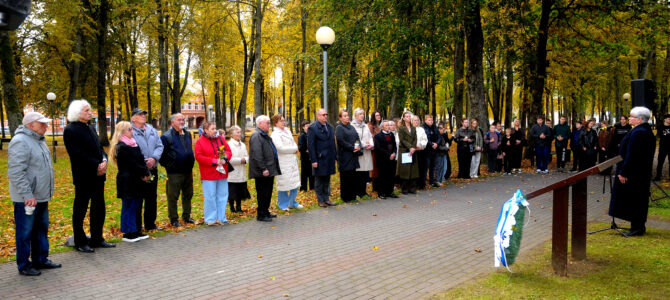
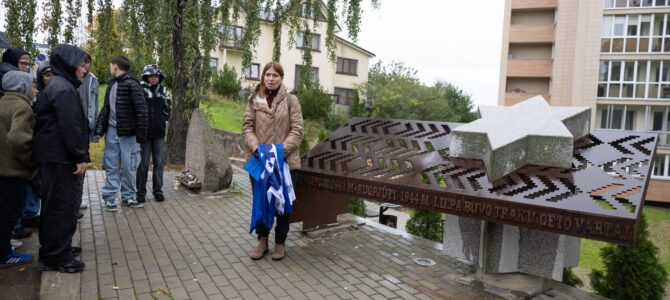
The Šiauliai Jewish Community marked the Day of Remembrance of Lithuanian Jewish Victims of Genocide September 23. Students from the Saulius Sondeckas Art Gymnasium in Šiauliai began the event with a musical performance.
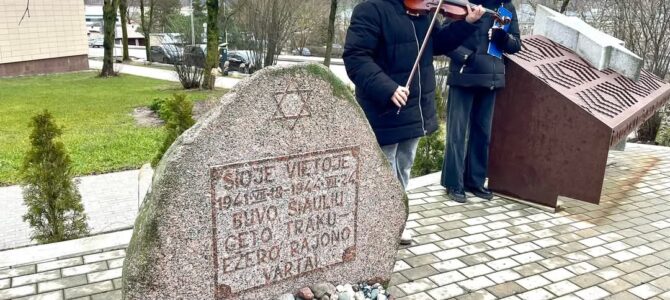
Deputy mayor Justinas Švėgžda attended. After the ceremony a silent procession moved from the site of the gate of the first ghetto (Caucasus) to the monument marking the gate of the second ghetto (Trakai).

Holocaust Commemoration in Švenčionys
The Švenčionys Jewish Community invites the public to remember the victims of the Holocaust and to mark the anniversary of the liquidation of the Švenčionys ghetto on October 4. Community and friends will gather at 11:00 A.M. on Sunday, October 4 at the Menorah statue in the Švenčionys city park. At noon there will be a commemoration at the mass grave in Platumai village in the Švenčionėliai aldermanship.

Voice of Departed Exhibit Closes November 30 in Klaipėda
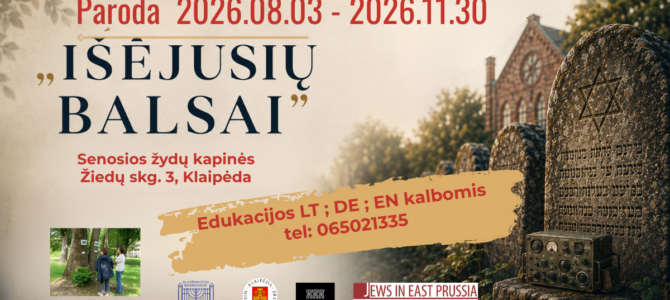
The Klaipėda Jewish Community invites the general public to tour the exhibit Voices of the Departed before the exhibit ends November 30. The exhibit highlights the old Jewish cemetery in the Lithuanian port city, and the cemetery hosts the exhibit. It’s located at Žiedų alley no. 3, Klaipėda. Tours are available in Lithuanian, German and English. For more information, call 0 650 21335.


Kaunas Jewish Community Accompanies Fayerlakh at Kaunas Concert
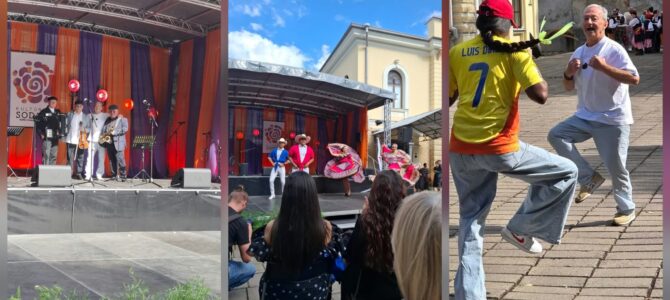
The Jewish song and dance group Fayerlakh performed at the Garden of Cultures 2026 event in Kaunas this month which showcases Lithuanian ethnic cultures. Kaunas Jewish Community chairman Gercas Žakas and other Community members spoke to the audience as well on Jewish culture and its place in the history of Kaunas.

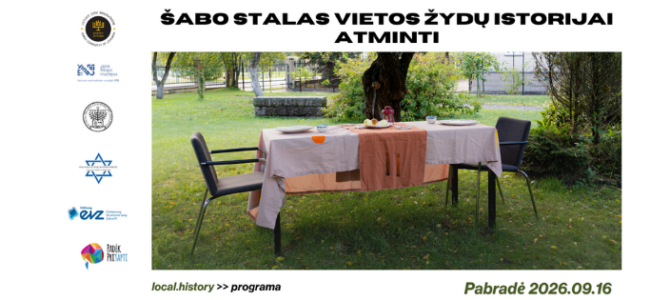
Sabbath Table to Remember Jewish History Exhibit in Pabradė
The first Sabbath Table to Remember Jewish History exhibit as part of the Children of the Holocaust: Lighting Up the Shadows of Lithuanian History project took place at the Pabradė Culture Center last week. The exhibit will be a changeable one depending on the decisions and sensibilities of the designers and exhibit item creators. This time the Sabbath table was laden with pomegranates, figs, apples and challa.
Residents of Pabradė in eastern Lithuania, visitors and local students and teachers attended the event. Švenčionys Jewish Community chairman Moshe Shapiro welcomes the attendees, followed by a panel discussion moderated by Sholem Alechem ORT Gymnasium students, moderated by Algis Davidavičius, who discussed local history, memory and modern forms of commemoration. Then visitors learned about Sabbath traditions, sampled traditional dishes and attended a Jewish cloth-dying workshop.
The Sabbath Table to Remember Jewish History exhibition is the fruit of a two-year meaningful journey during which brave and knowledge-thirsty students from Vilnius and Palanga and their teachers dove into live research on local Jewish history. The young people conducted tours, creative workshops, celebrated Purim and Sabbath together, marked commemorative dates, visited synagogue and spoke with representatives from the Palanga, Vilnius, Darbėn and Israeli Jewish communities.

Day of Remembrance of Lithuanian Jewish Victims of Genocide in Šiauliai
The Šiauliai District Jewish Community invites you to a ceremony to mark the Day of Remembrance of Lithuanian Jewish Victims of Genocide at the site of the former first ghetto gates at 11:00 A.M. on Wednesday, September 23. There will then be a procession to the second ghetto gates.
Time: 11:00 A.M., Wednesday, September 23
Place: Memorial marking gates of first ghetto at the intersection of Traku and Ezero streets, Righteous Gentile Square, Šiauliai

Droga Dō Concert Series Remembers Jewish Escape Route to Japan
The Droga Dō chamber concert series is dedicated to the memory of the escape route Polish and Lithuanian Jews took to Japan during the Holocaust, and to Japanese ambassador and Righteous Gentile Chiune Sugihara who made it possible, saving thousands of Jews. Dō (Dou, Doo) means “way” in Japanese, as does droga in Polish.
Droga Dō will be performed at the Kaunas State Philharmonic on September 19 with works by Toru Takemitsu, Dai Fujikura, Kishio Kirao, Mieczysław Weinberg, Władysław Szpilman, Aleksander Tansman, Aleksandr Veprik, Joseph Achron and others. For more information, click here. For information in Lithuanian and to purchase tickets, click here.
Time: 5:00 P.M., Saturday, September 19
Place: Kaunas State Philharmonic, E. Ožeškienės no. 12, Kaunas

Holocaust Commemoration in Vilkomir
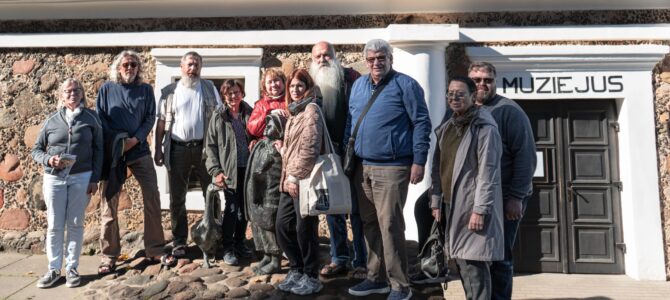
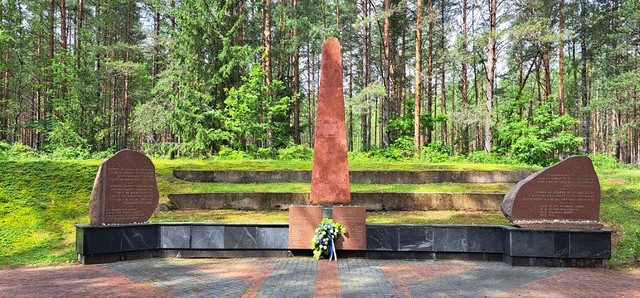
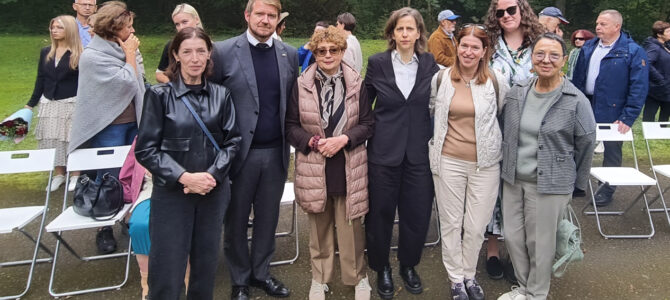
Lithuanian Jewish Community chairwoman Faina Kukliansky, Israeli ambassador Shelly Hugler Livne and members of the Šiauliai Jewish Community, the Ukmergė (Vilkomir) Jewish Community and Kaunas Jewish Community attended a ceremony to commemorate Holocaust victims at the memorial and mass grave site in the Pivonija Forest on September 6. The United States embassy’s deputy ambassador Dan Hunt and diplomat Emma Locatelli attended, as did Lithuania’s deputy minister for culture Lina Baublienė and others.
After the ceremony participants were invited to attend an exhibit of Righteous Gentiles at the Ukmergė Tolerance Center. Ukmergė Jewish Community chairman Artūras Taicas took the opportunity to announce a new initiative to create an internet archive of historical Jewish passports and identity documents.

Commemoration of 85th Anniversary of Liquidation of Panevėžys Ghetto
A ceremony to mark the 85th anniversary of the liquidation of the Ponevezh ghetto was held in the northern Lithuanian city September 8 with a number of speakers and music.
Lithuanian Jewish Community chairwoman Faina Kukliansky said they had gathered both to honor the dead and keep memory of the Holocaust alive for future generations.
Israel’s ambassador to Lithuania Shelly Hugler Livne said 85 years is long time in human life but only an instant in terms of historical memory.
Lithuanian MP Ramūnas Vyžintas reiterated the need to safeguard historical memory.
Sister Leonora Kasiūlytė from the Congregation of the Sisters of God’s Providence told the story Marija Rusteikaitė, the nun from the Panevėžys area who rescued 15 Jews including children.

Litvak Delegation Visits Panevėžys
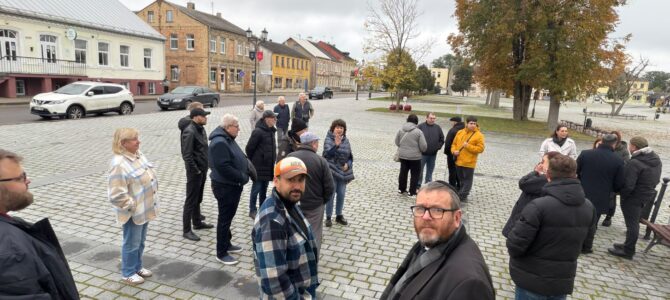
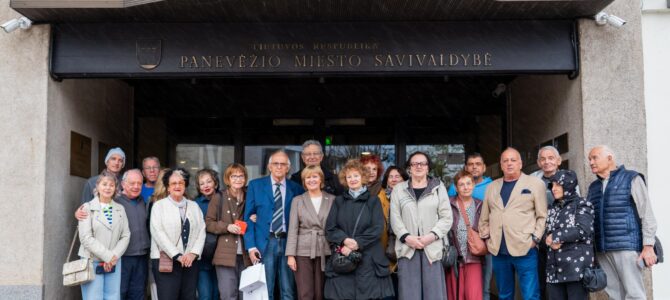
A delegation of about 30 Litvaks living in Israel are visiting the northern Lithuanian city Panevėžys, or Ponevezh, and have met with the mayor of the city, Loreta Masiliūnienė. For many of the visitors the trip is very personal, an opportunity to visit where their parents, grandparents and forefathers lived and died.
Association of Lithuanian Jews in Israel Grisha Deitch sat with mayor Masiliūnienė at city hall in front of the rest of the Israeli delegation and they discussed the history of the Ponevezh community, securing its future and ties with Litvaks abroad.
A memorial ceremony will be held at the monument marking the gates of the Panevėžys ghetto will be held at 2:00 P.M. on Tuesday, September 8, followed by a walking tour of Jewish sites. Later the delegation and others will visit the mass murder site in Kurganava Forest where about 8,000 Jews were murdered, and the mass murder site in Žalioji Forest, where about 5,000 Jews were murdered.

Vilnius Jewish Public Library Showcases Encyclopedic Vilnius Book
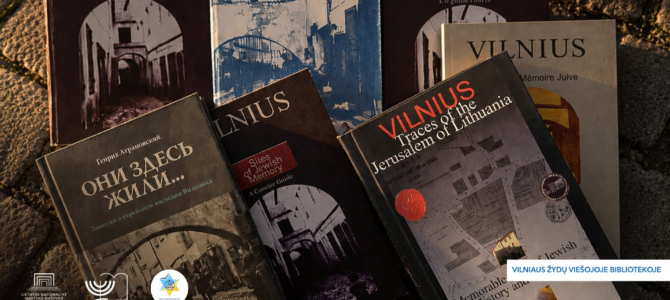
Last week the Vilnius Jewish Public Library recognized Irina Guzenberg and Henrik Agranovski’s impressive and encyclopedic book Vilnius, the result of more than 30 years of research, published in English and Russian.
The book is both a short encyclopedia and a chronicle of Yerushalayim d’Lite, the Jerusalem of Lithuania, Vilnius. Israeli ambassador Shelly Hugler Livne, Lithuanian deputy foreign minister Kristupas Vaitiekūnas, a large contingent from Beit Vilna, Lithuanian Jewish Community members and academics from Lithuania, Israel and the USA attended to book presentation.
The book was previously published as a much shorter version of Jewish sites in Vilnius for tourists and others. The larger volume goes into much greater depth about the sites and histories.

Kaunas Jewish Community Celebrates Love with Concert September 8
The Kaunas Jewish Community is celebrating this year’s theme for the European Day of Jewish Culture, love, with a free concert. A new installment in the Dance Me Back to the Future called Erev Shel Shoshanim, Evening of Roses, is a two-voice musical dialogue featuring Hebrew love songs and operatic arias.
Katya Kov is the organizer with support from Pasaka and the Create Culture Group in cooperation with Cvi Parkas. Supporters include the Goodwill Foundation and the city of Vilnius.
“The title Dance Me Back to the Future combines Leonard Cohen’s Dance Me to the End of Time and Robert Zemeckis’s film Back to the Future,” she explained. “Together, they open a path between the past and the present, following Lithuanian and Litvak history and stories, recollections and cultural ties which travel from generation to generation and find new voices today,” she said.
The concert is free and open to the public.
Time: 6:00 P.M., Tuesday, September 8
Place: Mikas and Kira Petrauskas House, K. Petrausko street no. 31, Kaunas

Smotkins Visit Panevėžys
Eugene Smotkin, 72, currently lives in Puerto Rico and works in renewable energy. He and wife Linda recently visited Panevėžys whence his family comes, and visited the Panevėžys Jewish Community where they were warmly received by chairman Gennady Kofman. They visited the mass murder sites in the Žalioji Forest and Kurganava Forest together.
Eugene Smotkin said his father Morris was 16 when his uncle, Rabbi Meyer Kimmel, arrived in Ponevezh. He took Morris to New York where he entered yeshiva, then enlisted in the army. Morris knew five languages and during his service he interrogated captured SS officers, collecting intelligence on Nazi Germany.

Book Presentation in Palanga
“I never wanted to write a book about myself. My goal was to tell the story of post-war Jewish life, and the example I know well is our family,” Lithuanian Jewish Community chairwoman Faina Kukliansky said Friday at a reading room in Palanga where she presented her book Dainos iš mėlynos užrašinės [Songs from the Blue Notebook].
She spoke about her family’s story, including stories about the post-war reality, and the childish fears and joys which sometimes last a lifetime.
“Don’t be surprised if I cry. My whole family got teary-eyed reading this book,” she cautioned.
Her book about her parents, grandparents and cousins, their experiences and fates, was more than an autobiography. It’s a portrait of three generations of Litvaks, the story of how they carried on after the Holocaust and learned to take joy in life again, while always carrying inside the unfathomable tragedy.

Presentation of Faina Kukliansky’s Book in Palanga
Faina Kukliansky will present her book “Dainos iš mėlynos užrašinės” [Songs from the Blue Notebook] in Palanga Friday at the Palanga summer reading room and will sign copies. The book is a family history comprising three generations of Litvaks, from her grandparents who survived the Holocaust, to her father who spent his youth in a concentration camp to Faina’s sister Sulamita and Faina herself, chairwoman of the Lithuanian Jewish Community and accomplished attorney.
“People sometimes ask me why I spend so much energy on the issue of history and the place of the Jews in the world, and all the more so since most of my people are no longer with us. All I can say is my goal: to preserve their memory. We don’t have my parents’ candelabrum anymore, in which every Jewish family lights their Sabbath candles. All we have left is memory and respect,” Kukliansky said.
Time: 6:00 P.M., Friday, August 28
Place: Palanga summer reading room, Vytauto street no. 72, Palanga

Holocaust Remembrance in Rokiškis
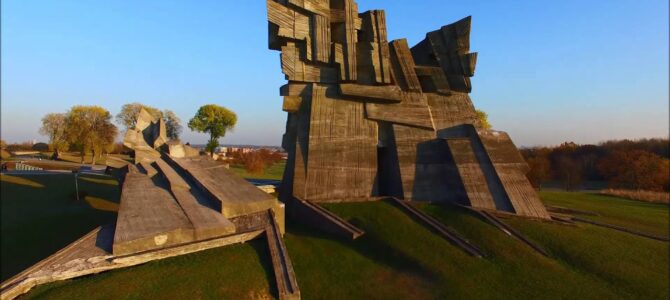
The Jews murdered August 15 and 16, 1941, in Rokishok were commemorated on August 16, 2026, in this small northern Lithuanian town and former shtetl. The Rokiškis Regional History Museum invited the public to attend a “Road of Memory” procession from the ghetto next to the Rokiškis manor house (where the museum is now housed) to the Velniaduobė forest about 4 kilometers outside town where the Jewish population was slaughtered.
Rokiškis Regional History Museum staff spoke at the beginning, midway and end of the procession. Participants places inscribed with the names of victims at the memorial stele marking the mass murder site where around 3,200 Jews, 6 Lithuanians and 1 Pole were killed.
Panevėžys Jewish Community chairman Gennady Kofman was in attendance and said no Jewish family was untouched by the Holocaust. Rokiškis regional municipality council member Vytautas Saulis spoke about the Soviet trials of Lithuanians who murdered Jews held in 1965, and said the main question hadn’t been addressed: why?
According to Lithuania’s International Commission to Asses the Crimes of the Nazi and Soviet Occupations in Lithuania, which is behind the Road of Memory initiatives throughout Lithuania, around 75% of the town’s population was Jewish before they were murdered.

Lithuania Betrays American Alliance
by Grant Gochin
A Lithuanian state institution took an American administrative record, hardened it into an exoneration and published the result as a verdict of the United States. It has defended that claim since 2018. On August 19, 2026, ninety-nine days after Lithuania’s Foreign Ministry told US Congress the wording had been corrected, the claim was still online in Lithuanian.
Everything that matters is in documents Lithuania itself has supplied.
What America Actually Decided
In 1974 the Immigration and Naturalization Service examined allegations concerning Juozas Ambrazevičius-Brazaitis, acting head of Lithuania’s 1941 Provisional Government, and interior minister Jonas Šlepetys. Commissioner Leonard Chapman reported that no information of an evidentiary nature had been elicited from the sources contacted; the names were removed from the active list and the investigations deactivated. He also said new meaningful information would reactivate the investigation.

Vilnius Printed It. LGGRTC Kept the Myth.
by Grant Gochin
A Lithuanian university published the contradictory wartime record in 2005. The Centre was told, and kept publishing.
Vilnius University Press published the wartime record in 2005. Thomas Remeikis assembled the American Legation dispatches from Stockholm and the Lithuanian material carried inside them; the Institute of International Relations and Political Science at Vilnius University appears on the imprint, and the introduction is signed Chicago-Vilnius, 2004. 1 Twenty-one years later the Genocide and Resistance Research Centre of Lithuania cannot describe the Lithuanian material in those documents as Soviet, inaccessible, or newly discovered in a foreign archive. That matters now, because the Centre is the state body expected to supply historical authority in the prosecution of Artur Fridman, a Jewish citizen of Vilnius charged over a Facebook post. Its disclosure conduct in that case is set out in Show the File.
Publication establishes availability. It does not prove that a particular official at the Centre read this volume. The correspondence set out below establishes something different and harder: the Centre received direct documentary challenges to the historical claims it went on publishing, and answered them.