

anti-Semitism

Šiauliai Regional Jewish Community Marks Ghetto Anniversaries

Šiauliai Regional Jewish Community Marks Ghetto Anniversaries

July 15 was the 82nd anniversary of the liquidation of the Shavl ghetto. In July of 1941 two ghettos were set up in the northern Lithuanian city to imprison around 6,000 Jews from there and surrounding locations. Thousands were tortured and murdered there. By Himmler’s order the ghetto was renamed a concentration camp in 1943. From July 15 to 19, 1944, the 3,000 or so survivors were sent to Dachau and Stutthof concentration camps where the majority were murdered and the Shavl ghettos were closed.

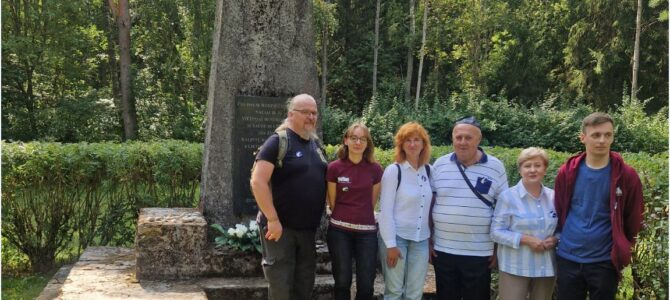
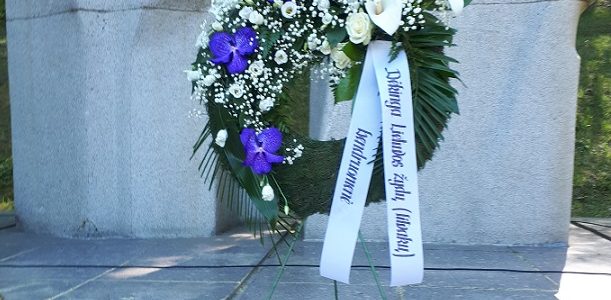
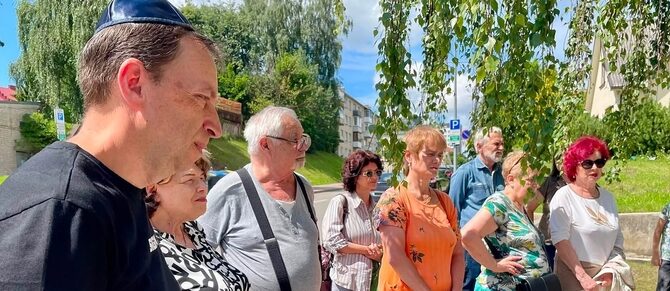
Members of the Šiauliai Regional Jewish Community gathered at the stone stele marking the entrance to the ghetto to remember both anniversaries on July 15 with a minute of silence, flowers, stones and candles to remember the victims.

This was followed by a film at the Povilas Višinskis Public Library. Professor Hektoras Vitkus from Klaipėda University spoke about the prevailing circumstance when the Nazis set up the two ghettos in the Lithuanian documentary. He said the city had a population of about 14,000 Jews on June 26, 1941.

The testimony of late Holocaust survivor and author Markas Petuchauskas was then presented. His testimony is well known in Lithuanian Holocaust historiography and the Holocaust Museum in Washington, D.C., and the Vilna Gaon Jewish History Museum in Lithuania both conserve recordings of his testimony.

The Dreyfus Test: Is Europe Failing Again?

The Dreyfus Test: Is Europe Failing Again?

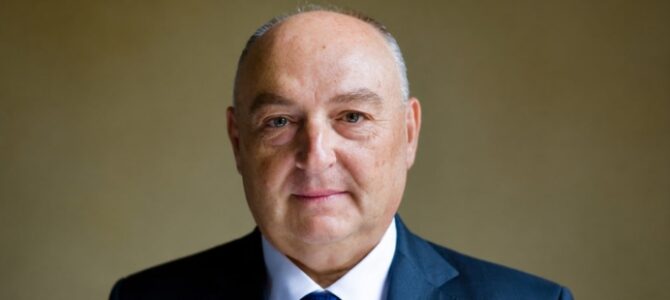
Photo: Moshe Kantor, president, EJC, courtesy EJC.

by Moshe Kantor

Society is again being tested on whether it can distinguish legitimate political disagreement from collective hatred directed at an entire people.

On July 12, Europe marks Alfred Dreyfus Day, commemorating the French Jewish army officer whose wrongful conviction for treason became one of the defining symbols of modern antisemitism. More than a century later, Europe likes to believe that the Dreyfus Affair belongs safely to history, a reminder of prejudices overcome and lessons learned.

Nonetheless, the uncomfortable truth is that while the language has changed, many of the underlying patterns have not.

The challenge facing European Jews today does not resemble the antisemitism of the late nineteenth century. It is rarely expressed through crude racial theories or open declarations of hatred. Instead, it increasingly arrives wrapped in the language of politics, activism and social justice. The result is not always easier to recognize, but it can be just as damaging.

Man Arrested over Anti-Semitic Attack in Vilnius

Man Arrested over Anti-Semitic Attack in Vilnius

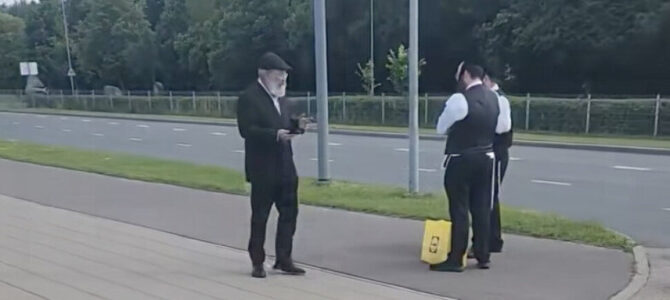
Internet news site and cable channel Delfi.lt reports a man attacked Israeli tourists in Vilnius and posted a video of the attack on Sunday. Delfi contacted Lithuanian police and learned they received a complaint Monday afternoon about the video positing on facebook on Sunday. According to Delfi, a male suspect born in 1972 posted a video taken on Dūkštų street in Vilnius where he verbally attacked a group of three Jews and spit on them, then called upon others to do the same. He told Jews to “go home.”

Delfi.lt said internet news portal and daily newspaper lrytas.lt reported the suspect was Gintaras Liutkevičius, who goes by Grafas Liutkevičius [Count Liutkevičius] on social media. According to the latter, he posted the video of his attack on what appeared to be Jewish tourists on facebook with the title New Challenge: Spit On and Out a Zionist. Liutkevičius apparently approached the group he thought were Jews and spoke to them in Lithuanian, but group members asked him to speak English. The suspect then said in English he had heard Jews spit on Christians, although the three men said that wasn’t true. Liutkevičius reportedly then told them to go home and then spit on them.

Liutkevičius has been arrested over the incident which police view as a violation of Lithuanian law against racial, ethnic and religious incitement. The Lithuanian law forbids mockery and belittlement and the encouragement of hatred against a group or individual belonging to a group based on age, gender, sexual orientation, disability, race, skin color, ethnicity, language, origin including ethnic origin, social status, beliefs including religious beliefs and convictions and points of view. The law provides for punishment for transgressions including arrest, imprisonment up to two years, limitation of freedoms, and other measures.

Full story in Lithuanian here.

The Law Lithuania Froze in 2000

The Law Lithuania Froze in 2000

by Grant Arthur Gochin

In 2000 the Lithuanian parliament or Seimas voted to make the 1941 declaration a legal act of the state, then reversed itself within a week. In 2026 the demand to finish the job is back.

On June 19, 2026, the Lithuanian parliament hosted a conference which reconstructed June of 1941 without the Jews murdered during it. I documented that event in They Rewrote History before Our Eyes. The conference was the visible, scholarly face of a longer project. Its legislative face is older, quieter, and now on the move again.

On September 12, 2000, the Seimas adopted a law recognizing the Provisional Government’s June 23, 1941 declaration, Restoration of Independence, as a legal act of the Republic of Lithuania. The vote was 48 in favor, none against and three abstentions, and the official record lists it among laws adopted rather than draft legislation (Seimas record, September 12, 2000).

The declaration that law would canonize carries a list of signatory ministers. One of them is the minister of communal economy, the architect Vytautas Landsbergis-Žemkalnis–father of Vytautas Landsbergis, who chaired the Seimas in 2000.

They Rewrote History before Our Eyes

They Rewrote History before Our Eyes

by Grant Gochin, June 24, 2026

Lithuania condemns Russian falsification of history. On June 19, its own parliament provided the screen for another falsification.

Holocaust revisionism was not whispered in a corridor of the Lithuanian parliament. It was projected onto the wall of the Hall of the Act of 11 March.

On June 19, 2026, the Seimas hosted an international conference marking the eighty-fifth anniversary of the 1941 Lithuanian uprising. The official announcement promised a discussion based on “sources and historical analysis,” rather than later stereotypes. The program listed the speaker of the Seimas, senior politicians, members of parliament and historians. This was not a private gathering in a rented hotel room. It carried the location, publicity and institutional prestige of the Lithuanian legislature. (Seimas conference program)

One presentation was delivered by Roman Kuzmyn of Lviv Polytechnic National University. Its subject was the supposed similarities and differences between the 1941 uprisings in Lithuania and Western Ukraine.

Remembering the Garage Pogrom 85 Years On

Remembering the Garage Pogrom 85 Years On

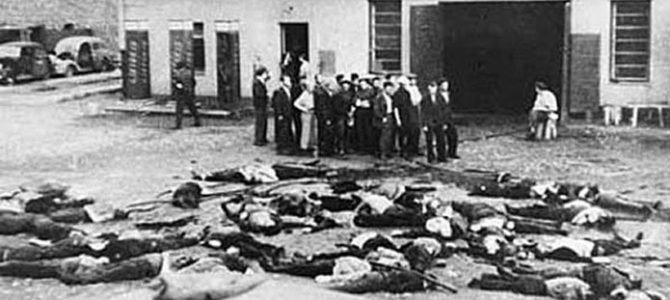
On Monday the Kaunas Jewish Community held a public commemoration for the victims of the Lietūkis Garage massacre in Kaunas. Although the exact number of victims remains unknown to this day, it’s believed around 50 Jewish men were rounded up and then tortured to death at the automobile repair cooperative before the German army had taken control of Kaunas, Lithuania’s provisional capital.

The mass murder attracted spectators, mainly Lithuanians but also Wehrmacht soldiers and officers. It happened on June 27, 1941. Firehoses were forced down the throats of many of the victims, bursting their stomachs and intestines, leading to death. Those who survived the various tortures were murdered with crowbars. The corpses were piled up in the parking lot and one of the perpetrators climbed on top and played a Lithuanian song. Some witnesses said it was the Lithuanian national anthem.

The commemoration took place at the site in Kaunas with a commemoration in the evening at Vytauts Magnus University there. Both commemorations featured live music, including accordion music at the mass murder site.

Kaunas Jewish Community chairman Gercas Žakas spoke at the commemoration at the site, as did Israeli ambassador to Lithuania Shelly Hugler Livne. The latter decried the world turning its collective back on the lessons learned from the Holocaust. Also attending were the American, German, Estonian and French ambassadors.

Keeping Memory Alive

Keeping Memory Alive

A small group marked the 85th anniversary of the beginning of the Holocaust in Lithuania at the Ponar Memorial Complex yesterday.

The Holocaust began in late June of 1941. Withing a few months about 95% of all Jews in Lithuania had been murdered.

Writer and director of the Vilna Gaon Museum Sergejus Kanovičius said: “Words can never express our respect for those who were murdered as well as prayer does. Their memory will always live in our hearts.”

Lithuanian Jewish Community chairwoman Faina Kukliansky said: “Those gathered here today are the people who don’t need salutes from an honor guard or ceremonies planned in the finest detail in order to understand that the massacre of Jews begun 85 years ago was a tragedy for all of Lithuania, not just for our people.”

Israeli ambassador to Lithuania Shelly Hugler Livne said it was horrible people hadn’t learned from the painful lessons of history. She said the ever-growing anti-Semitism around the world happening today was the best proof of that. Hugler Livne said it was said to see the world going down the same road again.

The Tragedy in Palanga 85 Years Ago Must Not Be Forgotten

The Tragedy in Palanga 85 Years Ago Must Not Be Forgotten

by Mindaugas Surblys

Today we commemorate the men and young men of the Palanga Jewish community who were murdered in Birutė Park in Palanga in 1941. Palanga Jewish Community chairman Vilnius Gutmanas, Palanga deputy mayor Rimantas Mikalkėnas, Palanga municipal culture department director Robertas Trautmanas and members of the community lit commemorative candles and placed commemorative stones.

The army of the Third Reich occupied Palanga on June 22, 1941, and by June 26 all of the town’s Jews had been locked up inside two synagogues, mothers, children and the elderly in one and men and young men in the other. The 106 males were taken on June 27 to Birutė Park and murdered, along with 5 Lithuanians accused of collaborating with the Soviet government. The remaining 300 or so women, children and elderly were murdered on October 11 and 12, 1941, in the Kunigiškiai forest.

The males were exhumed in July of 1958 and moved to the Palanga city cemetery, where a single marker marks the mass grave.

Memory lives so long as we remember.

Chairman Gutmanas said: “Eighty-five years have passed but time is powerless to erase our pain. People who had families, dreams and lives were silenced forever. They were murdered because of their origin. It is our duty today not just to commemorate them, but not to allow their stories to be forgotten.”

The Wreath and the Knife

The Wreath and the Knife

by Grant Gochin

On June 27, 2026, the eighty-fifth anniversary of the Lietūkis Garage massacre will be marked in Kaunas and by Lithuanian diplomats in Israel and the USA.

Expect the wreaths. Expect the candles, the bowed heads, the violin music, the brief and dignified statement. Expect a Lithuanian official, perhaps a diplomat, to speak of the Jews who “perished,” who were “lost,” whose world “vanished.” I have set out elsewhere, in What Lithuania Means When It Says “Vanished,” “Lost,” or “Perished,” what that vocabulary is built to hide. The short version is that none of those words contains a killer. They are the grammar of a state that has learned to mourn the Jews it cannot bring itself to say were murdered by Lithuanians.

Watch closely this June, because the commemoration is the knife.

Lietūkis Garage Commemoration

Lietūkis Garage Commemoration

The Kaunas Jewish Community is inviting the public to mark the 85th anniversary of the Lietūkis Garage massacre on Monday, June 29. The ceremony will take place at the commemoration to victims at Miško street no. 3 in Kaunas at 4:00 P.M., followed by a concert in the Great Hall at Vytautas Magnus University, Gimnazijos street no. 7, Kaunas, at 6:00 P.M.

How to Win in Iran: Thoughts from outside the Box

How to Win in Iran: Thoughts from outside the Box

by Geoff Vasil

The first task in the American and Israeli war against Iran is to open the Strait of Hormuz. This isn’t an impossible military task. It simply entails a cold, hard slog up the coast, reducing by attrition Iranian radar, speedboat, drone and missile sites.

For Donald Trump to lose the military engagement in Iran would be an American tragedy. Never mind he forgot to sell the war to the American public and Congress. Maybe he thought a 4-day war’s results would speak for themselves. I might be misremembering, but George Herbert Walker Bush spent about 6 months selling his First Gulf War and about 4 months actually fighting it, to a semblance of victory. My flawed memory doesn’t recall any war at all America engaged in which didn’t include a prequel to war, a long build-up and more importantly an argument or explanation of why it was in America’s national interest. The secret bombing of Cambodia and Laos might be an exception, but “Ho Chi Minh Road” was kind of self-explanatory in the end. Did fourth American president Madison make the case against Canadian terrorism and British imperialism in the War of 1812? I don’t know, I wasn’t born yet, but I kind of think he did make that case to the American people in that weirdest of all American wars. America’s third president Thomas Jefferson definitely did make the case in the two Barbary Pirate Wars before that..

Donald Trump as the most significant American president since George Washington can’t afford to lose. Of course he never wanted to be a “wartime president” and he probably isn’t cut by nature or nurture to be a great military leader. Maybe there was some hubris involved in the technically good military kidnapping of the Venezuelan president a month before; if we can do that, we can do anything.

Jewish Life in the Baltic Countries, 1917-1945

Jewish Life in the Baltic Countries, 1917-1945

Vytautas Magnus University in Kaunas in cooperation with the US Holocaust Museum, the Sugijara House Museum in Kaunas and the Ninth Fort Museum in Kaunas is holding a conference called “Jewish Life in the Baltic Countries, 1917-1945: from June 9 to June 11. The conference marks the 85th anniversary of the beginning of the Holocaust in the Baltic states with presentations on Jewish life including art, music, literature, education, languages, religion, government, land and nature, emigration, resistance, the rescue of Jews and commemoration. The Kapela Kotra trio will perform Litvak music and documentary films by Saulius Beržinis will be screened.

The conference will be held in the Senate Hall at Vytautas Magnus at Donelaičio street no. 28 in Kaunas. The program begins at 9:00 A.M. on Tuesday, June 9. It begins at 11:00 A.M. on June 10 and at 9:30 A.M. on June 11.

How Israel Should Respond to Trump

How Israel Should Respond to Trump

by Geoff Vasil

Last night the Israeli-American relationship was cast into doubt when Trump told the press he was about to call Israeli prime minister Benjamin Netanyahu and “tell” him not to respond to Iranian missile attacks on Israel.

Trump has gone back and forth for weeks now claiming he’s close to “a deal” with some group of Iranians on a peace plan. It’s fairly obvious the gangsters in the Islamic Republic have been goading and cajoling him on into some sort of idea of a peace plan, but that’s what Iran is best at, endless negotiations on a set of untenable principles.

It should be obvious to everyone watching that the best way to end the impasse with Iran is through military victory. They’re claiming some sort of sovereignty over the choke-point on world commerce, the Strait of Hormuz. They want Israel to stop bombing Hezbollah. They want war reparations from America. There are no common points for negotiation, but Trump keeps pretending there are. Even regarding nuclear enrichment.

LJC on New Decisions on the Sports Palace and the Šnipiškės Jewish Cemetery

LJC on New Decisions on the Sports Palace and the Šnipiškės Jewish Cemetery

The Lithuanian Jewish Community expresses its profound concern regarding the decision adopted by the parliament or Seimas of the Republic of Lithuania following its initial approval of draft resolution No. XVP-1423 which effectively revives plans first proposed more than a decade ago to convert the former Vilnius Sports Palace into a venue for congresses, conferences and cultural events (Government Resolution No. 597 of June 9, 2015).

These plans had previously provoked strong opposition from international Jewish organizations, including Jewish religious authorities. According to Jewish religious law, a cemetery is sacred and inviolable ground; not only are entertainment events and concerts prohibited there, but even disturbing the soil is forbidden. It was precisely for this reason that a special working group was established, bringing together representatives of state institutions, the Lithuanian Jewish Community and international organizations.

After lengthy and complex discussions, a compromise solution was reached, one that balanced respect for the dead, preservation of historical memory and the public interest. This agreement was confirmed by the Government of the Republic of Lithuania in July of 2024 (No. S-2174 of July 17, 2024).

Israel Eurovision Head: Don’t Know What Would Have Happened If We’d Won

Israel Eurovision Head: Don’t Know What Would Have Happened If We’d Won

by Florit Shoihet, May 17, 2026

Yoav Tsafir reflects on fears as booing became more intense as Israel came closer to winning in Vienna

The head of Israel’s Eurovision delegation said he felt a sense of relief when Noam Bettan’s entry was pipped to the post last night amid an increasingly hostile atmosphere in the hall.

“At that moment when we led and it wasn’t clear if Bulgaria would overtake us, the booing from the crowd was immense, and … it turned into violent booing toward the Israeli delegation,” Yoav Tsafir told Channel 12, adding: “I don’t know what would have happened if we had won”.

The director noted that until the announcement of the results, the atmosphere towards the Israeli delegation was better compared to the two previous contests. “There was a positive change, with no huge expressions of hate,” he said, and behind the scenes “there was huge appreciation” towards Noam Bettan and his song Michelle, pointing out even the jury panels awarded him 123 points, thus placing 8th before public votes came in.

News from Panevėžys

News from Panevėžys

Last weekend volunteers from the Panevėžys Jewish Community cleaned the interior and grounds of the Chevra Torah synagogue there. The brick synagogue was built in 1910. It was closed in 1940, the interior was destroyed and the decorative façade heavily damaged.

On May 6 Panevėžys Jewish Community representatives attended a lecture at the Lost Shtetl Museum in Šeduva by Holocaust historian Christoph Dieckmann called “How Did It Happen?” During questions afterwards, Panevėžys Jewish Community chairman Gennady Kofman thanked Dieckmann and asked about sources on Jewish vital statistics from the period between 1938 and 1941, engendering a discussion about the drop-off in marriages and births at a time when the Jewish community sensed the onset of tragedy.

EU Agree Sanctions against West Bank Settlers

EU Agree Sanctions against West Bank Settlers

Photo: Israeli settler places flag on day of re-establishment of Sa-Nur settlement, evacuated in Israel’s 2005 disengagement, in Sa-Nur in the West Bank, April 19, 2026. REUTERS/Shir Torem

BRUSSELS, May 11 (Reuters)–European Union foreign ministers reached an agreement on Monday on new sanctions targeting violent Israeli settlers in ‌the occupied West Bank, as well as leading Hamas figures, EU ‌foreign policy chief Kaja Kallas said.

The sanctions package, which targets three settlers and four settler organizations whose identities have yet to be publicly disclosed, had been blocked for months by the previous Hungarian government, which lost an election last month.

European governments have raised concern about a rise in reports of settler violence against Palestinians ‌in the West Bank.

“It was high time we move from deadlock to delivery,” Kallas said on X. “Extremisms [sic] and violence carry consequences,” she added.

Lost Shtetl Fifth Most Beautiful Museum in the World

Lost Shtetl Fifth Most Beautiful Museum in the World

The Lost Shtetl Museum in Šeduva, Lithuania, placed fifth in the Prix Versailles selection of the world’s most beautiful museums announced May 4 at UNESCO in Paris. Prix Versailles judges singled out the museum’s architecture designed by Finland’s Rainer Mahlamäki. The outer form of the museum is intended to replicate the silhouette of the skylines of typical Lithuanian shtetlakh.

Full story in Lithuanian here.

London Jews Heckle PM

London Jews Heckle PM

British prime minister Keir Starmber travelled to Golders Green in north London Thursday afternoon to talk with local Jewish volunteer security guards and others, and was greeted by a crowd of 100 to 200 Jews who heckled him, shouting “shame on you,” “traitor,” “coward” and “Keir Starmer, Jew harmer.”

The outrage in the Jewish neighborhood over lack of security and policing follows at least two arson attacks and the stabbing of two Jewish men Tuesday by a naturalized Somalian within a very narrow section of Golders Green, just three mostly residential streets. Other arson attacks against Jewish synagogues and institutions have also been committed over the past two months in north London.

The prime minister reportedly cut his visit short, it only lasted a few minutes, and he was heckled as his motorcade left the location.

Photo: londonlovesbusiness.com

Anti-Jewish Arson Rings in UK Investigated for Links to Iran

Anti-Jewish Arson Rings in UK Investigated for Links to Iran

A recent spate of arson attacks in London against Jewish synagogues and institutions is now being investigated by London’s Metropolitan Police for links to advertisements placed social media by Iran seeking criminals to commit anti-Semitic acts for pay.

Last year Australia’s ASIO intelligence service and the Australian Federal Police uncovered a similar scheme by Iran to attack synagogues and Jewish sites in Sydney. Australia threatened to cut off diplomatic relations and evacuated Australian embassy personnel from Tehran. Last week Australia sent a diplomatic protest to the Iranian embassy there for ads on Telegram and other social media sites again recruiting Australians for terrorist acts.

Scotland Yard and the Met in London have arrested over 15 people in possibly related arson rings in the greater London area in the last month.

According to Skynews UK reporting and interviews on the on-going investigation, Iran is using artificial intelligence, chatbots, to select potential viable candidates for its terror missions. After passing that gateway, would-be jihadists are put in touch with a human operator to assess their willingness to carry out terrorist acts, and are asked if they’d be willing to travel to Israel. Some of the posts intended to lure in sympathizers are bi-lingual, in English and Hebrew.

Photo: Alishia Abodunde/Getty Images