Holocaust Victims and Rescuers Remembered in Jurbarkas

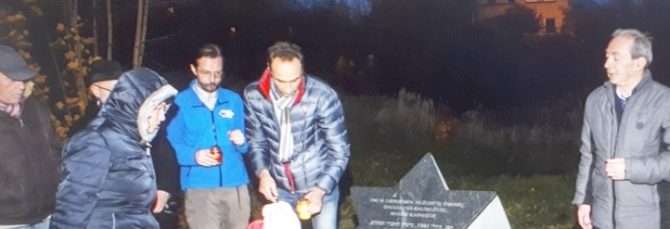
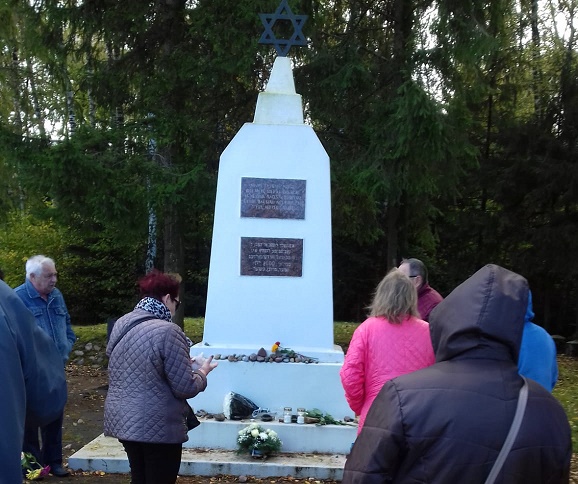
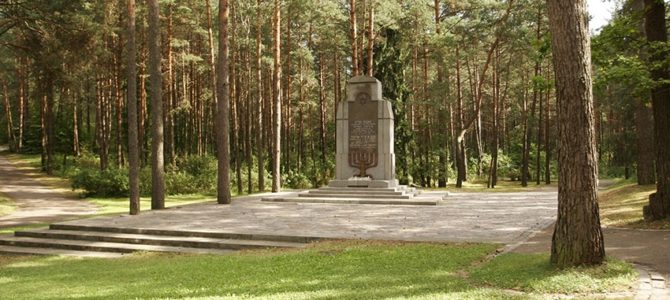
Seventy-seven years ago, on July 3, 1941, the first mass murder of Jews was carried out in Jurbarkas (Yurburg), Lithuania. The number murdered was 322 people, including about 20 ethnic Lithuanians (including Jurbarkas sculptor Vincas Grybas). The Jurbarkas community remembers this tragedy every year and holds an Hour of Memory at the grave site of the victims of the genocide, attended by local residents and friends and family of the Jews who lived in Jurbarkas and experienced the Holocaust there.

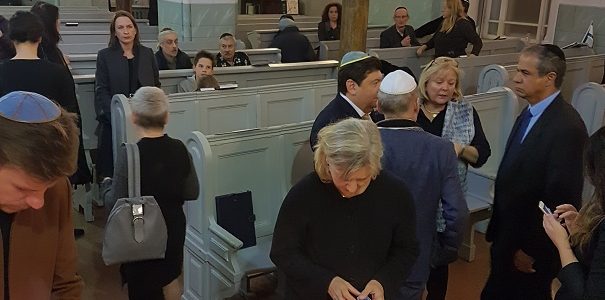
This year representatives of the Jurbarkas regional administration including deputy mayor Saulius Lapėnas, administration director Vida Rekešienė, Culture and Sports Department chief Antanas Gvildys, Jurbarkas alderman Audronis Kačiušis and staff from the Jurbarkas Regional History Museum and Jurbarkas Cultural Center attended along with victims and relatives the July 3 Hour of Memory held at the Jurbarkas Cultural Center.

Former Jewish Jurbarkas resident Jakovas Rikleris travelled from Germany to the event and said: “I am so glad you have not forgotten and maintain this site so dear to us, the old Jewish cemetery. There were extraordinarily noble, brave people from the land of my birth, from the area around Jurbarkas, people who were unable to remain uncaring seeing these brutal massacres. These people are immeasurably brave, in fear of the mortal danger they rescued Jews, hid them, shared their meager wartime food provisions with them and believed that in saving people from death they were performing the most important duty, sacrificing themselves for the lives of other innocent people. These are the true people of the Lithuanian nation.”

Young actors from the Jurbarkas Cultural Center’s children and youth theater Vaivorykštė under the direction of Birutė Šneiderienė read selections from Grigori Kanovich’s Shtetl Love Story and compositions by Jurbarkas composer Kęstutis Vasiliauskas were performed on violin.

Lithuanian Diplomats in the Arena of Humane Action and Aggression


V. Čečeta began working at the Lithuanian General Consulate in Vilnius on September 17, 1939. Photo: Archiwum akt nowych w Warszawe

kauno.diena.lt

Chiune Sugihara and Jan Zwartendijk are foreign diplomats who rescued Jews and they have been commemorated in Kaunas and the world, but they were only able to do what they did between 1939 and 1940 because of efforts by Lithuanian state officials.

Have we forgotten our own role?

When a monument costing 150,000 euros is erected next year in Kaunas to the so far little-known honorable Dutch consul in interwar Lithuania Jan Zwartendijk, the world will learn about another foreign diplomat who rescued Jews.

As current Dutch ambassador to Lithuania Bert van der Lingen told BNS, The role world-famous rescuer of Jews Chiune Sugihara was only made possible because Zwartendijk made an entry in the passports the travellers were travelling to a Dutch overseas territory. This entry, the Dutch ambassador says, was the basis for Sugihara to issue visas to Jews to transit Japan. But have we thought about our own diplomats in this context?

That there is little interest and even avoidance of this topic was demonstrated by the difficult search for historians and Foreign Ministry representatives able to say anything about the topic of the activities of the Lithuanian General Consulate in Vilnius in 1939.

Lost Property

Lost Property

At first they lost their civil rights, then their property and, in many cases, their lives. Jews from Lithuania are still waiting for the time when they can at least get their property back.

by Antanas Manstavičius
IQ magazine, June, 2018

For several decades now Lithuanian Jews who survived the Holocaust, along with other residents of the country, have had little hope of restoration of property rights, due to objective reasons. Lithuanian citizens who survived the Soviet and Nazi occupation have finally been allowed to get back private property seized or at least get compensation. Many have made use of this right.

Those who had to flee to save their lives during World War II and their descendants find themselves in a completely different situation. Until now, Lithuanian laws categorize those seeking to have their rights to property restored according to citizenship: those who don’t have it still cannot get their property back.

“You have to be a citizen to get property back,” Lithuanian Jewish Community chairwoman and attorney Faina Kukliansky said. “But what if you don’t want to be one? How can one be forced to become a citizen of Lithuania?” She says she has clients who still haven’t been to get real estate in Lithuania back. For at least some of the Litvaks living abroad, it’s not about the money, it’s a matter of principle.

Young People in Panevėžys Interested in Jewish Heritage

Monika Šinkūnaitė and her colleague appealed for help to the Panevėžys Jewish Community on June 11 regarding a project called Orientational Walking Tour and a discussion called Jewish Culture in Panevėžys. During the meeting both parties discussed scenarios for the event and topics for the discussion.

The point of the project is to get young and older people interested in Jewish heritage.

The educational walking tour happened on June 29 and was called Along Jewish Roads, including important historical Jewish heritage sites in the city. The youth group began the tour at Freedom Alley where there was a thriving Jewish neighborhood before World War II. There were Jewish residences, stores, workshops, dentistry and medical clinics and attorneys’ offices. Some streets were named after Jewish public figures, including Dr. Mer, Rabbi Gertzel, the industrialist Kisinas, Dembas and others.

The discussion was held after the walking tour at the café Kavos Dėžutė. Panevėžys publicist Donatas Puslys, Panevėžys Regional History Museum director Arūnas Astramskas, bishop emeritus Jonas Kauneckas, nun Eleonora Kasiulytė from the Congregation of the Sisters of God’s Love and Panevėžys Jewish Community chairman Gennady Kofman participated.

Condolences

Panevėžys Jewish Community member Jelena Larionova-Vaizberg has passed away. For many years she was a microbiologist and doctor at the Panevėžys Infection Clinic. The entire Lithuanian Jewish Community mourns her loss and we send our deepest condolences to her sons and daughters.

Thank You to Out-Going Cultural Heritage Department Director Diana Varnaitė

The Lithuanian Jewish Community sincerely thanks Lithuanian Cultural Heritage Department director Diana Varnaitė for all the work she’s done to preserve Jewish heritage in Lithuania. The Community is also wondering who could replace her professionalism, intellect and sense of heritage as a significant legacy we leave to future generations.

Since Faina Kukliansky became chairwoman of the LJC in 2013, the Community has paid special attention to the preservation of Lithuanian Jewish heritage sites. Mainly because of director Varnaitė’s personal attention to Jewish heritage, it became one of the Cultural Heritage Department’s priorities and thus a priority for protection nation-wide. The Jewish story in Lithuania began almost 700 years ago and much has been lost, but what remains needs urgent work to save it as a treasure of the state and the people which draws people here from around the world.

Lithuanian Jewish heritage sites are relics of a cultural landscape created over centuries by the community which once numbered a quarter million people living in almost every Lithuanian city and town. It is around 200 cemeteries, more than 200 mass murder sites and mass graves and over 40 synagogues listed as cultural treasures.

Jews from Australia Visit Panevėžys

The families of Jews who lived in Panevėžys before the war are now scattered around the world. Even before the war, back in tsarist times, Panevėžys Jews migrated widely to countries such as Argentina, the United States, Canada, Mexico, Chile, Brasil and also South Africa and Australia. The Panevėžys Jewish Community often receives visitors from these countries, and especially from South Africa. This time Kelly Rozmarim from Australia visited with her husband, brother and two daughters. She brought documents showing her grandfather Hona Shepts was born in Panevėžys in 1908 and immigrated with his brother to South Africa in 1939. Her father Judelis Shepts was a rabbi. He and his three sisters were also born in Panevėžys and stayed in Lithuania. All of them died in the Holocaust.

In South Africa in 1939 there was a world-renowned Jewish community called Ponevezh. Kelly Rozmarim has a document, a list of people who sailed to South Africa which includes members of her family. She and her brother have also discovered relatives in Šeduva, Pasvalys and Biržai.

The family’s visit to the Panevėžys Jewish Community enriched our archives and provided valuable information about the Jewish residents of Panevėžys back then. The visitors thanked Panevėžys Jewish Community chairman Gennady Kofman for his active efforts to preserve the Litvak heritage and to commemorate it in Panevėžys. All of the family members left warm words and greetings in the Community’s guest book.

Great Synagogue Excavation to Resume

Dr. Jon Seligman of the Israeli Antiquities Authority has announced excavation of the Great Synagogue and the former complex of surrounding buildings known as the Shulhoyf in Vilnius will resume this summer July 9 and will continue till July 27. Those interested in volunteering should contact Dr. Seligman, address below.

The Great Synagogue and Shulhoyf of Vilna (Vilnius): The 2018 Season
A Research, Excavation, Preservation and Memorial Project

A Quick Summary of the Work until Now

The successful outcome of the preliminary excavation of 2011, the 2015 ground-penetrating radar survey and the 2016 excavation showed us the potential of continued excavation at the site to uncover further sections of the Great Synagogue and the surrounding buildings. Given the resources available to the team, we decided to initially concentrate on issues relating to the water system of the shulhoyf that developed in and around the Great Synagogue in the 18thcentury. Written sources inform us that a pipeline was established in 1759 to bring water from the Vingrių springs, that belonged to the Dominican friars, to the synagogue complex. It supplied water to the communal “well,” and apparently to the bathhouse constructed between 1823 and 1828 that included a miqve and a public lavatory.

LJC Participates in 100 Faces of Lithuania Event

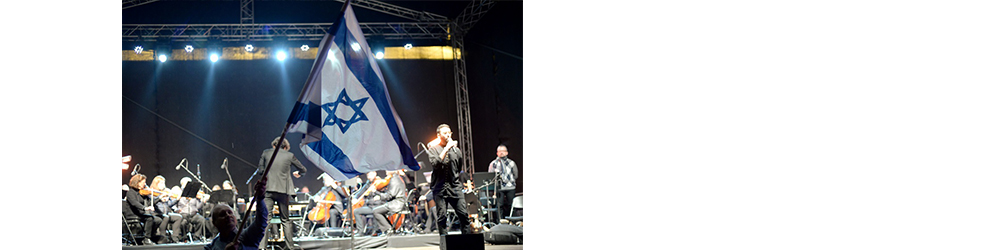
The World Lithuanian Community sponsored an event July 1 at Old Town Hall Square in Vilnius where for the first time since independence Lithuanians in Lithuania had the chance to learn about Lithuanian communities living around the world and Lithuanian ethnic minority communities at the same time. The Lithuanian Jewish Community and the Nerija Lithuanian Community in the State of Israel participated with stands on the square. Lithuanian president Dalia Grybauskaitė visited the LJC’s Bagel Shop stand and tried the imberlakh. The event also featured a concert and art exhibition in and around the Old Town Hall.

Condolences

Boris Finkelson passed away June 30. He was born in 1941. Our deepest condolences to his wife Adelija and their children.

The Jewish Community of Lithuania

The Jewish Community of Lithuania:

  • Address: Pylimo str. 4, 01117, Vilnius, Lithuania
  • Tel.: (8 5) 2613 003
  • Fax: (8 5) 2127 915
  • E-mail: info@lzb.lt

FK

Faina Kukliansky, chairwoman, Jewish Community of Lithuania

The Lithuanian national revival movement and initial struggle for liberation from Soviet oppression which occurred at the end of the 1980s also provided the conditions for a Jewish national rebirth. Jewish cultural support groups began to form in many institutions and towns.

On August 25, 1988 it was officially decided to create a Lithuanian Jewish Cultural Society; the founding meeting took place on March 5, 1989.

Mission and Vision

Mission

TO unite the Lithuanian Jewish community scattered around the world, to celebrate Jewishness, to preserve the true traditions of Litvak culture, to bring together Jews of all age groups, so that the Yiddish language would ring forth again, so that the Jewish Holy Days are celebrated and observed, so that the Jewish identity would be celebrated and so that the historical memory of the Holocaust is never forgotten.

Vision

The Community is a home where every Lithuanian Jew may celebrate their Jewishness, receive support and lend a helping hand to others.

The Community is a home in which every Jew from anywhere in the world may come and learn about their roots, the history of the Litvaks and their important contribution to world learning and culture.

The Community is a home for everyone who wants to learn about the distinct culture of the Jews.

The Community is a cozy home where everyone is welcome.


Litvak Grant Gochin Receives Mention in Prestigious African Magazine

Grant Gochin is a member in good standing of the Lithuanian Jewish Community. Originally from South Africa, he’s worked as a wealth and financial planner in the United States for decades. A dual citizen of Lithuania and the United States, he also operates the consulate of Togo in California, as well as performing important duties for the African Union. The following was published in the AU magazine Invest in Africa in the June, 2018, edition.

§§§

Full issue here.
Condolences

We send our deepest condolences to Vanda Klug, a long-time and active member of the Panevėžys Jewish Community and chairwoman of the congress of aldermen, on the death of her beloved father. Our sincerest wishes for strength in this time of loss to her and all relatives and friends.

First Hebrew Camp

For the first time in post-war Lithuania this summer a Hebrew language camp was held from June 22 to 24. Vilnius Sholem Aleichem ORT Gymansium Hebrew teacher Ruth Reches organized the event. She has been teaching Hebrew to adults for two years now at the Lithuanian Jewish Community.

Ruth says the idea for the camp occurred to her spontaneously. “I was speaking with students and we began to talk about how it wasn’t enough to learn Hebrew in the classroom. We were thinking about immersion in a Hebrew language environment and how good it would be to go to Israel for that reason. But first we decided to attempt to create a Hebrew environment at a camp,” she said.

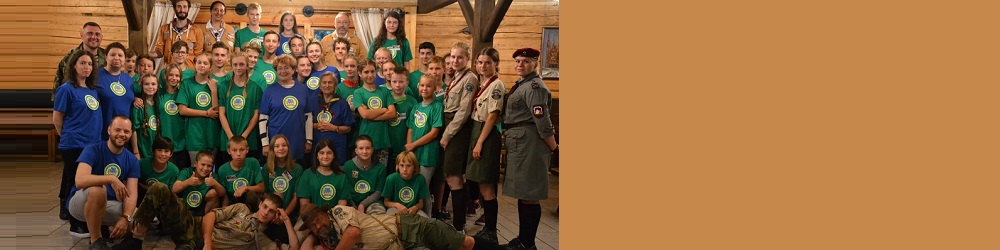
The camp was held on a rural farm where for three days over 40 people from all over Lithuania gathered. The people ranged in age from students to pensioners.

LJC Invites Children to Summer Camp Amehaye 2018

Lietuvos žydų (litvakų) bendruomenė kviečia vaikus į dieninę vasaros stovyklą „Amehaye 2018“

The Lithuanian Jewish Community invites children aged 5-10 to the Amehaye 2018 summer camp at the Karvys manor estate in Paežeriai village in the Maišiagala aldermanship in the Vilnius region from July 16 to 27. The program includes educational activities and walks. Facilities will be provided for naps for the younger children and breakfast, lunch and dinner will be served daily.

Cost for one child is 160 euros, or to register two children at once 150 euros apiece. The cost for one week is 80 euros. Children in the LJC social program receive a subsidy. Registration is open till July 10.

Electronic registration form here.

For more information and to register, contact Sofja Sirutienė by email at sofja@lzb.lt or call +37067257540, or contact Žana Skudovičienė at zanas@sc.lzb.lt or call +37067881514.

LJC Criticizes Vilnius Municipality Invitation to Celebrate 1941 Uprising

Vilnius, June 27, BNS–The Lithuanian Jewish Community Wednesday criticized an invitation to the public from the Vilnius municipality to mark the anniversary of the 1941 uprising.

According to the Community’s statement, in June of 1941 “Lithuania won a brief and very conditional freedom essentially in exchange for becoming a Nazi ally.”

The LJC said the Lithuanian Activist Front which staged the uprising against the Soviet government became a tool of anti-Semitic policy in Lithuania and the Provisional Government never passed any act condemning the mass murder of Jews.

“The LJC can’t remain indifferent when several days ago in the heart of the capital a celebration was held, while flags of mourning should have flown in the country to mark the first victims of the Holocaust in Lithuania,” the statement said.

The uprising in June, 1941, is supposed to have been a struggle the restore Lithuanian statehood destroyed by the Soviet occupation, but critics say the insurgents and the Provisional Government were not favorable towards Jews.

The invitation published on the internet page of the Vilnius municipality claims the 1941 uprising demonstrated the resolution of Lithuanians to fight the Bolshevik occupation.

“In June, 1941, to avenge for those murdered and family members deported to Siberia and other northern regions of the Soviet Union, the sons and daughters of our nation, relying only upon their own bravery and themselves, were able to drive out the hated occupier and albeit briefly (June 22 to 28, 1941) restore Lithuanian statehood and the independence lost due to the culpability of their politicians and military leaders,” the Vilnius municipality’s invitation said.

It’s Unfair to Say All Lithuanians Murdered Jews

The Lithuanian Jewish Community has never said or claimed and never will that all Lithuanians are murderers of Jews. Although approximately 95 percent of Jews in Lithuanian were murdered in the Holocaust with the help of local collaborators, it’s not fair to label the entire Lithuanian people with the offensive and shameful accusation of murderers.

This is especially not fair to those who remained steadfast and passed the most difficult trial of being human. Those brave Lithuanians who seemed to find themselves in a hopeless situation and nonetheless found within themselves the power to fight antihuman ideas and Nazi doctrine. We can speak the names today of more than 800 of these quiet heroes although certainly the names of more have been lost to time.

Marking on June 25 the massacre of Jews at Lietūkis garage in Kaunas, honoring the memory of our ancestors and their rescuers, the LJC cannot remain indifferent when several days ago in the heart of the capital a celebration was held, while flags of mourning should have flown in the country to remember the first victims of the Holocaust in Lithuania.

On June 21, 2018, the municipality of the city of Vilnius published on their internet page an invitation to mark the anniversary of the June 23 uprising in which, among other things, that in June of 1941 revenge was exacted for the deportation of family members to Siberia and other northern regions of the Soviet Union, and that the sons and daughters of our nation, relying only upon their own bravery and themselves, were able to drive out the hated occupier and at least briefly (from June 22 to 28, 1941) restore Lithuanian statehood and the independence lost due to the culpability of their politicians and military leaders.

Should we really be encouraging the celebration of revenge, should we really utilize hate in the alleged goal of uniting the nation? Even after 70 years have passed since the end of the war, these sorts of phrases, recalling those during the Holocaust, remain painfully familiar.

Kaunas Remembers Lietūkis Garage Victims

On an overcast Monday afternoon members of the Kaunas Jewish Community, friends of the Community and those who care honored the victims of the Lietūkis garage massacre. Lithuanian Jewish Community chairwoman Faina Kukliansky recalled the historical event when in the first days of World War II in Lithuania when one group of citizens brutally tortured and murdered another group of citizens just because they were Jews as a crowd looked on in the middle of the day. She spoke about enduring myths about Jews, the Holocaust and the reasons the Holocaust happened.

Kaunas Jewish Community chairman Gercas Žakas and ghetto inmate Fruma Kučinskienė recalled what their family members said about those horrible and not-so-distant times and the still living, blood-curdling images fixed in memory.

Chairman of the Kaunas chapter of Sąjūdis [Lithuanian independence movement] Raimundas Kaminskas and Ninth Fort Museum deputy director Marius Pečiulis both expressed condolences to Holocaust victims and their descendants and apologized for the crimes of their countrymen.

All speakers expressed a common idea: the need to educate children, not just to talk about the historical facts, crimes against humanity and genocide, but to try to figure out together with children how and why these sorts of crimes occur, what happens to the human mind, psyche and spirit so that a person loses all sense of humanity and commits inconceivable acts.

Israelis Visit Panevėžys

For the fourth year now Edit Perry from Israel has led delegations of visitors to Panevėžys and the Panevėžys Jewish Community. This year, on June 25, the guide and teacher led a group of 23 people from Tel Aviv and other locations in Israel engaged in researching Jewish heritage and history. They are university students who study Jewish history during the academic year and spend their summers actually visiting locations connected with the life of their forefathers in Lithuania and Poland.

Community member Jurij Smirnov shared his experience of the Holocaust as a child in the concentration camps in Šiauliai and Panevėžys, the death of family members and how he came to Panevėžys with surviving family.

Following the discussion, the visitors viewed a photography exhibition and Panevėžys Jewish Community chairman Gennady Kofman presented a brief history of the Jews of the Panevėžys region before World War II. All visitors were given a Jewish calendar published by the Lithuanian Jewish Community featuring drawings and paintings of Lithuanian synagogues by Gerardas Bagdonavičius made before the war.