World Jewish Congress Head Demands Apology for Remarks on Polish Role in Holocaust

WJC logo

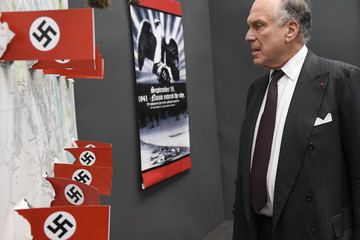
NEW YORK–World Jewish Congress president Ronald Lauder July 20 severely criticized statements by high-ranking Polish officials on Polish complicity in the mass murder of Jews during and after World War II. He was responding to remarks made by Poland’s education minister Anna Zalewska casting doubt on Polish participation in two pogroms against Jews in Jedwabne, and that city’s mayor Michael Chajewski even called for exhumation of the corpses contained in mass graves there. Lauder said such statements cause concern and seem like “a spit in the face” to the victims of the Holocaust in the town. In the pogrom in Jedwabne on July 10, 1941, Poles murdered about 340 people.

Lauder said the minister and mayor’s statements in effect discredit all the efforts made by Polish scholars, who for 25 years have been researching, studying and looking for evidence about the brutal violence Poles executed upon Jews. The president of the WJC called upon the Polish Government to demand immediate and clear apologies and retractions by both officials. Lauder recommended Zalewska and Chajewski would do better to listen carefully to the words of Polish president Andrzej Duda, who spoke at the 70th anniversary of a pogrom in the Polish town of Kielce in early July, saying: “There is no place in free, sovereign and independent Poland for any superstitions, racism, xenophobia or anti-Semitism.” Lauder noted the statements were especially troubling coming from Polish officials, and called Poland the leader in the fight against Communism in Eastern and Central Europe and a country which has accomplished much in Holocaust education. He said after the fall of Communism, Polish society collided with dark passages in the nation’s history, but showed courage and dignity, and because of the work done has become worthy of respect and has shown the way to neighboring countries which have been unable to come to terms with their own history.

Boris’s Litvak Roots

Jungtinės Karalystės užsienio reikalų sekretoriaus Boriso Johnsono šaknys Lietuvoje

lrytas logo

Lithuanian Roots of UK Formin Boris Johnson

British foreign secretary Boris Johnson has said he’ll travel to Lithuania because he has roots here. What roots? The newspaper Lietuvos Rytas tried to find out. Lithuanian foreign minister Linas Linkevičius discussed Lithuanian immigrants in Britain with the UK’s new foreign policy strategist Boris Johnson the day before yesterday and invited Johnson to visit the land of his ancestors. Johnson reportedly accepted the invitation enthusiastically. The family tree of Johson, 52, shows an Elias Avery Loew born October 15, 1879, in Kalvarija in what was then the Russian Empire. He later changed his surname to Low and is the father of Johnson’s grandmother. Both of Eli Low’s parents were born in Lithuania: Charles Loew, a silk merchant was born in Kalvarija in 1855, and Sarah Ragoller in Kaunas the same year. Later the family emigrated to the United States. Lithuanian archives don’t preserve the vital statistics on Johnson’s ancestors. Galina Baranova, advisor to the director of Information and Dissemination Department of the Lithuanian History Archive who has worked successfully for many years with the Lithuanian Jewish archives, said there is no way to find out more about the British foreign secretary’s forefathers, although it is clear he had ancestors in Kalvarija. Those records don’t survive and vital statistics only go back to 1922 now. There was a Ragoler family in Kaunas from 1898 to 1925, according to Kaunas Jewish Community birth records, but there is no way to connect this family with Boris Johnson’s.

Full story in Lithuanian here.

Simnas Synagogue to Get New Life

Simno sinagogą bus bandoma prikelti naujam gyvenimui

Dzukija logo

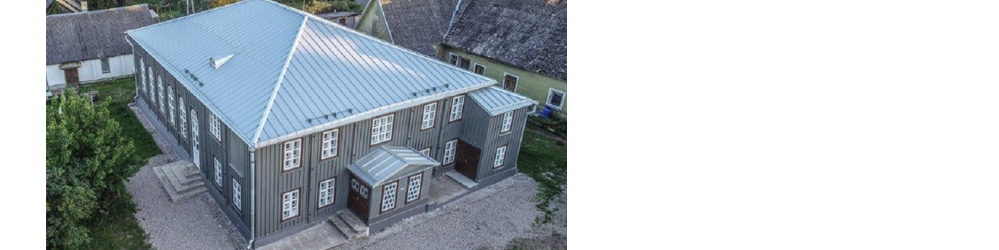
The Alytus regional administration will look for ways to use the synagogue located in Simnas for cultural activities. The head of the regional administration discussed the issue with representatives of the Lithuanian Jewish Community, the Ministry of Culture and the Cultural Heritage Department.

The synagogue was built in 1905 to replace the old wooden synagogue at the same site and was reconstructed in the mid-20th century. In 1952 it became a palace of culture, and later a school athletics gymnasium. Currently it belongs to the Alytus regional administration.

Evening with Markas Petuchauskas by Fundacja Borussia in Olsztyn, Poland

Evening with Markas Petuchauskas by Fundacja Borussia in Olsztyn, Poland

Petuchauskas portretas

The Fundacja Borussia (Borussia Foundation) organized a meeting, book presentation and discussion with professor habil. Markas Petuchauskas called “Cena Zgody,” the Polish translation of the title of his book “Price of Concord,” in Olsztyn, Poland, June 16.

The foundation responsible for the book-launch is a cultural NGO well known in Poland and outside its borders and is now in its second decade of operation. The foundation encourages exchanges of information about ethnic cultures: science, learning, literature, art, theater and music. Four times per year the foundation holds meetings with remarkable cultural and scholastic figures from around the world. Vilnius receives special attention. Before Petuchauskas, Alyvdas Šlepikas, author of “Mano vardas – Marytė” [“My Name Is Marytė”] was the guest of honor at a similar event. Petuchauskas said he was surprised by the invitation and he got quite emotional about it since the meeting is so formal and intellectual. Those attending came from outside of Olsztyn as well, some from as far away as Warsaw. Dainius Junevičius, Lithuania’s first post-independence ambassador to Poland and now ambassador for special assignments, also attended.
Virtual Shtetl Newsletter, July 19, 2016

75th Anniversary of Pogrom in Jedwabne

On July 10, 1941, an anti-Jewish pogrom took place in Jedwabne. On the 75th anniversary of these tragic events, the POLIN Museum wishes to commemorate the victims of this crime. Taking into consideration the difficult and multifaceted nature of the murder in Jedwabne, we have prepared a description of the pogrom, detailed timeline of the events and fragments of several academic works regarding the crime. More here:
http://mail.enewsletter.pl/k3/422/on/1dtn/0b12f3f9e95cf/lgriUOG5

Kaunas Jewish Community Celebrates Lithuanian Statehood Day

Kauno žydų bendruomenė kartu su kauniečiais švenčia Valstybės dieną

The Kaunas Jewish Community together with the city’s public organizations and municipal representatives celebrated Lithuanian Statehood/Coronation of King Mindaugas Day on July 6.

Those interested in the city’s history and that of its Jewish community were given a tour of the Slobodka neighborhood (Vilijampolė) where the Kaunas ghetto was established. The Veršva Vilijampolė Community Center organized the excursion led by Raimundas Kaminskas, an expert in the history of the neighborhood. Others took part holding and attending a Statehood Day celebration at the War Museum in Kaunas.

Road to Eden Exhibit in Kaunas

road to eden

The exhibit space on the fourth floor of the Kaunas Castle section of the Kaunas City Museum (Pilies street no. 17) is hosting an exhibit of paintings by Anatolijus Michailovas-Klošaras called “Road to Eden.” The exhibition opened July 7.

The theme of the paintings revolves around World War II in Europe. The paintings fall into three time-periods: pre-war peace, horrors of war and complicated post-war years.

The painter said if we don’t learn from the past the horrors of war could be repeated.

Anatolijus Michailovas-Klošaras was born and raised in Kaunas. His first showing of works was in Kaunas in 1996. He began showing abroad in 2002.

Full story in Lithuanian here.

Yusuf Hamied Receives First Chemistry Alumni Medal

Dr. Yusuf Hamied was awarded the first ever Department of Chemistry alumni medal in a ceremony on March 17, 2016. The vice-chancellor of the University of Cambdridge, professor Leszek Borysiewiecz, presented the medal “for services to the community that have brought honour to the Department of Chemistry.”

American Jewish Committee Celebrates 110th Anniversary in Moldova

Moldova Joe Resnik

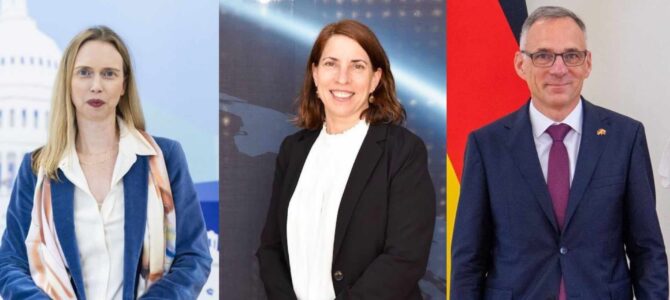
From left: Lithuanian ambassador to Moldova Rimantas Latakas, LJC chairwoman
Faina Kukliansky, AJC CEO David Harris

July 12, 2016, Chisinau (Kishinev), Moldova–AJC, the global Jewish advocacy organization founded in 1906 after vicious pogroms in Tsarist-ruled Kishinev, marked its 110th anniversary during a visit to the Moldovan capital.

The trip was highlighted by private meetings with president Nicolae Timofti, prime minister Pavel Filip, speaker of parliament Andrian Candu and deputy foreign minister Lilian Darii.

Lithuanian Holocaust Atlas Author: “I Crawled through the Underbrush to Find Commemorative Stones”

The Lithuanian internet news site 15min.lt has published an extensive interview with Milda Jakulytė-Vasil, the author and prime mover behind the Lithuanian Holocaust Atlas, a hardcopy manual on every known Holocaust mass murder site in Lithuania complete with GPS location and directions for drivers in Lithuanian and English, with an extensive interactive version on the web.

Known in Lithuanian as “Holokausto Lietuvoje atlasas,” the Lithuanian version is available here:
http://holocaustatlas.lt/LT/

with a complete English version here:
http://holocaustatlas.lt/EN/

In the interview on 15min.lt, Milda Jakulytė-Vasil recalled crawling through the brush to find long-neglected mass murder site commemorative markers. She also spoke about compiling the atlas and the help she received from the IHRA, but also from local people, local officials and politicians at the national level, including conservative opposition leader Andrius Kubilius.

Full interview in Lithuanian here.

Opening Ceremony for Yiddish Summer Course

Vilniaus Jidiš institute, esančiame Vilniaus universitete, liepos 17 prasidėjo vasaros programa 2016

Students, teachers and staff and other interested parties gathered at an opening ceremony for the summer course of the Vilnius Yiddish Institute at Vilnius University Sunday. Director Dr. Šarūnas Liekis welcomed the new students and thanked supporters and teachers from around the world. The courses are arranged in four levels and will end August 12.
Bagel Shop Café Draws Attention of ARD-1 German Public TV Crew

Vokietijos Visuomeninės televizijos ARD-1 kūrybinės grupės ypatingas dėmesys LŽB „Beigelių krautuvėlei“

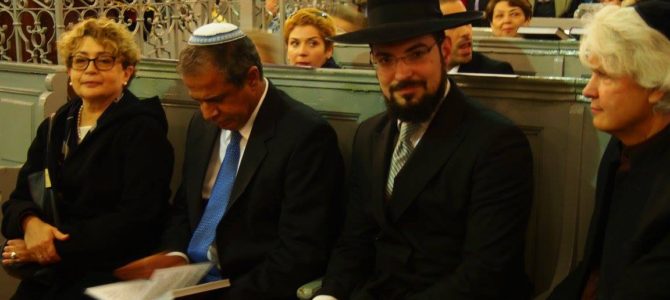
German public television channel ARD-1 filmed footage at the Lithuanian Jewish Community on July 13 with a focus on the Bagel Shop Café for a program to be called “Berlin-St. Petersburg,” according to director Christian Klemke.

He said although the itinerary for the film crew had been decided carefully prior to their trip through Poland, Lithuania, Latvia, Estonia and Russia, they had encountered interesting sites along the way which they will include in the final production.

When they were considering what to film in Vilnius, they discovered Vilnius’s rich pre-war Jewish cultural and spiritual life. “I wanted to know what there is now, so many years after the Holocaust,” Klemke said. Local producer Karolis Pilipauskas told him about the Bagel Shop Café. The Lithuanian Jewish Community facilitated meetings with members of the older generation, including Holocaust survivors. “I was very interested to hear their stories. Young members of the Jewish community also came to the café,” Klemke said.

Sholem Aleichem ORT Gymnasium Graduation Celebration

Šolom Aleichemo ORT gimnazijoje šiandien, liepos 15d. švenčiamos išleistuvės

The Lithuanian Jewish Community congratulates the students, parents and teachers on this significant day.

This year the Sholem Aleichem school graduated 18 high school students. This is the school’s 13th graduating class. Students come from a variety of ethnic backgrounds–Jewish, Lithuanian, Russian, Polish and others–and the school is a place of mutual respect and tolerance. Principal Miša Jakobas says he’s very proud because everyone passed their final exams, a major achievement in comparison to the problems encountered in other Lithuanian high schools. He said there were students who scored in the 96 to 97 percentile range, and one student scored 100% on the English language test, while the average scores were in the 70% range.

Let’s Not Name Streets after Nazi Collaborators

Let’s Not Name Streets after Nazi Collaborators

In Vilnius we have a street named after a Nazi collaborator, Kazys Škirpa, and as an elected city councillor I asked the municipality to change the name.

The street is in the absolute centre of town, between the Cathedral, the National Museum, the Castle and the Hill of the Three Crosses. Škirpa wrote the Lithuanian equivalent of Mein Kampf, and started an organisation to clear all the Jews out of Lithuania, men, women and children. He blamed them for Soviet atrocities just because they were Jewish.

I don’t think that’s the kind of person we should be celebrating on our walls. I asked the Names Commission to consider changing the name, to honour the Lithuanians who saved Jews from the Holocaust, instead of honouring a Nazi collaborator who wanted to create a racially pure Lithuania with Hitler’s help.

Yiddish Summer Course

The Vilnius Yiddish Institute at Vilnius University proudly announces

The 2016 Summer Program in Yiddish Language and Literature17 July — 12 August 2016

offering four levels of intensive language instruction:

YIDDISH I: for beginners    YIDDISH II: intermediate
YIDDISH III: higher intermediate    YIDDISH IV: advanced

more information from Indre Joffyte, info@judaicvilnius.com
(Coordinator of Programs at the Vilnius Yiddish Institute)

Kiev Renames Street after Nazi Collaborator

Authorities in Kiev decided July 7 to rename the city’s Moscow Prospect in honor of Nazi collaborator Stepan Bandera.

Allegedly pro-Western Ukrainian leaders and protestors have idolized Bandera, and the move to rename a street after the man could further trouble relations with neighboring Russia, Lithuania’s Baltic News Service reported on July 9.

As with Lithuania’s Nazi puppet government in the summer of 1941, Bandera declared Ukrainian independence as soon as the Nazis invaded the Ukrainian SSR.

Newsweek Magazine on the Last Nazi Hunter

by Stav Ziv

0715nazi04
Lithuanian-born Holocaust survivor Yitzhak Kagan visits the Chamber of the Holocaust Museum in Jerusalem. Photo: GALI TIBBON/AFP/Getty

Efraim Zuroff has accomplished much in his long career, but there’s one thing he’s particularly proud of: He’s the most hated Jew in Lithuania.

His Lithuanian friend Ruta Vanagaite agrees: She called him a “mammoth,” a “boogeyman” and the “ruiner of reputations”—and that’s just in the introduction to a book they co-authored.

Last summer, in a journey that helped cement his notoriety, Zuroff set off across the Lithuanian countryside in a gray SUV with Vanagaite, an author best known for a book about women finding happiness after age 50. Their goal: to visit some of the nation’s more than 200 sites of mass murder during World War II. On the road, between destinations, they talked and talked, recording their conversations. The trip formed the basis of their 2016 book, Our People: Journey With an Enemy, an instant best-seller in Lithuania. It also ignited a rancorous debate among Lithuanians, who have long downplayed their country’s considerable role in the Holocaust.

Farwell My Friend: Three Things I Learned from Elie Wiesel

Dear Friends,

Please find below Moshe Kantor’s opinion article published in the Newsweek following the sad loss of Prof. Elie Wiesel.

Kind regards,
The EJC team

European Jewish Congress (EJC)
Tel : +3225408159
Fax : +3225408169
Web : www.eurojewcong.org

FAREWELL MY FRIEND: THREE THINGS I LEARNED FROM ELIE WIESEL

The world has lost one of its premier moral voices, writes the president of the European Jewish Congress.

BY MOSHE KANTOR

The great French writer Victor Hugo once said that “adversity makes men.” There is no one in the history of humanity for whom this is more true than the late great Elie Wiesel. The world has lost one of its premier moral voices. His early life was fashioned in darkness, but he brought light to our world with his words of hope and peace. His courage to see good when he saw so much unspeakable evil should remain a legacy, not just for the Jewish people, but for mankind. Our view of life can be determined by interactions with extraordinary people. If you are lucky, each of us will meet one person who will change our world. For me, that was Elie Wiesel.

Documentary Film: “An Open Door: Jewish Rescue in the Philippines”

od

You are invited to attend a screening of An Open Door (2015) at the Lithuanian Jewish Community at 5:00 P.M. on July 13, 2016.

While Europe was under the thrall of the Nazis, Filipino president Manuel Quezon and US high commissioner to the Philippines Paul McNutt opened the door to 1,300 persecuted European Jews in the Philippines.

Jack Simke, assistant to the director and award-winning filmmaker Noel Izon, will introduce the film and lead a discussion afterwards. The event will take place in English.

For more information about the film, see here and here.

For more about the Jewish community in the Philippines, see here.