Israeli President Isaac Herzog Visits Lithuania

British actress Helen Mirren spoke out against the cultural boycott of Israel on Wednesday as she was honored at the 29th Israel Film Festival in Los Angeles, California.
Talking to the press before the ceremony, the Academy Award winner described the campaign to boycott Israeli through cutting off cultural ties as “a really bad idea.”
“The people who are the most inspiring in Israel tend to be from the cultural community. The writers, the directors, the poets, the musicians, they are truly extraordinary people doing amazing work, peace giving work, working towards peace all the time,” she said. “To cut them off is the craziest idea, I don’t agree with it at all.”
The World Jewish Congress website reports Pope Francis, the head of the Catholic Church, has issued a strong condemnation of anti-Semitism as he met with over a hundred leaders of the WJC Wednesday. During a private audience in the morning with WJC president Ronald S. Lauder, Francis made it clear that outright attacks against Israel’s existence is a form of anti-Semitism.
“To attack Jews is anti-Semitism, but an outright attack on the State of Israel is also anti-Semitism. There may be political disagreements between governments and on political issues, but the State of Israel has every right to exist in safety and prosperity,” Pope Francis told Lauder and the delegation.
Jews and Catholics today marked the anniversary of the 1965 declaration Nostra Aetate, which condemned anti-Semitism and improved and completely transformed relations between Jews and Catholics.
I was included in the delegation which went together with Lithuanian president Dalia Grybauskaitė to Israel. As the chairwoman of the Lithuanian Jewish Community I participated in everything and I can say the visit was historic. Despite the tension in the air because of the terrorist attacks by Palestinians, the leaders of Israel found the time to meet with the Lithuanian president on her working visit and to discuss the most urgent issues in regional security and bilateral cooperation. The Lithuanian president also discussed measures for strengthening Israeli and Lithuanian ties with Israeli president Reuven Rivlin, who emphasized his Litvak roots. The two leaders also spoke about the situation of the Jewish community and the commemoration of Holocaust victims in Lithuania. The Lithuanian president said Jews had contributed very much to the establishment of the Lithuanian state and that the two countries could combine forces in creating their future and prosperity. I remember moving moments when Litvaks in Israel met the president with tears in their eyes and how they spoke about the most beautiful times of their lives in Lithuania. These were times of youth, of the struggle for Jewish identity and for freedom. For them, Lithuania is the land of their forefathers from the time of Vytautas the Great, the land they call home and which they often recall even now.
Before her meeting with the president of Israel, the Lithuanian head of state visited the Yad Vashem museum to commemorate Holocaust victims and planted an olive tree in the Garden of the Righteous among Nations there. In her meeting with Israeli prime minister Benjamin Netanyahu, the Lithuanian president said could help Lithuania directly with security. “Israel is prepared to help Lithuania directly in the sphere of security: by training our military personnel, in the area of cyber-security and can even organize courses for our personal protection.”
Vatican City, October 28, (BNS-AP-AFP)–On Wednesday the Catholic Church marked the 50th anniversary of the historical Nostra Aetate [“In Our Time”] declaration which called for interfaith dialogue with a host of non-Christian religions and led to an historical change in Catholic-Jewish relations.
St. Peter’s Square Wednesday hosted an audience with the pope to remember this groundbreaking move made on October 28, 1965, when Paul VI was pope and the Church condemned anti-Semitism.
During his usual general audience, pope Francis spoke about the importance of Nostra Aetate and said it had transformed Catholic-Jewish relations from “doubt and opposition to cooperation and goodwill. … From enemies and strangers we have become friends and brothers.”
The Rothschild Foundation (Hanadiv) Europe held a conference to discuss Jewish cemetery heritage protection issues in Vilnius from October 25 to 28.
The conference, “A Cross-Disciplinary Seminar on European Jewish Cemeteries: Theory, Policy, Management and Dissemination,” with professionals from different European counties working in the field of Jewish Cemeteries including, scholars, genealogists, Jewish communities and federations, religious leaders, NGOs and policy makers, was designed to bring together a group of experts with 3 core aims:
• To review achievements since the conference on Jewish Immovable Heritage in Krakow 2013. The conference will provide a chance to conduct an appraisal of what has been done in the field until now. Organizations shared their most important projects, including new trends such as the development of technological tools to assist in the discovery and research of cemeteries.
• To explore important issues through a series of roundtable and panel conversations on the central questions and topics affecting the field.
• To encourage future collaboration between participating organizations, exploring how they can work together, encourage cross-border opportunities and consider further strategic cooperation.
Retired lieutenant colonel Jonathan D. Halevi, senior researcher on the Middle East and radical Islam at the Jerusalem Center for Public Affairs, has published an article on the current wave of violence in Israel called “The Hidden Hand behind the Palestinian Terror Wave” on the JCPA’s Institute for Contemporary Affairs website.
The Hidden Hand behind the Palestinian Terror Wave
Institute for Contemporary Affairs
Founded jointly with the Wechsler Family Foundation
Vol. 15, No. 33
October 25, 2015
• Gaza has in effect become an independent Palestinian state, and this Hamas-ruled state is making a pitch, by means of the “Al-Quds Intifada,” to annex the West Bank as well. For Hamas, this is only one phase in the phased plan to implement an ethnic cleansing of the Jews from the Land of Israel.
Gerald M. Steinberg, professor of political science at Bar Ilan University and president of NGO Monitor, a group which reports on anti-Israeli NGOs and the BDS (Boycott, Divest, Sanction) movement world-wide, has published an editorial in the Times of Israel on EU plans to require special labels on “colonial goods” produced in the occupied territories for import to the EU under the EU-Israel Association Agreement signed in 1995 granting preferential customs rates.
The op/ed came in response to an interview with EU ambassador to Israel Lars Faaborg-Andersen in the same newspaper in early October in which he said he failed to understand why Jerusalem was making such a “big fuss” about the EU’s plan to label Israeli products from the West Bank.
Steinberg said: “If nothing else, European officials at least get credit for consistency. For decades, in war and peace, terror and calm, they have not flagged in the belief that they can engineer their vision of peace for Israel. Having failed in so many previous attempts, the European move is another step in the effort to impose its preferred policies, via the labeling of products from the post-1967 ‘occupied territories’ in order to create economic pressure on Israel.”

Every year on the last Sunday in October members of the Kaunas Jewish Community and others gather to remember the victims of the so-called Great Action at the Ninth Fort in Kaunas. The largest mass murder operation to kill Jews in the Kaunas ghetto was carried out from October 28 into October 29 in 1941. Approximately ten thousand people were murdered during the single operation, including about 4,300 children.
Ninth Fort Museum director Jūratė Zakaitė spoke first at the ceremony, followed by Kaunas Jewish Community chairman Gercas Žakas. Žakas as well as Kaunas deputy mayor Vasiliy Popov, deputy Israeli ambassador to Lithuania Yehuda Gidron and Russian embassy attaché Svetlana Lepayeva spoke about how we must never forget the atrocities committed and must talk about the subject with young people, including humanity’s apparent inability to learn from its mistakes and parallels with racist crimes today. Kaunas Jewish Community member Julijana Zarchi, a Holocaust survivor and Soviet deportee, shared her experiences and insights.
An ominous shadow has swept across the Middle East and North Africa, leaving chaos and carnage in its wake. Mad men armed with Kalashnikovs and depraved convictions commit unspeakable acts—all safe in the knowledge that they are doing God’s work.
How the civilized world counters the Islamic State and its associates is the subject of lord Jonathan Sacks’s timely new book, “Not In God’s Name.”
The former chief rabbi of Britain sees the battle against ISIS and similar groups as the defining conflict of the 21st century.
The frontline might be Syria and Iraq, but the battle is being fought everywhere and targets everyone—especially Jews.

Amid a flurry of criticism directed at social networking giant Facebook over its policing, or lack thereof, of anti-Israel and anti-Semitic hate, a staunchly pro-Israel article by a renowned personality has mysteriously been wiped from the network’s pages.
The article, entitled Things We Need to Stop Hearing About the ‘Stabbing Intifada,’ was penned by famed French philosopher and activist Bernard-Henri Lévy and published exclusively by The Algemeiner on Wednesday.
Israel went on the defensive last Wednesday, pushing back against what officials, including prime minister Benjamin Netanyahu, have called the “10 biggest lies” being spread about the Jewish state and its actions amid the recent spate of Israeli-Palestinian violence.
In addition to the prime minister, who listed the 10 lies to the 37th World Zionist Congress in Jerusalem on Tuesday, Israeli ambassador to the U.S. Ron Dermer also laid them out, virtually identically, in a piece appearing on the same day in Politico.
The first two lies address the Temple Mount, a site around which Israel believes the current escalation in Arab attacks against Israeli Jews originated. Those lies are that Israel is either trying to change the agreements set up between Israel, Jordan and Palestinians to administer the site to allow Jews the right to pray there—many Israeli activists and some politicians say Jews should have the right to worship anywhere on the Temple Mount, which is where many Jews believe the Jewish temple once stood—or that Israel is trying to destroy the Al-Aqsa Mosque.
VILNIUS, Oct 22, BNS–Lithuania’s President Dalia Grybauskaite said in an interview to Israeli media that it is Russian President Vladimir Putin’s deeds, not words that should be taken into consideration.
She spoke when asked by i24news.tv to advise Israel’s Prime Minister Benjamin Netanyahu on the relations with Russia.
“Usually our experience with today’s Russia led by Mr. Putin, we usually say ‘don’t believe what they say, just try to check what they do’,” the Lithuanian president said, adding that Putin’s actions in Syria is not a war against the Islamic State but an attempt to support the regime of Syrian President Bashar al Assad.
“The busier you are, the more you get done,” Vilnius University medical student Amit Belaitė says. The young woman studying social medicine has earned the tolerance award for her work with the Bagel Shop campaign and she is an active promoter of Jewish culture. Belaitė currently heads the Lithuanian Jewish Student Union and was elected vice-president and executive board member of the European Jewish Student Union last summer.
The organization Belaitė leads operates at the Lithuanian Jewish Community. She says the student union’s spectrum of activities is broad and shouldn’t be construed as an exclusively religious or exclusively cultural institution.
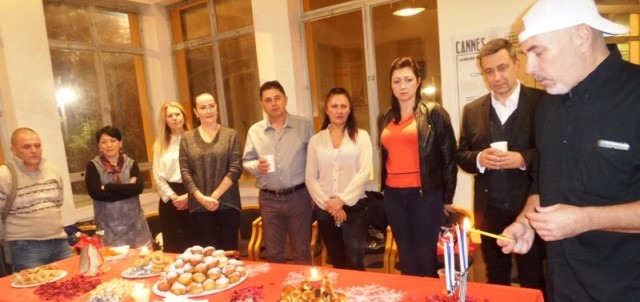
“We celebrate Jewish holidays, attend cultural events and attempt to learn more about our history. We organized a Purim holiday party, for example…”
Full article in Lithuanian at the Vilnius University website.
Job announcement aimed primarily at LJC members and their family members
Duties:
Coordinating youth counselor and youth volunteer work.
Initiating new programs for Jewish young people.
Encouraging participation by youth at all Jewish community events, including educational events, volunteer activities and etc.
Preparation of monthly reports and plans for the youth programs.
Work with the regional Jewish communities.
Requirements:
Experience working with young people.
Knowledge of Jewish history and traditions.
Enthusiasm, communications skills, striving for the best results.
Good organizational skills.
Good computer skills.
Driver’s license and private automobile.
Knowledge of Lithuanian, English and Russian.
Work experience at Jewish organizations would be a plus.
Please contact us with your CV and a motivational cover-letter at:
valentin.baltija@gmail.com
The LJC Social Center is seeking a personnel administrator for the home care department. Please send your CV to Social Center director Simas Levin at simas@sc.lzb.lt
You’re invited to attend Rabbi Klev Krelin’s lecture “Weekly Torah Selection: Abraham and His Sons. Jews and Arabs” at 6:00 P.M. on October 27 at the Choral Synagogue in Vilnius.
A delegation of the World Jewish Congress (WJC) and the Israel Council on Foreign Relations (ICFR) met with Lithuanian president Dalia Grybauskaitė in Tel Aviv Wednesday morning. The meeting was also attended by Lithuanian foreign minister Linas Linkevičius.
Grybauskaitė told the WJC-ICFR delegation: “Our society acknowledges its history. Our Jewish heritage is part of the heritage of Lithuania. Our support for Israel comes automatically. We understand what is going on in the Middle East, and we coordinate our position with the United States.”
WJC CEO Robert Singer praised strong relations between Israel and Lithuania, saying: “Lithuania’s support is much appreciated.”
Singer also raised the issue of neo-Nazi rallies held each year in Vilnius and Kaunas and said the Jewish world was “very distressed by this phenomenon, especially given the tragic history of Lithuanian Jewry.”
Grybauskaitė agreed that this was a problem but said it was difficult for the government to act unless the groups involved openly used Nazi symbols or explicitly espoused anti-Semitism and racism. She assured the delegation that this was an entirely marginal phenomenon. “They make lots of noise, but represent very few people.”
In recent years, Lithuania has tried to foster good relations with the World Jewish Congress Israel. In an address to a WJC-ICFR event last month, Lithuanian prime minister Algirdas Butkevičius pledged that all Jewish cemeteries in Lithuania would be “memorialized and marked” by the end of 2017.
In 2014 the World Jewish Congress established the WJC International Yiddish Center in Vilnius aimed at promoting cultural treasures created in Yiddish and the continuity of Yiddish learning and research.
Dalia Grybauskaitė took office as Lithuanian head of state in 2009 and was re-elected in 2014. She previously served as a government minister and was Lithuania’s first European Commission commissioner between 2004 and 2009.

In the picture above (from left to right): ICFR Board member professor Dina Porat, WJC Steering Committee member Eduardo Elsztain, WJC CEO Robert Singer, president Dalia Grybauskaitė, ICFR Board member Colette Avital, chairwoman of the Lithuanian Jewish Community Faina Kukliansky. Photo courtesy of World Jewish Congress.