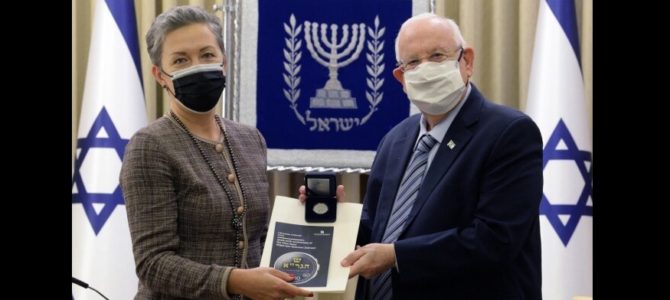




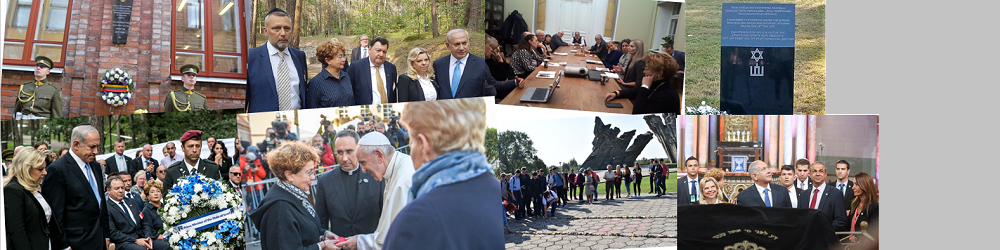

Israeli President Isaac Herzog Visits Lithuania

With deep sadness we report the death on December 16 of Anatolij Iljin, a member of the Šiauliai Regional Jewish Community. He was born in 1952. We extend our sincere condolences to his wife Nina, his sons and his many loved ones.
Ilja Cenz passed away December 13. He was born in 1929. We will always remember Ilja’s friendliness, energy and wonderful sense of humor. Our deepest condolences to his wife, children, grandchildren and many friends and relatives.

by Artūras Jančys
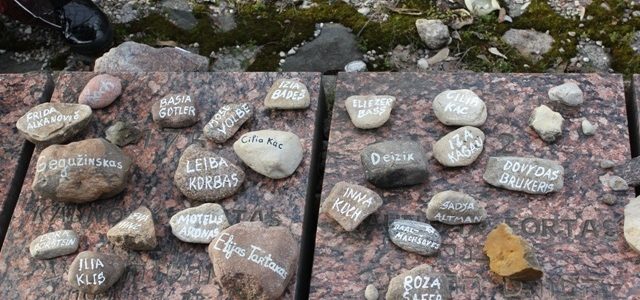
Should we restore desecrated Jewish grave markers and set up meditation and commemoration spaces in Jewish cemeteries, or should we leave the dead in peace and leave everything as it was? There is still no one good answer to the these questions.
Several years ago the municipality of Kaunas took resolute steps to include old Jewish cemeteries in the general context of the historical heritage of Kaunas. Students from Vytautas Magnus University were organized and sent to make photographic records, recording almost 6,000 Jewish headstones on film.
Each gravestone was photographed from several different angles resulting in well over 10,000 individual photographs. They will be entered in a general database which will aid in the continuing project to restore Jewish graveyards. The students’ work will also be displayed on a special internet site created for that purpose.
“Traditions are a sacred thing, but even they change, and now there are even female rabbis,” Gercas Žakas, chairman of the Kaunas Jewish Community, said.
Full story in Lithuanian here.

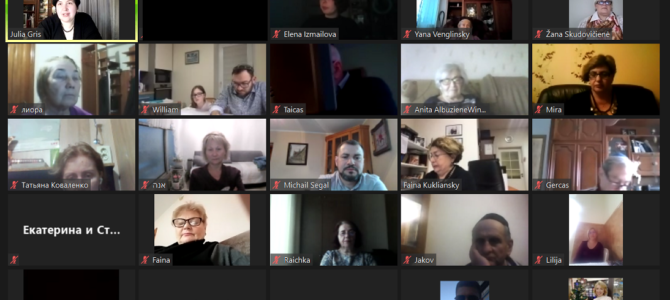
The Lithuanian Jewish Community and the Ilan Club invite all children to log on and keep the tradition of celebrating the Sabbath together this Friday, December 18, at 4:00 P.M. on the last day of Hanukkah. We will wish one another well and real Jewish nakhes! Sholem Aleichem ORT Gymnasium Jewish traditions teacher Algirdas Davidavičius will lead the Sabbath celebration. The virtual meeting will take place on Zoom. Please register by sending an email to sofja@lzb.lt or by calling +370 601 46656

The Ilan Children’s Club at the Lithuanian Jewish Community invites children aged 7 to 11 and their parents to spend some time together attending a lesson on emotional literacy from Kamila Gold, a therapeutic education expert and child and young adult mentor. Children who attend will receive an emotional-literacy workbook and parents will receive an autographed copy of the book “Drąsa būti savimi” [Courage to Be Oneself].
Number of participants is limited. The event will be held on Zoom at 1:00 P.M. on December 20. Please register by sending an email to sofja@lzb.lt or by calling +370 601 46656.

by Vytautas Bruveris, lrytas.lt
The country is marking the end of the ceremoniously declared Year of the Vilna Gaon and Litvak History, while the Lithuanian Jewish Community is looking at its front door and thinking it might have to leave its home. Because disagreements with state institutions are driving the Community from its longtime building in the center of the Lithuanian capital, located near the remains of Jewish Vilna and the city’s working synagogue.
Bailiffs and bricklayers in broad daylight have walled off one of the corridors in the building housing the LJC. This is the grotesque turn of events these days resulting from continuing disagreements between the LJC and the Vilna Gaon Jewish History Museum along with the Lithuanian Ministry of Culture. And even before this there were also episodes which seem rather odd, for example, letters from the museum to the members of the executive board of the LJC with accusations against the latter’s leadership, attempting to put political pressure directly upon the ethnic community/
With the new wall built, the LJC is now deciding on its future course: whether to dive headlong into legal battles, or simply pack its bags and hit the street. So why is all this happening? Because of disputes on how to share the courtyard which both the museum and the LJC, housed in the same building, claim. Instead of trying to act as moderator and as a moderating force, the Lithuanian Ministry of Culture has done the opposite. The neighbors are there next to each other, but separate.

Photo: UV disinfection being used to clean a laboratory (LeafenLin via iStock by Getty Images)
Tel Aviv University team behind discovery is working on self-cleaning surfaces, including laptop keyboard that kill germs with ultraviolet light every time lid is closed
by Nathan Jeffay
Israeli researchers have found a way to significantly cut the cost of COVID-19-killing ultraviolet lights, and they are working on LED-embedded surfaces that clean themselves.
“We have discovered that it’s easier than previously imagined to disinfect from corona virus using light, and we are already working on exciting applications for our findings,” Hadas Mamane, head of Tel Aviv University’s Environmental Engineering Program, told the Times of Israel.
As the world struggles to disinfect surfaces and public places, there is growing interest in the use of ultraviolet light, which has long had uses in fighting bacteria and viruses. It is not yet widespread in the corona virus fight, but has been deployed, including in transportation via light-emitting robots.
Mamane’s team has made a breakthrough it hopes will expedite its roll-out, namely finding that the desired effect can be achieved with higher-wavelength, or “less energetic” LEDs than previously believed.
Full story here.

Hag Hanukkah Sameach!
On behalf of all the members of the European Association for the Preservation and Promotion of Jewish Culture and Heritage, the AEPJ, we would like to send you our deepest wishes for joy, happiness and health on this Hanukkah 5781.
Chanukah Illuminates the Jewish Heritage of the Mediterranean

Thursday, December 17, 2020–European Jewish Congress president Moshe Kantor has slammed a ruling by the Court of Justice of the European Union (CJEU) which allows member states to require stunning before religious slaughter of animals for meat as a fundamental attack on the basic rights of Jewish religious expression and practice.
The Court was responding to the question on a preliminary ruling by the Belgian regions of Flanders and Wallonia (and, by extension, other European authorities) to make an EU-law based religious slaughter exception meaningless by banning religious slaughter.
“The right to practice our faith and customs, one which we have been assured over many years was granted under European law, has been severely undermined by this decision,” president Kantor said.

Happy Chanukah to all of you in Israel and around the world.
At Chanukah, we celebrate the victory of the Maccabees.
We remember the miracles of that time. We come together as a family and we light together the Menorah. We sing together Maoz Tzur (מַעוֹז צוּר). Each verse reminds us of the enemies our people has faced, over our long history, and our strength as a community as a people. I have celebrated many Chanukhas and I remember nearly all of them; I love all of them; but this Chanukah is for sure a little different.
This has been a year with all kinds of challenges we have all been dealing with the corona virus pandemic. We have lost loved ones; our schools, synagogues, and community centers have been closed; and we still face great uncertainty about the future. The virus has forced us to stay apart, although in our hearts we feel closer than ever.
Chanukah shows us that united we stand together, we are strong.
May the lights of Chanuka give us all strength and bring light to all Jewish people, wherever they are.
Happy Chanukah and Shalom from Jerusalem.

December 11, BNS–Intellectual, theater expert, literary expert and human rights activist Irena Veisaitė who passed away December 11 was an exceptionally good person and didn’t feel anger despite many tragic life events, Lithuanian Jewish Community chairwoman Faina Kukliansky told BNS.
“This is a great loss for us. What can you do, people die and let them rest in peace. They say holy people die during the holy days. She died during Hanukkah,” Kukliansky said.
She remembered Veisaitė as an active community member who taught goodness, forgiveness and understanding through the life she lived and in her daily activities.
“This was a unique person who spent half her life in a Jewish family, lived some portion of her life with a family of non-Jewish rescuers and acquired a very varied experience of life, her mother’s death, the goodness of rescuers, she spent some of her life in occupied Kaunas and was sent to Siberia with her rescuers. And despite all these hardships in life, all these problems and losses, she remained very much a person of goodwill. Not just that she was moral and wished everyone well, you’ll almost never hear an ill word about her. Life did not make her angry,” Kukliansky recalled.

Brussels, December 11, 2020–The European Jewish Congress has welcomed and lauded the reestablishment of full diplomatic ties and warm relations between the State of Israel and the Kingdom of Morocco.
“This is an important day, especially given the long ties between Morocco and the Jewish people,” Dr. Moshe Kantor, president of the EJC, said. “Morocco has always been very proud of its Jewish heritage and community and this is a natural step. This historic occasion may prove to be an extremely important development in future relations between Muslim and Jewish communities of Moroccan descent in Europe and around the world.”
“We would like to congratulate president Donald Trump, prime minister Benjamin Netanyahu and king Mohammed VI on this bold move. We hope all the nations of the region will join hands in tolerance and reconciliation and join the circle of peace which is ever expanding.”
Morocco became the fourth Arab state to normalize ties with Israel in recent months following the United Arab Emirates, Bahrain and Sudan.
Irena Veisaitė passed away December 11 in hospital following a struggle with respiratory infection. She was born in 1928 in Kaunas. Our deepest condolences to her friends and loved ones.

Today the world marks International Human Rights Day which began when the General Assembly of the United Nations adopted the Universal Human Rights Declaration on December 10, 1948. The call to stand up for human rights invites us to get involved and engaged in creating solidarity and societies respecting human rights, and calls on us to learn more about ethnic, religious and cultural communities and the way they live. Lithuanian Jewish Community chairwoman Faina Kukliansky calls it symbolic that this year’s International Human Rights Day coincides with the beginning of the traditional Jewish holiday of Hanukkah, a celebration of victory in perhaps the first battle for freedom of worship and freedom of conscience.
“The victory for our religion two millennia ago has continuity with modern Lithuania where all people have religious freedom. Hanukkah is an opportunity for the broader society to undersant and discover traditional Jewish culture as well as the activities of our community. We believe that it is only through understand and communication that we can overcome miscommunication and stereotypes, to insure respect for the rights of all people living in Lithuania,” chairwoman Kukliansky said.
Respect for human rights is urgent right now, she continued, because Jewish communities around the world are facing anti-Semitic sentiments. The European Union Council has responded to increasing attacks against Jews and all manner of anti-Semitic expressions, and on December 2 adopted a declaration on joint-efforts to fight anti-Semitism. The European Jewish Congress representing the Jewish communities of EU member-states and other European countries is asking national leaders to listen to the words of the declaration, follow it and pay additional attention towards creating a relationship of solidarity with the Jewish communities.

Photo: The IHRA Recommendations for Teaching and Learning about the Holocaust were adopted in 2019 and are now available in eight languages. Credit: Charles Caratini.
Holocaust education helps create a strong foundation for democratic societies and for combating hateful ideologies. One year after the adoption of the Recommendations for Teaching and Learning about the Holocaust, this resource has proven valuable to educators and policymakers across the globe.
The Importance of Holocaust Education
Holocaust education has always been central to the IHRA’s mandate. Both the 2000 Stockholm Declaration and the 2020 IHRA Ministerial Declaration underline the responsibility to promote Holocaust education. After all, it is an important part of “counter[ing] the influence of historical distortion, hate speech and incitement to violence and hatred.” That is, Holocaust education remains fundamental to the preservation of democratic values and pluralistic societies.
This is because learning about the Holocaust gives us a chance to reflect upon important moral, political and social questions. Understanding some of the mechanisms that lead to genocide helps to foster qualities necessary for the development of civic-minded citizens such as critical thinking and societal awareness. It also helps preserve the memory of the victims and survivors of the Holocaust.

Note: Triangular coins with Hebrew inscriptions are known from the ancient Jewish kingdom of Khazaria on the edge of Europe.

All the important Jewish holidays are described in the Torah except for two: Purim and Hanukkah. These two holidays celebrate the victory of the Jews over their enslavers and persecutors. They are celebrated because our sages have decided so, both of them following the revelation of the Torah to the Jews.
Hellenistic rulers ruled the land of Israel from 198 B.C.E. onward. They destroyed Jewish traditions, forbade the reading of the Torah and banned celebrating the Sabbath. They weren’t anti-Semites per se, they didn’t seek the physical destruction of the Jews, they more pressed for the spiritual destruction of Judaism.
After the victory of the Maccabees and the liberation of the Temple in Jerusalem, the Most High apparently emphasized the importance of this event. The vessel of oil intended for the purification of the Temple miraculously lasted eight days instead of one. That was the time needed for making more ritual oil.
Dear colleagues and friends, I greet you on this wonderful, bright and memorable holiday! It is not celebrated by military parades, but by candlelight, with doughnuts and traditional games.
Hag Hanukkah sameakh!
Simas Levinas, chairman
Vilnius Jewish Religious Community
Aleksandr Naftalovič passed away December 6. He was born in 1956. Our deepest condolences to his widow Laima on our shared loss.