

Wooden Synagogue in Alanta Renovated
Read more













Lithuania today is a truly democratic state. We are all free to express our opinions, and that is what I wish to do here today, without in any way detracting from my complete loyalty to our state.
According to local press reports, the new convention center for Vilniusis slated to be built, at a cost totaling around $25 million, on the site of the old Vilna Jewish Cemetery. The earliest known graves were from 1487, but some think that the site goes back to the early 1320s when Gediminas (Gedymin) founded Vilna and, tradition goes, when he invited people from many backgrounds, including Jews, to settle his new city. I hope to live to celebrate the 700th anniversary of Vilna’s founding in a few years.
After the war, the Soviets destroyed the visible (above-ground) part of the cemetery, removing all the gravestones. (They continue to turn up all over the city in a variety of uses, including as coating for the country’s power grid and as walls of schools.) The Soviets built a sports stadium on the site. It is that (now derelict) structure that would be converted to the new convention center at a total cost of $25 million.
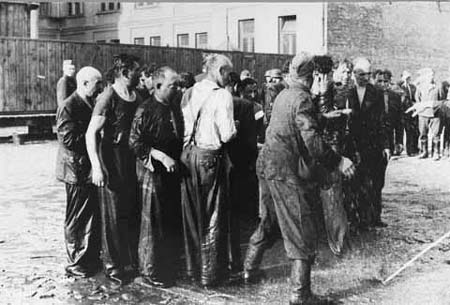
The Kaunas Jewish Community is planning to hold an event to commemorate the Lietūkis Garage mass murder at the monument commemorating these victims located at Miško street No. 1 in Kaunas at 4:30 P.M. on Friday, June 26, 2015. The ambassador and staff of the embassy of Israel to Lithuania plan to attend the event. You are invited to come as well.
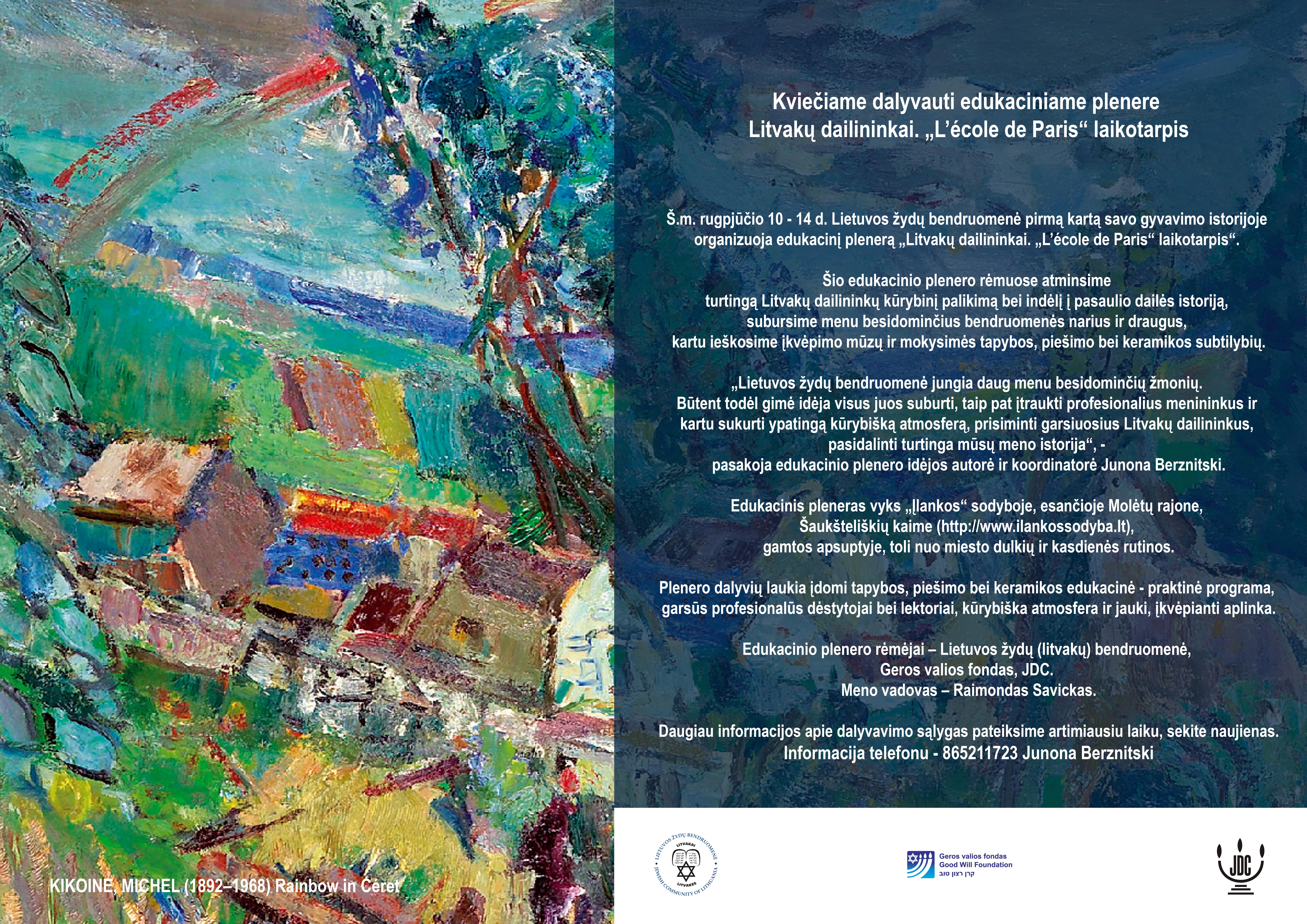
Litvak Artists: the L’école de Paris period
For the first time in its institutional existence the Lithuanian Jewish Community is planning to hold an educational “en plein air” outdoor painting workshop called “Litvak Artists: the L’école de Paris period.” The workshop will serve as a forum for remembering the rich legacy of Litvak painters and their contributions to art history. It is to include members and friends of the community with an interest in art. Besides painting, the workshop will also feature drawing and ceramics.
“The Lithuanian Jewish Community includes many people with an interest in art. That gave rise to the idea of bringing all of them together and to bring in professional artists as well, to create a special creative atmosphere, to remember famous Litvak painters and to share our rich artistic history,” Junona Berznitski, the initiator and coordinator of the educational workshop, said.
The “en plein air” workshop is to take place at the Ilanka farm (http://www.ilankossodyba.lt) in Šaukšteliškiai village in the Luokesa rural district in the Molėtai region of Lithuania, surrounded by nature and far from the dust and daily routine of the city.
Institute for Contemporary Affairs
Founded jointly with the Wechsler Family Foundation/ Vol. 15, No. 18 June 18, 2015

In light of the current wave of unrelenting attacks against Israel’s legitimacy, we the undersigned organizations have joined together to hold a rally in support of Israel.
To all who hold dear the value of human rights and democracy we call you to join us on June 29th between the hours of 12:00 to 15:00 in Geneva at Place des Nations.
Israel is the stronghold of democracy in a region where this basic value is threatened on all fronts. Today hegemony and radicalism threaten to thwart the fervent desire of all the people of the region for a better life, a thriving economy and stable and democratic governance.
At this critical time Israel’s legitimacy is being threatened on many fronts, the right to defend itself is being challenged and false allegations are being leveled in order to divert attention from true abuse of innocent civilian populations.
It is urgent for all to rally together in solidarity and show the world that we will not let agents of terror cynically abuse organizations such as the UN as a platform to wage political war against Israel and manipulate public opinion.
Your presence is urgently needed. Join us and make your voices heard.
Partner Organizations :

The 12 years of Nazism (1933-1945) inculcated young Germans with anti-Jewish ideas that continued after the defeat of Hitler, according to a new study on anti-Semitism.
The study, which American and Swiss researchers released Monday, found that Germans who grew up during the 1930s were far more likely than their younger countrymen to have negative attitudes about Jews. It reported that anti-Semitic views were particularly strong among Germans raised in regions of the country that were known for anti-Semitism even before Hitler came to power.
According to the researchers, who analyzed surveys conducted in 1996 and 2006, the findings indicated that Nazi propaganda was highly effective, especially when it confirmed existing beliefs.

The U.S. Supreme Court Rules on the Jerusalem Passport Case: Congress Does Not Have the Authority to Order the State Department to List Jerusalem, Israel, as the Passport Holder’s Place of Birth.
This Monday the U.S. Supreme Court decided on Zivitofsky v. Kerry, a case which determined that a U.S. citizen born in Jerusalem can only have the city listed on his U.S. passport as his place of birth, and not Jerusalem, Israel.
In 2002, Menachem Zivitofsky was born in Jerusalem; his American mother requested of the U.S. Embassy in Tel Aviv to list his place of birth as Jerusalem, Israel, in accordance with Section 214(d) of the Foreign Relations Authorization Act of 2003 which states for “purposes of the registration of birth, certification of nationality, or issuance of a passport of a United States citizen born in the city of Jerusalem, the Secretary shall, upon the request of the citizen or the citizen’s legal guardian, record the place of birth as Israel.”

It’s appalling to see how Israel is treated by a totally different standard than other countries in the international system. Of course, Israel deserves scrutiny, as does every other nation. But it also merits equal treatment — nothing more, nothing less.
First, Israel is the only UN member state whose very right to exist is under constant challenge.
Notwithstanding the fact that Israel embodies an age-old connection with the Jewish people as repeatedly cited in the most widely read book in the world, the Bible, that it was created based on the 1947 recommendation of the UN, and that it has been a member of the world body since 1949, there’s a relentless chorus of nations, institutions, and individuals denying Israel’s very political legitimacy.
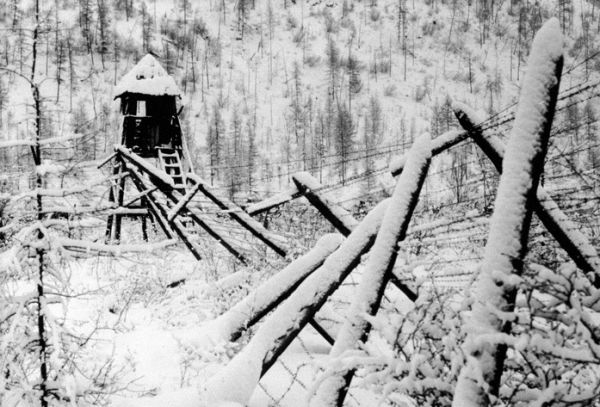
The first mass deportation of Lithuanian citizens to remote locations in the Soviet Union began on the night of June 14 in 1941.
The story of Lithuanian Jews deported has not been told. This untold story is the title of Dr. Violeta Davoliūtė’s lecture on Jewish exiles. The Soviet deportations in Lithuania in 1941 affected people of all ethnicities, including Lithuanian citizens of Jewish origin. Merchants, servants, industrialists and other Jews branded enemies of the Soviet regime were deported with their families to remote regions of the Soviet Union and imprisoned in gualgs and prisons. This aspect of the history of the deportation has not been widely studied and remains little known to the Lithuanian public. How did Lithuanian Jews survive deportation? How did the different ethnic groups get along in exile? How did deported Lithuanian Jews feel when they returned to their country, Lithuania, and were unable to find families and communities destroyed by the Holocaust?
www.lzb.lt
Abramas Leščius. the son of Chaimas, always stresses he’s from Raseiniai, Lithuania.
“I am a resident of Raseiniai. My mother travelled to doctor Levitanas in Kaunas to give birth to me. All Jewish women went to him to give birth. That’s what mother said. The roots of our family were in Seda and Mažeikiai. My great-grandparents, grandfathers and grandmothers lived there since ancient times, one may count it in centuries. I lived in Raseiniai with my parents until June 14, 1941. That day the Soviet Russians deported us. Why did they deport us? My father operated as a so-called middleman, he used to visit farmers and buy up linen and all sorts of grain. Then he brought it by car to a rich fellow in Klaipėda who bought everything from him. Father fed the whole family.
There were three of us children: my two sisters and I. Mother didn’t work. We were not rich, we lived moderately. I remember where we lived there was a synagogue in the yard to which my father and I went. Father was a good Jew, meaning, in his heart he was a Jew, and always helped with money if anyone asked, he prayed at synagogue and kept the Sabbath. Mother’s father was a rabbi in Seda, so she was more religious. I remember when we used to go to synagogue father and I would stop at an inn and when father took a drink mother would get very angry. Dad said there was a person in Raseiniai who used to say the Jews are bad, and perhaps he turned us in and that’s why we were deported. Many Jews lived in Raseiniai before the war.

Three archivists and three librarians have been conserving the documents at YIVO in New York, while a third of the archive remains in Vilnius, Lithuania.
After the project is completed within seven years, the documents scattered during the Holocaust will constitute a new virtual library with descriptions in English and Lithuanian.
Executive director of the YIVO Jonathan Brent told Baltic News Service: “We plan to process about a million and a half documents and about ten thousand books and to add this material to what we have in Vilnius.”
“Work has begun here and in Vilnius with books and manuscripts. This is a seven-year project. The people working on it have to know Polish, Russian, Yiddish and Lithuanian languages,” Brent said.

Dear Friends,
You are kindly invited to meet the Ambassador of the State of Israel Mr. Amir Maimon.
The meeting will take place in Vilnius Jewish Public Library, Gedimino pr. 24, Vilnius,
on June 18 at 3:30 PM
The main topic of the meeting is Operation Solomon where Mr. Amir Maimon took immediate participation as the Chief Campaign Coordinator (bernardinai.lt). Operation Solomon (Hebrew: מִבְצָע שלמה, Mivtza Shlomo) was a covert Israeli military operation to airlift Ethiopian Jews to Israel in 1991. Non-stop flights of 35 Israeli aircraft, including Israeli Air Force C-130s and El Al Boeing 747s, transported 14,325 Ethiopian Jews to Israel in 36 hours. (Wikipedia) The Jewish Community was threatened by the arising political and military destabilization in the country. A historical documentary to be screened during the meeting
New York Times about the successful campaign:
Looking forward to see you in the library!
RSVP by e-mail: info@vilnius-jewish-public-library.com ; or phone call: (8-5) 219 77 48
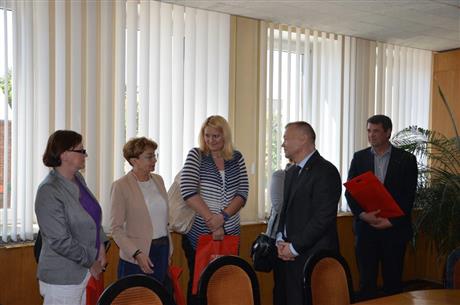
A delegation consisting of Lithuanian Jewish Community chair Faina Kukliansky, deputy minister of the Lithuanian Ministry of Culture Dr. Romas Jarockis, director Diana Varnaitė of the Cultural Heritage Department under the Ministry of Culture and urgita Bieliūnienė, advisor to the Lithuanian parliament’s Education, Science and Culture Committee, visited Alytus (Olita) mayor Vytautas Grigaravičius to discuss the fate of the Alytus synagogue, plans for renovating it and sources for financing that renovation.
Deputy mayor Tautvydas Tamulevičius, mayorial advisor Vilija Ramanauskienė, city council member Robertas Šarknickas, head of the Municipal Works Department Algimantas Tarasevičius and senior specialist from the same department Ramunė Jegelevičienė took part in the meeting.
“We are united by Jewish heritage issues, so once per half year our informal group travels to regions and other cities. There is a Jewish synagogue in Alytus so we came here. Our aspiration is for the revival of Jewish heritage and adaptation to educational, cultural and other activities in cities and towns where the it has been forgotten undeservedly. The Lithuanian and Jewish peoples and cultures are intertwined and have left deep impressions in one another’s culture. The goal of our visit is to engage in consultations and discussions,” deputy minister of the Lithuanian Ministry of Culture Dr. Romas Jarockis said.
The Lithuanian Jewish Community, corporation number 190722117, located at Pylimo No. 4 in Vilnius, Lithuania, calls a conference of the Lithuanian Jewish Community at 12 noon on June 16, 2015.
Planned agenda for the LJC conference:
1. Annual financial report of the LJC for 2014 and report and discussion of LJC activities in 2014;
2. Presentation and discussion of audit report;
3. On additions to LJC regulations.
We warmly welcome all LJC members’ attendance at the conference. A more detailed agenda can be viewed at the LJC headquarters.
For additional information, please call (8 5) 2613 003.
Fainia Kukliansky, LJC chair
Announcement in Lithuanian for >>download
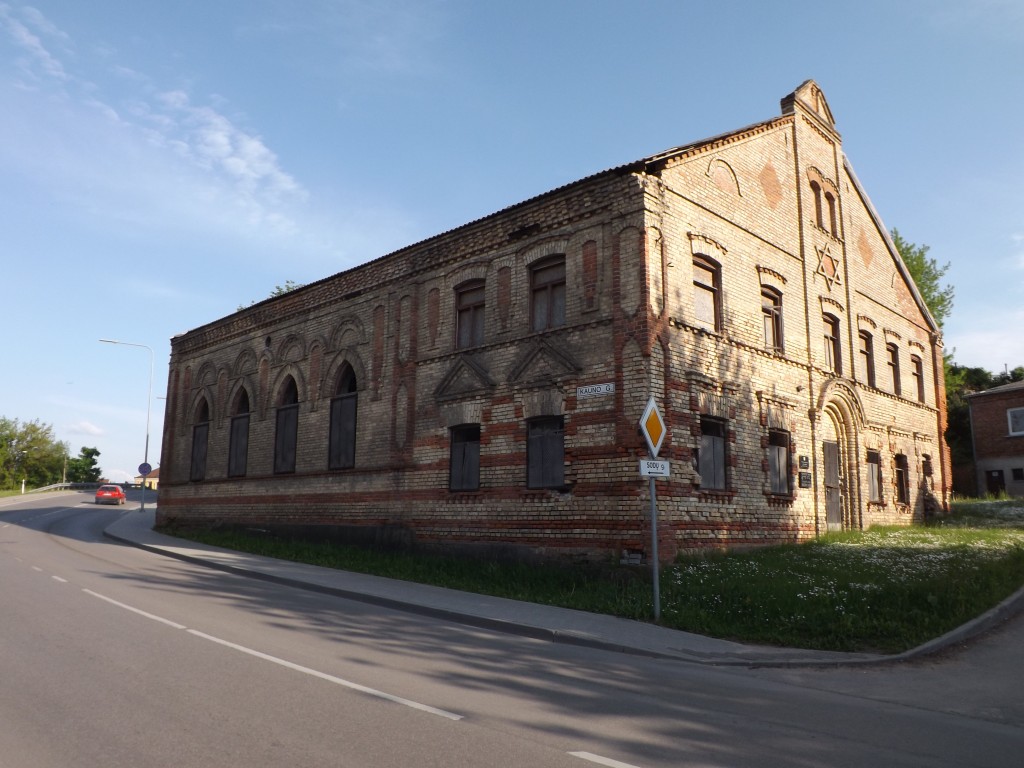
Cultural Heritage Department director Diana Varnaitė, deputy cultural minister Romas Jarockis and Lithuanian Jewish Community chair Faina Kukliansky have travelled to Alytus (Olita) in the south of Lithuania to meet the new municipal administration and discuss the fate of the Alytus synagogue. The delegation included Government representative Lina Saulėnaitė and Jurgita Bieliūnienė, a representative from the parliament’s Education, Science and Culture Committee.
The issue of the synagogue comes up often, but very few actual steps have been taken. City mayor Vytautas Grigaravičius said there was a project for how to develop the public use of the synagogue before, but now this idea needs to be examined more deeply. Museum exhibits might be housed at the rabbi’s house next to the synagogue.
Deputy minister of the Ministry of Culture Romas Jarockis said several funding sources could be used to finance the renovation of the synagogue. If there was approval from the Committee of the Regions, in the 2014-2015 funding period about 85 percent of funding for the synagogue could come from the EU, and 15 percent from the municipality. The deputy minister said the renovation of the cultural heritage site would have to be useful to the local community, so the renovation wouldn’t culminate in empty buildings but that they would become instead lively public venues. Cultural Heritage Department director said renewal of the Alytus synagogue is not only a great responsibility, but would provide as well a new opportunity to join the European Route of Jewish Heritage. Lithuanian Jewish Community chair Faina Kukliansky said the time has come for there to be a site in Alytus not just for the mass murder of Jews, but also a place for Jewish life.
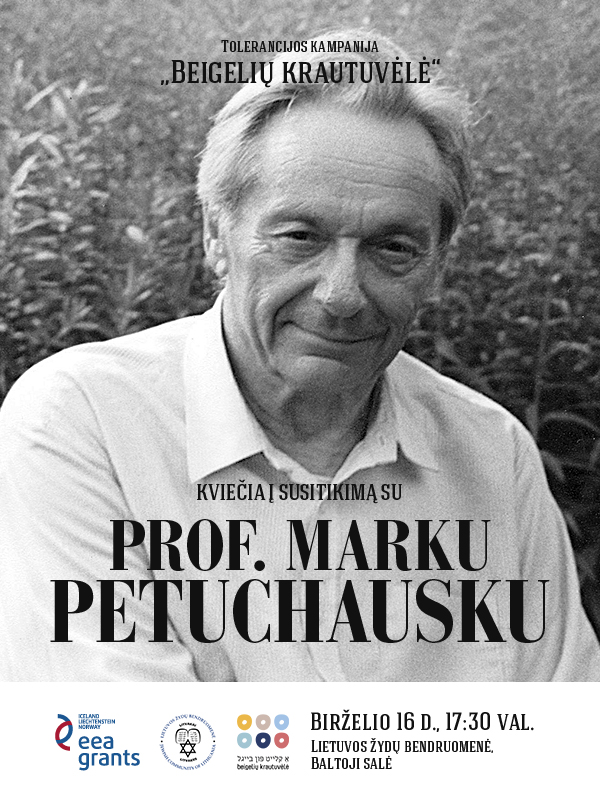
The Bagel Shop tolerance campaign invites you to meet professor Markas Petuchauskas, a theatrical specialist, doctor of art history and the author of a number of books about the art of theater.
The meeting is to take place at 5:30 P.M. on June 16 at the Lithuanian Jewish Community at Pylimo No. 4 in Vilnius.
The professor plans to share his memories of the Vilna ghetto theater, its offerings and actors and the interaction of Lithuanian and Jewish culture. His new book Price of Concord/Portraits of Artists/Interactions of Cultures is to presented at the meeting.
Those who want to attend may register by sending an email to agne.zilinskaite@lzb.lt or by calling+370 613 81889 before 5:00 P.M. on June 15.
Today Pastor Michael Maass, director of the Lithuanian branch of the International Christian Embassy Jerusalem (ICEJ) became the first Christian leader to speak out in writing on plans for a congress and entertainment complex on the site of the oldest Jewish cemetery in Vinius
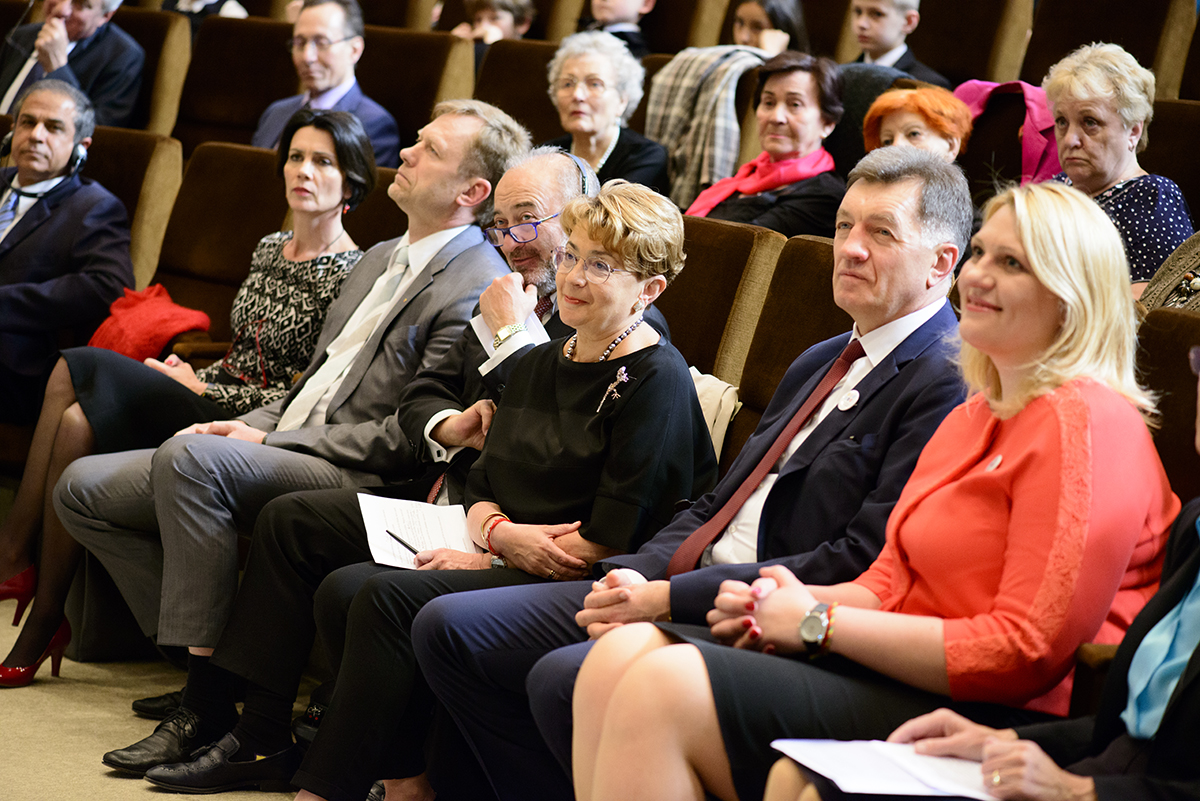
Vilnius, June 5 BNS — On Friday the Government House in Vilnius hosted an awards ceremony by the Lithuanian Jewish Community for fostering tolerance in Lithuania. The awards are presented to six people or organizations.
Historian Lara Lempertienė was recognized for her work in passing on the Jewish cultural legacy to future generations and Žana Skudovičienė, long-time coordinator of LJC Social Center programs, received the award for her lifelong devotion to her work.
Museum specialist Monika Žąsytienė received the distinction for her work in preserving historical memory and the heritage of ethnic minorities, and the Jewish song-and-dance ensemble Fayerlakh were awarded for their enduring promotion of Yiddish culture in Lithuania and abroad.