WJC News

WJC News

And more

Tisha b’Av

Tisha b’Av

The Tisha b’Av fast this year falls on Saturday, July 25, beginning at 9:17 P.M. local time in Lithuania and ending at 10:26 P.M. on July 26.

Services will be held at the Vilnius Choral Synagogue at 9:00 A.M. and at 7:30 P.M. on July 26.

Tisha b’Av, literally “the ninth day of the month of Av,” commemorates the destruction of the First Temple of Solomon ca. 587 BCE and the Second Temple in 70 CE in Jerusalem and is traditionally a day of fasting and mourning. Observance includes five prohibitions, the main one being a 25-hour fast. The Book of Lamentations is read in the synagogue followed by the recitation of kinnos, liturgical dirges for the Temple and Jerusalem. Since the day has become associated with other major Jewish tragedies, some kinnos recall other events, including the murder of the Ten Martyrs in ancient Rome, pogroms against medieval Jewish communities and the Holocaust.

According to tradition, the sin of the Ten Spies is the real origin of Tisha B’Av. In the Book of Numbers, 13:1-33 when the Israelites accepted their false report of the Promised Land, they wept, thinking God could no help them. The night the people wept and wailed was the ninth day of Av, which then became a day of weeping and misfortune for all time, according to tradition, following which the Jews were made to wander the desert for 40 years.

World Lithuanian Economic Forum to Meet in Israel

The Lithuanian news website bernardinai.lt reports Lithuanians living around the world and other people with connections to Lithuania will meet for the seventh annual World Lithuanian Economic Forum this October, and that this year it’s being held in Tel Aviv. Lithuanian president Dalia Grybauskaitė is scheduled to make an official visit to Israel during the event planned for October 20 and 21.

Full article in Lithuanian


Work to Restore Zavel Synagogue in Vilnius Begins

Work to Restore Zavel Synagogue in Vilnius Begins

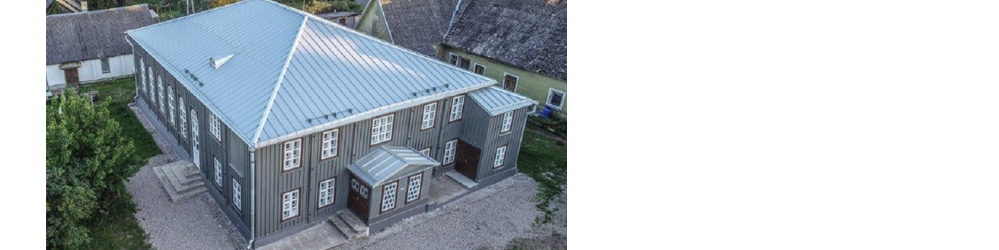
The newspaper and news website Lietuvos žinios [News of Lithuania] reports work to restore the historic Zavel Synagogue on what is now called Gėlių street (former Sadova/Sadowa street, now a continuation of Sodų street) near the Vilnius train station has begun. The restoration plan includes repairs to the entry stairs, floors, windows, doors, roof and cupola as well as a façade-lift, according to the newspaper. The synagogue, traditionally known as Zavl shul, was once a venue for the preaching of Rabbi Nathan Mileikowsky, the grandfather of current Israeli prime minister Binyamin Netanyahu. The synagogue kept extraordinary hours to cater to travelling Jewish merchants who passed through the Vilnius
station regularly.

>>Complete article in Lithuanian

LJC news

1. Alan Levin Resigns as Executive Director of Lithuanian Jewish Community

Alan Levin has asked to be relieved of his duties as executive director of the Lithuanian Jewish Community before the expiration of the three-month trial period which was agreed during the hiring process. The Community regrets his decision and the loss of an energetic professional who got off
to such a good start, and wishes him the best in all his future endeavors.

2. Lithuanian Jewish Community Chair Meets with Minyan at Breakfast to Discuss Religious Issues

Lithuanian Jewish Community chair Faina Kukliansky and Lithuanian Religious Jewish Community chair Simon Levin as well as members of the religious community met for breakfast and a warm and frank discussion of issues.

3. Lithuanian Jewish Community Chair Meets with Chief Rabbi Chaim Burstein to Discuss Changes in Work Agreement

Lithuanian Jewish Community chair Faina Kukliansky met with Chief Lithuanian Rabbi Chaim Burstein today to talk about changing the current employment arrangement to make the post of Chief Rabbi a permanent position. “Lithuania needs a full-time rabbi,” she said.

75th Yórtsayt of the famous Vilner Rov:  Rabbi Chaim-Ozer Grodzenski (1863-1940)

75th Yórtsayt of the famous Vilner Rov:  Rabbi Chaim-Ozer Grodzenski (1863-1940)

This week, the entire Ashkenazic Orthodox world, spread over many parts of the world, marked the 75th yórtsayt (anniversary of the death) of the beloved pre-Holocaust “last rabbi of Vilna,” Rabbi Chaim Ozer Grodzenski, forever known in Litvak Yiddish as Reb Chaim-Eyzer. To this day, Jewish visitors from around the world come to look at the legendary balcony on the corner of Zaválne (today’s Pylimo St.) and Greys-Pohulánke (Basanavičiaus).

One of the many tributes came in >>Hamodia
Lithuanian Maccabi Athletics Club Travel to 14th European Maccabi Games in Berlin

Lithuanian Maccabi Athletics Club Travel to 14th European Maccabi Games in Berlin

The Lithuanian team who have participated in six European Macabbi games since 1995 is constituted of 26 athletes and coaches in five different sports. They include a mini soccer team who became the European champions twice, in the Netherlands in 1995 and in Austria in 2011 and made it to second place three times. Gercas Žakas is the team trainer, Matvejus Frišmanas is the coach and Artūras Sobolis is the team captain. During the training period the soccer team had a number of practice matches in Vilnius with opponents coming from Kaunas and Šiauliai.

Maccabi Games veteran games champion and swimmer Ela Pavinskienė continues to lead the strong swim team. The team includes winner of multiple European championships Andrej Fadeev and the promising Artiom Perepelica and Jekaterina Gamper.

The Lithuanian team also includes badminton player Alanas Plavinas who took second place at the World Maccabiah Games, the powerful table-tennis player Vanessa Ražinskytė and outdoor tennis veterans Ilja Bereznickas and Valentina Finkelšteinienė.

The head of delegation is Kostas Pavinskas, the youth team director is Sofija Pavinskaitė, Arkadij Goldin is the team doctor and Daumantas Todesas is deputy coach of the soccer team.

Delegations from thirty-eight countries in nineteen fields of sport are to take part at the European Maccabi Games in Berlin this year for a total of 2,300 athletes participating. The games are to include a large cultural program, a ceremony for victims of the Holocaust and a Sabbath dinner and a series of excursions and tours for the athletes.

Semionas Finkelšteinas

Head of delegation, Lithuanian Maccabi Athletics Club

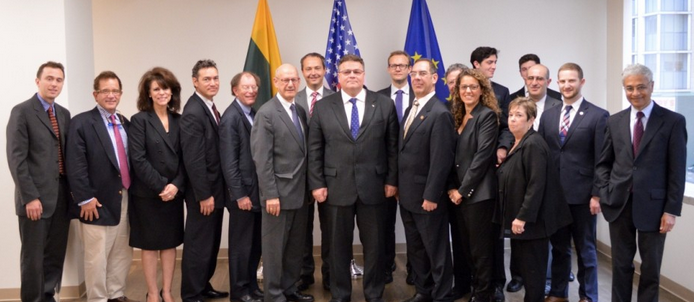
Photo : Maccabi delegation at the Lithuanian Jewish Community.

Special Message from MK Hilik Bar, Chair of the European Forum of the Knesset

Special Message from MK Hilik Bar, Chair of the European Forum of the Knesset

This week the P5+1 and Iran agreed to terms on the Iran Deal, which represents a direct threat to Israel’s national security, and we believe is also detrimental to Europe, bearing in mind EU was also one of the key negotiating partners.

The bottom line of this very bad deal is exactly what Iran’s President Rouhani said immediately following signing of the agreement: “The international community is removing the sanctions and Iran is keeping its nuclear program.”

Meantime, Iran will be rewarded with hundreds of billions of dollars, while its proxies, including Hamas and Hezbollah, which continue to be active throughout Europe, will also present a direct threat to the EU and the national security of European citizens. A number of European nations and companies have already expressed willingness to increase trade with Iran.

Despite the best intentions of those negotiating this deal, unfortunately the world and our region today has become a much more dangerous place, with the world’s leading state sponsor of terrorism, one step closer to nuclear weapons.

Accordingly, this underscores the need for Jewish communities around the world to unite and consolidate, including in support of the State of Israel, at this critical time of need. This is of course at the very core of The Israeli-Jewish Congress (IJC) mission.

Jews Refuse Estonia

A Jerusalem-based research center announced recently the world Jewish community is about the same size now it was before the Holocaust. Estonia, however, only has about half the number of Jews it did in 1939. There are about 2,000 Jews living there currently. Before the war the number was 4,500. The director of Estonia’s Jewish museum says he has no explanation, that Estonia is a good place to live and there is no sense of open hostility there.

According to the announcement there are currently 14.2 million Jews in the world. That number jumps to 16.5 million if you include people with just one Jewish parent. Most live in Israel and America, 6.1 and 5.7 million respectively. In the 1930s the Soviet Union was home to more than 4 million Jews, but not just 300,000 live in the same territory. In 1941 before Germany invaded Estonia the Jewish population had dropped because a majority sought refuge in the Soviet Union. The thousand or so who decided to stay on and brave it out were all murdered by Nazi forces. By December, 1941, there was not a single Jew left in Estonia, and the Nazis proudly hailed the conquered territory as the first judenrein–“Jew-free”–area in the Reich.

LJC Congratulates Jakovas Braveris on His Final Exam

LJC Congratulates Jakovas Braveris on His Final Exam

LJC Congratulates Jakovas Braveris on His Final Exam! Well done!

Thursday the high school students with the best final exam results assembled at the Old Town Hall in Vilnius where Vilnius mayor Remigijus Šimašius congratulated them.

Among the best were Jakovas Braveris of the Sholem Aleichem Jewish Gymnasium in Vilnius.

Jakovas’s father is Igor, a doctor in physics and mathematics who has taught at Sholem Aleichem for 20 years. He said both his sons had inherited their father’s gene for science and he had been aware of that since their early childhoods.

Local Jewish Historian a Walking Encyclopedia

by Simona Simonavičė, simona@skrastas.lt  I skrastas.lt

One of the most remarkable members of the Šiauliai (Shavl) Jewish community in recent decades, Leiba Lipšic (1925-2002) would have celebrated his 90th birthday today [July 14, 2015]. The Jewish community and the local Aušra Museum held an event to celebrate the date. Those who knew Lipšic personally called him a walking encyclopedia to whose end it was impossible to read.

A Walking Encyclopedia

“Looking back on the past, I and the people who worked with Lipšic are sorry we didn’t use him to his full potential. He knew so much that it was impossible for us to comprehend it all, and we lost part of that legacy along with losing him,” Girsh Rafael, a resident of Šiauliai, Lithuania and a friend of Leiba Lipšic said.

Lithuania: City Halts Excavation at Mass Grave Site

Following concerns raised by the Jewish community and an appeal by Lithuania’s Chief Rabbi, authorities in the northern town of Šiauliai are halting excavation of human remains at a Holocaust-era mass grave site that was discovered last week during road construction.

“The municipality of the city of Šiauliai affirms … no digging work will take place until the appropriate respect is guaranteed for the human remains of the people murdered and buried in the mass grave,”  Martynas Šiurkus, the deputy director of the municipal administration of the city, told a press conference Wednesday.

The Baltic News Service reported that Šiurkus said the decision was made to show respect for “the customs and traditions of all ethnic groups.”

 Lithuanian Jewish Community chair Faina Kukliansky welcomed the decision.

“In consideration of a request by the Jewish community, the government of the city of Šiauliai, Lithuania has shelved plans to move human remains discovered during road construction,” she said in a statement issued Thursday on the Lithuanian Jewish Community web site.  “The Šiauliai municipality has given assurances no earth moving work will be performed until due respect is guaranteed for the mortal remains of the people murdered and buried in the mass grave.”

Read more

A statement by Faina Kukliansky, chairperson of the Lithuanian Jewish Community, on the halting of work at a grave site uncovered during construction

A statement by Faina Kukliansky, chairperson of the Lithuanian Jewish Community, on the halting of work at a grave site uncovered during construction

In consideration of a request by the Jewish community, the government of the city of Šiauliai, Lithuania has shelved plans to move human remains discovered during road construction. The Šiauliai municipality has given assurances no earth moving work will be performed until due respect is guaranteed for the mortal remains of the people murdered and buried in the mass grave.

Lithuanian Jewish Community chairperson Faina Kukliansky would like to underline the stop in construction is not somehow the fault of Jews, but rather happened because human remains were found at a location where they should have been expected before construction began.

“I can’t say what sort of historical research was performed before construction work was begun. If it had been performed and a new location was discovered accidentally, that would be possible to understand, to forgive and to correct. Until now eight such sites were known. The issue of the Pročiūnai mass murder site was raised earlier and all of the material associated with that issue is preserved in primary sources at the Lithuanian Central State Archive, meaning it has been collected and is known. Although the location hasn’t been determined definitively, today we have all sorts of technology which we can use to determine where human remains are located without even disturbing the surface of the ground. It doesn’t matter whether those remains are of Jews or non-Jews.

In Response to Jewish Concerns City of Šiauliai Rejects Plans to Move Human Remains Found During Road Construction

In Response to Jewish Concerns City of Šiauliai Rejects Plans to Move Human Remains Found During Road Construction

bg

Vilnius, July 15, BNS–In response to a request made by the Jewish community the administration of the Lithuanian city of Šiauliai has shelved plans to move human remains discovered during road construction.

Deputy director of the municipal administration of the city of Šiauliai Martynas Šiurkus said the decision was made to show respect for “the customs and traditions of all ethnic groups.”

“The municipality of the city of Šiauliai affirms … no digging work will take place until the appropriate respect is guaranteed for the human remains of the people murdered and buried in the mass grave,” Šiurkus told a press conference Wednesday.

The city’s press representative Vitalis Lebedis told BNS the road construction project in Šiauliai will be amended.

Lithuanian Jewish Community chair Faina Kukliansky welcomed the decision.

“Jewish concerns are satisfied because there is a cultural difference and a different requirement for honoring the dead. On the other hand I would still prefer something concrete from the municipality because there is no guarantee that more human remains won’t be found as the work continues,” Kukliansky told BNS.

She said representatives of the Committee for the Preservation of Jewish Cemeteries in Europe and from Lithuania’s Cultural Heritage Department had traveled to Šiauliai Wednesday.

There are documents showing the site in question might have been a mass murder site during World War II where prisoners from the Šiauliai jail were taken and executed.

There are the mortal remains of approximately 40 people in the section of the grave site uncovered during road work. It is likely some of them are Jews. Jewish religious customs forbid moving human remains buried in the ground.

shs

‘Bookkeeper of Auschwitz’ sentenced to 4 years by German court

‘Bookkeeper of Auschwitz’ sentenced to 4 years by German court

IL times

Lüneburg, July 15, AFP/BNS–A German court Wednesday sentenced the bookkeeper of Auschwitz, former SS officer Oskar Gröning, to four years of incarceration. Gröning is considered one of the last possible suspects in Holocaust crimes.

The 94-year-old sat as judge Franz Kompisch read the verdict finding the accused guilty of being an accomplice to the murder of 300,000 people, mainly Hungarian Jews sent to the gas chambers in 1944.

The judge characterized Gröning as cheerfully accepting “safe office work” contributing to the working of “a machine with a single goal,” a system which was “inhumane and almost incomprehensible to the mind of man.”

Interview with the cantor of the Vilnius Choral Synagogue

Interview with the cantor of the Vilnius Choral Synagogue

The Synagogue‘s Cantor Shmuel: What Jews Need in the Diaspora, Is Unity

Even though Shmuel Yatom, the cantor of the Vilnius Choral Synagogue and a Hebrew teacher, wasn‘t born in Vilnius, he has a special connection with this town. Shmuel says that he comes from a family with a long-lasting cantorial tradition, which was transferred from generation to generation.

A European Look at Jewish Heritage

A European Look at Jewish Heritage

A meeting of the Kėdainiai regional council at the beginning of July resolved to establish a Jewish Cultural Heritage Association.

It is to include residents of Ukmergė and Joniškis as well as Kėdainiai.

The Kėdainiai regional leaders have already adopted the plan and are now waiting to see how the two partners resolve to act. the city councils of Ukmergė and Joniškis are supposed to meet in August and their decision is expected at that time.

Once the resolutions are known, work to establish the association is to begin.