The Ghetto on Subačiaus Street

Vidmantė Jasukaitytė, an award-winning Lithuanian poet, prose and theatrical writer, as well as a signatory to the Lithuanian Act of the Restoration of Lithuanian Independence in 1990 when she was a member of the first free Lithuanian parliament, was the initiator of a multimedia artistic performance at the site of the Holocaust-era HKP slave labor camp on Subačiaus street in Vilnius. The performance took place on the evening of September 24, 2015, and was called simply “Subačiaus street. Ghetto,” also the name of one of Jasukaitytė’s collections of poetry published in 2003 which earned her the Lithuanian Television Literary Prize loosely based on her own experiences and impressions living in the former Nazi camp, two brick apartment blocks which still serve as housing for an entire Vilnius neighborhood just outside the Old Town.

The construction of the buildings as cheap housing for Jews was funded in 1900 by Baron Maurice de Hirsch (aka Moritz Hirsch, freeman from Gereuth), who established in 1891 the Jewish Colonization Association to help Russian and Eastern European Jews emigrate to Argentina:

“Large tracts of land were purchased in Buenos Ayres, Sante Fé, and Entre-Rios. The Russian government, which had rejected the baron’s offer for the amelioration of the condition of the Jews in the empire, cooperated with him in the organization of a system of emigration. A central committee, selected by the baron, was formed in St. Petersburg, at the head of which were Barons Horace and David Günzburg, together with S. Poliakoff, M. Sack, Passower, and Raffalovich, the latter three being distinguished members of the St. Petersburg bar. The baron also formed a governing body in Argentina; and the personal direction of the colonies was entrusted to Col. Albert Goldsmid, who obtained temporary leave of absence from the English War Office for the purpose.”

from http://www.jewishencyclopedia.com/articles/7739-hirsch-baron-maurice-de-moritz-hirsch-freiherr-auf-gereuth

One of the baron’s main concerns was overcrowding among Jews, whether in their new colonies in South America or Palestine, or in their European home lands, and his philanthropical activities included supporting Jewish communities where the lived in the Diaspora, with special emphasis on providing Russian Jews with trades and an industrious attitude. In 1898 the Jewish Colonization Association allocated funds for “the construction of cheap housing for the impoverished Jews of the city of Vilna.” A Healthy Homes Association was established in Vilnius and had the two buildings with 216 apartments built in the year 1900. The architect was Eduard Goldberg. Poor Jews, students, and young Halutzim who were planning to go to Palestine to practice agriculture there. The land around the “cheap housing” was turned into gardens.

Later the Healthy Homes Association transferred the buildings to the Vilnius Jewish Community. In 1940 the Soviet government nationalized the buildings and the plot of land there.

In the fall of 1941 the residents of the buildings were murdered at Ponar along with many other Vilnius Jews during the initial extermination operations. The Germans used these emptied buildings to house the wives and children of Soviet officers, so creating a “Russian ghetto.” Later some of these women were shot at Ponar and the children placed in orphanages. Some of the women were sent to forced labor camps in Germany. Thus by 1943 the buildings had been emptied of people a second time.

As August turned to September in 1943, just before the liquidation of the Vilnius ghetto, several Jewish labor camps were established in Vilnius. One of them was at the two buildings on Subačiaus street, whose address at that time was No. 37, but is now Nos. 47 and 49. Several hundred qualified workers with their families were taken from the ghetto and housed here. The majority were mechanics, metal workers, glass workers and so on, i.e., those who had worked before the establishment of the new camp at the German military equipment repair workshops called HKP (an abbreviation of the German “Heereskraftfahrpark Ost 562”) while living in the ghetto.

These auto repair workshops where ghetto prisoners worked were scattered all over the city, at the barracks and garages in the Verkių street neighborhood (some of the workers, mainly single men, lived there, and were taken back to the camp on Subačiaus street by truck on their days off), and at the bus park garage at Savanorių street No. 2 where, as at the barracks, automobile engines were outfitted and hardened for military duty. The main headquarters and workshop for HKP Ost 562 was the technical school building at Olandų street No. 12 (now No. 16) and across the street from it.

Workshops were also housed on the first floors of both buildings on Subačiaus street and in surrounding buildings, including the one-floor building to the left of Block I (there’s a sauna there now). Vehicles brought to the camp were also repaired or disassembled into parts at the repair pit to the left of Block II (in the 1960s a five-storey building was erected there). The perimeter of the camp was surrounded by barbed wire and guarded. SS officer Richter was in charge of this camp as well as the Kailis labor camp in Vilnius. Entry to the camp was from Subačiaus street between the two apartment blocks. After the war this entrance was blocked by a new four-storey building. Entering from Subačiaus street, Block I was on the left and Block II on the right. There was also a sauna in Block II.

There is information indicating Wehrmacht officer Karl Plagge came up with the idea of creating a separate Jewish camp for the HKP. He was in charge of the camp and was responsible for the automobile repair workshops in general. Was he trying to save “his” Jews from certain death as preparations were being made to liquidate the Vilnius ghetto? Was it because he was responsible for automobile repairs, and more qualified workers were needed? Whatever the case, many of those who survived say major Plagge saved them.

In September of 1943 workers were sought directly on the streets of the ghetto. Plagge compiled the first lists of those to be moved to the new camp in August. During August’s deportations of ghetto inmates to Estonia, however, many mechanics experts were lost. So additional lists of those to be sent to the HKP camp were drawn up, and many people, not just specialists, tried to get on those lists. People listed their fathers, relatives and spouses and others offered bribes to the people making the lists. It was a hope to survive and everyone sought that at any cost.

These lists have not come down to us (or at least haven’t been found yet but exist in some archives somewhere). We don’t know the exact number of camp inmates when it began. Documents published earlier show the number of camp inmates a the beginning November, 1943. According to those documents, the total number of inmates on November 6, 1943, was 1,218 people. This number grew somewhat to stand at 1,257 on March 26, 1944. It seems this was due to some people legalizing themselves after entering the camp without being specialists, or as family members of non-specialists. Others sought shelter and work there and Vilnius ghetto prisoners who survived the liquidation by hiding in malinas there found a way to get into the two apartment blocks on Subačiaus street. Some of these found haven outside the camps and there were escapes. Perhaps some remained as “illegals” there as much as conditions at the HKP camp allowed for that; there were constant roll calls and scrupulous counts of workers.

There were many women and children at the camp besides men. Initially only a few women worked in the vehicle repair shops. One supposed Plagge knew that the train carrying Vilnius ghetto prisoners supposedly to Kaunas, where “there was a lack of labor,” at the beginning of April, 1943, actually stopped at Ponar where all 4,000 or so prisoners were shot. Perhaps this explains Plagge’s strenuous justifications that the presence of women and children in the camp ensured high-quality work by the men, and that sending unemployed women to Kaunas was not a good idea. Plagge initiated workplaces for almost all women at the camp in the winter of 1944, sewing and repairing military uniforms to order for the E. Reitz Uniformwerke and Meier Herbert companies. The sewing sections located on the top floor of Block I and in a specially constructed barracks to the left of the entrance to the camp were outfitted by the local construction team and the Reitz and Meier companies later supplied sewing and weaving machines.

On March 27, 1944, “Children’s Operations” were carried out at both HKP and the Kailis camp. Only a few children found suitable hiding places and became illegals whom no one should ever see in public again. These mass murder operations also targeted non-working and mainly elderly women. All of them were shot at Ponar. The camp population lost 246 women and children (1,257 people on March 25 dropped to 1,011 on April 13). There were work disruptions, and some people made use of the fact that no one was sure of the exact number of prisoners at that point to make their escape.

In mid-May the number of prisoners dropped again, this time because of the loss of 67 people, mostly men. Some accounts say some of them were sent to mine peat in Kazlų Rūda and others were sent to exhume and burn corpses at Ponar.

The camp existed until the summer of 1944.

As the front drew closer on July 1, 1944, Plegge warned the workers the camp was to be evacuated and would come under the jurisdiction of the SS. Other accounts have it that Josef “Sep” Gramer mentioned the coming liquidation to several of the workers under him. Understanding the true meaning of “liquidation” in the Nazi lexicon, some prisoners escaped with their families that very day as soon as it was slightly dark. Others went to their malinas, hiding places whose existence they kept even from fellow slave laborers.

During the last roll-call on July 2, many were missing. The next day everyone was brought to trucks which were to carry them away. These people were shot at Ponar along with the surviving Jews from other slave labor camps in the city. Those found hiding were shot the same day right beside the two residential blocks. Some managed to flee.

The Germans quit the camp on July 4, 1944.

Some of the malinas in the eaves, basements and behind brick walls went undiscovered and nearly 100 Jews half-dying of thirst lived to see liberation. The Soviet Red Army was already on the outskirts of Vilnius and on July 7 broke through the German defensive lines. By July 9 Nazi forces were surrounded and on July 13 soldiers of the 3rd Byelorussian Front entered the city proper.

for more information on the history of the HKP camp, see:

http://www.jmuseum.lt/index.aspx?TopicID=405

Shot: A Decade of Yahad-In Unum Holcaust Studies

Picture for flyer

Exhibit opening ceremony 5:00 P.M., Thursday, October 1, at the Tolerance Center of the Vilna Gaon State Jewish Museum (Naugarduko street No. 10/2, Vilnius)

The Tolerance Center will host a mobile exhibition from the French-based Yahad-In Unum organization called “Shot: A Decade of Yahad-In Unum Studies” from October 1 to November 22, 2015. The exhibit presents material from comprehensive historical research based on testimony by eye-witnesses, photographs and maps to reveal the lesser-known side of the Holocaust in the East, “The Holocaust by Shooting.” This refers to the systematic extermination of Jews and Roma in the Soviet Union starting with the establishment of ghettos and camps and culminating in the end of the war.

Yahad-In Unum, Hebrew and Latin for “together,” is a humanitarian organization founded by French Catholic priest Patrick Desbois in 2004 whose goal is to identify, document and systematize information about sites in Eastern Europe where the Nazi einsatzgruppen carried out the mass murder of Jews during World War II.

The ten-year study by the organization uncovered the Nazis’ main plan for extermination. Over 79 field studies researchers discovered 1,700 mass murder sites and collected testimony from over 4,000 non-Jewish locals in Belarus, Ukraine, Russia, Moldova, Romania, Makedonia and Poland. In 2013 the organization began studies in Lithuania. Over 2 years Yahad-In Unum recorded testimony from 243 witnesses who identified 131 mass murder sites.

Unlike at the concentration camps, many victims of the “Shooting Holocaust” survived to tell the world what happened. It is believed that five years from now very few of those who witnessed but didn’t personally experience the crimes committed will be left among the living. Researchers at the organization say they want to investigate the evidence for every mass shooting in order to present undisputable proof to Holocaust deniers, to commemorate the victims and to protect the mass grave sites, and also to prevent genocide and mass violence in the future.

Marco Gonzalez, the director of Yahad-In Unum in Paris, said: “The Nazis used a special method of killing Jews in Eastern Europe, leaving their corpses in mass graves dug deep in the forest. Each murderer saw his victim, and each victim saw his murderer.” The exhibit presents a five-tier plan used for almost all the mass murder operations in Eastern Europe: collecting the victims, marching them to their deaths, disrobing, mass shooting and then expropriations of property following the murders.

Father Desbois said the massacres which the Nazis and their collaborators carried out village by village in Eastern Europe have become the archetypal model for mass murder in the present time in countries such as Cambodia, Rwanda, the Balkan states and Syria. “As a wave of anti-Semitism and hate rises, Yahad-In Unum’s work is more important than ever before. … This exhibit was first shown at UNESCO headquarters in Paris in January of 2015, and this will be its second showing in Europe, in Lithuania, where more than ninety percent of Jews were murdered during the Holocaust,’ Father Desbois said.

The Vilna Gaon State Jewish Museum and the International Commission for the Assessment of the Crimes of the Nazi and Soviet Occupational Regimes in Lithuania together with the exhibit organizers will hold a seminar for teachers the same day the new exhibit is unveiled to the public.

Entry is free of charge.

Those wanting to attend the seminar are asked to register by September 28 by sending an email to: rasa.ziburyte@leu.lt

For more information, please see:
www.jmuseum.lt
http://www.yahadinunum.org/

Press contacts:
Julijanas Galisanskis, Yahad-In Unum representative
telephone: +32 25137713
email: j.galisanskis@yahadinunum.org

Ieva Šadzevičienė, director of Tolerance Center, Vilna Gaon State Jewish Museum
telephone: (8 5) 262 9666
email: ieva.sadzeviciene@jmuseum.lt

Israeli Scholar and Relative to Attend Gandhi-Kallenbach Event in Vilnius

The Jerusalem Post reports Israeli researcher Shimon Lev is planning to attend a ceremony to unveil a two-person statue of Mahatma Gandhi and Hermann Kallenbach.

According to Jpost, Lev is completing his doctorate at the Hebrew University of Jerusalem on perceptions of India in the Jewish world, and is the author of a book about the special relationship between the two men called “Soulmates: The Story of Mahatma Gandhi and Hermann Kallenbach.”

Published in 2012, the book is based on documents and letters contained in the Kallenbach archive in Haifa, then under the possession of his great-niece, Dr. Isa Sarid, who co-authored a 1997 biography of her uncle with Christian Bartolf, Jerusalem Post reports. After Sarid’s death in 2012, they were sold to the Indian government. While Kallenbach never married or had children, Lev tracked down his great-nephew Eli Sarid, who lives in Tel Aviv and will also attend the ceremony, according to Jpost.

full article here:
http://www.jpost.com/Diaspora/Israeli-researcher-to-attend-opening-of-Gandhi-Kallenbach-monument-of-friendship-in-Lithuania-419080

Jewish Community Thankful for Help

Events to mark Lithuanian Holocaust Remembrance Day have ended. All week long civics lessons, social campaigns and other events were held throughout the Kaunas region to remember and honor Holocaust victims.

At the final event Kaunas Jewish Community chairman Gercas Žakas passed on a message from Lithuanian Jewish Community chairwoman Faina Kukliansky, singling out and thanking for their contributions in preserving the Jewish cultural legacy leaders of the Kaunas municipality and regional administration, the aldermen of Babtai, Čekiškė and Garliava districts as well as of Vilkija, Vandžiogala and Zapyškis; the director of the public library; folk artist Arūnas Sniečkus, Jonučiai Gymnasium director Valentinas Padriezas and Urban Planning Department deputy director Rūta Černiauskienė for her active cooperation with the Jewish Community.

Gercas and Kaunas mayor Makūnas agreed that more than money is needed to safeguard history. “Since joint efforts and good will are needed. All of the dead were Lithuanian Jews, which is to say, Lithuanians, who, like you, fought for the country’s independence, studied, worked and lived in common with everyone else,” Gercas said.

Goodwill Fund Director Gets Married

The Lithuanian Jewish Community congratulates Vytautas Višinskis, the
director of the Goodwill Fund, and Lina Saulėnaitė on the occasion of
their wedding. We wish you much love for each other, concord, faithfulness
and happiness!

Congratulations

Congratulations

The Lithuanian Jewish Community congratulates Vytautas Višinskis, the director of the Goodwill Fund,

and Lina Saulėnaitė on the occasion of their wedding.

We wish you much love for each other, concord, faithfulness and happiness!


Rescuers of Jews attest humanity

Rescuers of Jews attest humanity

Tuesday, September 22, Vilnius – On the occasion of the National Memorial Day for the Genocide of Lithuanian Jews, President Dalia Grybauskaitė awarded the Life Saving Cross to those who despite grave danger to their families and themselves saved Jews from the Nazi genocide during World War II.

“We are proud of those brave men and women who overcame egoism, disregarded the instinct of self-preservation and did what seemed to be the impossible. Today we can say that their act was priceless,” the President said.

According to the President, to help people persecuted by the Nazis – such was the noble mission of Lithuanians who rescued Jews during World War II. It was a genuine sign of true friendship between Lithuanians and Jews who had lived in peace and harmony for very many years.

Although many of those decorated today are no longer among us, the President said, their heroism lives on in our hearts and in our minds. It should inspire and give strength to each and every person at all times and in every place to defend freedom, protect fellow man and promote democracy.

The President sincerely thanked all those who – although exhausted by war and persecution – saved lives and attested humanity as well as those whose work and dedication had kept this memory alive.

The Life Saving Cross was conferred on 47 persons by presidential decree.

Statues to be Unveiled of Mahatma Gandhi and Hermann Kallenbach Together

You’re invited to attend events to commemorate Mahatma Gandhi and Hermann Kallenbach in Vilnius and Rusnė

October 1

6:00 P.M. Lecture by Israeli scholar Shimon Lev on Ghandi and Kallenbach at the National Museum of the Palace of the Grand Dukes of Lithuania (in English)

October 2

2:00 P.M. Ceremony to unveil statues of Ghandi and Kallenbach in Rusnė, Lithuania

Those wishing to travel to this event with LJC transportation are asked to inform us of their intentions before September 28 by sending an email to info@lzb.lt .

YIVO Party at Lithuanian Jewish Community

YIVO Party at Lithuanian Jewish Community

After the day-long conference at the Lithuanian parliament on Sunday, September 20, 2015, to mark the 90th anniversary of the founding of YIVO in Vilnius, Lithuanian Jewish Community chairwoman Faina Kukliansky invited speakers and organizers to attend a special dinner at the Community building in Vilnius.Deputy chairwoman Maša Grodnikienė greeted guests in a short speech in both Yiddish and Lithuanian, and called YIVO and LJC staff up to the podium to receive gifts.

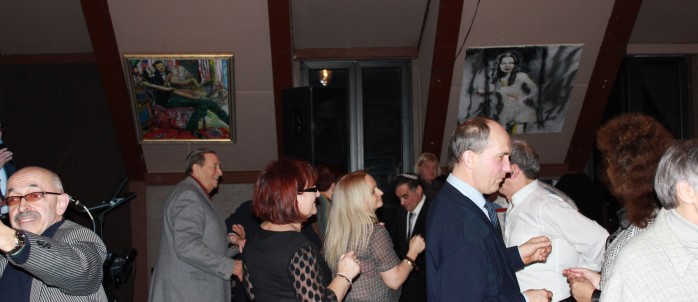
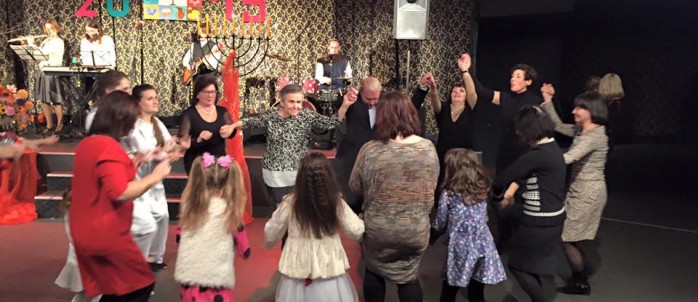
Guests were treated to a variety of hot dishes served at a buffet, red and white wines and vodka.The Lithuanian Jewish ensemble Fayerlakh played a variety of instrumental and lyrical favorites in their repertoire and the audience danced a circle dance around the room. Some couples also appeared on the small dance floor by the stage later.

Besides YIVO and LJC staff, Israeli ambassador to Lithuania Amir Maimon also attended and spoke briefly, and MP Emanuelis Zingeris came by to wish YIVO a warm birthday.

Schedule of Yom Kippur services

Monday, September 21
7:00 P.M. Evening prayer

Kapporois (atonement ritual) and writing of names for Yizkor follow
evening prayer at 7:30 P.M.

Tuesday, September 22
7:15 P.M. Yom Kippur Eve
7:15 P.M. Mincha (evening prayer)
8:10 Kol Nidrei and Ma’ariv

Wednesday, September 23
8:30 A.M. Shacharis (morning prayer)
~11:30 A.M.-12 noon Torah readings and Yizkor
5:30 P.M. Mincha
7:15 P.M. Ne’ila (ending prayer and blowing of Shofar)

Prayer schedule from September 24 to October 7

Morning prayer on weekdays at 8:30 A.M. (9:00 A.M. on Saturday and
Sunday), Mincha and Ma’ariv at 6:30 P.M.

Lithuanian parlt speaker, govt chancellor pay tribute to genocide victims in Paneriai

Lithuanian parlt speaker, govt chancellor pay tribute to genocide victims in Paneriai

VILNIUS, Sep 22, BNS – Lithuania’s Parliamentary Speaker Loreta Grauziniene and Government Chancellor Alminas Maciulis on Tuesday paid tribute to victims of the Jewish genocide at the Paneriai Memorial in Vilnius.

In her speech, Grauziniene emphasized that the suffering of the Jewish nation should be known, realized and accepted as an inseparable part of the past, while the strength of survivors should become a lesson of human dignity.”Forgetting, deleting or ignoring the experiences would be the same as justifying the crimes that were committed. Therefore, we focus on getting the young generation of Lithuania to know the page in history,” the parliamentary speaker said at a memorial ceremony held on the eve of the Holocaust Memorial Day.

The government chancellor, Maciulis, said genocide was one of the most horrific episodes in the history of Lithuania: “No wars, fires or plague epidemics will be as terrible as the (developments in) Paneriai. People were annihilated here under a murderous plan. At all times of the year, day and night. Nearly all of the Lithuanian Jerusalem was annihilated here.”

On Sept. 23, Lithuania will observe the Holocaust Memorial Day, witnessing the history of the Vilnius Ghetto that was destroyed on that day in 1943.Nearly 90 percent of Lithuania’s pre-war Jewish population of about 208,000 was annihilated by the Nazis during World War II, often with the help of local collaborators.Over 800 Lithuanians have been listed as Righteous Among Nations for rescuing Jews.

Lithuanian President Rescinds State Award to Lithuanian Partisan


BNS, Delfi.lt

Lithuanian president Dalia Grybauskaitė rescinded a presidential decree signed in the year 2000 to award Lithuanian partisan Pranas Končius-Adomas the Order of the Cross of Vytis, fourth degree. She took the action following the discovery Končius-Adomas was a Holocaust perpetrator.

full story in Lithuanian here:
http://www.delfi.lt/news/daily/lithuania/partizanas-pkoncius-adomas-neteko-valstybinio-apdovanojimo.d?id=69065726

Names of Holocaust Victims to be Read in Five Lithuanian Cities

Famous Israeli-based writer Grigorijus Kanovičius read out the beginning of a list of names of the Jews murdered in Jonava, Lithuania on Lithuanian State Radio’s most popular program Ryto garsai [Morning Sounds].

The Names project is being held in Vilnius for the fifth time in as many years and will be read out this year at two locations in the Lithuanian capital: in the courtyard of Herman Kruk’s ghetto library and at the Skalvija movie theater. Residents of Jonava, Molėtai, Švėkšna and Jurbarkas will also read the names of Jews killed in their towns.

More than 95 percent of approximately 220,000 Jews living in Lithuania were killed during the Holcoaust, but the organizers of the Names project are asking the public not to think of them as a statistic. “This is our history, our memory, which they tried to destroy along with people. When you say the names and professions of these people who lived here out loud, you can longer pretend they didn’t exist,” organizers of the civic initiative said in a press release before the events.

Grigorijus Kanovičius, an author whose works have helped many readers understand Jewish daily life in Lithuania and the Holocaust, and the winner of the Lithuanian National Prize, responded to the news that the names would be read out for the first time in his hometown of Jonava: “I hope these readings will bring us even closer to that historical truth which is impossible to hide or distort.”

Concert to Commemorate Holocaust Victims at Vilnius Church of the Bernardines

Wednesday, September 23

7:00 P.M. International concert “Breaking the Silence” (Vilnius Church of St. Francis of Assisi (Church of the Bernardines), Maironio street No. 10-22, Vilnius).


To honor the memory of Jewish artists who suffered, there will be a concert program of 3 premieres in Vilnius: Karl Amadeus Hartmann (1905-1963), Concerto funebre altui and string orchestra; Erwin Schulhoff (1894-1942), five works for strings; and Arvo Pärt (born 1935), Stabat Mater for choir and stringed instruments. Performers: Vilnius City Municipality Choir Jauna muzika, artistic director and conductor Vaclovas Augustinas, Austrian-Bulgarian string orchestra, Camerata Orphica Les Orphéïstes, Razvan Hamza (alto), conductor Amaury du Closel. Donatas Puslys will be master of ceremonies. Entry is free.

Lithuanian Man Rescued Jewish Historical Material from Soviets


Lrytas.lt

The city of Vilnius in 1925 was an ideal place to establish the YIVO Jewish research institute, Joanathan Brent, director of YIVO which is now located in New York City, said. Later the institute encountered difficulties: the Nazis initially wanted to destroy the collections, so they had to be hidden, and later the material was saved by a Lithuanian librarian from Soviet aggression.

Brent told Lithuanian Radio that all the material saved from the Nazis was to have been destroyed by the Soviets, but that librarian Antanas Ulpis decided to save it instead. He called it an act of bravery. Ulpis and colleagues took the material to the basement of the Palace of Books in Vilnius where it lay from 1948 till 1988. Ulpis died in 1987 never knowing what was to become of the books, Brent said in an interview on Lithuanian state radio.Professor Cecile Kuznitz from Bard College in the US said it was down to actions by average people that the material was collected in the first place, although the history of the institute is graced by famous people such as Albert Einstein and Sigmund Freud. …

full article in Lithuanian here:http://kultura.lrytas.lt/istorija/zydu-istorijos-medziaga-nuo-sovietu-isgelbejo-lietuvis.htm


Reading of Yitzhok Rudashevski’s Diary

As part of a program of events to mark the 90th anniversary of the founding of the YIVO Jewish research institute in Vilnius, readings from Yitzhok Rudashevski’s diary in Lithuanian and Yiddish were held at the Piano.Lt concert venue. YIVO director Jonathan Brent, Lithuanian Jewish Community chairwoman Faina Kukliansky and Jewish partisan and Vilnius Yiddish Institute librarian Fania Brancovskaja participated, and Klezmatics soloist Lorin Sklamberg sang songs composed as songs and poems in the Vilnius ghetto by Kaczerginski, Sutzkever and Wolkowski. A unique recording of Sutzkever reading his own poetry in Yiddish was played.

Jew savers awarded in Lithuania

Jew savers awarded in Lithuania

VILNIUS, Sep 22, BNS – Lithuanian President Dalia Grybauskaite on Tuesday awarded 47 people with Life Saving Crosses for saving Jews from the Nazis during WWII, with the majority of them awarded posthumously.

“Many of those decorated today are no longer among us. But their heroism lives on in our hearts and in our minds. I wish that it should inspire and give strength to each and every at all times and in every place to defend our freedom, protect the human being and promote democracy,” the president said during the ceremony.

The Jewish Community of Lithuania’s leader Faina Kukliansky said Jews will never forget those good people who saved Jews, calling them heroes.

The Touch of a Holocaust Film Director

On Monday, September 21, the Lithuanian Jewish Community screened a film by Marek Tomasz Pawlowski called “Dotkniecie aniola,” or “The Touch of an Angel,” in the Jascha Heifetz hall on the third floor of the community building in Vilnius.

Scheduled to begin at 5 P.M., the large hall was filled to overflowing and staff scrambled to find extra chairs to seat everyone. By 5:15 a variety of local people—a large contingent of students speaking Lithuanian and Polish, staff from the Vilna Gaon State Jewish Museum, teachers, local residents of different ethnicities—and a significant number of foreign visitors from Poland and Israel had been seated, and LJC chairwoman Faina Kukliansky addressed the audience, introducing Sebastian Rejak, special envoy of Poland’s minister of foreign affairs for relations with the Jewish Diaspora; Mickey Kantor, chairwoman of the Beit Vilna Association of Jews from Vilnius and Region; Ya’arit Glezer, deputy director of the Association of Lithuanian Jews in Israel and others.Head of the Political and Economics Department of the Polish embassy in Vilnius Maria Slebioda thanked the Lithuanian Jewish Community and chairwoman Faina Kukliansky for showing the film, and introduced it to the audience, calling it an unusual film in terms of content and cinematography, which was soon to become apparent to the audience as well. She spoke as well about the recent opening of a new museum of Jewish history in Poland, which she presented as evidence of Poland’s concern for Jews, along with a whole slew of other projects in Poland and at Polish embassies around the world. She gave several examples of projects supported by the Polish embassy to Lithuania, including an exhibit at the Vilna Gaon State Jewish Museum on Polish righteous gentiles and the screenign of a film about the liberation of a concentration camp. Last year there was an exhibit on Jan Karski, a Polish envoy who intentionally entered a transit camp (thinking it was a concentration camp) and told the world about the atrocities being perpetrated against the Jewish people of Europe. There were also two exhibitions in Vilnius about the hero Janusz Korczak, she said, and that this was only a portion of a long list of events organized and supported by the Polish embassy and Polish Institute. Slebioda said there was actually little choice but to keep up with the resolute execution of the policy by Warsaw to support Jewish heritage and to keep up with the Vilnius Jewish Community, which, while small, is also very active.

Sebastian Rejak spoke at length in Polish about the film, the Holocaust, visiting the Holocaust museum in Warsaw, Poland’s support for preserving Jewish heritage, expanding relations with Jewish communities in the Diaspora and other matters, with a simultaneous translation into Lithuanian.

By 5:25 the film was rolling and a hush went over the overflow audience. The film itself was bizarre. A man narrated in Polish, but even non-speakers heard there was something wrong with his voice, it was both pained and somehow off. He briefly recounted some moments from his childhood as the scenery switched back and forth between reconstructed scenes from the 1930s and 1940s and ruined buildings and landscapes in present-day Poland. It quickly becomes evident the man was a Jewish boy from Auschwitz, not the concentration camp, the actual town. A boy he used to play with sometimes who was struck dumb after a head injury and only occasionally commanded the power of speech suddenly told him one day, “All the sons of Abraham will be murdered. But you will survive. I know. The birds told me.” The boy, Henryk Schoenker, wasn’t sure what it meant, but it jolted him. There follow a series of flights by the family from one Polish location to another as the Nazis begin implementing the Holocaust. His father signs the family up for immigration to Palestine under one Nazi ruse which ends up saving the family’s life later. There is a prophetic meeting with a famous rabbi and supposedly a prophecy he made is fulfilled. Near the end Henryk Schoenker reveals he is deaf. A series of narrow escapes culminates in a meeting with what Henryk Schoenker says must have been an angel as the family hides in some grass near a lake. The strange man instructs them to stay hidden, and promises to bring them food. As Schoenker hikes over ruins of Nazi buildings and scenes from his childhood, he becomes increasingly bitter. There is a mixed message near the end: Schoenker says every Jew who survived the Holocaust in Poland was helped by at least one Pole, followed by his blanket condemnation of all non-Jews for not stopping it. “They knew, they all knew,” he says. “They did nothing. Nobody did anything.” Up until the end of the film Schoenker speaks as if the Nazi ruse of deporting Jews to Palestine had been real, a real offer on the table, but that the countries of the world had prevented the Nazis from implementing the relocation project. Knowledge about the Holocaust among the Allies is not discussed, only “they knew” is offered, and Allied victory against the Nazis at the cost of so many lives is not acknowledged. Instead Schoenker revels in a simple and almost child-like conception of what happened based on his personal memories. The most moving parts of the film involve childhood reasoning about the lives of dolls.As a personal memoir and testimony, the film is excellent. As a tool for telling children about the Holocaust, it is good yet terrifying and might not be appropriate for very young children. As history, it is a work of fiction. As cinematography, it suffers from an overbearing soundtrack, too many “soupy strings,” too much sad violin music which lasts for too long, and some of the quick transitions between scenes seems more a matter of haste and sloppiness than artistic intent. Despite that, the film is moving. The prophecy gleaned by the damaged child from the language of the birds, the “angel” in the guise of a man in robes with a long beard and staff and the family’s “flight” could all be considered religious symbols centering around the concept of spirits trapped in a material world, but just as “a little bird” informed Henryk’s friend of the coming Holocaust, so Henryk Schoenker demands the entire world employ that sort of epistemology, or claims they actually did, and also knew what was coming, what was happening and what had happened, and yet did nothing. He makes the claim despite the millions of non-Jewish lives lost defeating the Nazis in order to end their reign of barbarity.

The audience seemed to really appreciate the film and erupted into applause at the end.

Ironically, although the screening was included on the program of events to commemorate the 90th anniversary of the founding of YIVO in Vilnius, there were actually more audience members who came to watch the film than the number of people who turned out for the main YIVO birthday event the day before at the spacious Lithuanian parliament, a day-long conference.

The film ran for 60 minutes. It was almost entirely in Polish, with Lithuanian subtitles. Full credits and a description are available here:

http://www.imdb.com/title/tt4500584/


Remembering the Vilna Ghetto

Remembering the Vilna Ghetto

This week we mark the anniversary of the liquidation of the Vilna Ghetto (September 23, 1943). Irena Veisaite survived the Holocaust in Lithuania and is now an influential human rights activist. These words come from a speech she delivered at a Holocaust memorial ceremony in Vilnius.

“Straight after the end of the war I instinctively shrank from reminiscing. It would have been unbearable. I lost my mother who was only 35 years old; I lost my grandparents and the whole of my parents’ generation, an infinite number of friends and acquaintances. Their death is impossible to explain and even harder to justify. Where did so much cruelty suddenly come from? I could not comprehend why I, as a Jew, became a marked person, humiliated and hunted. I also could not comprehend why this horrific crime – not only against the Jews but a crime against all humanity – was being hushed up or distorted in the years following the end of the war.”