

An English translation of the new issue of the Bagel Shop newsletter is now available.
Please click BK_16_1_ENG_A4_screen for a PDF version.










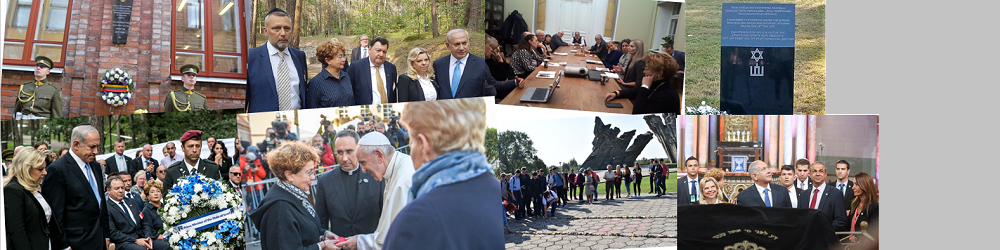


An English translation of the new issue of the Bagel Shop newsletter is now available.
Please click BK_16_1_ENG_A4_screen for a PDF version.
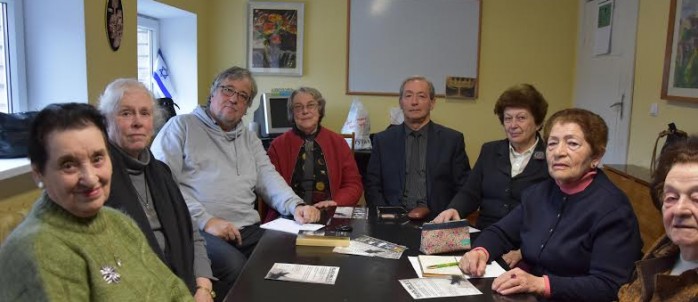
A German man named Jürgen Dettling, described on facebook as the initiator of various social projects and public education programs, visited the Kaunas Jewish Community recently. He said he is currently involved in a project concerning Karl Jäger, the author of the infamous Jäger Report and mass murderer of Lithuanian Jews. He took photographs of mass murder sites in Lithuania and spoke with Holocaust survivors. He said he is planning a return trip in April and hopes to interview survivors for a film about the mass murderer. Jäger was commander of the SD Einsatzkommando 3a in Kaunas during World War II, which included command over the Rollkommando Hamann mobile death squad. He was captured after the war and hung himself in jail in 1959.
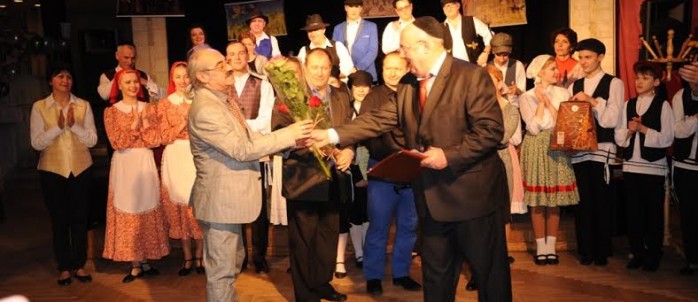
The Panevėžys Jewish Community kicked off their Purim celebrations in the events hall of the Panevėžys Community Center March 20. Panevėžys Jewish Community chairman Gennady Kofman greeted a large party of guests from Vilnius, Ukmergė, Šiauliai and Panevežys and read an excerpt from Magilat Ester.
Artūras Taicas, deputy chairman of the Lithuanian Jewish Community and chairman of the Ukmergė Jewish Community, greeted guests as well and passed on the good wishes of LJC chairwoman Faina Kukliansky. Panevėžys city deputy mayor Petras Luomanas and city council member Alfonsas Petrauskas also gave wonderful addresses.
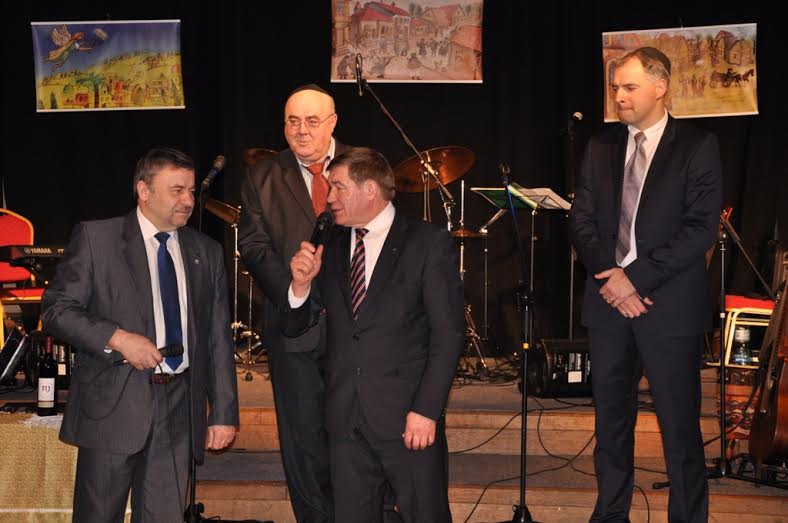
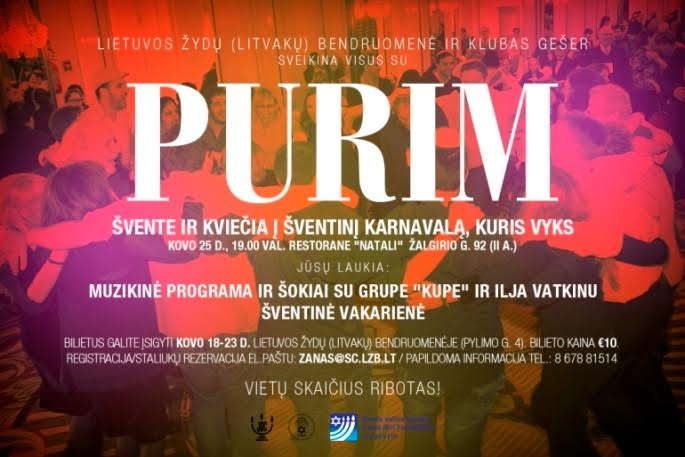
The Kaunas Jewish Community sends its Purim greetings to everyone and invites you to attend their combined Purim and Sabbath celebration on Friday, March 25.
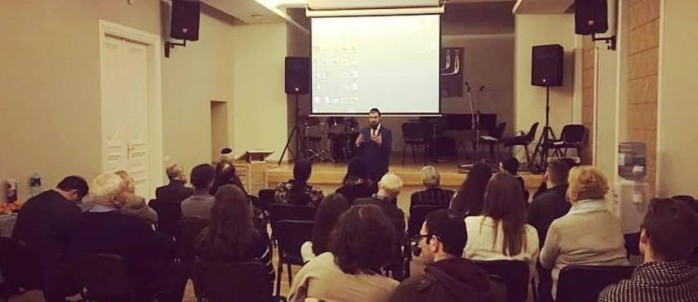
The film club of the Lithuanian Jewish Student Union screened the film “Kaddish” on March 10, an event during which the public was able to meet one of Lithuania’s newest rabbis, Rabbi Samson Daniel Isaacson. Before the film started, Rabbi Isaacson gave a short talk welcoming the audience and telling about the film made by a friend of his. Kaddish is the story of Rabbi Yitzhak Yosef Zilber, born in Russia in 1917 (died 2003, a Russian, later Israeli Haredi rabbi and a leader of the Russian baal teshuva movement, author of several books, Russian Israeli religious authority). Zilber studied Judaism privately, at home, because his father Ben-Tzion Haim Zilber (originally Tsiyuni) refused to allow him to attend ant-religious Soviet schools.
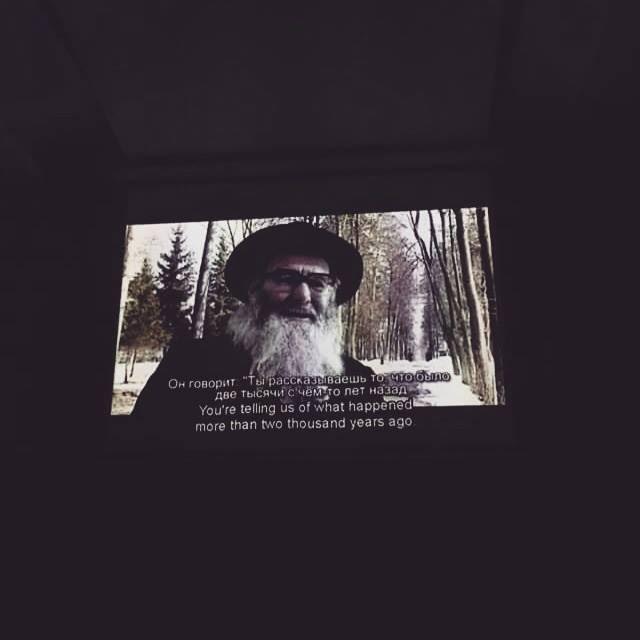
At the age of 15 he began to teach Judaism in his hometown of Kazan, although it was illegal under Soviet law to do so. After a life filled with hardship, oppression by the Soviets and incarceration in the gulag, he and his family were finally allowed to leave the USSR for Israel in 1972, where he continued to teach, practice traditions and attract a large group of young people.
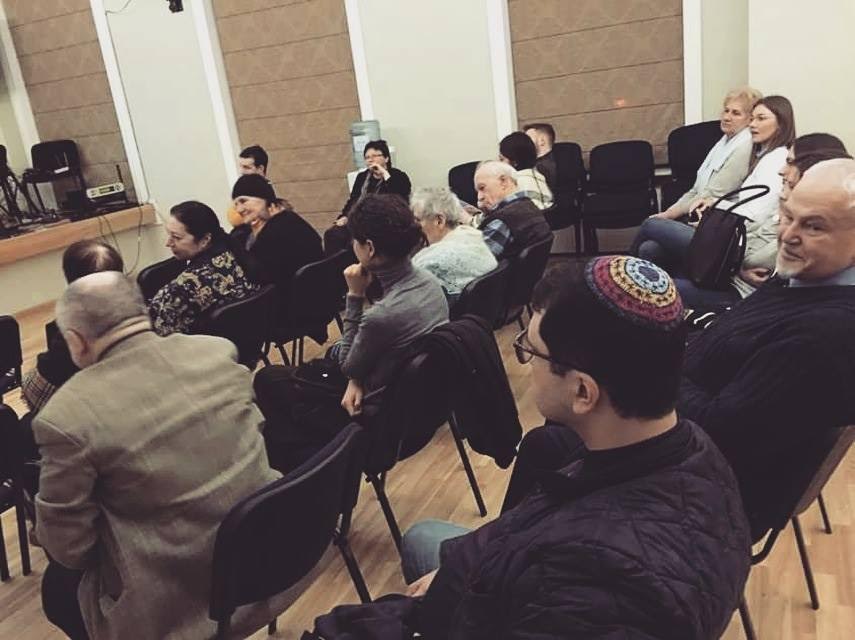
Discussion followed the screening of the film as audience members asked the rabbi questions and he responded. The several dozen members of the audience and the rabbi were treated to snacks and tea after the discussion, allowing people to get to know the rabbi better in a somewhat informal setting.

The kosher Bagel Shop Café of the Lithuanian Jewish Community is in full gear getting ready for the Purim holiday. There are several new pastry items the chefs there have cooked up, including the “red velvet” pastry taking the Jewish culinary internet by storm. Their special hamantashen recipe passed down through the generations uses yeast as well.
Senior chef Riva Portnaja says her family calls hamantashen “omentashen,” and that her mother always put yeast in the dough. According to her, Litvak hamantashen only contain poppy-seed fillings, and the triangular pastry is made so that is almost closed.
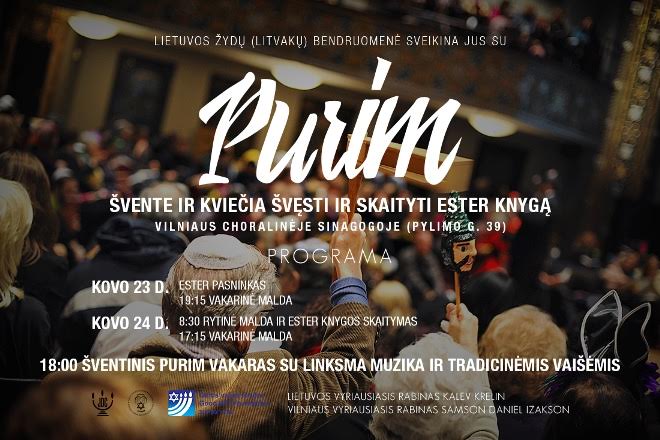
LJC staff will get an additional day off on Thursday, March 24 for the Purim holiday. The community building will remain open as usual so if you need to come in to work for organizing events or other matters, you will be able to do so. Staff are also invited to attend the Purim celebration at the synagogue beginning at 6:00 P.M. Thursday.
The Lithuanian Government has declared Thursday a day of mourning for those killed in Brussels, the capital of Belgium, the Benelux Union, the EU and NATO. The day of mourning has been set as the period from 7:00 A.M. to 10:00 P.M. on Thursday, March 24, 2016. Lithuania flags will be flown at half-mast or with a black ribbon. Speaking at an ad hoc meeting, acting prime minister and minister of finance Rimantas Šadžius expressed solidarity with the city of Brussels and Belgium, and the cabinet observed a moment of silence, according to BNS.
March 23, BNS–Investigation into cultural treasures the Nazis stole from Jews in Lithuania has begun, the newspaper Lietuvos žinios reports.
Last week a meeting of the International Commission for Assessing the Crimes of the Nazi and Soviet Occupational Regimes in Lithuania reached agreement on conducting several large studies, commission chairman Emanuelis Zingeris confirmed. He said the Rosenberg task force drew up lists of rare and valuable items held by Jewish organizations, libraries and museums before the war even started. “So we’re asking for additional research, which is being performed by researchers in Lithuania and abroad. I believe we will approach the German Government on with a request for clarification, because there shouldn’t be any lingering doubts regarding this,” Zingeris said.
He also spoke about the items listed in the book “Lietuvos inkunabulai” [Incunabula of Lithuania] by Nojus Feigelmanas from the Strashun library in Vilnius. “There are clear indications there were four incunabula in this library in Hebrew which the Germans took. The incunabula were printed in an Italian city in 1475. They are priceless,” Zingeris commented. His commission’s work was resumed by presidential decree in the fall of 2012. After a break of eight years, the renewed commission met again in 2013. As reported at that time, the commission only discussed technical and financial issues at that meeting. The chairman said the subcommittee investigating crimes of the Soviet occupational regime would meet in early summer this year.

Esther, the star of the Purim story, is one of the bravest heroines for so many reasons–she not only strategized to save the Persian Jews from certain death (breaking social norms in doing so), but she also maintained a kosher diet as an undercover Jew in the Persian palace. Wait, what?
Legend has it that like many Jews today, Esther kept kosher by avoiding things like non-kosher meat, and instead enjoyed a plant-based diet full of fresh produce, grains, legumes, nuts, and seeds. For those of you with eating restrictions, you know how hard it is to turn down foods that everyone else is noshing!
In the story of Purim, food and celebration are central to her strategic success. In order to earn the favor of her husband, King Ahasuerus, she hosted two impressive (and probably extremely delicious!) banquets that set the stage for her requests of the King to save the Jews of Persia.
After all these years, delicious food and drink–like hamantaschen, Haman’s fingers, and plenty of wine–are essential parts of the celebration of Queen Esther and Purim.
If you’d like to party like Esther this Purim, click here for recipes.
At least 34 people killed in Brussels as two suicide bombers strike
“Fight of good against evil’ – WJC president calls for international alliance to stamp out Islamist terrorism
NEW YORK – “We are shocked and we are sad, but we are determined to fight this scourge until it is defeated,” World Jewish Congress President Ronald S. Lauder said in reaction to Tuesday’s terrorist attacks in the Belgian capital Brussels. Lauder condemned the attacks at the city’s airport and a metro station in downtown Brussels, in which at least 34 people were killed, and dozens wounded. He urged more international cooperation in the fight against Islamist terrorism and said police and intelligence services “must now get all necessary resources to prevent further attacks from happening.”
“On Saturday, four people were murdered in Istanbul, three of them Israelis, presumably by an ISIS supporter. Today, it was in the same fanatic ideology that struck at the very heart of Europe, in Brussels. Our hearts go out to the many victims and their families. Those who masterminded these attacks must be caught, their support network must be dismantled and their financial resources dried out.
“Having suffered from so many attacks in recent months and years, Europe and the wider world must now sit together and come up with adequate measures. Albeit important, it is not sufficient to just have more police or military patrolling the streets, to improve border controls, or to install extra security measures at airports. What is more important is to cut the tree from its roots, to combat the Islamist and jihadist ideologies on all fronts, and to finally ensure that the senseless killing of people by fanatics is stopped wherever it takes place.
“This is a deteriorating situation. It’s clear: any country, any citizen can become a target of these terrorists, and therefore, all countries must unite to defeat the terrorists and the ideology that inspires them. This is a fight of good against evil, and we must not shy away from it,” said Lauder.
About the World Jewish Congress
The World Jewish Congress (WJC) is the international organization representing Jewish communities in 100 countries to governments, parliaments and international organizations.
Email: media@worldjewishcongress.org
Website: www.worldjewishcongress.org

European Jewish Congress Shocked and Appalled by Attacks in Brussels Calling
Them “Shots at the Heart of Europe”
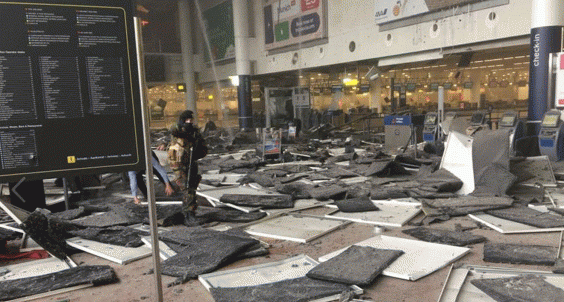
The European Jewish Congress (EJC) has expressed shock and revulsion at the attacks which took place in Brussels this morning. Two explosions rocked the departure lounge at Brussels Airport and another blast went off in the Brussel Maelbeek metro station, very close to European Union institutions.
“This is yet another shocking, appalling and deadly attack on innocent Europeans by terrorists,” Dr. Moshe Kantor, President of the EJC, said. “These attacks on an airport, train system and outside European Union institutions are shots at the heart of Europe. Our prayers and thoughts are with the Belgian people at these difficult times.”
“These are attacks against all that we stand for. All Europeans regardless of background must stand together and expel this terror and intolerance from our midst.”
The blasts come four days after Belgian police arrested a key suspect in the November, 2015 attacks in Paris.
“We can no longer ignore the fact that radical Islamists are at war with Europe and all Europeans and we call on our governments and law enforcement agencies to act accordingly,” Dr. Kantor said. “We have been exposed for too long and now we must strike back at the terrorist infrastructure including those who support it economically, and those who inspire and provide it legitimacy.”
Tuesday, March 22, 2016.

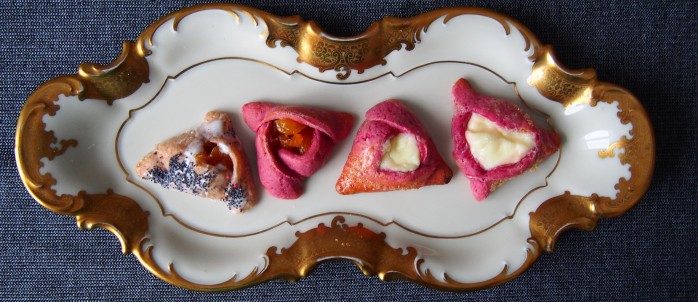
Purim is a happy time when sorrow, worry and fear take a vacation as the holiday of delicious food and jokes arrives. Purim is one of the most-anticipated and interesting of holidays on the Jewish calendar. It’s a celebration harkening back to the time when the Jews living in Persia were saved from destruction.
Book of Esther
The Purim story is contained in the Book of Esther in the Old Testament of the Bible. The heroine of the story is Ester, a beautiful young woman who lived in Persia, and the hero is her brother Mordecai. Ester was taken into the harem of king Ahasuerus and became queen, but the king didn’t know Ester was a Jew because she hid this from him. The villain of the story is Haman, the arrogant, egotistical vizier to the king. Haman hated Mordecai because he wouldn’t bow down and serve him, so Haman decided to destroy the Jewish people. In his well-known speech to the king, Haman said:
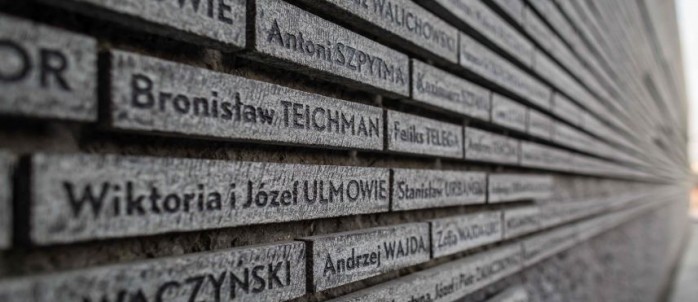
Poland’s president talks about anti-Semitism as not only a demonstration of hatred towards Jews, but also as disrespectful to the memory of those who risked their lives to save Jews during the Holocaust.
Poland’s president spoke of anti-Semitism as not only hateful to Jews, but also disrespectful to the memory of those who risked their lives to save them. Amid a public debate about Poland’s Holocaust-era record (as in Lithuania), the country’s president attended the opening of a museum for non-Jews who saved Jews during the genocide.
At a ceremony attended by approximately 2,000 people Thursday, Andrzej Duda spoke of anti-Semitism as not only hateful to Jews, but also disrespectful to the memory of those who risked their lives to save them. Those who “sow hatred between people, sow and foment anti-Semitism, at the same time trample upon the grave of the Ulma family,” he said of the family who gave the new museum in the southeastern town of Markowa its name: the Ulma Family Museum of Poles Who Saved Jews. On March 24, 1944, German police murdered eight Jews and several people who hid them: Jozef Ulma, his pregnant wife and their six children. The Ulmas were recognized in 1995 as Righteous among the Nations for their actions by Yad Vashem, Israel’s Holocaust museum.
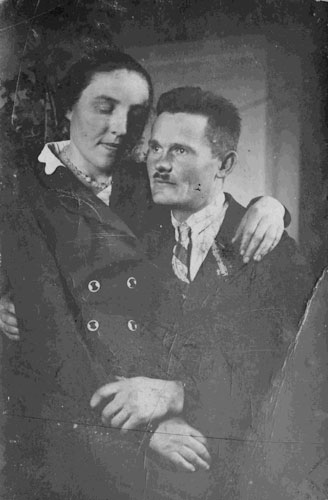
Righteous Gentiles Jozef and Wiktoria Ulma
The Markowa museum’s opening is one of several new government initiatives to commemorate the Righteous, including plans and funding for a monument to be located next to the All Saints Church on Warsaw’s Grzybowski Square. Another monument, which is controversial for its location, is planned near the Museum of the History of Polish Jews at what used to be the Warsaw Ghetto. The Polish government allocated this year $53,000 for building a chapel in Torun near Bydgoszcz in central Poland dedicated to the Righteous.
At the same time, Poland’s rightist government, elected in 2014, has courted controversy by taking steps which are seen as inhibitive for confronting the actions of Poles who participated in the murder of Jews during the Holocaust.
President Duda in January requested a re-evaluation of the Knight’s Cross of the Order of Merit medal, which was given in 1996 to Jan Gross, author of the controversial 2001 book “Neighbors” about the 1941 pogrom perpetrated against Jews by their non-Jewish countrymen in the town of Jedwabne.
Full story here.

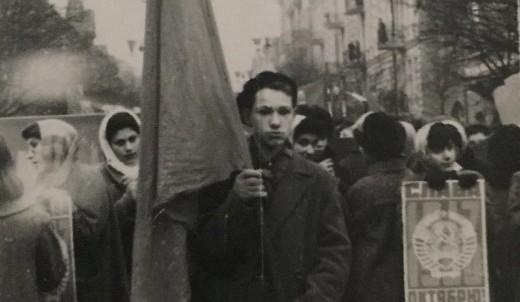
Mažoji leidykla publishing house, 2016
I am a post-war child. I was born in Vilnius October 8, 1946. I remember my life from about the age of four. Lithuanians, Jews (including Jews from the ghetto), Poles and Russians, we lived in an old building at the intersection of K. Giedrio and J. Garelio streets (now Šv. Ignoto and Dominikonų streets). Above us there lived Mr. Valteris, a former translator for the Gestapo. No one spoke to him about that, but everyone knew he had collaborated with the Germans.
For those living behind the iron curtain, for BBC radio listeners, Sam Yossman, who did the popular program Babushkin Sunduk (Grandmother’s Chest) and Perekati Pole (Tumbleweed), was better known by the pseudonym Sam Jones. Born and raised in Soviet Lithuania, Yossman decided after many years to record his memories in the book “Šaltojo karo samdinys” (Cold War Hired Hand).
Read more in Lithuanian here.
March 10, 2016 No. 46
Office of Prosecutor General
Republic of Lithuania
March 8, 2016 No. 17.2. -3073
re: February 29, 2016 No. 190
To: Faina Kukliansky, attorney, chairwoman,
Lithuanian Jewish Community
Pylimo street no. 4
01117 Vilnius
cc:
Teresė Birutė Burauskaitė, general director
Center for the Study of the Genocide and Resistance of the Residents of Lithuania
Didžioji street no. 17/1
01128 Vilnius
On Assessing the Basis for the Rehabilitation of the Priest Jonas Žvinys and on the De-Rehabilitation of Bronius Žvinys
Upon examination of a request sent by the Lithuanian Jewish Community to assess the actions of the priest Jonas Žvinys and Bronius Žvinys and received at the Office of Prosecutor General, and having examined according to our competency that part of the request demanding the Prosecutor General, in light of conclusions and material supplied by the Center for the Study of the Genocide and Resistance of the Residents of Lithuania (hereafter CSGRRL), investigate whether the Supreme Court of Lithuania justly rehabilitated Jonas Žvinys, we respond to the applicant by explaining that such a demand can only be undertaken after the CSGRRL performs archival research on the general assertions (without any factual information) made in the request and provides its conclusion to the Office of Prosecutor General. The Prosecutor General has no information about the repression of, the reasons for the repression of or the restoration of civil rights (rehabilitation) of Jonas Žvinys.
The Jewish Culture and Information Center’s Shofar Gallery (Mėsinių street no. 3, Vilnius) presented an exhibit of pastel works by Kęstutis Milkevičius called “Stories about Rabbis” March 17.
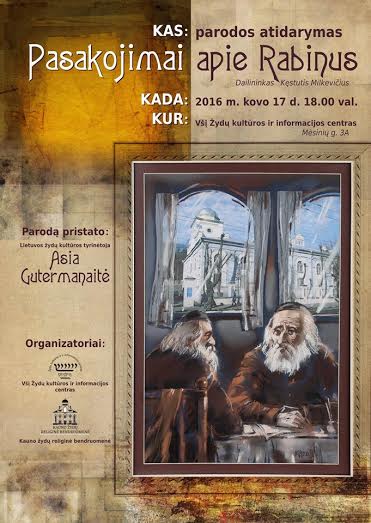
The collection on exhibit was formed at the initiative of the leader of the Kaunas Jewish religious community, Maushe Bairak. Artist Raimundas Majauskas commented on Milkevičius’s artworks:
“The old portraits of wise Jewish rabbis are suffused with time and come down to us from a modified Rembrandtesque chromatic environment. The artist is a master of line and composition. The individualized, artistically realistic works betraying a deep aesthetic foundation are part of the cultural and communal life of Kaunas and Lithuania.”
Litvak cultural heritage scholar Asia Gutermanaitė opened the exhibit. The opening including stories and interesting tales about rabbis. The exhibit will run until April 12.

The Sunday lectures continue at 12:00 noon on March 20:
Subject: Sacred Text
by Rabbi Shimshon Daniel Isaacson
Third floor, Lithuanian Jewish Community, Pylimo street no. 4


A ceremony to mark the 72nd anniversary of the Children’s Aktion in the Kaunas ghetto will be held at 4:00 P.M. on March 25, 2016, at E. Ožeškienės street No. 13 in Kaunas. We will never forget the horror of that day when over 2,000 children were torn from their families and brutally murdered.