







Family Seder

Bring your whole family to the Lithuanian Jewish Community Passover Seder starting at 5:00 P.M. on April 15 at the Radisson Blue Hotel Lietuva, Konstitucijos street no. 20, Vilnius. Tickets are 12 euros. For more information and to buy tickets from April 4 to April 12, contact Žana Skudovičienė at telephone 867881514 or Julija Lipšic at 865952604.

Nietzsche and Pesach: How the Exodus Ruined Everything

by Andrés Spokoiny

Frederick Nietzsche believed that the Egyptians were blond.

My apologies; I’m getting ahead of myself. Let’s start from the beginning:

Despite what people sometimes claim, Frederick Nietzsche wasn’t an anti-Semite. To the contrary, he was strongly against the anti-Semitism that raged in Germany in his lifetime. He even said in his private correspondence that anti-Semites, his racist sister included, “should be shot”. (And you thought your family had issues…)

Yet, Nietzsche had a problem with Pesach. A big problem.

For the bespectacled professor, Jews, with their “revolt of the slaves”, had “subverted the natural order” and instituted a “morality of slaves” that is opposed to the “morality of the masters”, the latter being the natural and desired state of the world. That ushered in the “collective degeneration of man” that Nietzsche saw in his own time. The French Revolution, the American Revolution, and democracy as a whole were for Nietzsche direct results of the revolution of morality that the Jewish slaves started.

Full piece here.

Vilnius Mayor, Lithuanian PM Decree: And There Shall Be Built a Jewish History Museum Next to the Palace of Sports

Vilnius, March 30, BNS–Lithuanian prime minister Saulius Skvernelis said there are deliberations on changing the project for the reconstruction of the Palace of Sports to include a equip a building to host a Jewish history museum and for conferences. There was consideration on holding concerts and other cultural events in the project initiated by the former Government.

Vilnius mayor Remigijus Šimašius proposed setting up a Litvak History Museum next to the Palace of Sports which the Government is planning to renovate. “I think the Government has done the right thing in halting the untransparent bid begun earlier. But there should be a conference center there without any doubt. We just discussed that it would be more sensible if next to the conference center or partially integrated with the conference center there were a museum of Litvak history. It is probably this could be accomplished wonderfully and would become an attraction. We agreed to develop the idea further. I’m glad my opinion and the prime minister’s coincide on this,” the mayor of Vilnius told BNS after meeting with Lithuanian prime minister Saulius Skvernelis Thursday.

“It should be able to be used for conferences. Now there is a concept, a conference and concert hall, so it should be conferences and a museum,” the prime minister told reporters at parliament.

Recovering Memory: Vilnius University Memory Diploma Graduation Ceremony

Event at 3:00 P.M. on April 3, 2017

Vilnius University will host a Memory Diploma Graduation Ceremony in the small auditorium at Universiteto street no. 3, Vilnius. The ceremony is intended to honor students, staff and members of the university community who were marginalized, thrown out, not allowed to finish their education or academic work and otherwise repressed because of the actions of the totalitarian regimes or local collaborators.

The university was compelled to rethink its relation with the past after receiving a letter from Israeli professor of medicine Moshe Lapidoth in the summer of 2016, requesting a symbolic commemoration of his uncle Khlaune Meishtovski who was a student at the Mathematics and Natural Sciences Faculty of Vilnius University before the war. After eight successful semesters studying chemistry and physics, he was expelled July 1, 1941 because he was a Jew.

In 2016 the university formed a commission to do a historical study and decide selection criteria for people who were unfairly deprived of an education there. A symbolic Memory Diploma was established to remember these people. It is hoped the graduation ceremony will become a university tradition.

After preliminary study, the university determined about 650 Jews and 80 Poles were forced out as well as a professor whose wife was Jewish during the beginning of the Nazi occupation. Several hundred Lithuanians were also deprived of university study and employment.

There will be a live-stream on facebook:

https://www.facebook.com/events/898366480305748/

On the Meeting of the Board of the Vilnius Jewish Community

Dear members of the board of the Vilnius Jewish Community,

I would like to inform you that a demand was received on March 23 signed by Vilnius Jewish Community (VJC) board members Aleksandr Arončik, Simon Ceitlinas, Arkadij Goldin, Aleksandras Lukas Jurevičius, Dovydas Kocas, Margarita Koževatova, Simonas Portnoj, Simon Gurevičius and Rachmil Garber to convene a meeting of the VJC executive board on March 30, 2017, to discuss the issues of convening an extraordinary VJC conference and of adopting new VJC members as well as confirming existing memberships.

I would like to thank the above-mentioned LJC board members for their initiative and also to state that this demand is not legally correct according to the regulations of the VJC and the laws of the Republic of Lithuania (the reasons are indicated in a letter to VJC board members which will be sent to all VJC board members by registered mail).

We would like to inform you that the plan is to convoke the board of the VJC at 6:00 P.M. on April 28, 2017, and to ask that VJC board members mark the date on their schedules. Information about elections will be posted on the official Community website, www.lzb.lt, and we also invite anyone with questions about the elections to contact us.

Sincerely,

Faina Kukliansky, chairwoman
Vilnius Jewish Community

Equality and Diversity Prizes Awarded to Leonidas Donskis, Baltic Pride Organizers, Crisis Center Director

Vilnius, March 30, BNS–The fourth National Equality and Diversity Awards recognized the contributions of Lithuanian philosopher Leonidas Donskis who died last year.

The gender equality award was presented to Vilnius Crisis Center director Nijolė Dirsienė for her many years of caring for women suffering domestic violence and active work over 20 years in preventing violence. In the break-through category the Baltic Pride gay march organizers got the award, according to event spokespeople.

The ceremony held at the Royal Palace in Vilnius Wednesday handed out ten awards for achievements and initiatives over the last year.

The award for dialogue between peoples went to Vilnius Ukrainian Association chairwoman Natalija Šertvytienė for active work in expanding ethnic dialogue in Lithuania, preserving the Ukrainian ethnic identity and aid in integrating Ukraine in Europe.

LJC Chairwoman Faina Kukliansky Speaks at National Equality and Diversity Awards Ceremony

The Lithuanian Jewish Community and other ethnic communities and public organizations appreciate the National Equality and Diversity Awards includes a nomination for “Dialogue between Peoples.”

As a member of an ethnic minority, I feel a more enlightened view in society on topics such as the Holocaust and xenophobia. People are slowly coming around to asking questions, engaging in discussions and thinking about the issues. Four years ago the Lithuanian Jewish Community began the Bagel Shop tolerance campaign which opened the Community’s doors to the public and made Jewish culture and history more accessible and, of course, more attractive. When the Community opened its doors, the public opened their hearts to the Community. I would like to thank everyone who took an interest and participated in this tolerance initiative which I believe marked the beginning of a small “dialogue between peoples” revolution. I present the highly esteemed candidates for the “Dialogue between Peoples” award:

Marius Ivaškevičius, the force behind the March of Memory dedicated to the murdered Jewish community of Molėtai. A record number of people turned out to remember and honor those killed, up to 3,000 participants marched along the last route taken by the victims of genocide perpetrated by Lithuanian hands.

Lithuania’s Shoah Whitewash Project

Efraim Zuroff of the Simon Wiesenthal Centre in Jerusalem has said the Lithuanian authorities were “very culpable.”


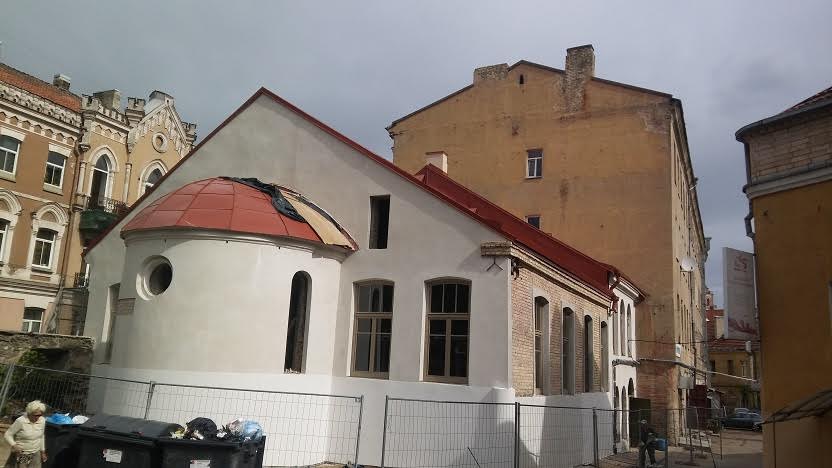
A derelict shul in Vilnius (Getty Images)

Lithuanian parliamentary ombudsman Augustinas Normantas has refused to open an investigation into a complaint that his country’s Genocide and Resistance Center presents a revisionist version of wartime history.

Instead, the ombudsman said that the center itself must address the issue first, and “if its answer is disputed, then in a court of law.”

The complainant, Grant Gochin, has challenged the Genocide Center’s description of Lithuania’s wartime treatment of its Jews, calling it “a distortion of history and an insult to the Jewish citizens of Lithuania.”

American Jewish Committee Opens Central European Office

by David Harris
March 22, 2017

On March 27, AJC, the global Jewish advocacy organization, opened its newest international office in Warsaw. Named AJC Central Europe, it covers seven countries – Czech Republic, Estonia, Hungary, Latvia, Lithuania, Poland, and Slovakia. AJC also has such offices in Berlin, Paris, Brussels and Rome.

AJC president John M. Shapiro gave a speech at the opening of the Warsaw office. Lithuanian Jewish Community chairwoman Faina Kukliansky attended the opening ceremony. Both appear in the photograph below.

Polish Rabbi M. Schudrichhangs a mezuzah on the doorway of the AJC office.

Why such an office?

There are several timely and pressing reasons for intensified engagement.

These nations form one-fourth of the current membership of the European Union, hence they have an important voice in Brussels, which will only grow with the anticipated exit of the United Kingdom from the EU in 2019.

They are all deeply committed to the trans-Atlantic partnership and their bilateral links with Washington, and, of course, they are valued NATO members.

They also have robust ties with Israel, in some cases described as strategic partnerships.

New American Jewish Committee Office in Warsaw to Work on Jewish Issues in Baltic States, Too

Warsaw, March 28, AP/BNS–In Warsaw Monday an official ceremony opened the new American Jewish Committee (AJC) office there. The AJC has been operating for 111 years with headquarters in New York but has long been operating in Central and Eastern Europe as well.

It was the first Jewish organization which called for the unification of East and West Germany when the Berlin Wall fell. It also supported the aspirations of Central and Eastern European states to join NATO and the EU. Poland’s president Andrzej Duda welcomed the AJC to Poland and said Poles “until today with gratitude remember your support for our goals.”

“I am certain this will give further impulse to trans-Atlantic cooperation,” the president of Poland said in a press release which was read out at the ceremony Monday evening by a presidential advisor. The organization says it is pledged to support democracies because it believes open and tolerant societies provide greater safety for Jews and other minorities.

The new AJC bureau in Warsaw will concern itself with Jewish issues in Poland, the Czech Republic, Hungary, Slovakia, Estonia, Latvia and Lithuania.

Its priority is supporting good relations with Israel and the United States and says these relationships are an essential matter in insuring geopolitical security for Jews.

Anti-Semitism in Soviet Lithuania: The Case of the Vilnius Money-Changers

Antisemitizmas Sovietų Lietuvoje. Vilniaus „Valiutininkų byla“

Bernardinai.lt

by Justas Stončius, doctoral candidate and lecturer at the Institute of the History and Archaeology of the Baltic Region, Klaipėda University

Fifty-five years ago on March 22, 1962, death sentences were issued to three Jews from the Lithuanian Soviet Socialist Republic. They were accused of violations in exchanging currency. The local press reported the trial in detail and the Western press covered it as well, viewing it (correctly) as traditional anti-Semitism, whose existence in the USSR was denied. Klaipėda University doctoral candidate Justas Stončius discusses the motivations and history of the Vinius Money-Changers Case.

The trial of the “Vilnius money-changers” lasted from January 30 to March 22, 1962. The Supreme Court of the Lithuanian Soviet Socialist Republic tried eight people of Jewish ethnicity who were accused of violating the rules for exchanging currencies and of currency speculation. The decision was made to hold a public trial and a special group of correspondents was formed to cover the trial in newspapers and magazines. Invitations were distributed at Vilnius city factories to the more active workers and activists in the production sector. During sentencing the death sentence was given Aron Reznitsk, Mikhail Rabinovich and Fyodor Kaminer, while Basia Reznitsk was sentenced to 15 years’ imprisonment, decreased to 10 years 6 years later.

The Vilnius Money-Changers Case received much attention in the West. On April 17, 1962, French newspaper Le Progrès reported “by order of the Vilnius Tribunal three Lithuanian Jews have been put to death” and noted the events had caused unrest in the Jewish community of the Soviet Union. France’s Le Monde newspaper stated Jews of the USSR were afraid “that they, too, might become scapegoats for the rampant lack of food stuffs in the Soviet Union…”

Full story in Lithuanian here.

Ponar Mass Murder Site Three Times Larger than Memorial Complex

Paneriuose nacių įkurta žudymo bazė buvo tris kartus didesnė nei dabartinis memorialas
Then-president of Israel Shimon Peres at Ponar in 2013. Photo: AFP/Scanpix

Vilnius, March 27, BNS–The mass murder site established by Nazi Germany in Ponar outside Vilnius during World War II was three times larger than the memorial complex there now, Lithuanian historians have discovered.

“The memorial is only a small part of the Ponar murder operation site. It might have covered 65 hectares, but the memorial complex/museum there occupies 19 hectares,” Lithuanian History Institute researcher Saulius Sarcevičius told BNS Monday. He said researchers working at the site since last year have discovered five new mass murder pits and additional research is being carried out on two of them.

German Historian Raises Painful Question of Lithuanian Collaboration


Dr. Christoph Dieckmann. Photo by Karolina Pansevič, © 2017 Delfi.lt

Effective cooperation between Germans and Lithuanians became a fatal trap for Lithuanian Jews. It was patriots–ethnic nationalists–who murdered the Jews in Lithuania, hoping to form a strong nation-state without Jews, Russians and Poles.

So German historian Christoph Dieckmann said in an exclusive interview with Delfi.lt. Dieckmann, who works at the Fritz Bauer Institute in Frankfurt, is the author of the two-volume Deutsche Besatzungspolitik in Litauen 1941-44 published in 2011. As a member of the Lithuanian International Commission to Assess the Crimes of the Nazi and Soviet Occupational Regimes, Dieckmann raises a painful moral question: why didn’t the Lithuanian people, seeing and hearing the Jews being murdered around them, protest? He believes it’s largely due to the position of the Church, which he believes was only concerned with what to do with the property of Jewish converts to Catholicism.

Full story in Lithuanian here.
Panevėžys Jewish Community Passover Celebrations

The Panevėžys Jewish Community greet you on the upcoming holiday of Passover and invite you to a series of events for the holiday:

April 6 Concert “From a Forgotten Book” at the Gabrielė Petkevičaitė-Bitė Panevėžys Regional Public Library, Respublikos street no. 14 at 5:00 P.M.

April 10 First Passover Seder at the Rojaus paukštė café, Respublikos street no. 4A at 6:30 P.M.

April 11 Second Passover Seder at the Panevėžys Jewish Community, Ramygalos street no. 18 at 2:00 P.M.

April 14 Third Passover Seder and Sabbath at the Panevėžys Jewish Community, Ramygalos street no. 18 at 2:00 P.M.

Israeli Exchange Students Feel at Home in Kaunas, Lithuania

For a decade now there has been a club for Israeli young people studying in Kaunas. The club meets at what is called the Kaunas Jewish Center in the center of town. Currently about 130 students from the Lithuanian Health Sciences University attend regularly and all Jewish students in Lithuania are welcome.

The center features a synagogue, the student club and a kosher food restaurant for students, and hosts events and holiday celebrations. A mikvah for married women is to be set up before Shavuot this year. Rabbi Moshe Sheynfeld and his right-hand man Aleks Minin run the center. Minin helps with the daily tasks and making new ideas real. The founder, financial supporter and tutelary spirit of the center is William Shtern, who says he’s happy the students have found a small piece of Israel in Kaunas, their second home, where they can further their own identities, but he says he is even more glad they are meeting one another, becoming friends and even starting families.

The Kaunas Jewish Community has been working with Shtern and his center for several years now and acts as partner in certain center projects, and people from the center attend Kaunas Jewish Community events. Every Friday people from the center donate fresh challa bread for the Kaunas Jewish Community’s Sabbath dinner.

You can find out more about the Kaunas Jewish Center here.

Ponar a Precisely Built Efficient Murder Factory

Three years ago archaeological digs began and are on-going at the Ponar Memorial Complex, and in 2015 two more killing pits were discovered, previously unknown, and a more-accurate perimeter of the mass murder site was determined. Saulius Sarcevičius, director of the Urban Research Department at the Lithuanian History Institute, says these discoveries are not only new, they’re unique. “Ponar, established as a so-called base, was not just any mass murder site, but was a precisely planned–down to the finest details–and built and continuously improved murder factory. The incomprehensible action of this mechanism has literally gone to ground and the traces discovered in the reconstruction relief map makes us living witnesses to these crimes which the Nazis tried so hard to hide,” the Lithuanian History Institute historian told the audience at the first International Holocaust Remembrance Alliance conference held in Vilnius.

The Lithuanian Special Unit, or Ypatingasis būrys, subordinate to the Nazi security service, murdered around 100,000 residents of Vilnius and Eastern Lithuania based on racial considerations from 1941 to 1944, most of them Jews. The Ponar site on the edge of Vilnius is the largest Holocaust mass murder site in Lithuania and is well known internationally.

Full story in Lithuanian here.