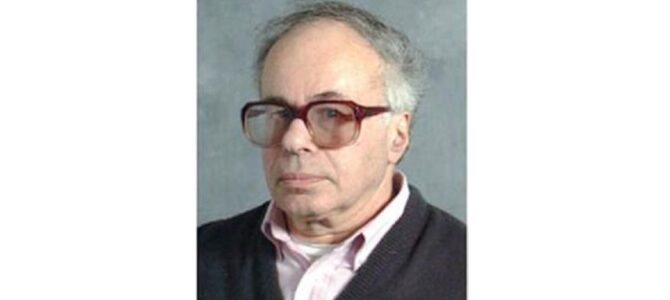
Igor Gorodishcher passed away February 7, 2021. He was born in 1955. We send our condolences to his brother Gennady at this painful time.
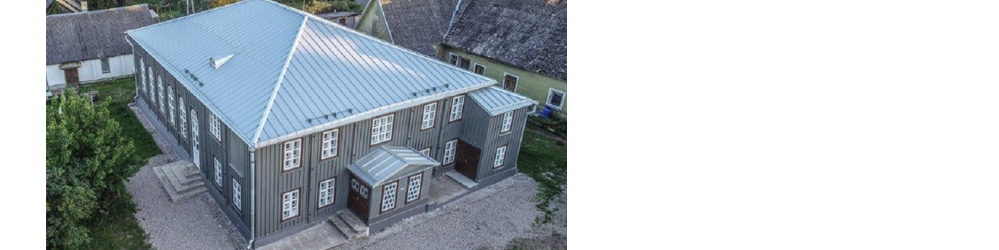
Wooden Synagogue in Alanta Renovated
Read more











Igor Gorodishcher passed away February 7, 2021. He was born in 1955. We send our condolences to his brother Gennady at this painful time.
The Lithuanian media report several stories related to recent internal dissent and the resignation of Vidmantas Valiušaitis at the Center for the Study of the Genocide and Resistance of Residents of Lithuania, usually called the Genocide Center, a state-financed arbiter of the official Lithuanian version of history.
Delfi.lt reported Lithuanian speaker of parliament Viktorija Čmilytė-Nielsen said it was too early to talk of replacing Genocide Center’s recently-appointed director Adas Jakubauskas, but called the problems there real, and said she thought a parliamentary commission should be formed to look into complaints which came to light last week when staff historians at the state institution published an open letter issued as an appeal to the speaker of parliament, complaining history was being politicized under the current director, see https://www.delfi.lt/news/daily/lithuania/cmilyte-nielsen-kelti-genocido-centro-vadovybes-kaitos-klausima-tikrai-per-anksti.d?id=86384653 for the complete story in Lithuanian. Long-time observers note the Genocide Center has always been politicized and that is its main mission as defined in law, to present a politicized version of history.
Delfi.lt also carried an in-depth account of a discussion held last week on Lithuania’s Žinių Radijas talk radio station between Vytautas Bruveris, a writer and journalist who has won much public respect for his reporting and editorials over the years at Lithuania’s Lietuvos rytas newspaper, and Vidmantas Valiušaitis, a writer with an ultra-nationalist view of Lithuanian history who has worked as a newspaper writer and whose work has been featured in the official magazine of the Lithuanian military, Karys. Valiušaitis’s appointment to a post created especially for him by the new director of Genocide Center was one of the main complaints in the appeal staff and historians sent to the speaker of parliament. The text in Lithuanian can be found here:
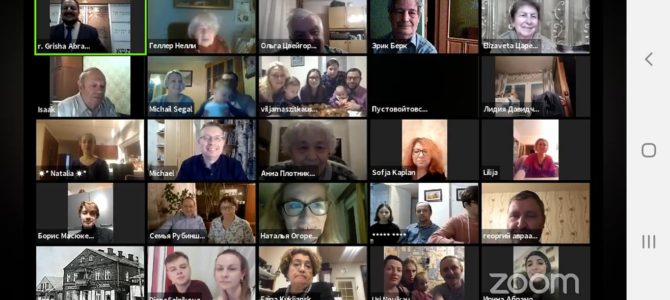
Belarussian progressive Jewish Community Beit Simha’s Rabbi Grigoriy Abromovich created an international project to link up cities in Lithuania, Belarus and Israel and Lithuanian Jewish Community social programs director Žana Skudovičienė was an important part of the project on the evening of Friday, February 6, when more than 40 families celebrated Sabbath together via internet.
“We know and love the Jerusalem of Lithuania Jewish Community and we love visiting there [Vilnius]. New technology allows us to be closer together despite distance in time and space,” Rabbi Abromovich said.
Lithuanian Jewish Community chairwoman Faina Kukliansky said we all miss communication and support because of the difficult period of the viral pandemic, and the Sabbath has the unique ability to bring us all together.
Michailis Segalis, LJC executive director, said: “During Passover we say to one another: next year in Jerusalem. Today I’d like to rephrase that wish and say to all our virtual Sabbath participants: next year in Minsk, Vilnius and, perhaps, we will all celebrate Sabbath in Jerusalem.”
A big thank you to all who made the virtual Sabbath possible and participated. Thank you for your kind words and smiles.

by Wailana Kalama

After a long absence, the Jewish staple has returned to the Lithuanian capital
Most food historians place the origin of the bagel somewhere vaguely in the Jewish alleys of the Polish-Lithuanian Commonwealth. In those days in Lithuania’s capital, Vilnius–also known as Vilna, the city once dubbed the “Jerusalem of the North”–bagels were ubiquitous, sold on the streets, and in the bakeries and markets. In modern times, however, the bagel had all but been erased from popular memory. Until now.
For centuries, the city’s Old Town was home to a thriving community of Litvaks, as local Jews referred to themselves. The district was lauded for its cultured elite and a Great Synagogue that attracted scholars from all over Europe. All that changed with the Holocaust, during which 95% of Lithuanian Jews were deported and murdered. Now, all that remains in the Old Town are monuments to what once was: street signs in Yiddish, inscriptions educating about the ghetto, a bust of the famed intellectual Vilna Gaon.

Maja celebrated a milestone birthday February 4. She is a chemist and teacher, a wonderful housewife and an active member of the Šiauliai Regional Jewish Community. It is our pleasure to wish her a very happy birthday and much health, a happy family and many wonderful moments with her grandchildren.
We have learned the sad news of the death of Jakovas Gurinas’s mother in the United States. Our deepest condolences to her family and friends.
Fayerlakh ensemble musician Igoris Dolgopolovas has died. The Lithuanian Jewish Community and members of the Fayerlakh Jewish song and dance ensemble extend our deepest condolences to his family and friends.
Aida Galvanauskienė passed away January 18, 2021. She was born in 1966. Our deepest condolences to her son Erlandas and daughter Estela on the loss of their beloved mother, and to brother Artūras on the loss of his sister.
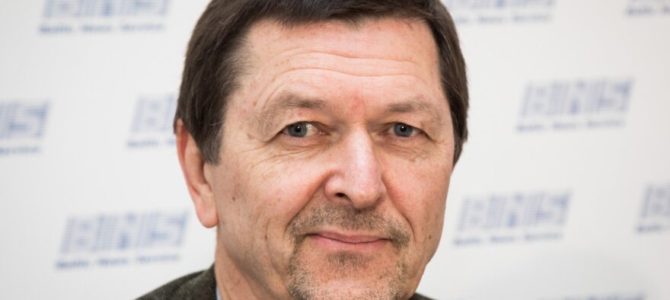
Vidmantas Valiušaitis announced he is quitting the post of advisor to the general director of the Center for the Study of the Genocide and Resistance of Residents of Lithuania (Genocide Center). He served in the post for five-and-a-half months. Valiušaitis said a letter by Center staff was partially responsible for his leaving.
The webpage of Lithuanian Public Radio and Television reported last week on an appeal a group of Genocide Center researchers made to their general director Adas Jakubauskas and parliamentary leaders, complaining research had become ideologized and politicized following a change in leadership.
They also complained of a stressful and emotional work environment, and said experienced historians were leaving because of pressure from the leadership. Their appeal singled out Vidmantas Valiušaitis as an issue of concern, saying a special post had been created for him specifically with job requirements tailored especially for him, introducing a skills requirement which was unconnected with the activities carried out by the Genocide Center.
Full article in Lithuanian here.
by G. Jaruševičiūtė, ELTA
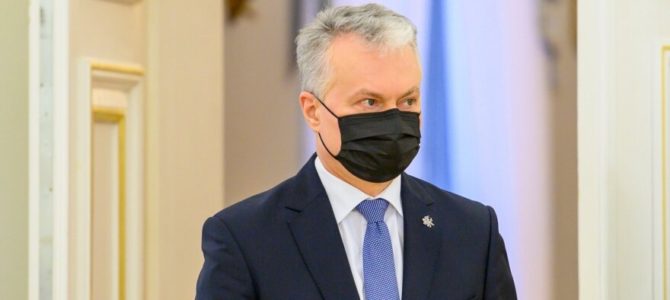
Lithuanian president Gitanas Nausėda criticized scandalous statements on the Holocaust by Conservative MP Valdas Rakutis. He said he regretted people with such great political responsibility sometimes make these sorts of statements painful to the families of Holocaust victims.
“It’s really a regretful misunderstanding made on this very important commemorative day when we all again bow and stand in memory with the victims, the Jewish people during World War II. And it’s a shame that we sometimes hear these kinds of speculations by people with great political responsibility which cause further pain to relatives of the victims, and pain to our partners,” president Nausėda said at a press conference at the Office of President.
He expressed hope the correct conclusions would be drawn from Rakutis’s statements.
“I hope the conclusion will be drawn that this person’s opinion, specially that of Mr. Valdas Rakutis, in no way expresses the opinion of the party, the parliamentary faction or the parliament. I think there have been sufficient comments made and denials issued from the head of the party, but still we apologize for the lack of understanding and request no hurried conclusions be made,” the president said.
Full report in Lithuanian here.
by Arkadijus Vinokuras
The events shaking the Genocide Center in the last few days are the logical result of several years of flawed policy. This is what happens when responsibility for research into and assessment of historical events is passed into the hands of politically-agitated profaners. According to the professional historians who are finally quitting the Genocide Center, this leads to: “the disappearance of the distinction between the work of professional specialists and amateurish initiatives. In terms of both historical research and the field of commemoration and the authoring and publication of documents, there is a danger that this will become an imitation of academic and expert work and a profanation of academic research.”
So, the honorable historians of the Genocide Center confirmed in a statement they released what I have been repeating for several years now: there simply cannot be a state institution whose task it is to perform objective studies in connection with the history of our country, if it is led by radicals appointed by politicians rather than professional historians. All these sorts of self-declared historians–geologists, philologists and mechanics–cannot prepare properly findings of history for the courts and other important institutions. All the more so if they don’t even consult with professional historians.
The result of this dishonest and likely criminal activity (when history is written based not on facts but on politically-motivated interpretations and myths) are findings of history, binding legally. Thus Kazys Škirpa, who collaborated with the Nazis, dreamt of a Nazi Lithuania and drove the Jews out, is proclaimed a Lithuanian hero. The same goes for Jonas Noreika, who for two years acted as a Holocaust perpetrator, and if his heroization isn’t enough, now he has become “a rescuer of Jews.” And those Jews, allegedly, “themselves, of their own volition, barricaded themselves in ghettos.” So did other Lithuanians as well “themselves, of their own will, yearned to leave for Siberia?” Isn’t it pathetically funny, the Genocide Center’s self-justification is “our Holocaust was different, and collaboration with the Nazis was also different than in other places?” Another example: Juozas Ambrazevičius-Brazaitis, who was, it seems, “vindicated and rehabilitated by US institutions.” This is how the brains of Lithuanian people with no connection are washed, people who find it very difficult to determine where the truth lies, and where the lie does.
Three university history staff and the head of the Lithuanian History Institute report they cannot cooperate any loner with the Center for the Study of the Genocide and Resistance of Residents of Lithuanian (Genocide Center) because of the policies carried out by the leaders of the latter.
Lithuanian History Institute director Alvydas Nikžentaitis, Vilinius University History Faculty dean Loreta Skurvydaitė, Klaipėda University Baltic Regional History and Archaeological Institute director Vasilijus Safronovas and Vytautas Magnus University head of History Faculty Marius Sirutavičius sent notice of this decision to Lithuanian parliamentary speaker Viktorija Čmilytė-Nielsen Monday.
Meanwhile, Genocide Center general director Adas Jakubauskas reported some staff there are dissatisfied with reforms underway there and are making noises about that in the community of historians.

Following International Holocaust Remembrance Day, the Israeli-American Civic Action Network (ICAN) has launched an issue education initiative to ensure all 535 members of the United States Congress learn about the ongoing Holocaust revisionism campaign perpetrated by the Lithuanian government.
“The Republic of Lithuania is engaged in a cynical, dishonest, and morally bankrupt campaign to deny and distort facts about the Holocaust. Facts supported by indisputable evidence, which proves that Lithuanians engaged in Holocaust crimes on a massive scale,” said Dillon Hosier, CEO at ICAN.
“The Lithuanian government not only hides the criminal histories of Holocaust perpetrators but adds insult to injury by bestowing their highest national honors to those who are proven murderers of Jews,” Hosier concluded. “If the Lithuanian government is able to effortlessly lie about history’s greatest crime, then it begs the question: what won’t they lie about?”
On three separate occasions dating back to February 26, 2018, the Genocide and Resistance Research Center of Lithuania (LGGRTC) falsely claimed that the United States Congress and the United States Immigration and Naturalization Service (INS) “completely exonerated” Juozas Ambrazevičius-Brazaitis for culpability in the murder of Jews in Lithuania. In response to inquiries and objections from senior members of Congress about these false claims, Lithuania responded that these members of Congress were “just politicians” and that their opposition has no merit.
ICAN’s initiative to educate Congress about Lithuania’s campaign to deny and distort certain facts about the Holocaust will be launched alongside the publication of “The Nazi’s Granddaughter: How I Discovered My Grandfather was a War Criminal” written by Silvia Foti, available on March 9, 2021.
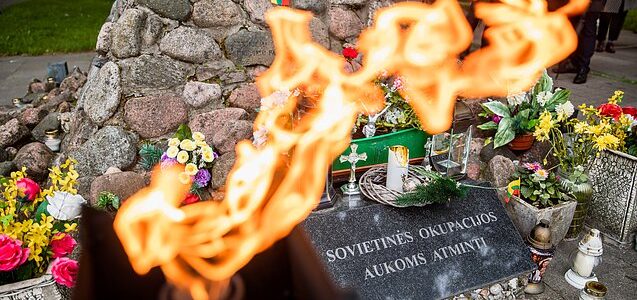
Photo: Ceremony to commemorate victims of occupation, genocide and Soviet repression. J. Stacevičius/LRT
by Modesta Gaučaitė-Znutienė, LRT.lt

You speak up, you receive a warning. That’s what happened to a Center for the Study of the Genocide and Resistance of Residents of Lithuania (Genocide Center) historian who openly criticized the current situation there. The director of Genocide Center says the warning was issued because of unprofessional behavior.
LRT.lt reminds readers we have written before about doubts expressed by Genocide Center employees regarding attempts to politicize the Center’s activities as well as regarding the decision to present the status of freedom fighter to deputy general director Vidmantas Valiušaitis. Now it turns out historian Mingailė Jurkutė has received an official warning for publicly airing her concerns.
Received Letter from Advisor to the Director
Historian Monika Kareniauskaitė who no longer works at the Center shared a post on social media Thursday saying she still thinks the Center is one of the institutions working in the field of memory studies with the greatest potential. Nonetheless, she observed problems and poor practices which didn’t affect her alone. Kareniauskaitė said if she had been only one to suffer in this situation, she would’ve kept silent, but her colleagues were coming up against the same things.
Delfi.lt, BNS
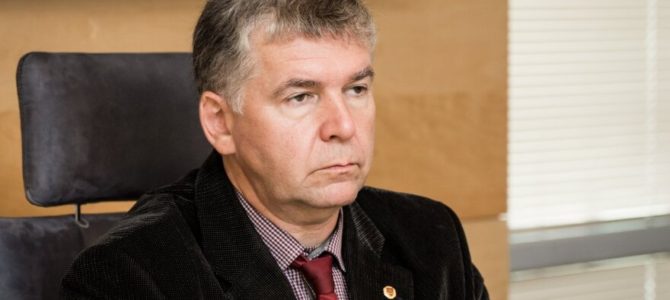
Conservative Lithuanian MP Valdas Rakutis has resigned as chairman of the parliament’s Commission on the Battles for Freedom and State Historical Memory following criticism of his statements about the Holocaust.
“Asked by the leadership of the Homeland Union/Lithuanian Christian Democrat [Conservative] Party and parliamentary faction, accepting political responsibility, and not wanting the very important work of the Commission on the Battles for Freedom and State Historical Memory to be made more difficult by this statement of mine, and also following the Western political tradition, I have decided to take the honorable step and to withdraw from the post of chairman of this commission,” the MP said in a statement released Friday. “I hope this step will help calm unnecessary tension both within the country and abroad with our important strategic partners, and will allow for further discussion to develop in a constructive direction,” he said.
Full story in Lithuanian here.
You Are Quiet Again, as You Were in 1941
A comment on the silent state and the vociferous Rakutises
The Lithuanian Jewish Community, along with tens of thousands of Lithuanian Jews who were captured on the streets, locked in ghettos, marched to pits and shot and buried there, often close to their own hometowns, or shtetlakh, as Jews call them, where for centuries they had lived in common with Lithuanians–we are again guilty. Member of parliament of the Republic of Lithuania Valdas Rakutis in his commentary has said nothing new, and only repeats the mendacious and misleading narrative which has gone on for decades: We ourselves, the Jews, are guilty for the extermination of 95% of the Jews who lived in Lithuania before World War II.
I have met many such Rakutises, they always say the same thing. It is horrific that today these Rakutises also speak confidently in the parliament of the Republic of Lithuania, they are published and quoted, and again and again they blame those who were escorted by their neighbors to collection points in 1941, to synagogues, and from there to margins of forests and gravel pits, for the horror of the Holocaust.
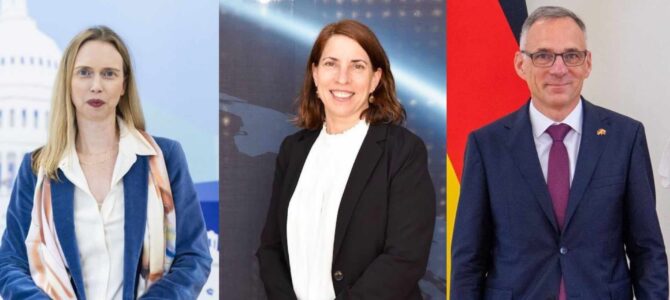
It is said that all those who remained looked on in silence as the columns of Jewish men, women and children were marched along the streets of the towns in broad daylight. And now we have the same sort of situation: there isn’t much reaction at all to the lie of these Rakutises. The majority remain silent. There are some soft noises from his fellow party members, a few observations and speculations that maybe “Rakutis was mistaken,” but nothing even close to the precise and sharp uncompromising reaction demonstrated by the foreign embassies to Lithuania. The German, Israel and US ambassadors to Lithuania were among the first to condemn clearly and publicly Rakutis’s statement. The European Jewish Congress also responded as did the Jewish communities living abroad. The words by the Lithuanian MP didn’t slip by unnoticed by any of the Western states, where they react without excuse or compromise to open or hidden attempts to distort history and to expressions of anti-Semitism.
DELFI.lt and BNS
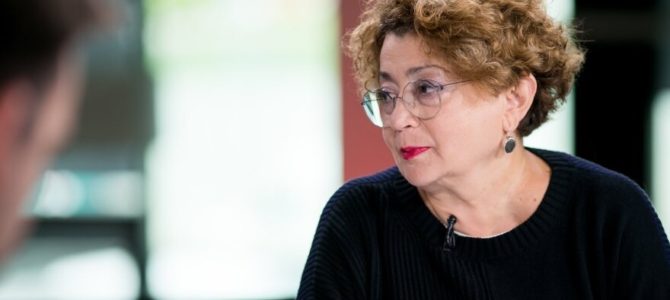
Lithuanian Jewish Community chairwoman Faina Kukliansky reacted to MP Valdas Rakutis’s statement on the Holocaust by demanding the Office of General Prosecutor initiate a pre-trial investigation on Holocaust denial and distortion.
“Representing the Lithuanian Jewish Community, I demand … the prosecutor general begin a pre-trial investigation on Holocaust denial and distortion.
“Slaps on the hand don’t satisfy us. We, citizens of Lithuania, Jews living here, demand the rule of law and defense of our basic rights. And in the end, you should feel shame before those whose blood soaks the land of Lithuania,” Kukliansky said in a statement to the press.
The Office of Prosecutor General said they would consider beginning an investigation after they receive a complaint. “Currently this complaint has not yet been received, but if it is received, it will be considered in the prescribed manner and the corresponding decision will be made,” Office of Prosecutor General press representative Elena Martinonienė told BNS.

(JTA)–The U.S. ambassador to Lithuania has accused a senior Lithuanian lawmaker of distorting the history of the Holocaust and blaming Jews for it.
Robert Gilchrist, who took up the post in February last year, made the charge following a speech Wednesday by Valdas Rakutis, a member of the Seimas, Lithuania’s parliament, and chairman of its commission on historical memory.
“There was no shortage of Holocaust perpetrators among the Jews themselves, especially in the ghetto self-government structures,” Rakutis said in the speech, which took place on International Holocaust Remembrance Day. “We need to name these people out loud and try not to have people like them again.”
Rakutis also said that two wartime collaborators with Nazi Germany, Kazys Škirpa and Jonas Noreika, were not to blame for the fact that more than 95% of Lithuanian Jewry was murdered, mostly by locals and often by followers of the two leaders.
The speech prompted rare recrimination from the U.S. ambassador as well as from advocates who monitor anti-Semitism in the region.
“It is shocking that on International Holocaust Remembrance Day, of all days, a member of Seimas should espouse distortions regarding Holocaust collaborators in Lithuania and shamefully seek to accuse Jews of being the perpetrators,” Gilchrist wrote on Twitter under the official account for the U.S. Embassy in Vilnius.
Efraim Zuroff, director of Eastern European affairs at the Simon Wiesenthal Center, said in a statement: “Rakutis has clearly demonstrated that he is totally unsuited to head the Seimas committee on national memory, unless lying about Lithuanian history is the main requirement for the post.”