
History of the Jews in Lithuania

Sent to Siberia Despite Rescuing Jews

Sent to Siberia Despite Rescuing Jews

Photo: Lithuanian deportees en route to Siberia. Center: Family of B. and I. Jablonskiai. The only known photograph in Lithuania of a deportation cattle wagon.

by Romualdas Beniušis

This year marks 70 years since the third large post-war deportation operation Osen (Autumn) carried out by the Soviet security structures (MGB) on October 2 and 3, 1951, during which more than 16,000 people deemed “bourgeoisie,” including 5,000 children, were packed into cattle cars and deported to Siberia.

At that time, 39 children didn’t reach their places of exile. Their deaths marked the way along which Lithuanians were deported to Siberia. This time, the lists of deportees were entrusted to the local government administration and Party committees because it had become ever more difficult to find the “bourgeoisie” needed for carrying out the deportation plans. Thus the opportunity arose to include on the list of people to be deported those the local government didn’t like, the more educated, and even people who lived in the cities, carrying out personal grudges and to seize the property of the deportees.

Since only a few days passed between the confirmation of the lists and the beginning of deportations, the deportations began to be carried out without formal deportation cases which were drawn up later. The barely-literate locals who compiled the lists and usually foreign MGB officials who drafted the formal cases made endless mistakes in those documents, distorting surnames, dates of birth and so on, but this did not become an obstruction on the way to Siberia.

Lithuanian History Institute Director Tells Parliamentary Speaker Genocide Center Planned Propaganda Campaigns

Lithuanian History Institute Director Tells Parliamentary Speaker Genocide Center Planned Propaganda Campaigns

15min.lt

Speaker of Lithuanian parliament Viktorija Čmilytė-Nielsen met representatives Tuesday of universities and the Lithuanian History Institute to discuss the situation at Lithuania’s Genocide Center, following a boycott of Genocide Center announced by these institutions. Lithuanian History Institute director Alvydas Nikžentaitis said the problem is not just a domestic one and needs a final solution.

Historians from Vilnius University, Vytautas Magnus University, Klaipėda University and the Lithuanian History Institute sent the speaker a letter complaining the new leadership of Genocide Center under Adas Jakubauskas after he was appointed in February of 2020 had led to a primitive politicization of sensitive and painful events of the past without taking sources into account. They said they could no longer work with Genocide Center under those conditions, and didn’t agree with unprofessional statements made by representatives of the Genocide Center.

Nikžentaitis said there had been indications very long before Jakubauskas’s appointment that things weren’t right at the Center, and that his colleagues had made numerous complaints. Nikžentaitis said some of them were even persecuted for expressing their opinion regarding the Center. Nikžentaitis listed among other complaints that there were allegedly discussions inside Genocide Center that if the current director of the Center’s Department of Historical Research [Arūnas Bubnys] withdrew from the post, he would be given a different post, while behind the scenes agreement was reached on replacing him with another person more obedient to the leadership.

“So basically this was preparing the ground, let’s say, for preparing opinions very far from academic at the Center, so that the Center would be ready to carry out specific propaganda goals,” Nikžentaitis said.

On the meeting with the speaker of parliament, Nikžentaitis said they discussed how to change the existing situation. He added that in a certain sense the problems at Genocide Center were pre-programmed from its very inception.

Full article in Lithuanian here.

Mass Murders in Utena: Memories of the Holocaust

Mass Murders in Utena: Memories of the Holocaust

Photo: Just a few buildings witnessing to the Jewish past still stand in Utena.

Translated to Lithuanian by Vytautas Ridikas from Massacres in Utena by Tsozdik Bleiman writing in Russian

§§§

As the only living witness left, I am able to share some special memories.

My father Jakov Bleiman, who was formerly a rabbi in Crimea, performed the same duties in Utena, where my brother-in-law Efraim Yudelovich also lived with the family. At the beginning of the war I lived in Kaunas.

I decided to see my parents and then, if the right conditions were in place, to evacuate with the entire family. As it turned out there was no way to leave for somewhere, because just as I arrived in the city the Germans entered. Our fate became clear: we were all condemned to death.

Thursday. The first day of the German regime. Dozens of Jews are herded to work, led to the Germans and their Lithuanian helpers. The work is meaningless and insignificant, just in order to deride the Jews, sending them around all day with brooms, shovels and other implements.

Bringing Bagels Back to Vilnius

Bringing Bagels Back to Vilnius

by Wailana Kalama

After a long absence, the Jewish staple has returned to the Lithuanian capital

Most food historians place the origin of the bagel somewhere vaguely in the Jewish alleys of the Polish-Lithuanian Commonwealth. In those days in Lithuania’s capital, Vilnius–also known as Vilna, the city once dubbed the “Jerusalem of the North”–bagels were ubiquitous, sold on the streets, and in the bakeries and markets. In modern times, however, the bagel had all but been erased from popular memory. Until now.

For centuries, the city’s Old Town was home to a thriving community of Litvaks, as local Jews referred to themselves. The district was lauded for its cultured elite and a Great Synagogue that attracted scholars from all over Europe. All that changed with the Holocaust, during which 95% of Lithuanian Jews were deported and murdered. Now, all that remains in the Old Town are monuments to what once was: street signs in Yiddish, inscriptions educating about the ghetto, a bust of the famed intellectual Vilna Gaon.

Time for Genocide Center to Halt Mob Rule and Communist Censorship

Time for Genocide Center to Halt Mob Rule and Communist Censorship

by Arkadijus Vinokuras

The events shaking the Genocide Center in the last few days are the logical result of several years of flawed policy. This is what happens when responsibility for research into and assessment of historical events is passed into the hands of politically-agitated profaners. According to the professional historians who are finally quitting the Genocide Center, this leads to: “the disappearance of the distinction between the work of professional specialists and amateurish initiatives. In terms of both historical research and the field of commemoration and the authoring and publication of documents, there is a danger that this will become an imitation of academic and expert work and a profanation of academic research.”

So, the honorable historians of the Genocide Center confirmed in a statement they released what I have been repeating for several years now: there simply cannot be a state institution whose task it is to perform objective studies in connection with the history of our country, if it is led by radicals appointed by politicians rather than professional historians. All these sorts of self-declared historians–geologists, philologists and mechanics–cannot prepare properly findings of history for the courts and other important institutions. All the more so if they don’t even consult with professional historians.

The result of this dishonest and likely criminal activity (when history is written based not on facts but on politically-motivated interpretations and myths) are findings of history, binding legally. Thus Kazys Škirpa, who collaborated with the Nazis, dreamt of a Nazi Lithuania and drove the Jews out, is proclaimed a Lithuanian hero. The same goes for Jonas Noreika, who for two years acted as a Holocaust perpetrator, and if his heroization isn’t enough, now he has become “a rescuer of Jews.” And those Jews, allegedly, “themselves, of their own volition, barricaded themselves in ghettos.” So did other Lithuanians as well “themselves, of their own will, yearned to leave for Siberia?” Isn’t it pathetically funny, the Genocide Center’s self-justification is “our Holocaust was different, and collaboration with the Nazis was also different than in other places?” Another example: Juozas Ambrazevičius-Brazaitis, who was, it seems, “vindicated and rehabilitated by US institutions.” This is how the brains of Lithuanian people with no connection are washed, people who find it very difficult to determine where the truth lies, and where the lie does.

Unpleasant Surprise at the Genocide Center: Historian Warned over Doubts Expressed Publicly

Unpleasant Surprise at the Genocide Center: Historian Warned over Doubts Expressed Publicly

Photo: Ceremony to commemorate victims of occupation, genocide and Soviet repression. J. Stacevičius/LRT

by Modesta Gaučaitė-Znutienė, LRT.lt

You speak up, you receive a warning. That’s what happened to a Center for the Study of the Genocide and Resistance of Residents of Lithuania (Genocide Center) historian who openly criticized the current situation there. The director of Genocide Center says the warning was issued because of unprofessional behavior.

LRT.lt reminds readers we have written before about doubts expressed by Genocide Center employees regarding attempts to politicize the Center’s activities as well as regarding the decision to present the status of freedom fighter to deputy general director Vidmantas Valiušaitis. Now it turns out historian Mingailė Jurkutė has received an official warning for publicly airing her concerns.

Received Letter from Advisor to the Director

Historian Monika Kareniauskaitė who no longer works at the Center shared a post on social media Thursday saying she still thinks the Center is one of the institutions working in the field of memory studies with the greatest potential. Nonetheless, she observed problems and poor practices which didn’t affect her alone. Kareniauskaitė said if she had been only one to suffer in this situation, she would’ve kept silent, but her colleagues were coming up against the same things.

Statement by LJC Chairwoman on Recent Holocaust Denial by Lithuanian MP

Statement by LJC Chairwoman on Recent Holocaust Denial by Lithuanian MP

You Are Quiet Again, as You Were in 1941

A comment on the silent state and the vociferous Rakutises

The Lithuanian Jewish Community, along with tens of thousands of Lithuanian Jews who were captured on the streets, locked in ghettos, marched to pits and shot and buried there, often close to their own hometowns, or shtetlakh, as Jews call them, where for centuries they had lived in common with Lithuanians–we are again guilty. Member of parliament of the Republic of Lithuania Valdas Rakutis in his commentary has said nothing new, and only repeats the mendacious and misleading narrative which has gone on for decades: We ourselves, the Jews, are guilty for the extermination of 95% of the Jews who lived in Lithuania before World War II.

I have met many such Rakutises, they always say the same thing. It is horrific that today these Rakutises also speak confidently in the parliament of the Republic of Lithuania, they are published and quoted, and again and again they blame those who were escorted by their neighbors to collection points in 1941, to synagogues, and from there to margins of forests and gravel pits, for the horror of the Holocaust.

It is said that all those who remained looked on in silence as the columns of Jewish men, women and children were marched along the streets of the towns in broad daylight. And now we have the same sort of situation: there isn’t much reaction at all to the lie of these Rakutises. The majority remain silent. There are some soft noises from his fellow party members, a few observations and speculations that maybe “Rakutis was mistaken,” but nothing even close to the precise and sharp uncompromising reaction demonstrated by the foreign embassies to Lithuania. The German, Israel and US ambassadors to Lithuania were among the first to condemn clearly and publicly Rakutis’s statement. The European Jewish Congress also responded as did the Jewish communities living abroad. The words by the Lithuanian MP didn’t slip by unnoticed by any of the Western states, where they react without excuse or compromise to open or hidden attempts to distort history and to expressions of anti-Semitism.

Lithuanian Jewish Community Chairwoman Demands Investigation for Holocaust Denial

Lithuanian Jewish Community Chairwoman Demands Investigation for Holocaust Denial

DELFI.lt and BNS

Lithuanian Jewish Community chairwoman Faina Kukliansky reacted to MP Valdas Rakutis’s statement on the Holocaust by demanding the Office of General Prosecutor initiate a pre-trial investigation on Holocaust denial and distortion.

“Representing the Lithuanian Jewish Community, I demand … the prosecutor general begin a pre-trial investigation on Holocaust denial and distortion.

“Slaps on the hand don’t satisfy us. We, citizens of Lithuania, Jews living here, demand the rule of law and defense of our basic rights. And in the end, you should feel shame before those whose blood soaks the land of Lithuania,” Kukliansky said in a statement to the press.

The Office of Prosecutor General said they would consider beginning an investigation after they receive a complaint. “Currently this complaint has not yet been received, but if it is received, it will be considered in the prescribed manner and the corresponding decision will be made,” Office of Prosecutor General press representative Elena Martinonienė told BNS.

Ona Šimaitė: First Lithuanian Righteous Gentile Who Lived the Spirit of the National Anthem

Ona Šimaitė: First Lithuanian Righteous Gentile Who Lived the Spirit of the National Anthem

Excerpts from Ona Šimaitė’s memoirs and Rimantas Stankevičius’s book “Gyvenusi tautos himno dvasia” [She Lived the Spirit of the National Anthem].

The Name Which Became Legend

Ona Šimaitė:

“I was too close to Jews during their time of great misfortune not to express my wonder at their unbreakable heroism and moral fortitude in the face of the death of their people on the other side of the barb-wire fence of the ghetto. You could say any people would have been broke physically and morally if they had to experience what every single Jew experienced. The Jews in the ghetto were heroes who never called themselves that.

“During that horrific time for Jews (and for all people of conscience) I often used to think that after it was all over, what the Jewish people had experienced would open the eyes of many people, and that we would only know about the hatred of Jews in archives and museums.

“But I was very wrong.

“Only a small portion of non-Jews remember the horrible means the Nazis used to exterminate thousands of Jews, and how Jewish children, women and the elderly were murdered.

“And shame to those who forget by whose hands this was accomplished, and who saved Jewish lives.”

Interview with Ruth Reches on the Holocaust

Interview with Ruth Reches on the Holocaust

Photo: Ruth Reches, by J. Stacevičius, courtesy LRT.lt

by Domantė Platūkytė

Life in the lion’s den, classmates as part of execution squads and concentration camps. These are aspects of Ruth Reches’s family life she shared with the LRT.lt website. Her grandmother after coming back from a concentration camp found the family home occupied. The new owners brought out a tub of water and let them spend the night on the ground in an adjacent shack. “What happened in Lithuania can’t be understood and explained rationally,” Reches said.

Reches, the principal of the Sholem Aleichem ORT Gymnasium and a doctor of psychology, gave an interview to LRT.lt and spoke about her grandparents surviving the Holocaust, the brutality of people and the impulse to aggression disinhibited by the war.

“When neighbors and classmates murder people… My grandfather’s mother was murdered by my grandfather’s brother’s classmates in Alytus. There are so many stories where teachers shot their students, and the town priest rang the bells so the shots wouldn’t be heard,” Reches, who has a published a book about the Holocaust and self-identity, said.

She said the experiences of the Holocaust haunted her grandparents their entire lives.

“The Holocaust left trauma in my grandparents’ lives because the environment to which they returned after the war was hostile and traumatizing. They returned to their hometowns and my grandparents saw their homes had been taken, and society wasn’t ready to accept them back. They felt no support from society, only anger that they had survivied,” Reches told LRT.

No More Lies. My Grandfather Was a Nazi.

No More Lies. My Grandfather Was a Nazi.

The author’s grandfather, Jonas Noreika. Family photograph

In Lithuania, he was celebrated as a hero. But we can’t move on until we admit what he really did.

by Silvia Foti

Ms. Foti is a journalist and the author of the forthcoming “The Nazi’s Granddaughter: How I Learned My Grandfather Was a War Criminal.”

When I was growing up in Chicago during the Cold War, my parents taught me to revere my Lithuanian heritage. We sang Lithuanian songs and recited Lithuanian poems; after Lithuanian school on Saturdays, I would eat Lithuanian-style potato pancakes.

My grandfather, Jonas Noreika, was a particularly important part of my family story: He was the mastermind of a 1945-1946 revolt against the Soviet Union, and was executed. A picture of him in his military uniform hung in our living room. Today, he is a hero not just in my family. He has streets, plaques and a school named after him. He was awarded the Cross of the Vytis, Lithuania’s highest posthumous honor.

On her deathbed in 2000, my mother asked me to take over writing a book about her father. I eagerly agreed. But as I sifted through the material, I came across a document with his signature from 1941 and everything changed. The story of my grandfather was much darker than I had known.

Full story here.

When No Eye-Witnesses Remain: LJC Invites Public to Internet Discussion on Holocaust

To mark International Holocaust Remembrance Day, the Lithuanian Jewish Community is holding an internet discussion called “When No Eye-Witnesses Remain” at 2:00 P.M. on Wednesday, January 27, at https://www.facebook.com/zydubendruomene

LJC chairwoman Faina Kukliansky, who helped initiate the virtual conference and plans to take part, said: “There are ever fewer Holocaust witnesses who can take an active part in educating society. When the last eye-witnesses die, all responsibility for preserving memory will pass to the younger generations. Memory of the Holocaust should become simply an history lesson where dates, names and locations are the most significant. It should be an eternal lesson in human moral values which moves the heart as well as the mind.”

Watch live, starting at 2:00 P.M.:

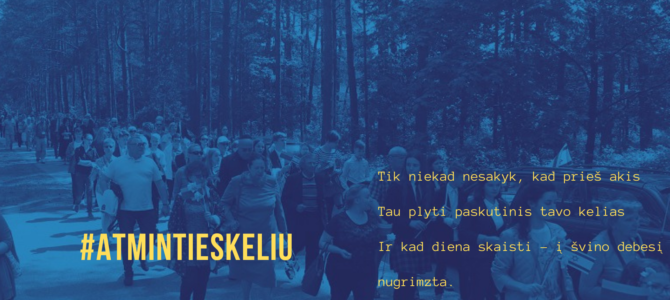
Remembering and Honoring Holocaust Victims: Global #MesPrisimename/ #WeRemember Campaign

Remembering and Honoring Holocaust Victims: Global #MesPrisimename/ #WeRemember Campaign

by Nadežda Spiridonovienė, historian, museum specialist, Nalšia Museum

Lithuania along with the United Nations marks Holocaust Remembrance Day on January 27. Only by preserving the memory of the victims of the Holocaust can we create a safe future for humanity, the kind in which no anti-Semitism, racial, ethnic and religious hatred and discrimination would remain.

We remember the tragedy of the extermination of 6 million European Jews on International Holocaust Remembrance Day.

What happened to people during the Holocaust? What happened in Švenčionys where Lithuanians, Jews, Tartars, Ukrainians, Poles, Russians and other peoples lived together? Where within a territory of a few kilometers people prayed at Catholic church, five synagogues, the Orthodox church and other houses of prayer? What happened 80 years ago to people if there was such a catastrophe, and what can the younger generation do today to insure it never happens again?

They Aren’t Beating Jews on the Street and Drawing Swastikas on Our Backs, But There’s Still a Lot of Hate

They Aren’t Beating Jews on the Street and Drawing Swastikas on Our Backs, But There’s Still a Lot of Hate

According to the Lithuanian Jewish Community, there are currently about 5,000 Jews living in Lithuania, constituting less than one percent of the country’s total population. Despite their small demographic spread, members of the Jewish community living in Lithuania continue to encounter a lack of tolerance and expressions of hate. Lithuanian Jewish Community chairwoman Faina Kukliansky says that although no one is beating Jews or drawing swastikas on their backs, there could be a lot more respect and the sense of shared humanity.

No lack of angry comments, go back to Israel

“Thirty years of independence have expanded our society’s horizons and made us more tolerant of one another. Travelling in other countries people begin to recognize diversity and realize we are all different. Even so, when some positive information appears in the public space about Jews and supportive of this community in Lithuania, there come endless disgusting comments and hate speech,” Kukliansky said.

She revealed she had experienced a number of anti-Semitic attacks in her life and therefore would never allow herself to think of another person as somehow lesser because of their ethnicity, race or other characteristics.

Happy Birthday, Vilnius

Happy Birthday, Vilnius

We are celebrating the official birthday of Vilnius with great enthusiasm and devotion, and on this occasion we would like to share with you an extraordinary work; Rafailas Karpis and Darius Mažintas accompanied by Dalia Dedinskaite on violin and Gleb Pyšniak on cello present the music video “A Tour of Jewish Vilnius” using the musical composition of Anatolijus Šenderovas.

More on the #MesPrisimename Campaign to Remember the Victims of the Holocaust

More on the #MesPrisimename Campaign to Remember the Victims of the Holocaust

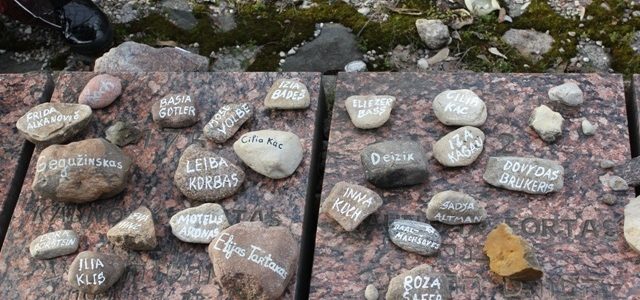
International Holocaust Remembrance Day will be marked around the world January 27 and the Lithuanian Jewish Community has and is inviting the people of Lithuania to join the #MesPrisimename (#WeRemember) campaign to remember the Jewish communities of Lithuania’s cities and towns exterminated in the Holocaust, the survivors and the rescuers.

“We remember the tragedy of the destruction of six million Jews of Europe every year at this time. We invite everyone–heads of state, politicians, the entire academic and education community and all the people of Lithuania–to remember on the eve of International Holocaust Remembrance Day the people who were murdered in the flames of the Holocaust. This is our shared loss, the loss of the entire country,” Lithuanian Jewish Community chairwoman Faina Kukliansky said.

“We appeal to the entire academic and education community: use the opportunity this day provides and give attention to educating young people on commemorating the victims of the Holocaust. Hold virtual meetings with older members of the Jewish communities who remember these horrific periods of history. We still have the unique opportunity to speak directly with the eye-witnesses of these events, so let’s use it,” she added.

Internet Discussion: When All Eye-Witnesses to the Holocaust Are Gone

Internet Discussion: When All Eye-Witnesses to the Holocaust Are Gone

The Lithuanian Jewish Community is holding an internet discussion on International Holocaust Remembrance Day, January 27, called “When All Eye-Witnesses to the Holocaust Are Gone, There Must Still Be Public Commemorations.” The internet discussion is scheduled for 2:00 P.M. Wednesday.

Participants are to include LJC chairwoman Faina Kukliansky, writer and law professor Justinas Žilinskas, Institute of the History and Archaeology of the Baltic Region Hektoras Vituks, Human Rights Monitoring Institute executive board member and philosopher Paulius Gritėnas and director of the Media and Democracy Program of the Vilnius Policy Analysis Institute Donatas Puslys. Šeduva Jewish Memorial Fund director and writer Sergejus Kanovičius is to moderate the event.

Those interested in “attending” are invited to go to the LJC facebook page for the event or youtube channel at the designated time and date.