History of the Jews in Lithuania

LJC Members Gather to CommemorateInternational Holocaust Day

LJC Members Gather to CommemorateInternational Holocaust Day

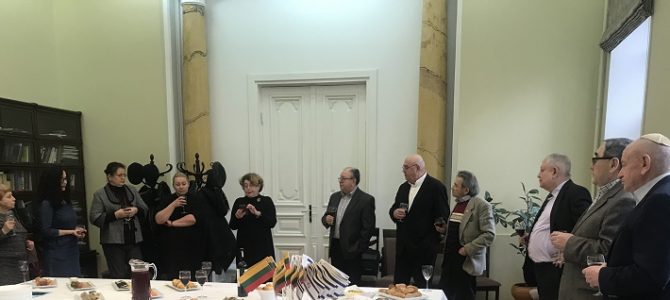
In 2005 the UN General Assembly proclaimed January 27 the International Day of Commemoration in Memory of the Victims of the Holocaust. On that day in 1945 the Red Army liberated the prisoners at the Auschqitz-Birkenau death camp.

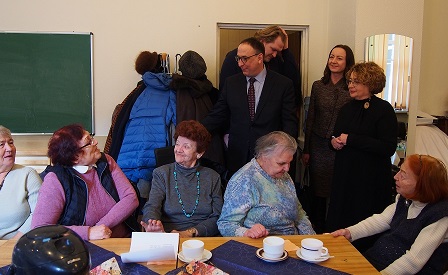
All survivors were invited to invited to come to the commemoration at the Lithuanian Jewish Community.

An exhibit of paintings by Levas Saksonovas called Holocaust was unveiled on the third floor of the LJC, at the initiative of active LJC member, doctor and photo artists Robertas Skalskis and social programs director Žana Skudovičienė. The artist’s son Danilias and art historian and researched Vera Kalmykova presented the exhibit.

Lithuanian Foreign Ministry Commemorates Holocaust Victims

Lithuanian Foreign Ministry Commemorates Holocaust Victims

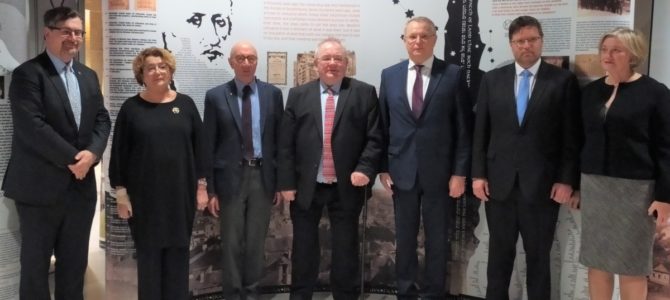
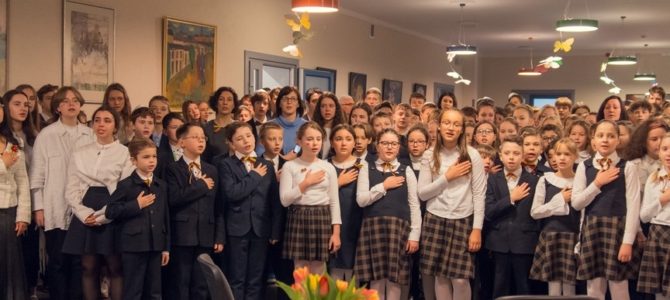
On January 28 the Lithuanian Foreign Ministry and the Lithuanian Jewish Community held a commemoration of International Holocaust Day at the ministry.

“The Holocaust is a horrid scar on humanity, on the face of Lithuania. It is a wound which likely will never heal. Let’s hope and try so that humanity never experiences this again. We are endlessly grateful to all the survivors of the Holocaust who are with us here today. In celebrating the 300th anniversary of the birth of the Vilna Gaon, we hope Vilnius will again become a center of gravity for the Jews of the entire world, as the Jerusalem of Lithuania once was,” foreign minister Linas Linkevičius said after presenting red roses to Holocaust survivors attending the event.

A student choir from the Sholem Aleichem ORT Gymnasium performed three songs in Yiddish and Lithuanian.

Israeli Litvaks Protest Lithuanian MP Gumuliauskas in Tel Aviv

Israeli Litvaks Protest Lithuanian MP Gumuliauskas in Tel Aviv

Photos: Dr. Andrejus Aron from Vilnius, resident in Israel

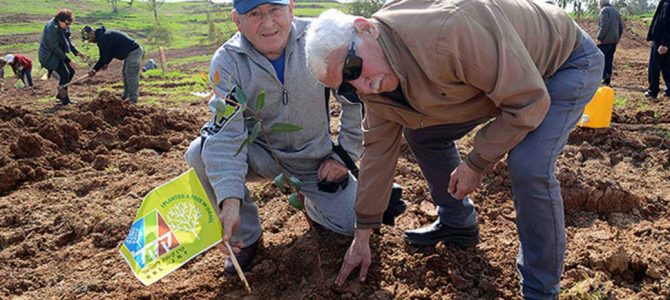
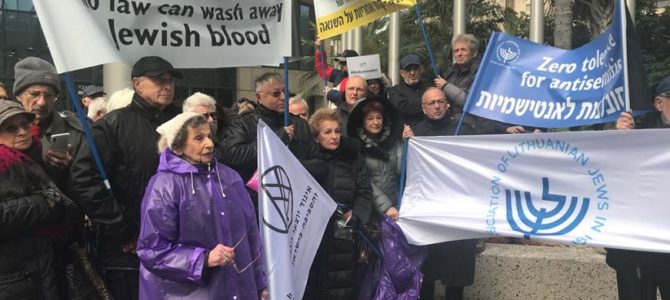
Litvaks held a protest January 24 at the Lithuanian embassy to Israel in Ramat Gan, a neighborhood of Tel Aviv.

The Association of Lithuanian Jews Living in Israel under the leadership of former Vilnius resident Arie Ben-Ari Grodzenskis sponsored the protest, which was mainly attended by elderly Litvaks, most of whom were born after the war, their grandparents having been murdered in Lithuania in the Holocaust.

Despite cold weather and rain, they gathered to remember the 220,000 Jews who lived in Lithuania before the Holocaust and built the Jerusalem of Lithuania.

The picket was aimed specifically against Lithuanian MP Arūnas Gumuliauskas, the chairman of the Lithuanian parliament’s Battles for Freedom and State Historical Memory Commission who announced in mid-December he was drafting a parliamentary resolution proclaiming the Lithuanian state and nation innocent of participating in the Holocaust, because the state and the people were under occupation, first by the Soviets and then by the Nazis.

One of the signs at the protest read: “Gumuliauskas: no law can wash away Jewish blood.”

Lithuania’s Holocaust Memory: “Reliable” or “Unreliable?”

Lithuania’s Holocaust Memory: “Reliable” or “Unreliable?”

by Grant Gochin

Many South African Jews are descended from an immigration wave from Lithuania in the 1920s. Our grandparents seldom explained the context; here it is.

During World War 1 when the current territory of Lithuania was part of Russia, the Tsarist army conducted a mass ethnic cleansing of Jews. During that period, especially in the spring of 1915, a number of Lithuanians took an active part in murdering old Jewish men, women, and even children, and plundering Jewish assets. Lithuania claims the Russians were entirely responsible for the actions of ethnic Lithuanians. Lithuanians retained the stolen Jewish property.

Betrayal after betrayal followed and Jews began to leave for greener pastures. It was the lesser-educated and unemployed Jews who left Lithuania, while the intelligentsia stayed on, hoping life would improve. Instead, they were slaughtered.

The world knows of the genocide perpetrated in Lithuania in 1941 in which Jonas Noreika was responsible for the murder of about 14,500 out of the 200,000 murder victims (including my own family). The sharing of Jewish property was widespread and once again Lithuanians were enriched by Jewish property.

Who Are You, Dr. Gumuliauskas? Fat Strokes for a Portrait of the Chairman of the Parliament’s Freedom Battles and State Historical Memory Commission

Who Are You, Dr. Gumuliauskas? Fat Strokes for a Portrait of the Chairman of the Parliament’s Freedom Battles and State Historical Memory Commission

by Pinchos Fridberg, Holocaust “historian”

My slogan my whole life:
lakhn iz gezunt.
Laughter is health.

Who Are You, Dr. Gumuliauskas? Fat Strokes for a Portrait of the Chairman of the Parliament’s Freedom Battles and State Historical Memory Commission

Introduction

I’m forced to repeat that Radio Free Europe/Radio Liberty called me an Holocaust historian (in an article in Russian). I won’t pretend the appellation isn’t soothing to the ear, but it is not true, unfortunately. That’s why I put the word “historian” in quotation marks after my name.

Unlike me, professor Arūnas Gumuliauskas is a “professional historian.” I’ll explain the use of quotation marks below.

His lucky star rose at exactly 12:59 P.M. on December 28, 2019. That’s the moment when his sensational article appeared on the website 15min.lt, whose daily audience is almost one half of a million readers:

Speech by Markas Petuchauskas at Commemoration of International Holocaust Remembrance Day

Speech by Markas Petuchauskas at Commemoration of International Holocaust Remembrance Day

The Lithuanian Foreign Ministry and the Lithuanian Jewish Community held a commemoration of International Holocaust Remembrance Day on January 28. Markas Petuchauskas, the noted theater expert, art historian and professor as well as Holocaust survivor, spoke. Here is a translation of the speech he delivered to the overflow audience of Foreign Ministry staff, diplomats and members of the Lithuanian Jewish Community at the hall at the Foreign Ministry.

Perhaps the smallest of all is small group of former Vilnius ghetto inmates who survived. As a member of that group, I thought it would be best here today to share with those gather how I feel today and how I sense things. I feel good now. Because here prevails the solid principles of foreign minister Linas Linkevičius and his great spirit of courage. Linkevičius has never bent with the changing “line”…

Five years ago the Foreign Ministry, not the Culture Ministry, hosted the presentation my book in English, “Price of Concord.” From here it spread to the largest public and prestigious university libraries across Europe and all the continents. Beginning in North and South America and ending in the Republic of South Africa and Japan… Last spring the German translation was launched at the Leipzig International Book Fair and then it was presented in Berlin, again, at our embassy there. I’m not saying this to brag. The book preserves for the future the heroic spiritual resistance of many famous Litvak artists who ended up in the Vilnius ghetto. They opposed Hitler in their artistic work and his desire to tread upon the human dignity of the ghetto inmates.

Yad Vashem Publishes What Would Have Been Lithuanian President’s Speech

Yad Vashem Publishes What Would Have Been Lithuanian President’s Speech


Lithuanian public radio and television posted an article on their news website containing what appears to be the speech Lithuanian president Gitanas Nausėda would have delivered at the Fifth World Holocaust Forum commemoration at Yad Vashem in Israel Thursday. The Lithuanian president canceled his trip there at the last minute apparently in solidarity with Polish president Andrzej Duda, who declined the initial invitation to the event saying it was strange he wouldn’t be allowed to speak there while Vladimir Putin would. Lithuanian public radio and television or LRT quoted the Lithuanian president from “a book published by Yad Vashem.”

“I want to express the deepest respect for the millions of Jews murdered in the Shoa. I bow my head in honor and memory of the two hundred thousand who were my countrymen. The tragedy of the Jews of Lithuania is Lithuania’s tragedy.

“We don’t have the power to raise from the dead the innocent victims, the men, women and children. We probably cannot ease the pain of those who lost their family members and loved ones. Even 75 years after the suffering is still felt, it is alive. There is only one thing which we can and must do. That is honoring the memory of the victims of the Shoa. Each of us can do that in his own way, by lighting a candle and saying a prayer. We can pledge to discover the historical truth. The only way to come to terms with history is to find the truth and to proclaim it loudly.”

Miša Jakobas Retires

Miša Jakobas Retires

Miša Jakobas has retired as principal of the Sholem Aleichem ORT Gymnasium in Vilnius. Lithuanian public radio and television conducted the following in-depth interview with him about education, life and his thoughts about the future.

Miša Jakobas Talks about Problems in Lithuanian Education after Leaving Jewish Gymnasium

by Aida Murauskaitė, LRT.lt

At the beginning of January the former Sholem Aleichem ORT Gymnasium principal and mathematics teacher took on a new job having nothing in common with the school, except that it does have something in common with Jews and math. He is now the executive director of the Lithuanian-Israeli Chamber of Commerce.

After half of a century you have left your job as teacher and the gymnasium which you yourself established three decades ago. How did you come to this decision?

The Vilna Gaon: The Central Figure Who Made Vilnius the Jerusalem of the North

The Vilna Gaon: The Central Figure Who Made Vilnius the Jerusalem of the North

by Mindaugas Klusas, LRT.lt

The Vilna Gaon, the 18th-century sage from the Jerusalem of the North, has left behind a significant legacy of Jewish scholarship as well as many legends about his erudition and idiosyncratic devotion to the study of religious texts.

Lithuania designated 2020 the Year of the History of Jews of Lithuania, and 2020 is also the 300th anniversary of the Vilna Gaon. Lara Lempertienė, an historian and the head of the Judaica Department at the Lithuanian National Library, spoke with LRT.lt about the 18th-century sage from Vilnius.

While other nations are proud of battles and glorious buildings, Jewish history is about writing and books, Lempertienė quoted a modern rabbi. The Vilna Gaon and his town Vilnius, often dubbed the Jerusalem of the North, played a crucial role in this history.

Full text here.

Association of Lithuanian Jews in Israel Protests Lithuanian Attempt to Whitewash Holocaust

In two months the Lithuanian parliament will recess. Prior to that MP Arūnas Gumuliauskas, chair of the parliament’s Commission on the Fight for Freedom and Historical Memory, will propose a parliamentary resolution declaring Lithuania has no responsibility for the murders and extermination of Lithuanian Jews during World War II because it was occupied by the Soviets and then by Nazi Germany. His resolution is to absolve Lithuania from the horrors of the Holocaust because it was occupied by Russia and Germany!

Member of parliament Gumuliauskas is not clearly anti-Semitic (compared to those living in Lithuania), he is a professor of history. His primary research during the Soviet era showed positive impact of the Communist Party on the Lithuanian theater. Apparently in 1987 he didn’t think that three years hence everything would be turned upside down. Instead of praising Communism a change had to be made: to stand out and to pave his way to the parliament, Jews can always be accused of something. Anti-Semitism has always been popular in Lithuania at all times. In 2016 the learned professor was elected to parliament. At the end of this year there will be another parliamentary election and an opportunity for him to stand out by proposing a parliamentary resolution which releases Lithuania and Lithuanians of involvement in the Holocaust, for the murder of 95% of Jewish citizens of Lithuania who had lived as good neighbors with Lithuanians for over 400 years.

Condolences

In great sadness we report the death on January 15 of the long-time, active member of our community Vladimir Vakhman at the age of 77. He was born September 24, 1943, in Nazi-occupied Kiev. He only survived by being hidden until the Soviet army liberated the Ukrainian capital. Actually he didn’t see the light of day until then. Vakhman was well known to collectors and book lovers in Vilnius. Readers of Obzor know his translations from Lithuanian to Russian. Vladimir Vakhman will stay in our hearts forever as a conscientious fellow traveller who was always ready to help others. Our deepest condolences to his widow and children.

MP Behind Holocaust Resolution Claims He Was Misunderstood

MP Behind Holocaust Resolution Claims He Was Misunderstood

Lithuanian MP and chairman of the parliament’s Commission on the Fight for Freedom and Historical Memory Arūnas Gumuliauskas announced earlier he is drafting a parliamentary resolution saying the Lithuanian state and the Lithuanian people are guiltless in the mass murder of Jews during WWII. The announcement made in mid-December provoked public discussion and it seems the author, who said earlier Lithuania’s position on the Holocaust cannot be the same as the West’s, has changed his mind and is now citing resolutions adopted by the European Parliament in 2009 and 2019 as the foundation for his resolution.

Lithuanian Jewish Community chairwoman Faina Kukliansky refrained from any categorical comment on the planned resolution because of the lack of information surrounding it.

“We only know about this draft from the press, so it’s very difficult to judge it, because we just don’t what it really says,” Kukliansky told alfa.lt

Lithuanian Jews Concerned over Possible Holocaust Legislation

Lithuanian Jews Concerned over Possible Holocaust Legislation

Photo: Adam Jones/Wikimedia

Lithuanian Government “shares concerns” of Jewish community over proposed Holocaust law

Lithuania’s Jewish community and members of the expatriate Lithuanian Jewish community in Israel have expressed serious concern about possible legislation in the parliament in Vilnius which would declare the Lithuanian state and people didn’t collaborate in the murder of Jews during the Holocaust.

Member of Lithuanian parliament Arūnas Gumuliauskas and chairman of its State Historical Memory Committee said last month he would propose legislation declaring the Lithuanian state didn’t participate in the murder of Jews because it was an occupied nation, first by the Soviet Union and then by Nazi Germany.

The parliamentary draft resolution has not yet been submitted to the parliament. The parliament goes into recess this Wednesday.

Gumuliauskas’s resolution, which he said was being prepared by the committee, would also claim the Lithuanian people could not have participated in the murder of Jews since Lithuanians were “an enslaved people” during World War II.

Full article here.

National Museum, Street Sign Vandalized over New Year’s Holiday

National Museum, Street Sign Vandalized over New Year’s Holiday

Some Lithuanians didn’t spend New Year’s Day recovering from the previous evening’s festivities and took to the streets to vandalize a street sign and the National Museum in an attempt to rehabilitate Lithuania’s leading World War II-era Nazi ideologue and activist Kazys Škirpa.

On January 1, 2020, vandals placed an adhesive sticker over the street sign for Vilnius’s small central Trispalvė (Tricolor) Alley proclaiming it K. Škirpa Alley, the name it had for a decade until the Vilnius city council changed it early last year in response to repeated requests over many years. The reason the street caused controversy was that Škirpa was the leading Lithuanian Nazi ideologue based in Berlin who created the Lithuanian Activist Front, notorious in the Holocaust in Lithuania, and its governing organ, the Lithuanian Provisional Government, with Škirpa appointing himself tin-pot dictator or “prime minister” of the pro-Nazi government in exile, the pro-Nazi underground in what was now Soviet Lithuania and the “prime minister” of a future semi-independent pro-Nazi Lithuania liberated by Nazi Germany and a belligerent fighting on the side of the Axis in World War II.

Škirpa’s proponents prefer to ignore all that messy stuff about World War II and the Holocaust and point instead to his one non-controversial action: on January 1, 1919, he and a group of Lithuanian volunteer soldiers hauled the newly-created Lithuanian flag, the tricolor, up Gediminas Hill, at the base of which the alley in question lies. It would be the moral equivalent of modern Germany erecting a sign proclaiming Alexanderplatz is now Adolf-Hitler-Platz to honor Adolf’s status as a German World War I veteran, never mind what came later. In fact the Vilnius city council in an act of very precedented obsequiousness did allow Škirpa’s apologists and would-be rehabilitators to post a plaque under the new street sign, Tricolor Alley, whitewashing Škirpa’s real biography in favor of his imaginary status as Lithuanian hero. A small group of picketers also held signs on January 1, 2020, reading: “Tauta savo didvyrius žino!” or, “The nation knows who its heroes are!”

Vilnius city administration director Povilas Poderskis told Baltic News Service the sticker was removed Thursday, January 2, and said the incident would be reported to police as an act of vandalism.

Reconstruction of Sports Palace Agreed, First Event Scheduled in 2023

Reconstruction of Sports Palace Agreed, First Event Scheduled in 2023

Press release, lrytas.lt

Representatives and technical coordinators from Lithuania’s Turto Bankas, which administers and maintains real estate belonging to the state, the Lithuanian Jewish Community and the Committee for the Preservation of Jewish Cemeteries in Europe have arrived at joint solutions for renovating Vilnius’s Palace of Sports as a conference and cultural venue and preserving the territory of the old Šnipiškės Jewish cemetery which surrounds the building.

The reached basic agreement on solutions for reconstruction and maintaining the cemetery territory.

The decisions made regarding the technical project are based on a protocol signed by Lithuanian Government and the Lithuanian Jewish Community in 2009 on heritage protection for the site and a buffer zone and on reconstructing the former sports arena for conferences and other cultural events. The Committee for the Preservation of Jewish Cemeteries in Europe approved the protocol in 2016.

How a Geologist Dug Up Historical Findings

How a Geologist Dug Up Historical Findings

by Arkadijus Vinokuras, translated by Geoff Vasil

Lithuania’s Genocide Center has published another finding of alleged historic dimensions, transforming Nazi collaborator Jonas Noreika into a Righteous Gentile who rescued Jews from the Holocaust. The story goes, he organized a network for rescuing Jews from the Šiauliai ghetto. How many professional historians did it take, after long discussion and examination of the facts, witnesses and circumstance, to come to this stunning conclusion exactly on Christmas Eve? One. And he’s not an historian, he’s a geologist working as a public relations expert.

What do the professional historians say about this finding (it was written based on testimony by the Catholic priest Jonas Borevičius to a court in the United States)? Director and senior academic of the Lithuanian History Institute, doctor habil. of the liberal arts Alvydas Nikžentaitis and Vilnius University History Faculty professor Dr. Nerijus Šepetys appear to hold the same opinion: if this were a student’s work, it wouldn’t weather critique and would receive a very poor grade indeed. It’s appalling the director of the Center for the Study of the Genocide and Resistance of Residents of Lithuania signed off on the finding.

Before I go further, I’d like to remind my detractors as well as proponents I have never, neither in writing or orally, demeaned Jonas Noreika’s nor Kazys Škirpa’s devotion to Lithuania from 1941 to 1944. If real, reliable documentary evidence were discovered demonstrating I have made a mistake, for example, regarding Jonas Noreika, I would change my mind. My criticism was and is directed against the criteria for heroization by which the Genocide Center facilely lionizes those who are tainted with the persecution of their Jewish fellow citizens.

Lithuanian Parliament Hosts Photo Exhibit “Brave Jews in the Battle for Lithuanian Freedom”

Lithuanian Parliament Hosts Photo Exhibit “Brave Jews in the Battle for Lithuanian Freedom”

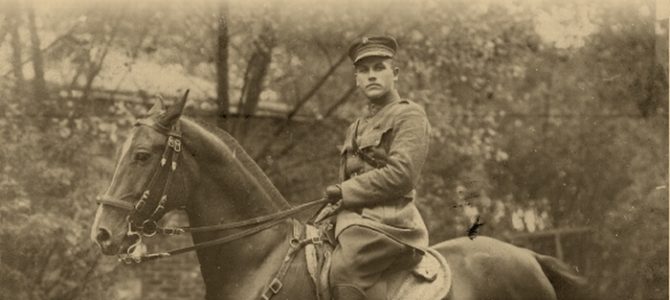
The Lithuanian parliament is hosting a photo exhibit called “Brave Jews of the Battle for Lithuanian Freedom” in its exihibt space from January 2 to 15. The photo exhibit chronicles Lithuanian Jewish veterans who fought for Lithuanian independence in the run-up to the first republic in 1919, including a large number of officers, recipients of military awards and those who laid down their lives for the new state.

The Lithuanian Jewish Community and the Vytis Support Fund organized the photo exhibit. It was inspired by a similar exhibit at Yad Vashem on Austrian Jewish military heroes.

Anniversaries of Vilna Gaon and Marija Gimbutas Included on UNESCO List

Anniversaries of Vilna Gaon and Marija Gimbutas Included on UNESCO List

The anniversaries of two people from Lithuania have been put on the UNESCO list of anniversaries for 2020-2021, the Lithuanian National Commission for UNESCO said.

2020 will mark the 300th anniversary of Rabbi Elijah ben Solomon Zalman (1720-1797), the Gaon of Vilna.

The inclusion of this anniversary was backed by Belarus, Poland, the YIVO Institute for Jewish Research, the UK-based Institute for Polish-Jewish Studies, the Lithuanian commission said.

2021 will mark the 100th anniversary of Marija Birutė Alseikaitė-Gimbutienė (aka Marija Gimbutas, 1921-1994), the Lithuanian archeologist, anthropologist and archeomythology pioneer. The inclusion of this anniversary was backed by Latvia, Germany and the Alumni Association of Pacific University.

In exchange, Lithuania backed the inclusions of other anniversaries into the UNESCO list.

In all, the UNESCO list of anniversaries for 2020–2021 includes people with achievements in the fields of culture, education and science from 59 countries.

Old Argument Lithuania Guiltless in Holocaust Rehashed

Old Argument Lithuania Guiltless in Holocaust Rehashed

A Lithuanian MP announced December 16 he would draft and submit legislation for a parliamentary resolution declaring the Lithuanian nation or people and the Lithuanian state were not complicit in the Holocaust, since Lithuania was occupied by Nazi Germany at the time upwards of 96% of all Lithuanian Jews were exterminated, mainly at the hands of ethnic Lithuanians.

Arūnas Gumuliauskas, chairman of the parliament’s Commission on Battles for Freedom and State Historical Memory, allegedly announced his intention to introduce the legislation at an event at the Lithuanian National Library.

A press report on Lithuania’s 15min.lt website said the idea was reminiscent of Poland’s recent law making it illegal to call Nazi death camps in Poland “Polish.” Gumuliauskas refused to disclose details of the language of the resolution, saying it hadn’t been written yet, and hinted he would not reveal either who his advisors were in writing the document.