
History of the Jews in Lithuania

New Litvak Cultural Museum Concept Presented

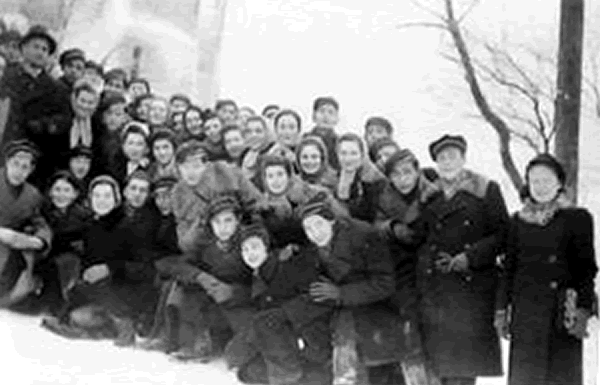
Tarbut students on a field trip ca. 1939. Courtesy vilnaghetto.com

Tarbut students on a field trip ca. 1939. Courtesy vilnaghetto.com

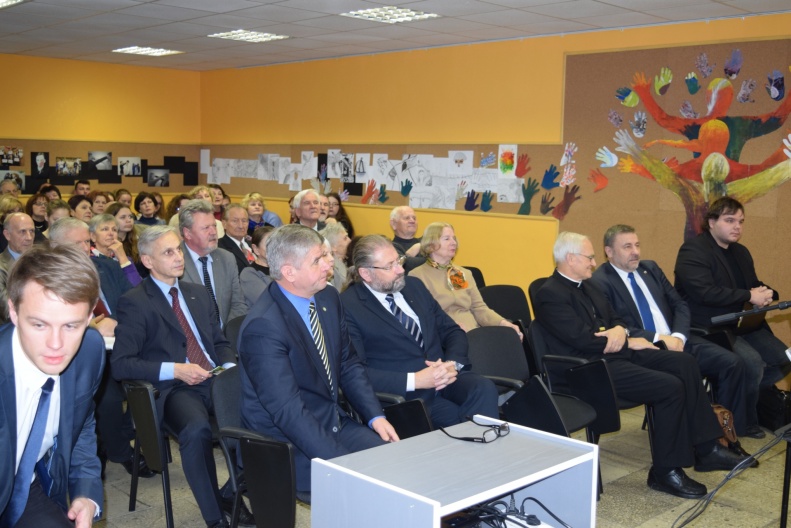
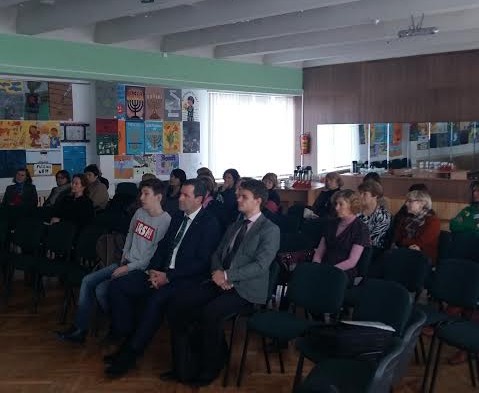
The Tolerance Center of the Vilna Gaon Jewish State Museum hosted a presentation by director Markas Zingeris of plans to restore the museum’s building at Pylimo street No. 4 in Vilnius for use as a new museum of Litvak culture and achievements December 3.

Currently the building is mostly empty but formerly housed the museum’s History Department and Gallery of the Righteous. It is actually part of the same building now as the Lithuanian Jewish Community and is connected by corridors with the LJC. Formerly it was the Tarbut Gymnasium or high school established after World War I. The name of the proposed new center is the Center of Litvak Culture and Art.

Zingeris’s plan includes showcasing famous Litvaks who have contributed to culture and science and he presented a number of figures including Nobel Prize winners for inclusion. He emphasized the need to teach the Lithuanian public about Litvak achievements as part of their own history. He also had a map projected onto the overhead screen showing other Jewish cultural museums in Europe and spoke specifically about Vilnius’s place on “the Northern European Jewish route.” Whether this “route” is an official EU program or not wasn’t made clear.
New Bagel Shop Magazine On-Line

The Bagel Shop newsletter is now a magazine and is available on-line in three languages, Lithuanian, English and Russian.

In this issue we present an interview with Laurina Todesaitė about Jewish cuisine, an excursion through the world of Jewish botanists in the inter-war period, a tour of Jewish Vilna, a new questions section and a new Mystery Photograph contest as well as all the usual columns.

Niv Shimoni Asks LJC for Help Finding Jewish Roots in Aukštadvaris

The Lithuanian Jewish Community has received a letter from Niv Shimoni of Israel. He is interested in his Lithuanian roots which he discovered only recently. His grandfather lived in Aukštadvaris. If anyone is able to help, please contact us via the Communicate section located on the right-hand side of the webpage.

Aukštadvaris

My grandfather, Sneur Razin, was born in Aukštadvaris in 1910, a small village 50 kilometers from Vilnius. During World War II most of his family was murdered in the Holocaust. Before the war he began studies in Kaunas in order to become a pharmacist yet decided to drop everything and make aliyah to Israel. He was active in the Zionist movement which greatly influenced him and of course helped him in his decision to come and be a part of Israel. Now, more than a hundred years later, his children wanted to see where their parents came from (their mother was from Latvia). They returned from this journey filled with emotional impressions, especially because after they discovered a small and remote Jewish cemetery in Aukštadvaris, the final resting place of their grandfather. I have now decided that I, too, must see with my own eyes his resting place and to discover more about him. It is impossible to describe the feelings I would have standing next to my great-grandfather’s resting place which until only a few weeks ago I did not imagine could ever be found. I have a special connection with the city of Vilnius, its past and future and ancient Jewish heritage. It is heartbreaking to see how one of the largest Jewish communities has disappeared almost completely.

All of my big family live in a small village in the north of Israel. They are people who contribute to the State of Israel and the Zionist movement in agricultural education and security. Our grandfather always said it was important to contribute to the state as much as possible. To do more and talk less. My goal is strengthening ties among Jewish communities with the land of Israel.

http://nivshimoni.wix.com/niv-s
http://nivshimoni.wix.com/niv-s#!contact/c24vq

Panevežys Jewish Community Conference Report

p2

Principal Aida Adiklienė opened the conference “The History of the Holocaust: A Bridge from the Past to the Future,” financed by the Goodwill Fund and held on November 25 at the Rožynas Pre-Gymnasium in Panevežys, Lithuania. She emphasized the institution she heads supports the recognition of human rights. In consideration of that, the gymnasium constantly emphasizes local history, including local Jewish history. “It says in the Universal Charter of Human Rights that everyone is born free and equal, with intelligence and conscience,” the principal said. “When we talk about the Holocaust, we are truly talking about our own history. We need to be glad that we have addressed this topic for more than ten years now at the gymnasium.” Adiklienė said the Holocaust is one of the most complicated topics and not all schools want to deal with it. She was disappointed that even now not all people accept people of other religions and ethnicities. She said there were clear signs of intolerance at work in our society.

Lithuanian Jewish Community Student Activities

Last Sunday the weekly lecture in the lecture series was dedicated to European Jewish youth life. Amit Belaitė, elected this year to the board of the European Union of Jewish Students, shared her impressions of this organization. Attendees had the opportunity to speak directly with three guests who attended via telephone and shared information about the life of youth in their countries. These were Viktoriya Grodnik from Ukraine, European Union of Jewish Students president Benjamin Fisher and Natan Pollak, a Litvak born in South Africa and former head of the Jewish student union whose great-grandparents came from Lithuania.

The students of the Lithuanian Jewish Community began a photographic project which will tell the stories of Lithuanian Jews. The first interview should be forthcoming immediately. If you’d like to take part in the project and tell your story, please write or call Amit Belaitė at amit.belaite@gmail.com or 869227326

image1Studentai

Blogger Focuses on Litvak Architecture, Cemetery Protection

photosdg

Among the 60 or so experts from more than a dozen countries at the multi-disciplinary conference on Jewish cemeteries in Europe organized by the Rothschild Foundation (Hanadiv) Europe and hosted by the Lithuanian Jewish community on October 25-28 in Vilnius, Lithuania, was Samuel Gruber. Gruber is a cultural heritage consultant who has consulted in the drafting of various documents, scientific research, conservation, exhibition and educational projects in the USA and Europe. He is an historian of architecture and an archaeologist, and an expert on Jewish artistic, architectural and historical sites. He is also a prolific blogger. His blog contains copious posts on Jewish sites, commemorative monuments and issues in Lithuania.

Some of his more recent postings include:

Lithuania: Test Excavations (2011) and Ground Radar Survey (2015) of Great Synagogue and Shulhoyf point to More Archaeology in 2016

Lithuania: The Pakruojis Jewish Cemetery as an Example Where Historic Boundaries Have been Diminished

Presentation of Book on Biržai Jews

DSCF7661sm

During a conference on November 13 to mark the 150th anniversary of the birth of Dr. Meir (reported here in earlier news items), a large book called “Žydai Lietuvos žemėlapyje. Biržai” [“Jews on the Map of Lithuania. Biržai”] was presented to the public in the Arsenal Hall of the Biržai Castle. Those who attended included Panevėžys Jewish Community members Yuri Smirnov and Tamara Antanaitienė, Panevėžys school teacher Asta Kurulytė and history teacher and head of the Rožynas school’s Tolerance center Genutė Žilytė. Israel’s ambassador to Lithuania, Amir Maimon, was invited and arrived early to look over the old Jewish cemetery in Biržai and pay his respects at the graveside of the last Jew of Biržai who recently passed away, Sheftel Melamed, and to visit the memorial for the Jews who were murdered in the Pakamponys Forest. Greeting the large audience who turned out for the event, the ambassador remembered the old proverb: “If you want to know where you’re going, you have to know whence you’ve come.”

Speaking of the Holocaust, the ambassador said the past cannot be forgotten so that it never happens again. “One of my priorities is the protection of Jewish heritage,” he also said. The ambassador managed to surprise even locals with his knowledge of Biržai Jewish history, citing prewar population figures and talking about the walks of life of local Jews.

Full story in Lithuanian and picture gallery here.

Panevėžys Celebrates 150th Anniversary of Birth of Doctor Shakhnel Avrahom Meir

Margaritos mokykla

Panevėžys city mayor Rytis Račkauskas attended a conference to unveil a memorial plaque to mark the 150th anniversary of the birth of public figure and doctor Shakhnel Avrahom Meir. The project was financed by the Goodwill Fund and was supported by the Panevėžys Jewish Community and the municipality.

“The great contribution made by Dr. Meir to the life of the city is undisputed among residents. The doctor set up a hospital, clinics for children and adults and a tuberculosis dispensary. It is difficult to list all his accomplishments. But one must be mentioned: his concern for people. Meir dedicated himself to children from poor families and never discriminated against patients based on wealth or ethnicity. To him they were all the same, they were all important to him. The 150th anniversary of his birth compels us to remember and commemorate this notable person. I sincerely thank the organizers of this event for this initiative,” mayor Račkauskas told the audience.

Celebrating 150th Birthday of Panevėžys Doctor Shakhnel Avrahom Meir

This year marks 150 years since the birth and 85 years since the death of Dr. Meir.

A ceremony to honor the memory of Dr. Shakhnel Avrahom Meir will be held in Panevėžys, Lithuania on November 13, the famous Lithuania doctor’s hometown.

He studied medicine at Moscow University and began his medical practice in Chernigov guberniya in the Ukraine before returning to Lithuania in 1891, where he first set up practice in Pasvalys and then moved back to Panevėžys in 1914. He had a reputation for selflessness and devoted all his time and energy to healing everyone who needed help. He improved his skills by working in clinics abroad and kept up with the latest advances in medicine, applying them at home. The Jewish Hospital was built and opened in Panevėžys in 1919 on his initiative. It served people of all ethnicities.

Lithuanian Jewish Community Responds to Report on Jonas Noreika

lzb

The Lithuanian Jewish Community responds to a report presented by the Center for the Study of the Genocide and Resistance of the Residents of Lithuania about the activity of Jonas Noreika in Nazi-occupied Lithuania during World War II. The report is available in Lithuanian on their website:

http://genocid.lt/UserFiles/File/Pazymos/201510_noreika_pazyma01.pdf

________________________________________________________________________

Lithuanian Jewish Community
Pylimo street no. 4, LT-01117 Vilnius, tel.: (8~5) 261 30 03, fax: (8~5) 2127915, email: info@lzb.lt

November 6, 2015

To: Teresa Birutė Burauskaitė, director
Center for the Study of the Genocide and Resistance of the Residents of Lithuania
Didžioji street no. 17/1, LT-01128 Vilnius

Two Steps Forward, One Back

Two Steps Forward, One Back
by Geoff Vasil

Readers of the Lithuanian Jewish Community website might have been surprised yesterday by a news item appearing there in which Jonas Noreika was absolved, seemingly, of complicity in the Holocaust. Noreika is one of those names which lives on in infamy among scholars of the Lithuanian Holocaust but proffered as an anti-Soviet hero by Lithuanian nationalists. The intent of the LJC, of course, was merely to report the Lithuanian news to Jews here and abroad, and not to white-wash Noreika in any way. The news item would not have been surprising even a few years ago, but now it comes as a shock exactly because Lithuanian society has moved forward so rapidly in coming to terms with the horrible loss to the country known as the Holocaust.

In summary, a Lithuanian state institution, the Center for Research on the Genocide and Resistance of the Residents of Lithuania, charged with sorting out history, issued a politicized report claiming Noreika was only involved in isolating Jews during World War II, not murdering them. The report came in response to a joint call by well known figures in Lithuania, including Tomas Venclova, to remove a plaque honoring Noreika from the wall of the library of the Lithuanian Academy of Sciences in Vilnius, a move which the LJC has long championed.

The document released this week cautions Noreika’s actions “cannot be judged categorically.”

LJC Chairwoman on Lithuanian President Dalia Grybauskaitė’s Visit to Israel

I was included in the delegation which went together with Lithuanian president Dalia Grybauskaitė to Israel. As the chairwoman of the Lithuanian Jewish Community I participated in everything and I can say the visit was historic. Despite the tension in the air because of the terrorist attacks by Palestinians, the leaders of Israel found the time to meet with the Lithuanian president on her working visit and to discuss the most urgent issues in regional security and bilateral cooperation. The Lithuanian president also discussed measures for strengthening Israeli and Lithuanian ties with Israeli president Reuven Rivlin, who emphasized his Litvak roots. The two leaders also spoke about the situation of the Jewish community and the commemoration of Holocaust victims in Lithuania. The Lithuanian president said Jews had contributed very much to the establishment of the Lithuanian state and that the two countries could combine forces in creating their future and prosperity. I remember moving moments when Litvaks in Israel met the president with tears in their eyes and how they spoke about the most beautiful times of their lives in Lithuania. These were times of youth, of the struggle for Jewish identity and for freedom. For them, Lithuania is the land of their forefathers from the time of Vytautas the Great, the land they call home and which they often recall even now.

Before her meeting with the president of Israel, the Lithuanian head of state visited the Yad Vashem museum to commemorate Holocaust victims and planted an olive tree in the Garden of the Righteous among Nations there. In her meeting with Israeli prime minister Benjamin Netanyahu, the Lithuanian president said could help Lithuania directly with security. “Israel is prepared to help Lithuania directly in the sphere of security: by training our military personnel, in the area of cyber-security and can even organize courses for our personal protection.”

Rothschild Foundation Holds International Conference on Jewish Cemetery Protection in Vilnius

The Rothschild Foundation (Hanadiv) Europe held a conference to discuss Jewish cemetery heritage protection issues in Vilnius from October 25 to 28.

The conference, “A Cross-Disciplinary Seminar on European Jewish Cemeteries: Theory, Policy, Management and Dissemination,” with professionals from different European counties working in the field of Jewish Cemeteries including, scholars, genealogists, Jewish communities and federations, religious leaders, NGOs and policy makers, was designed to bring together a group of experts with 3 core aims:

• To review achievements since the conference on Jewish Immovable Heritage in Krakow 2013. The conference will provide a chance to conduct an appraisal of what has been done in the field until now. Organizations shared their most important projects, including new trends such as the development of technological tools to assist in the discovery and research of cemeteries.

• To explore important issues through a series of roundtable and panel conversations on the central questions and topics affecting the field.

• To encourage future collaboration between participating organizations, exploring how they can work together, encourage cross-border opportunities and consider further strategic cooperation.

Memorial Plaque Commemorating Bluma Katz Unveiled

OLYMPUS DIGITAL CAMERA

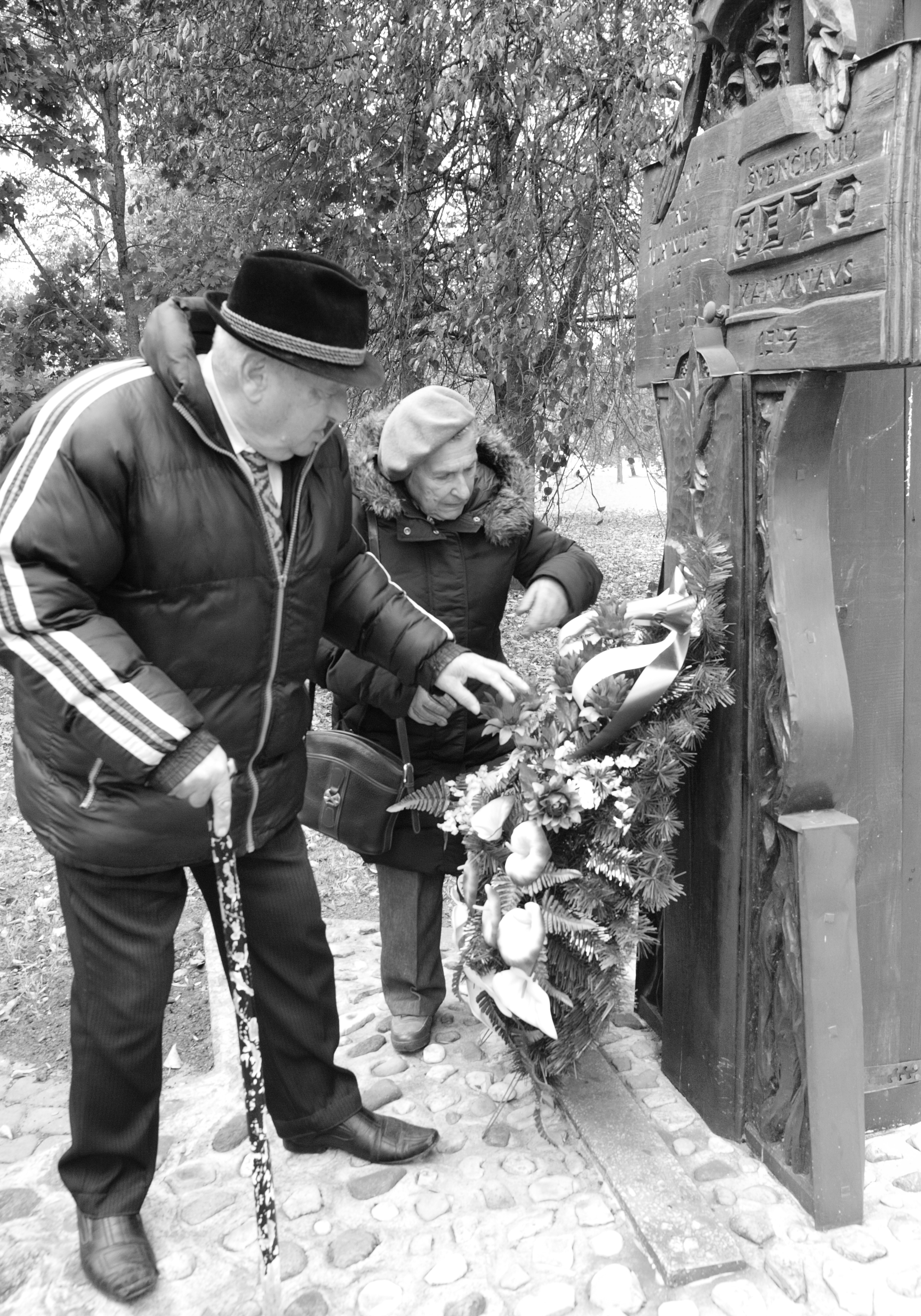
Moisejus Preisas and Fania Brancovskaja lay a wreath at the Menorah statue in Švenčionys

Every year at the beginning of October a small group of people gather at the Menorah statue in the Švenčionys City Park who remember what happened there from 1941 to 1943.

This year Švenčionys Jewish Community chairman Moisiejus Šapiro began the meeting and presented Nalšia Regional History Museum historian Nadežda Spiridonovienė, who spoke about historical events in Švenčionys and how Jewish settlement in Lithuania was a result of tragedies in Western and Central Europe in the 19th century.

“Lithuania was an agrarian country and belonged to the large non-industrial part of Russia. Most of the country people were Catholic Lithuanians, Belarusians and Poles. This was the main factor in the locals’ relationship with Jews. To Lithuanians, Belarusians and Poles, it seemed the Jew was clever and wise because of his many talents. Jews were small businessmen and craftsmen who traveled around and were much valued for spreading information as bearers of news. There were about 4,500 Jews living in Švenčionys then, they established an herbal medicine factory and had leather-working workshops in the city center. The hard work, initiative and expertise of Jewish business people expressed themselves in all areas of production.

Lithuanian President: Litvaks Played Special Role in Establishment of Lithuania and Israel

VILNIUS, October 21, BNS–Litvaks, or Jews originating from Lithuania, played a key role in establishing both Lithuania and Israel, Lithuanian president Dalia Grybauskaitė said at the opening of the World Litvak Forum in Israel.

She said Litvaks are among the most active Israeli public, business, cultural and political figures who have worked effectively in all the parliaments of democratic Lithuania, both in the interwar period and after the country regained independence in 1990.

“Litvaks have always been among the most active Israeli public, business, cultural and political figures, they still are and will continue to be so,” the Lithuanian president said in a press release published by the presidential press service.

She applauded the Litvak contribution to the Lithuanian economy, culture and science.

President Grybauskaitė said Lithuania and Israel cherish democracy, human rights and a culture of tolerance, and that world-wide challenges including terrorism and aggression are problems the two countries share.

According to a census in 201ą, 3,000 Jews lived in Lithuania. In Israel the Lithuanian Foreign Ministry calculates there are about 200,000 Litvaks and their descendants, the world’s largest Litvak community.

BNS

Taboo against Death

New book entitled Price of Concord/Memoirs;Portraits of Artists; Interactions of Cultures by prof. Markas Petuchauskas („Versus aureus“ Publishers, 2015; www.versus.lt; info@versus.lt) is available to the readers.

Please find the extracts about prominent Litvak artists from the book.


Samuel Bak, with whom I keep corresponding, told me that he had seen a mono-performance by Chaje Rozental’s daughter Naava Piatka dedicated to her mother. He liked the performance. I thought then that the transference of the performance to the stage in Vilnius might be a good idea. I started corresponding with Naava Piatka. We discussed the questions pertaining to her arrival to the land of her parents as well as those concerning the preparation of the performance. Both in the States and in London, Naava performed in English. It took me a long time to talk her into rehearsing the performance in Yiddish, a language posing difficulties for the actress. Eventually I managed to convince her that on the stage of the Vilnius Ghetto Theatre one must use Yiddish. On the 24th of September 2003, I organized the first night of the play dedicated to Chaje Rozental entitled Better Don’t Talk. By extending the Art Days dedicated to the commemoration of the 60th anniversary of the Vilnius Ghetto theatre, we also marked the 60th anniversary of this phenomenon of Lithuanian Jerusalem and the destruction of the Vilnius ghetto.

 The Precedent of the Binkis Family

New book entitled Price of Concord/Memoirs;Portraits of Artists; Interactions of Cultures by prof. Markas Petuchauskas („Versus aureus“ Publishers, 2015; www.versus.lt; info@versus.lt) is available to the readers.

Please find the extracts about prominent Litvak artists from the book.

I had already written a review about the play Dress Rehearsal by Kazys Binkis. It was stage director Henrikas Vancevičius who for the first time dared to save that play from complete forgetfulness by staging it. By publishing my article in the newspaper Tiesa, run by the Central Committee of the Communist Party, I wanted to support Binkis’ European level play, which was a new word in our dramaturgy. That was the play which, unused, had been lying in the drawer for a very long time, and which had given lots of doubts to our men in power.

When I proof-read the text, prepared by the publishing house, I felt sick. The main emphases of the review had been changed for another text, underlining the professional limitations of the play and of its production as well. The emphasis was laid on Binkis’ inability to differentiate between the right kind of wars and the wrong ones. All of that had been flavoured with usual Soviet phraseology. I was enraged, and I told them I was retrieving my article, because the present text was reversing my review and was putting it from head to foot.

Alexander Macht Chess Tournament at Lithuanian Jewish Community Sunday

The Alexander Macht Chess Tournament will be held at the Lithuanian Jewish Community at Pylimo street No. 4 at 6:00 P.M. on Sunday, October 18. The tournament was organized by the LJC and the elite chess and checkers clubs Rositsan and Maccabi.

Boris Rositsan gave the LJC website a small interview in the run-up to the tournament where, he said, at least 30 people are planning to play. Special medals have been ordered for this competition.

What does the name Alexander Macht signify?

Boris Rositsan: Alexander Macht is an historical figure and a very important person in the history of Lithuanian chess as well as Jewish. We cannot forget this sort of person, so we are continuing the tradition of tournaments. In interwar Lithuania he was Lithuanian champion seven times over. Macht lived in Kaunas and was director of the Jewish People’s Bank. He went to Israel in 1935 and directed the famous Bank Leumi there. No one wrote, said or remembered anything at all about this great chess player during the Soviet period. We have prepared a program dedicated to Litvak chess players. After we presented our book “Žydai Lietuvos šachmatų istorijoje” [“Jews in Lithuanian Chess History”] at the beginning of this year, LJC chairwoman Faina Kukliansky asked us why weren’t continuing that history. I would like to say that we are preparing to do just that in cooperation with the community. We are holding two tournaments, this is for adults, but if strong young chess players come forward, we will include them. On October 31st there will be a tournament dedicated to the memory of Itzhak Vistinietzki [Isakas Vistaneckis] and children will play in that. We are inviting children aged five and over to come and learn to play chess. We have student groups at the community for the ages of 5, 6, 7… and 13 years old. Also, elderly and retired LJC members are coming to us. Fishman is helping me with the training. Serious work is taking place, non-commercial, I really love chess and I want to revive the LJC chess movement.

First Chairwoman of Švenčionys Jewish Community Remembered

A memorial plaque has gone up on the building at Vilniaus street No. 5 in Bluma Katz’s hometown of Švenčionys. Bluma Katz was the first chairwoman of the Švenčionys Region Jewish Community. City and regional administration leaders, Lithuanian Jewish Community chairwoman Faina Kukliansky, deputy Israeli ambassador to Lithuania Yehuda Gidron and local residents gathered to remember her at the ceremony to unveil the new plaque.

Katzs was born in Švenčionys in 1913, studied at a Jewish gymnasium and continued her education in Vilnius where she was an active participant in Jewish life. Her teachers included well-known Jewish scholars and writers such as Max Weinreich and Zalman Reyzen, among others. She moved to Russia with her future husband Sh. Yavich. They were both arrested there in 1937, with Bluma Katz sentenced to ten years at a Stalinist gulag in Kolyma. She returned, remarried to her second husband Segalovich, to her hometown, Švenčionys, in 1947. She completed nursing courses and worked for the next 42 years at the city hospital. After Lithuanian independence Katz formed and led the Švenčionys Jewish Community and was noted for her sincere and personal concern for every member of the community. Katz’s memoirs have been published in Lithuania and the West and she always consented cheerfully to meet students from around the world coming to Vilnius to study Yiddish. Katz also attended Yiddish workshops at Oxford University in Great Britain.