
The Lithuanian Jewish Community notes with sadness the death of Bernard Lown on February 16, 2021. He was born in Utena, Lithuania, on June 7, 1921, to Nisson Lown and Bella Lown née Grossbard and lived in Lithuania till he was 14. Bernard Lown passed away following a long struggle with illness at his home near Boston just a few months before his 100th birthday. He made major achievements in cardiology and was the founder of the group Physicians for the Prevention of Nuclear War which was awarded the Nobel peace prize for opposing nuclear proliferation in 1985.

Purim at the Ilan Club
The Lithuanian Jewish Community and the Ilan Club invite parents and children to spend Sunday morning with culinary chef Andžejus Žukovskis. We’ll bake hamentashen, the traditional Purim treat, together. It all begins at 12 noon on Sunday, February 21, via Zoom. To register send an email to sofja@lzb.lt and together with the Zoom code we’ll send you a list of ingredients needed. For more information you may also call Sofja at +370 601 46656.

Hamantash
The Bagel Shop Café will make hamantash available for Purim from February 23 to 25, made in the traditional manner with poppy seeds and raspberry jam. The cost will be 12 euros per kilogram (about 30 to 35 individual hamantashen) and smaller orders are also possible. Please reserve your pastry now or at least by February 23 so we’ll know how many to make. The Bagel Shop Café itself is closed for repairs so customers will be able to pick up their orders in the foyer at the main entrance to the Lithuanian Jewish Community in Vilnius. Pick-up will begin on February 23 and run till February 25, from 12 noon to 4:00 P.M. Payment may only be made by bank card.
Reservations: https://forms.gle/YhmP2nt82uoUALbc8

Litvak Anti-War Activist, Cardiologist Bernard Lown Dead at 99
Photo: NYTimes.com
BOSTON (AP)–Dr. Bernard Lown, the Massachusetts cardiologist who invented the first reliable heart defibrillator and later co-founded an anti-nuclear war group who were awarded the Nobel Peace Prize, died Tuesday at the age of 99.
The Boston Globe reported the Lithuanian-born doctor’s health had been declining from congestive heart failure. He died at his home near Boston.
Lown was a professor at Harvard College and physician at Brigham and Women’s Hospital in Boston. He advanced cardiac treatment.
He was one of the first doctors to emphasize diet and exercise in treating heart disease, and introduced the drug lidocaine as a treatment for arrhythmia, the Globe reports. In 1962 Lown invented the direct-current defibrillator, or cardioverter, which uses electric shocks to get the heart to resume beating.
He was also an outspoken social activist, founding Physicians for Social Responsibility in 1960 and later co-founding International Physicians for the Prevention of Nuclear War in the 1980s, the newspaper reports.
The international anti-war group called for a moratorium on testing and building nuclear weapons. They were awarded the 1985 Nobel Peace Prize for raising awareness about the consequences of nuclear war during the height of Cold War tensions between the U.S. and the Soviet Union. At its peak the group had more than 200,000 members and chapters in more than 60 countries.
Full obituary here.

History Policy and Historical Memory
by professor Rimvydas Petrauskas, rector, Vilnius University, for DELFI.lt
Recent discussions on the topic of historical memory and policy have brought to the fore the issue of the role the professional historian plays in shaping the public’s historical memory. This text is about history, historians, historical memory and the historian’s mission.
History and Historians
The noted French historian Jacques Le Goff who died a few years ago spoke about the relationship between history and the present, soberly saying history can at one and the same time be that which connects, and that which afflicts. It can be utilized for the most different ends, to encourage healthy patriotism and to justify the annexation of another country, and those are just two of the more extreme poles. At the same time, Le Goff explained, the discipline of histry should help people live their lives and in communal life, help them navigate between a rich legacy of the past and what is sometimes a dangerous nostalgia.
He knew what he was talking about. In 1942 his teacher Marc Bloch, founder of the Annales School of French social history, had lost his job, books and some of his old friends in occupied France, but authored what is probably the most optimistic explanation of history ever, calling for seeking out historical truth in the face of historical tragedy. This member of the French Resistance was shot two years later by the Nazis.
Full text in Lithuanian here.
A Cantor Doesn’t Just Sing, He Must Have Knowledge

Lithuanian Internet News Site Interviews Polish Historian on Holocaust Censorship
15min.lt

Historian Dariusz Stola says there is a campaign underway in Poland to frighten historians who speak about Holocaust crimes committed by Poles. The result, he says, is invisible: books and articles which are never written. Stola says 10 years ago he was sure it would only get easier to talk about these complex historical events as time passed. Now something has changed, and it might be related to the growth of social media.
Stola is a professor of history at the Polish Academy of Sciences and served earlier as the director of Poland’s Jewish History Museum POLIN.
After five years directing POLIN Stola submitted an application to be rehired and received 11 of 15 votes by judges on the hiring commission, but the Polish minister of culture refused to appoint him director again.
We caught up with Stola a few days after a Polish court ordered two of the country’s leading historians to apologize to the niece of a village alderman who claimed Polish historians Barbara Engelking and Jan Grobowski libeled her relative in the monograph they coauthored where they wrote he was an accomplice in the mass murder of Jews.
Indirect Government Intervention

A Tale of Two Statues
In remembrance of signatories of conscience
Lithuanian Jewish Community chairwoman Faina Kukliansky’s observations on the eve of the 103rd celebration of February 16
We live in good times, incomparable to those which the Lithuanian Jewish community experiences eight decades ago. We live in a time of great achievements and at the same time there is still much to achieve. We live at a time when we still have to explain and defend ourselves, and we do this patiently but resolutely. We live at a time when society is crossing swords over ideas, attitudes and, most significantly, statues. Let this be the tale of two statues which don’t exist.
We are about to celebrate February 16, Lithuania Day, for the 103rd time. When we name the names of the signatories to the Lithuanian Act of Independence, this shows that the date for us is not just an historical day, but the triumph of the personal decision made by specific people whose result–a free and sovereign country–we all enjoy and take pride in. In the context of February 16, let’s also remember another group of people, a group I call signatories of conscience, the people whose decision resulted in hundreds of lives saved.
During the different Holocaust commemorations we often hear people taking pride that over 900 Lithuanians have been named Righteous Gentiles, but I don’t hear their names or their stories. I see the lack of context. And the context is very simple: the citizens of the first Republic of Lithuania, the same people who forged the young state, heard the Jews’ cry for help and responded. Do you think about the fact that generation which hid persecuted Jews on their farms, in their apartments and basements were the same people who created the first Lithuanian Republic? That they are the same generation whose achievements in art, learning and politics we take pride in today, whose deeds and lives we cite today as examples in the creation of the state? They include the family of February 16th signatory and engineer Steponas Kairys, and Lithuanian president Kazys Grinius, and the daughter of M. K. Čiurlionis, one of Lithuania’s greatest artists, Danutė Čiurlionytė abd her husband Vladimiras Zubovas, the family of Lithuanian writer Balys Sruoga, the family of writer Kazys Binkis, and professor Pranas Mažylis, the grandfather of Liudas Mažylis who rediscovered the original Lithuanian proclamation of independence German archives. They include Ona Jablonskytė, the daughter of the founder of the standard Lithuanian language Jonas Joblonskis, and his daughter-in-law advyga Jablonskienė. And not just presidents and professors, but simple village people were able to make the right choice. These are names which are inseparable from the history of Lithuania. Why don’t we want to erect a statues to these people, Lithuania’s signatories of conscience?

Writer Katarzyna Markusz Questioned by Polish Prosecutor for Insulting National Myth about Holocaust
Katarzyna Markusz was questioned on suspicion of violating a law against defaming the country after an anonymous complaint about an article from 2020. She faces up to 3 years in jail.
Polish police are probing a local journalist who wrote last year about Polish complicity in the Holocaust.
Katarzyna Markusz, who runs the Jewish.pl website and writes for the Jewish Telegraphic Agency, was questioned last Thursday on suspicion that she violated Article 133 of the Polish constitution, which subjects those who “publicly insults the Nation or the Republic of Poland” to up to three years in prison.
An anonymous complaint was filed against Markusz, which led to her detention and interrogation, according to Oko.press.
In October, 2020, Markusz wrote in an article: “Will we live to see the day when the Polish authorities also admit that hostility toward Jews was widespread among Poles, and that Polish complicity in the Holocaust is a historical fact?

Two Noreikas: Laser Sight against Flintlock Musket in Information Wars
by Mingailė Jurkutė, chief historian, Center for the Study of the Genocide and Resistance of Residents of Lithuania
The current director of the Genocide Center is trying to give the impression all that is happening are just internal department disputes, depot against depot, one faction of historians against another, or maybe historians vs. museum specialists, or maybe even brave, ambitious and mobile visionaries of the new administration against the academics at a small bureaucratic institution who long for stagnation and a light work-load. This is a terrific and naked lie.
Center historians are productive and their academic production and other specific Center production, for example, writing brief–barely two pages long–and exact findings of history, which often require examining just as much material as for an article in the normal academic format. And they want reform, they are proposing reforms themselves. This story is a very successful technique when you want misconstrue and hide what is going on, for example, as Soviet ideologues went to extremes to explain the partisan war was really a class war, or a civil war, and in any case… an internal social dispute.
But I want to return the real players (the sides) to center stage, because they are getting lost due to the noise, agitation and intentional mud-slinging (of which an example is the letter the administration drafted to defend the administration, not without pressure from direct bosses to staff to sign on in telephone calls made outside working hours, forcing employees to arrive in person at the workplace to sign in the midst of the pandemic).

Stark War of Principles Brewing in Lithuanian Parliament: Ruling Coalition MPs to Cross Swords
by Vytautas Bruveris, Lietuvos rytas
Even representatives of different camps within the ruling majority are set to cross swords. This war of positions will come to the fore in parliament because of the activities of the Center for the Study of the Genocide and Resistance of Residents of Lithuania currently besieged by scandal.
Tomas Raskevičius, chairman of the Lithuanian parliament’s Human Rights Committee and a member of the ruling Freedom Party, believes the Office of State Auditor needs to thoroughly investigate the Genocide Center and says there could be many different problems there.
The Human Rights Committee exercises parliamentary supervision of the Genocide Center, but the Lithuanian parliament’s National Security and Defense Committee chaired by conservative Laurynas Kasčiūnas has taken the reins over the Center into its own hands. Further, a special working group empaneled by parliamentary speaker Viktorija Čmilytė-Nielsen is set to begin investigating the activities of the Genocide Center, a working group which will also feature a diversity of opinions.

Former Death Camp Guard Age 100 Faces Charges in Germany
Delfi.lt
Charges have been laid in Germany against a 100-year-old former concentration camp guard accused of complicity in the murder of 3,518 people as the country rushes to bring the last living people who worked for the Nazis to justice, AFP reported Monday.
The male suspect is accused of “consciously and willingly” aiding in the murder of Jewish prisoners at the Sachsenhausen concentration camp in Oranienburg north of Berlin between 1942 and 1945. Despite the accused’s advanced age, he was found to be able to stand trial according to prosecutors, who said the trial would be televised. These charges following those made in recent days against a concentration camp secretary accused of being an accomplice in the murder of 10,000 people. This is the first such case in recent years made against a woman who worked at a Nazi concentration camp.
Reader’s question: Will the Lithuania and the EU find the will to try or condemn members of the Lithuanian Activist Front and the Lithuanian Provisional Government who adopted the Nazis’ plan to exterminate Jews and carried it out, who voluntarily elected to take part in the Holocaust?
Full text in Lithuanian here.

Sent to Siberia Despite Rescuing Jews
Photo: Lithuanian deportees en route to Siberia. Center: Family of B. and I. Jablonskiai. The only known photograph in Lithuania of a deportation cattle wagon.
by Romualdas Beniušis
This year marks 70 years since the third large post-war deportation operation Osen (Autumn) carried out by the Soviet security structures (MGB) on October 2 and 3, 1951, during which more than 16,000 people deemed “bourgeoisie,” including 5,000 children, were packed into cattle cars and deported to Siberia.
At that time, 39 children didn’t reach their places of exile. Their deaths marked the way along which Lithuanians were deported to Siberia. This time, the lists of deportees were entrusted to the local government administration and Party committees because it had become ever more difficult to find the “bourgeoisie” needed for carrying out the deportation plans. Thus the opportunity arose to include on the list of people to be deported those the local government didn’t like, the more educated, and even people who lived in the cities, carrying out personal grudges and to seize the property of the deportees.
Since only a few days passed between the confirmation of the lists and the beginning of deportations, the deportations began to be carried out without formal deportation cases which were drawn up later. The barely-literate locals who compiled the lists and usually foreign MGB officials who drafted the formal cases made endless mistakes in those documents, distorting surnames, dates of birth and so on, but this did not become an obstruction on the way to Siberia.

Lithuanian History Institute Director Tells Parliamentary Speaker Genocide Center Planned Propaganda Campaigns
15min.lt

Speaker of Lithuanian parliament Viktorija Čmilytė-Nielsen met representatives Tuesday of universities and the Lithuanian History Institute to discuss the situation at Lithuania’s Genocide Center, following a boycott of Genocide Center announced by these institutions. Lithuanian History Institute director Alvydas Nikžentaitis said the problem is not just a domestic one and needs a final solution.
Historians from Vilnius University, Vytautas Magnus University, Klaipėda University and the Lithuanian History Institute sent the speaker a letter complaining the new leadership of Genocide Center under Adas Jakubauskas after he was appointed in February of 2020 had led to a primitive politicization of sensitive and painful events of the past without taking sources into account. They said they could no longer work with Genocide Center under those conditions, and didn’t agree with unprofessional statements made by representatives of the Genocide Center.
Nikžentaitis said there had been indications very long before Jakubauskas’s appointment that things weren’t right at the Center, and that his colleagues had made numerous complaints. Nikžentaitis said some of them were even persecuted for expressing their opinion regarding the Center. Nikžentaitis listed among other complaints that there were allegedly discussions inside Genocide Center that if the current director of the Center’s Department of Historical Research [Arūnas Bubnys] withdrew from the post, he would be given a different post, while behind the scenes agreement was reached on replacing him with another person more obedient to the leadership.
“So basically this was preparing the ground, let’s say, for preparing opinions very far from academic at the Center, so that the Center would be ready to carry out specific propaganda goals,” Nikžentaitis said.
On the meeting with the speaker of parliament, Nikžentaitis said they discussed how to change the existing situation. He added that in a certain sense the problems at Genocide Center were pre-programmed from its very inception.
Full article in Lithuanian here.

World Jewish Congress Dismayed at Polish Court Ruling against Holocaust Historians
Press Release
February 9, 2021
NEW YORK–World Jewish Congress president Ronald S. Lauder expressed his dismay following the announcement of a verdict in a Polish libel case against historians prof. Barbara Engelking and prof. Jan Grabowski for their scholarly work in which they cited the testimony of a survivor regarding the actions of a Polish mayor during the Holocaust.
Commenting on the decision, Lauder said, “As someone who has been deeply engaged with Poland for more than three decades, I am dismayed that a Warsaw court ruled against historians prof. Barbara Engelking and pProf. Jan Grabowski in the misguided libel case that was brought against them. It is simply unacceptable that historians should be afraid of citing credible testimony of Holocaust survivors.
“This outcome does not bode well for the future of historical research in Poland and sends precisely the wrong message to those who seek to stifle the work of scholars. I hope that today’s verdict will be overturned on appeal, and that the day will come when decisions regarding the integrity of history will once again be left to historians and not politicians or judges.”

Mass Murders in Utena: Memories of the Holocaust
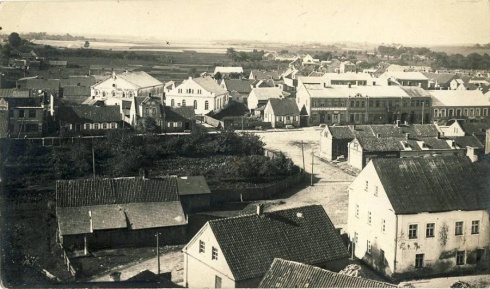
Photo: Just a few buildings witnessing to the Jewish past still stand in Utena.
Translated to Lithuanian by Vytautas Ridikas from Massacres in Utena by Tsozdik Bleiman writing in Russian
§§§
As the only living witness left, I am able to share some special memories.
My father Jakov Bleiman, who was formerly a rabbi in Crimea, performed the same duties in Utena, where my brother-in-law Efraim Yudelovich also lived with the family. At the beginning of the war I lived in Kaunas.
I decided to see my parents and then, if the right conditions were in place, to evacuate with the entire family. As it turned out there was no way to leave for somewhere, because just as I arrived in the city the Germans entered. Our fate became clear: we were all condemned to death.
Thursday. The first day of the German regime. Dozens of Jews are herded to work, led to the Germans and their Lithuanian helpers. The work is meaningless and insignificant, just in order to deride the Jews, sending them around all day with brooms, shovels and other implements.

Lithuanian Media Respond to Changes at Genocide Center
The Lithuanian media report several stories related to recent internal dissent and the resignation of Vidmantas Valiušaitis at the Center for the Study of the Genocide and Resistance of Residents of Lithuania, usually called the Genocide Center, a state-financed arbiter of the official Lithuanian version of history.
Delfi.lt reported Lithuanian speaker of parliament Viktorija Čmilytė-Nielsen said it was too early to talk of replacing Genocide Center’s recently-appointed director Adas Jakubauskas, but called the problems there real, and said she thought a parliamentary commission should be formed to look into complaints which came to light last week when staff historians at the state institution published an open letter issued as an appeal to the speaker of parliament, complaining history was being politicized under the current director, see https://www.delfi.lt/news/daily/lithuania/cmilyte-nielsen-kelti-genocido-centro-vadovybes-kaitos-klausima-tikrai-per-anksti.d?id=86384653 for the complete story in Lithuanian. Long-time observers note the Genocide Center has always been politicized and that is its main mission as defined in law, to present a politicized version of history.
Delfi.lt also carried an in-depth account of a discussion held last week on Lithuania’s Žinių Radijas talk radio station between Vytautas Bruveris, a writer and journalist who has won much public respect for his reporting and editorials over the years at Lithuania’s Lietuvos rytas newspaper, and Vidmantas Valiušaitis, a writer with an ultra-nationalist view of Lithuanian history who has worked as a newspaper writer and whose work has been featured in the official magazine of the Lithuanian military, Karys. Valiušaitis’s appointment to a post created especially for him by the new director of Genocide Center was one of the main complaints in the appeal staff and historians sent to the speaker of parliament. The text in Lithuanian can be found here:

Minsk and Vilnius Jewish Communities Celebrate Sabbath Together via Internet
Belarussian progressive Jewish Community Beit Simha’s Rabbi Grigoriy Abromovich created an international project to link up cities in Lithuania, Belarus and Israel and Lithuanian Jewish Community social programs director Žana Skudovičienė was an important part of the project on the evening of Friday, February 6, when more than 40 families celebrated Sabbath together via internet.
“We know and love the Jerusalem of Lithuania Jewish Community and we love visiting there [Vilnius]. New technology allows us to be closer together despite distance in time and space,” Rabbi Abromovich said.
Lithuanian Jewish Community chairwoman Faina Kukliansky said we all miss communication and support because of the difficult period of the viral pandemic, and the Sabbath has the unique ability to bring us all together.
Michailis Segalis, LJC executive director, said: “During Passover we say to one another: next year in Jerusalem. Today I’d like to rephrase that wish and say to all our virtual Sabbath participants: next year in Minsk, Vilnius and, perhaps, we will all celebrate Sabbath in Jerusalem.”
A big thank you to all who made the virtual Sabbath possible and participated. Thank you for your kind words and smiles.

Bringing Bagels Back to Vilnius
by Wailana Kalama

After a long absence, the Jewish staple has returned to the Lithuanian capital
Most food historians place the origin of the bagel somewhere vaguely in the Jewish alleys of the Polish-Lithuanian Commonwealth. In those days in Lithuania’s capital, Vilnius–also known as Vilna, the city once dubbed the “Jerusalem of the North”–bagels were ubiquitous, sold on the streets, and in the bakeries and markets. In modern times, however, the bagel had all but been erased from popular memory. Until now.
For centuries, the city’s Old Town was home to a thriving community of Litvaks, as local Jews referred to themselves. The district was lauded for its cultured elite and a Great Synagogue that attracted scholars from all over Europe. All that changed with the Holocaust, during which 95% of Lithuanian Jews were deported and murdered. Now, all that remains in the Old Town are monuments to what once was: street signs in Yiddish, inscriptions educating about the ghetto, a bust of the famed intellectual Vilna Gaon.
Condolences
Fayerlakh ensemble musician Igoris Dolgopolovas has died. The Lithuanian Jewish Community and members of the Fayerlakh Jewish song and dance ensemble extend our deepest condolences to his family and friends.