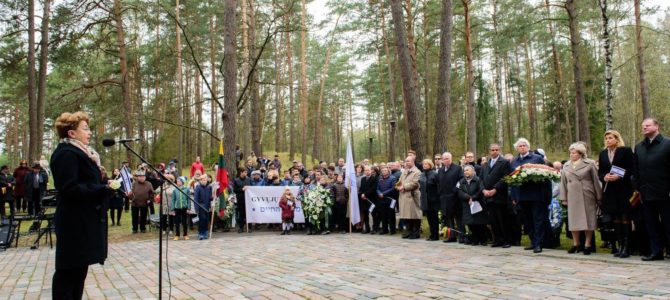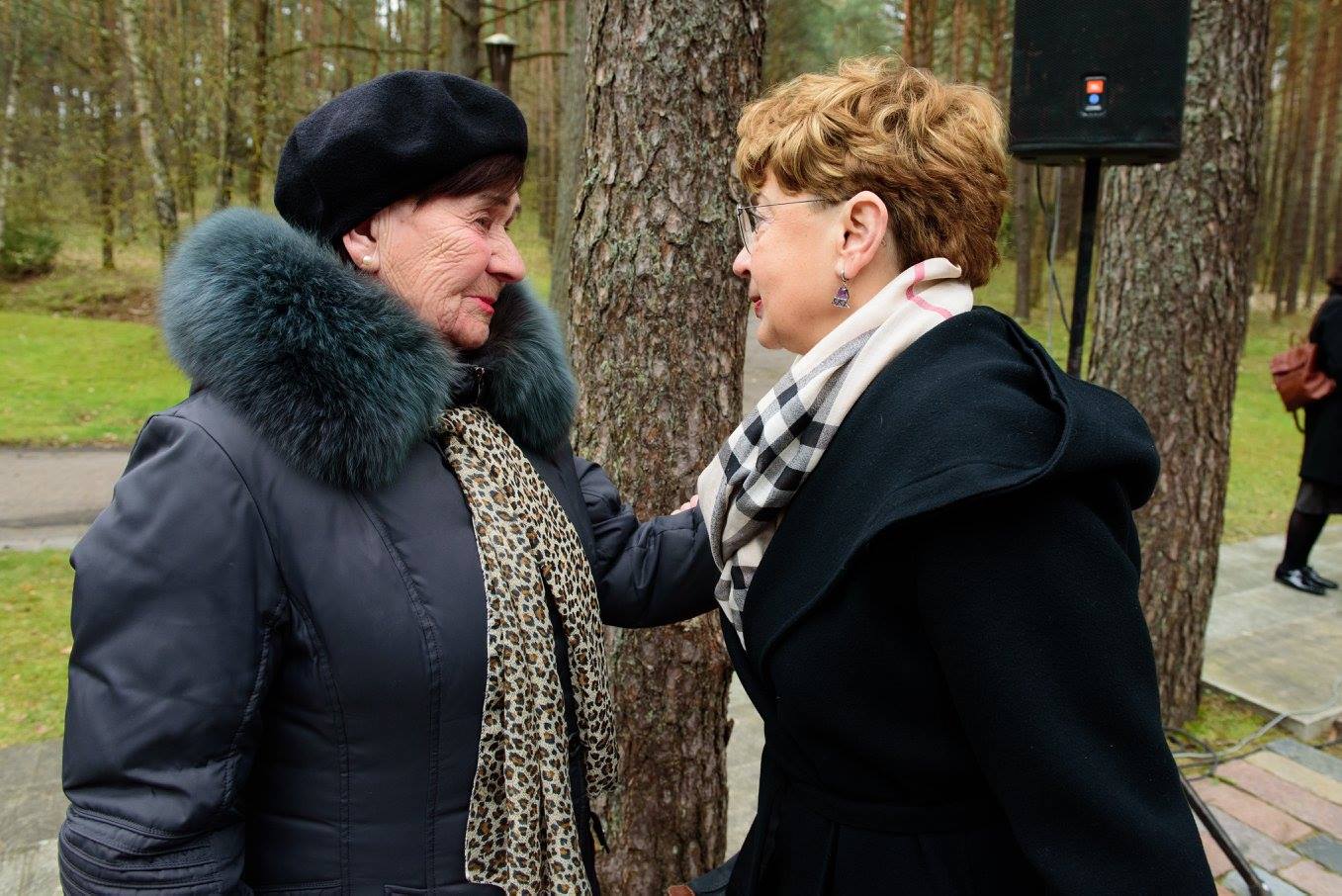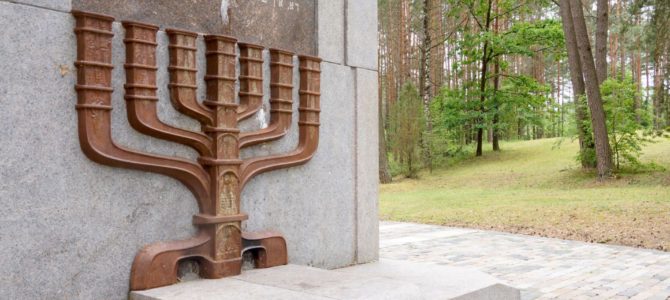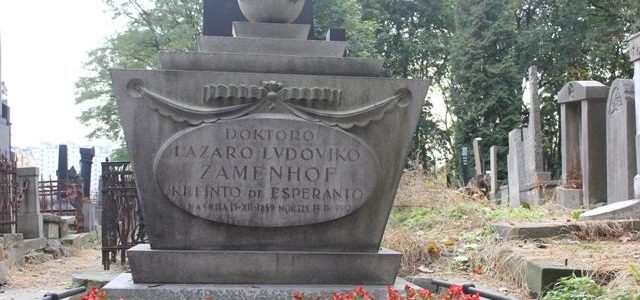

The Shtetl Commemorative Garden is located in the Žemaitija National Park in Medsėdžiai village in the Plateliai aldermanship in the Plungė region of Lithuania. Go visit!


The Shtetl Commemorative Garden is located in the Žemaitija National Park in Medsėdžiai village in the Plateliai aldermanship in the Plungė region of Lithuania. Go visit!

Vilnius, March 30, BNS–Lithuanian prime minister Saulius Skvernelis said there are deliberations on changing the project for the reconstruction of the Palace of Sports to include a equip a building to host a Jewish history museum and for conferences. There was consideration on holding concerts and other cultural events in the project initiated by the former Government.
Vilnius mayor Remigijus Šimašius proposed setting up a Litvak History Museum next to the Palace of Sports which the Government is planning to renovate. “I think the Government has done the right thing in halting the untransparent bid begun earlier. But there should be a conference center there without any doubt. We just discussed that it would be more sensible if next to the conference center or partially integrated with the conference center there were a museum of Litvak history. It is probably this could be accomplished wonderfully and would become an attraction. We agreed to develop the idea further. I’m glad my opinion and the prime minister’s coincide on this,” the mayor of Vilnius told BNS after meeting with Lithuanian prime minister Saulius Skvernelis Thursday.
“It should be able to be used for conferences. Now there is a concept, a conference and concert hall, so it should be conferences and a museum,” the prime minister told reporters at parliament.

Efraim Zuroff of the Simon Wiesenthal Centre in Jerusalem has said the Lithuanian authorities were “very culpable.”

A derelict shul in Vilnius (Getty Images)
Lithuanian parliamentary ombudsman Augustinas Normantas has refused to open an investigation into a complaint that his country’s Genocide and Resistance Center presents a revisionist version of wartime history.
Instead, the ombudsman said that the center itself must address the issue first, and “if its answer is disputed, then in a court of law.”
The complainant, Grant Gochin, has challenged the Genocide Center’s description of Lithuania’s wartime treatment of its Jews, calling it “a distortion of history and an insult to the Jewish citizens of Lithuania.”
The American Jewish Committee issued a statement on twitter about the opening of their new Warsaw office;
It is a historic day for AJC as we open our Central Europe Office! WATCH to learn about all that led to this moment:
https://t.co/ZK0XfuXINe pic.twitter.com/EPARAjFfu1
— AJC (@AJCGlobal)
March 27, 2017

Bernardinai.lt
by Justas Stončius, doctoral candidate and lecturer at the Institute of the History and Archaeology of the Baltic Region, Klaipėda University
Fifty-five years ago on March 22, 1962, death sentences were issued to three Jews from the Lithuanian Soviet Socialist Republic. They were accused of violations in exchanging currency. The local press reported the trial in detail and the Western press covered it as well, viewing it (correctly) as traditional anti-Semitism, whose existence in the USSR was denied. Klaipėda University doctoral candidate Justas Stončius discusses the motivations and history of the Vinius Money-Changers Case.
The trial of the “Vilnius money-changers” lasted from January 30 to March 22, 1962. The Supreme Court of the Lithuanian Soviet Socialist Republic tried eight people of Jewish ethnicity who were accused of violating the rules for exchanging currencies and of currency speculation. The decision was made to hold a public trial and a special group of correspondents was formed to cover the trial in newspapers and magazines. Invitations were distributed at Vilnius city factories to the more active workers and activists in the production sector. During sentencing the death sentence was given Aron Reznitsk, Mikhail Rabinovich and Fyodor Kaminer, while Basia Reznitsk was sentenced to 15 years’ imprisonment, decreased to 10 years 6 years later.
The Vilnius Money-Changers Case received much attention in the West. On April 17, 1962, French newspaper Le Progrès reported “by order of the Vilnius Tribunal three Lithuanian Jews have been put to death” and noted the events had caused unrest in the Jewish community of the Soviet Union. France’s Le Monde newspaper stated Jews of the USSR were afraid “that they, too, might become scapegoats for the rampant lack of food stuffs in the Soviet Union…”
Full story in Lithuanian here.


Then-president of Israel Shimon Peres at Ponar in 2013. Photo: AFP/Scanpix
Vilnius, March 27, BNS–The mass murder site established by Nazi Germany in Ponar outside Vilnius during World War II was three times larger than the memorial complex there now, Lithuanian historians have discovered.
“The memorial is only a small part of the Ponar murder operation site. It might have covered 65 hectares, but the memorial complex/museum there occupies 19 hectares,” Lithuanian History Institute researcher Saulius Sarcevičius told BNS Monday. He said researchers working at the site since last year have discovered five new mass murder pits and additional research is being carried out on two of them.

Dr. Christoph Dieckmann. Photo by Karolina Pansevič, © 2017 Delfi.lt
Effective cooperation between Germans and Lithuanians became a fatal trap for Lithuanian Jews. It was patriots–ethnic nationalists–who murdered the Jews in Lithuania, hoping to form a strong nation-state without Jews, Russians and Poles.
So German historian Christoph Dieckmann said in an exclusive interview with Delfi.lt. Dieckmann, who works at the Fritz Bauer Institute in Frankfurt, is the author of the two-volume Deutsche Besatzungspolitik in Litauen 1941-44 published in 2011. As a member of the Lithuanian International Commission to Assess the Crimes of the Nazi and Soviet Occupational Regimes, Dieckmann raises a painful moral question: why didn’t the Lithuanian people, seeing and hearing the Jews being murdered around them, protest? He believes it’s largely due to the position of the Church, which he believes was only concerned with what to do with the property of Jewish converts to Catholicism.
Full story in Lithuanian here.


The Panevėžys Jewish Community greet you on the upcoming holiday of Passover and invite you to a series of events for the holiday:
April 6 Concert “From a Forgotten Book” at the Gabrielė Petkevičaitė-Bitė Panevėžys Regional Public Library, Respublikos street no. 14 at 5:00 P.M.
April 10 First Passover Seder at the Rojaus paukštė café, Respublikos street no. 4A at 6:30 P.M.
April 11 Second Passover Seder at the Panevėžys Jewish Community, Ramygalos street no. 18 at 2:00 P.M.
April 14 Third Passover Seder and Sabbath at the Panevėžys Jewish Community, Ramygalos street no. 18 at 2:00 P.M.

For a decade now there has been a club for Israeli young people studying in Kaunas. The club meets at what is called the Kaunas Jewish Center in the center of town. Currently about 130 students from the Lithuanian Health Sciences University attend regularly and all Jewish students in Lithuania are welcome.
The center features a synagogue, the student club and a kosher food restaurant for students, and hosts events and holiday celebrations. A mikvah for married women is to be set up before Shavuot this year. Rabbi Moshe Sheynfeld and his right-hand man Aleks Minin run the center. Minin helps with the daily tasks and making new ideas real. The founder, financial supporter and tutelary spirit of the center is William Shtern, who says he’s happy the students have found a small piece of Israel in Kaunas, their second home, where they can further their own identities, but he says he is even more glad they are meeting one another, becoming friends and even starting families.
The Kaunas Jewish Community has been working with Shtern and his center for several years now and acts as partner in certain center projects, and people from the center attend Kaunas Jewish Community events. Every Friday people from the center donate fresh challa bread for the Kaunas Jewish Community’s Sabbath dinner.
You can find out more about the Kaunas Jewish Center here.

Remembrance. Responsibility. The Future. These are the sequential steps leading to real changes in society. The future of democracy and tolerance depends on memory and responsibility assumed, allowing for moving forward. A step towards the future–after surveying, judging and adopting expertise from the best initiatives aimed at fighting discrimination–this is the goal of this new start-up project.
The new project is called Development and Publication of Recommendations for Actions to Fight Anti-Semitism and Romophobia in Lithuania.
The project is supported by the Erinnerung, Verantwortung und Zukunft foundation or EVZ in Germany. This foundation supports systematic and long-term studies of discrimination against and marginalization of Jews and Roma in Europe.
The Lithuanian Jewish Community has brought together a group of leading experts from among Lithuanian human rights organizations, community activists, academics and specialists from abroad. This group is undertaking to come up with effective and valuable recommendations on actions for fighting anti-Semitism and Romophobia in Lithuania.

![]()
Vilnius, March 22, BNS–The building of a former Jewish library in Vilnius has been entered on the registry of cultural treasures and there are plans to house a Vilnius ghetto museum there.
The Cultural Heritage Department announced the building with a commemorative plaque at Žemaitijos street no. 4 is being provided legal protection for its valuable archaeological, architectural and historical characteristics. The first council for assessing real estate cultural heritage at the department made the decision.
Cultural Heritage Department director Diana Varnaitė the surviving building which was part of the Vilnius ghetto and where the Mefitsei Haskalah library operated and later the Vilnius ghetto library is not currently being used and belongs to the Vilna Gaon State Jewish Museum.
“At [the museum’s] initiative there are plants to set up a museum commemorating the Holocaust in Lithuania and the Vilnius ghetto which will exhibit the vast Jewish cultural heritage and the history of the Holocaust in Lithuania. The names of Holocaust victims are read out there annually to mark the day of Jewish genocide,” director Diana Varnaitė said.


Lzinios.lt
The newspaper Ūkininko patarėjas [Farmer’s Helper], 30% of whose stock is owned by Union of Peasants and Greens [ruling] party leader Ramūnas Karbauskis, is printing articles raising doubt and uncertainty concerning the conferring of a state award to former ghetto inmate and Soviet partisan Fania Brancovskaja, articles which are insulting to the Lithuanian Jewish community. Historian and MP Arvydas Anušauskas says he thinks these sorts of publications bring to mind Nazi propaganda and contribute to the sowing of ethnic discord.
“The Lithuanian Jewish Community strives to base its words on facts, documents checked a hundred times before making a statement. These sort of accusations and this kind of rhetoric being published by Ūkininko patarėjas is, in my understanding, at the very least unethical,” Lithuanian Jewish Community chairwoman Faina Kukliansky told [the newspaper] Lietuvos žinios.
She was talking about publications in Ūkininko patarėjas which raise doubts concerning the actions during World War II of Fania Brancovskaja. Brancovskaja was conferred the Order of the Cross of the Knight “For Merit to Lithuania” on February 16 this year. Some publications have claimed Brancovskaja, who fled the Vilnius ghetto and joined the Soviet partisans, is complicit in the mass murder of residents of the village of Kaniūkai [Lithuania] carried out in January of 1944, although research by experts from the Center for the Study of the Genocide and Resistance of Residents of Lithuania found she had not taken part in that operation.
Going on Speculation
The March 14 issue of Ūkininko patarėjas contained an article stating: “On February 21 Ūkininko patarėjas was the first media organ in Lithuania to report to the public the President’s Office on the occasion of February 16 [Lithuanian Independence Day], by awarding the ‘knightess’s’ cross to a Soviet agent of diversion, to member of the Jewish gang which exterminated the village of Kaniūkai in Eastern Lithuania Fania Brancovskaja, in truth awarded and rehabilitated all the perpetrators of the genocide of the Lithuanian nation.”
Full story in Lithuanian here.

The Department of Ethnic Minorities under the Government of the Republic of Lithuania invited those interested in cultural heritage to the launch of their multimedia DVD March 16. The DVD presents moveable and non-moveable heritage objects and sites of ethnic minorities living in Lithuania. The disc contains panoramic photographs of Lithuanian ethnic minority heritage sites by photographer Kostas Šukevičius. This section of the disc includes heritage associated with the Polish and Jewish communities in Lithuania.
Speakers and participants at the event included Cultural Heritage Department director Diana Varnaitė, senior archivist of Lithuania Ramojus Kraujelis, acting director of the State Tourism Department Indrė Trakimaitė-Šeškuvienė, journalist and author Aurelija Arlauskienė who has written a number of books about Lithuanian cultural sites including about the Paulava Republic, and Lithuanian Jewish Community heritage specialist Martynas Užpelkis. Donatas Puslys, editor-in-chief of the website bernardinai.lt, was moderator.
Full story in Lithuanian here.

The Ukmergė Jewish Community celebrated Purim together in high spirits on March 19.

The Kaunas Jewish Community invites you to come and remember the victims of the Children’s Aktion in the Kaunas ghetto during the Holocaust. Approximately 2,000 children were murdered during the mass murder operation. This will be the 73rd anniversary of that tragic day. The event will be held at 4:00 P.M. on March 24 at E. Ožeškienės street no. 13 in Kaunas.

Lithuanian Jewish Community chairwoman Faina Kukliansky met with Glenn Drew, chief executive officer of the American Hebrew Academy, the international Jewish college preparatory boarding school with a distance-learning program via internet, on March 17 to discuss educational opportunities for members of the LJC and their children. The Baltic Council for International Education facilitated the meeting.
Mr. Drew first visited Vilnius in October, 2016. Reading recently about the Lithuanian Jewish Community’s chairwoman and her work, he decided to make contact with the Community directly.
In a letter to the chairwoman sent before the meeting, Mr. Drew wrote:
“I spend a considerable amount of time traveling around the world visiting Jewish communities to inform them about opportunities for Jewish teenagers to study and the American Hebrew Academy in the United States. During my visit to Vilnius, I welcome the opportunity to meet with you and your board. I believe we share many common interests and would like to explore how we may collaborate in the future.

Psychiatrist Danella Eliasov from the Republic of South Africa visited the Panevėžys Jewish Community March 16. Her grandparents, great-parents and relatives lived in Kupiškis where there was a large Jewish population before the Holocaust. Danella talked about her family and wanted to learn more about the fate of the Jews in Lithuania during the Holocaust. After a fruitful discussion she thanked Panevėžys Jewish Community chairman Gennady Kofman for the warm reception.
Last weekend was special for the Šiauliai Jewish Community. Friday many members of the community gathered to celebrate the Sabbath conducted properly by Rabbi Kalev Krelin. The men went for prayer to the synagogue and the women lit the candles to the kiddush and challa. We had a special guest: Israeli ambassador to Lithuania Amir Maimon paid an unofficial visit.
At the culmination of the evening the entire community enjoyed kosher floimen-tzimmes.
Early Saturday morning the men gathered again for prayer at synagogue with the rabbi.
In the evening all members of the community dressed up in carnival costumes and masks and gathered to celebrate Purim. Rabbi Kalev Krelin read from the Book of Esther and all of us, together and loudly, wiped the name of Haman from history.
This year the holiday coincided with the 27th anniversary of modern Lithuanian independence and the community didn’t neglect that holiday either, singing the Lithuanian national anthem (and Hatikvah).
With our feasting and fun we celebrated Purim according to all the Jewish traditions.
I wish all members of the community a happy holiday!
For Litvaks Lithuania is the land of our ancestors, and March 11, the day 27 years ago when Lithuanian independence was restored, is an important holiday for us, marking as well the beginning of the rebirth of the surviving Jewish community. March 11 is for each of us an exceptional and dear day, and we cannot allow ourselves to forget how important the state where we live and where our children grow is to us. In 1918 as the first Republic of Lithuania was being born her Jewish citizens volunteered to fight for Lithuanian freedom, and went on to foster the economic and social welfare of this state.
In the run-up to March 11, significant activity by the Lithuanian Jewish initiative group took place in 1988 dedicated to the rebirth of Jewish culture. After the Lithuanian independence movement Sąjūdis was established, Lithuanian Jews were faced with the dilemma of how Jewish relations with the Lithuanian national movement would develop as the wounds of the Holocaust remained painful, recalling the tragedy which took place in this country.
Along side the rebirth of Lithuanian independence, first came the rebirth of Jewish cultural activity, and the Jewish Cultural Association was the first to hold a congress, beginning the conversation about the destruction of the Jewish community during the Holocaust in 1989, for the first time since the decline of the Soviet era in Lithuania. I have to say Jewish-Lithuanian relations in the historical context, their evaluation and research began exactly with the rebirth of independence when there had to be an assessment of the Holocaust and the active role played by Lithuanians in it had to be admitted. There were also efforts made to help Jews restore their Jewish identity.
The Jewish communities in the shtetls were exterminated in the Holocaust, the shtetls are gone and Yiddish is no longer spoken in Lithuania. Currently the Jewish communities in Vilnius, Kaunas, Klaipėda, Šiauliai, Panevėžys and Švenčionys have been re-formed. We still dream of a revival of the Yiddish language.
In the recent past we have sensed the emergence of a new generation in Lithuanian society who are interested in Jewish history and the life of the Jews in Lithuania, and slowly but surely stereotypical thinking is fading away.
When we speak of the values of March 11, we underline human rights and freedoms and their necessary consolidation and growth. We hope for the generation who understand their importance and who cherish and protect these rights and freedoms, and who connect love for their native land with self-respect and respect for all of its citizens.

Hag Purim sameakh!
The Bagel Shop this week offers vegetarian bebelakh. During the Purim holiday period we are also making a variety of delicious treats including hamentashen and serving wine. We are making vegetarian dishes in honor of Queen Esther, who was a vegetarian. The Bagel Shop is located at Pylimo street no. 4 at street level in Vilnius.
Bean bebelakh, a recipe from Riva Portnaja’s mother Sara Berienė
Sara always made this dish for the Purim holiday where all dishes were vegetarian in honor of Queen Esther.
Soak a liter of large beans overnight, boil in salted water for a long time until they go soft. Served cold sprinkled with salt. Simple and delicious!