History of the Jews in Lithuania

Ponar Calls on Us to Remember

Ponar Calls on Us to Remember

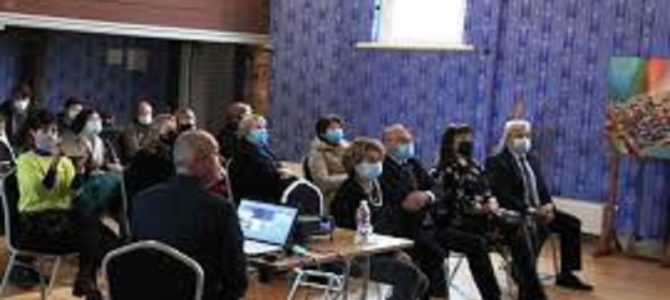
I thank all of you who walked with the Lithuanian Jewish Community today along the route taken by 70,000 men, women and children 77 years ago.

While the bodies of the victims of Ponar, reduced to ashes, will not rise again, no attempts to burn the pages of history will liberate our fellow citizens from the guilt dwelling in the subconscious over the murder of the Jews, nor will it relieve the suffering of the experience of the Holocaust even of the generation which came after.

No actions will return the lives of the more than 200,000 people of Lithuania lost during the Holocaust while words, whether in Lithuanian or Yiddish, will only briefly return a glimmer of the crown of the Jerusalem of Lithuania.

The memory of the Holocaust, however, isn’t just filled with shame for one side and pain for another. Its memory awakens our conscience and our duty to the future: to remember and honor the dead, thus imparting some sense to the victims of senseless hatred, lessons written in innocent blood for humanity. As long as we’re alive we must insure through joint effort, testifying to the memory of the Holocaust victims, the tragedy of Ponar never recurs, and that it doesn’t become the object of new and error-filled forms of hatred.

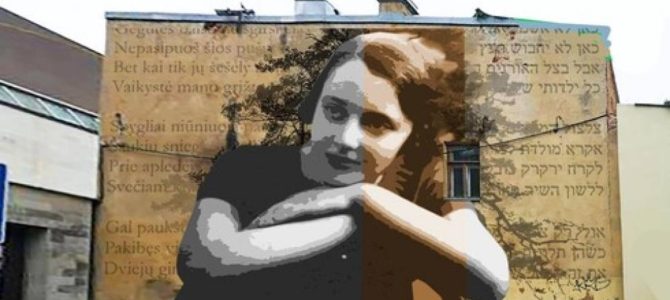
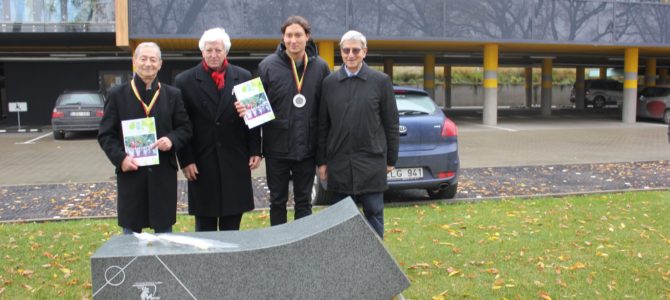
As we recall the events of that era of pain, it’s just as important to remember those giants of the spirit. I don’t know how many times now here in Ponar I’ve talked about Liba Mednikienė, a heroine of Lithuania’s battles for freedom. Finally now, during the Year of the Vilna Gaon and the Year of Litvak History, a monument to her memory, to this Lithuanian patriot murdered at the hands of Lithuanians, has found a home in the town of her youth, Širvintos.

Today hope is reborn, listening to the words of the president and prime minister and watching the soldiers pay tribute to Lithuania’s Jewish victims of genocide, hope that our society and out state have matured, have reached a new stage in the dialogue between Jews and Lithuanians, devoted wholly to learning and recognizing historical justice. We have an history inherited and shared from the time of Vytautas the Great, and so I believe commemoration of the victims of the Holocaust and being an indivisible part of it will become, eventually, not a matter of just marking an event or opportunity, but an issue of civic dignity and our view of the world.

Thanks to all of you for being here today with us, the small Lithuanian Jewish Community, for blazing a path in remembering those who were innocent and were sentenced to death.

Faina Kukliansky
September 23, 2020
Ponar, Lithuania

Jewish Street in Utena Gets New Street Sign in Yiddish and Hebrew

Jewish Street in Utena Gets New Street Sign in Yiddish and Hebrew

The Utena regional administration in northeastern Lithuania decided to celebrate 2020 as the Year of the Vilna Gaon and Litvak History with a project called “Signs of the History of the Jews of Utena.” Project events were scheduled to coincide with European Heritage Days 2020 from September 11 to 20.

One of the first events was the unveiling of a street sign on Žydų gatvė (Jewish Street) in the town of Utena with the name of the street in Hebrew and Yiddish. Earlier a portrait of kosher butcher Kavinskis appeared on a wall next to the street to recall the formerly large Jewish community there. Between the two world wars most of the central parts of the town was inhabited by Jews. Nobel prize winner Bernard Lown, the inventor of the defibrillator, came from Utena.

Utena regional administration mayor Alvydas Katinas said at the unveiling ceremony Lithuania and Utena are on the right path: “Jewish commemorations, cherishing Jewish history and culture and keeping up cemeteries–this activity should become a daily one. I believe honoring Jews shouldn’t be limited to just memories or knowing how many Jews lived in Utena and how they lived here. Our work primarily should testify to the fact Jews live with us in the here and now.” LJC chairwoman Faina Kukliansky, MP Emanuelis Zingeris and others including many local residents attended the ceremony as well.

Lithuanian President Awards Rescuers of Jews

Lithuanian President Awards Rescuers of Jews

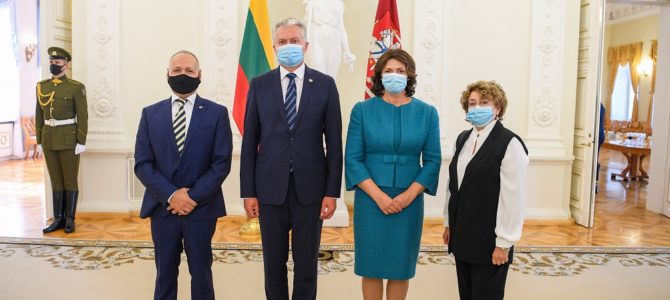
Lithuanian president Gitanas Nausėda awarded Lithuania’s Life-Saver’s Cross to remember those who saved Jews during the Holocaust at a ceremony at the presidential palace Monday. Most of the 44 recipients are no longer alive and the awards were received by relatives.

The president said most of us are too young to have rescued Jews during the Holocaust, but we are involved in creating the world after Auschwitz and fortunately, he said, we have a road sign, the people who back then opposed hate through their quiet great deeds.

“Following the example of rescuers of Jews, let’s create the sort of society where community would spread and thrive, where humanitarianism would rise above any ideological, political, religious or economic interests. Let’s teach altruism, transcending our private interests as the fulfillment of humanitarianism,” he said.

The annual ceremony is held to coincide with the Lithuanian Day of Remembrance of Jewish Victims of Genocide on September 23, the day 77 years ago marking the final liquidation of the Vilnius ghetto.

Lithuanian MPs Send Rosh Hashanah Greetings

Lithuanian MPs Send Rosh Hashanah Greetings

Members of Lithuania’s parliament Gediminas Kirkilas and Aušrinė Armonaitė sent Rosh Hashanah greetings to the Lithuanian Jewish Community as the country’s Jewish community marked the beginning of the new year, 5781 on the Jewish calendar.

Former prime minister Gediminas Kirkilas, now deputy speaker of parliament and chairman of the European Affairs Committee there as well as heading his Social Democratic Labor Party, regularly sends greetings to the Community on major holidays and occasions.

Aušrinė Armonaitė was voted in as an MP in 2016 on the Liberal Movement ticket and was a member of the independent faction there. In 2019 she helped found and was voted in as chairwoman of the new Freedom Party. Vilnius mayor Remigijus Šimašius is a deputy chairman in the new party.

Conference and Righteous Gentiles Ceremony at Vytautas Magnus University

Conference and Righteous Gentiles Ceremony at Vytautas Magnus University

Vyautas Magnus University in Kaunas and the Lithuanian Foreign Ministry will host a conference dedicated to Japanese wartime diplomat and Righteous Gentile Chiune Sugihara in the Great Hall of the University located at Simono Daukanto street no. 28 in Kaunas from 9:00 A.M. till 2:00 P.M. on Thursday, September 24. The conference will include a ceremony to award Righteous Gentiles in Lithuania. The conference will have synchronous translation available via mobile telephone requiring the installation of a special app for that purpose.

This year, 2020, marks the 80th anniversary of Sugihara’s work rescuing Jews in Kaunas from the Holocaust in 1939 and 1940. The Lithuanian parliament in 2019 declared 2020 the Year of Chiune Sugihara.

Please indicate your intention to attend by sending an email to sugihara-year@urm.lt

Remembering the Victims in Žagarė

Remembering the Victims in Žagarė

On Sunday, September 13, foreign ambassadors, Lithuanian Jews and local residents gathered in Žagarė in northeast Lithuania to remember the once-thriving Jewish community who were murdered in the Holocaust.

Israeli ambassador Yossi Avni-Levy, German ambassador Matthias Sonn, Lithuanian Jewish Community chairwoman Faina Kukliansky and Sania Kerbelis of Šiauliai, among others, gathered at the small Dmitrijus Naryškinas park in the center of the rural Lithuanian town. Kerbelis’s grandmother, cousins and other relatives were shot in this park in 1941. They were killed in a mass murder operation where German, Lithuanian and Latvian police mowed down starving Jewish men, women and children with machine guns.

Around 800 victims were murdered in there in the town square. Smaller children were murdered by smashing their heads against trees and walls. Those who weren’t killed on the town square were marched into the nearby forest to pits where another 3,000 victims were cast.

One 15-year-old Jewish girl survived the massacre on the town square, taken and hidden by a Lithuanian family. That girl’s granddaughter is Kornelija Tiesnesytė, Lithuanian deputy minister of education, who was at the ceremony Sunday.

Jewish Symbols in the Calendar for 5781

Jewish Symbols in the Calendar for 5781

The Lithuanian Jewish Community is greeting the new year, 5781, with the publication and distribution of our Jewish calendar for the coming year. As well as being attractive and nice to look at, this year’s calendar, as in past years, points back to our shared Litvak legacy. Every featured item once belonged to the Lithuanian Jewish communities and Lithuanian synagogues.

Dr. Aistė Niunkaitė has written a text about Jewish symbols and shared it with us in Lithuanian and in English translation below.

§ § §

See, the Lord has called by name Bezalel…

LJC Marks New Year 5781 This Week with New Jewish Calendar

LJC Marks New Year 5781 This Week with New Jewish Calendar

The year 5781 is almost upon us. The Lithuanian Jewish Community is celebrating the new year with our calendar, which has become a tradition, dedicated this time to the unique symbols of the Jewish people and their significance.

Before talking about the next year, I can’t pass over the foregoing which became a year of challenges and coming together for the entire world. The corona virus restricted our social life and the Community’s operation, but at the same time showed to us we are capable of taking care of our members, especially the elderly, that we can apply and perfectly well use digital technology and that even under the most difficult conditions we were able to mark the dates so important to Jews, Israel, Lithuania and the world and our own holidays.

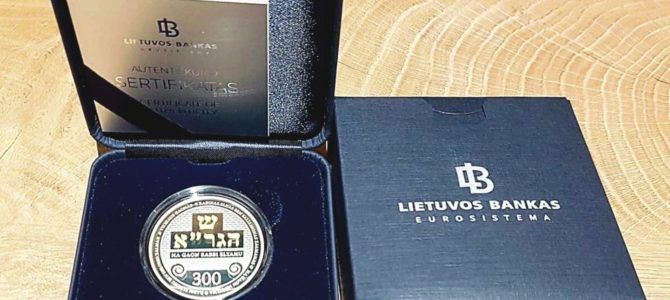
The Community was not able to mark appropriately the Year of the Vilna Gaon and Litvak History declared by the Lithuanian parliament because of the pandemic. But the historical past of Jews and its importance for Lithuania’s culture don’t fit within the frames of a single year, so I promise we will continue to organize events dedicated to Lithuania’s Jews, to Eliyahu ben Shlomo Zalman aka the Vilna Gaon and other important people. There can never be too many such events.

Conference for Historians Researching Jewish Heritage in NE Lithuania

Conference for Historians Researching Jewish Heritage in NE Lithuania

The Rokiškis Regional Museum hosted a conference called “The Jewish Community’s Contribution to the Cultural, Political and Economic Development of the North-Eastern Region of Lithuania during the Period of the First Republic of Lithuania” to mark the Year of the Vilna Gaon and Litvak History on Friday, September 4, 2020.

Kupiškis Ethnographic Museum specialist and historian Aušra Jonušytė in her presentation “The Jewish Community of Kupiškis” spoke about the former Jewish community in Kupiškis and their contribution to economic, social and political life in the Lithuanian town. She presented examples of friendship and fellowship between Jewish and Lithuanian families is safeguarding the town from fires.

Two books were presented at the conference: “Kupiškio žydų bendruomenė. Praeities ir dabarties sąsajos” [The Kupiškis Jewish Community: Connections between Past and Present] (2016) and “Kupiškio krašto žydų bendruomenės pastatai ir paminklai” [Buildings and Monuments of the Jewish Community of the Kupiškis Region] (2017). The audience appeared very interested in these books. Former Israeli ambassador to Lithuania Amir Maimon wrote the forewords to both books. Museum specialist and historian Aušra Jonušytė compiled these publications. She also talked about a new publication planned provisionally called “Žydų virtuvės valgiai, gaminti Kupiškyje” [Jewish Cuisine Made in Kupiškis] which will include input from LJC projects coordinator and Litvak cook Dovilė Rūkaitė, Natalja Cheifec and members of the Kaunas Jewish Community. Panevėžys Jewish Community chairman Gennady Kofman has also offered his help with the new book project, as has philanthropist Philip Shapiro.

Book Presentation

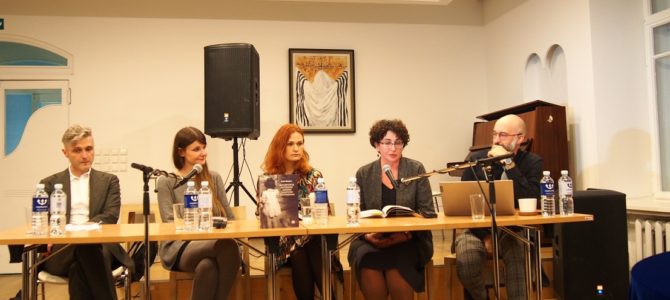
A presentation of Rūta Vanagaitė’s book “Kaip tai įvyko? Christoph DIeckmann atsako Rūtai Vanagaitei” [How Did It Happen? Rūta Vanagaitė Interviews Christoph Dieckmann] and a panel discussion will be held at 6:00 P.M. on August 15 at the Adomas Mickevičius Public Library at Trakų street no. 10 in Vilnius. Speakers and panelists will include Rūta Vanagaitė, Lithuanian History Institute director Alvydas Nikžentaits, Lithuanian Jewish Community chairwoman Faina Kukliansky, professors Irena Veisaitė and Tomas Venclova, and by video Christoph Dieckmann and Saulius Sužiedelis, moderated by Aurimas Švedas. The event is being held by the Adomas Mickevičius Public Library and the Vilnius Jewish Public Library in cooperation with the LJC.

Registration is required, spaces are limited and visitors will be required to wear surgical masks. To register, send an email to info@vilnius-jewish-public-library.com or call (8-5) 219 77 48 work days between 11:00 A.M. and 6:00 P.M.

In Memoriam Ronald Harwood

In Memoriam Ronald Harwood

Ronald Harwood, the son of Isaac Hurwich and Isabelle Peper-Hurwich of Plungė who was born November 9, 1934 in the Union of South Africa, passed away in London September 9, 2020.

The Lithuanian Jewish Community expresses our deepest condolences to the family and loved ones of the late Sir Ronald Harwood.

He was graduated from the Sea Point Boys’ High School in Cape Town and in 1951 went to London to pursue an acting career, becoming the friend of and personal assistant to British actor Donald Wolfit, who directed a Shakespeare company. Harwood was nominated for an Oscar for his screenplay for the film Dresser and won an Academy Award for best-adapted screenplay for Pianist. He was awarded the order of Commander of the British Empire and named a fellow of the Royal Society of Literature, among other distinctions.

Harwood visited his parents’ native Plungė, Lithuania, in 2002.

Twelve Thousand Holocaust Victims Commemorated Near Ukmergė

Twelve Thousand Holocaust Victims Commemorated Near Ukmergė

The annual commemoration in fall of about twelve thousand Holocaust victims killed in the Pivonija forest near Ukmergė (Vilkomir) were commemorated at their mass murder site Sunday. The annual commemoration takes place at noon on the first Sunday in the month of September.

Members of the Ukmergė Regional Jewish Community and a significant group of Jews from Vilnius, Šiauliai and the Kaunas Jewish Community attended the commemoration of the third largest mass murder site in Lithuania. So did representatives of the Ukmergė Regional Administration and the US embassy.

Ukmergė Regional Jewish Community chairman Artūras Taicas spoke, recalling the sea of people who moved from Ukmergė to the Pivonija woods 79 years ago, including thousands of children.

Who Is That Gaon?

Who Is That Gaon?

by Sergejus Kanovičius. Photo by Evgenia Levin/Bernardinai.lt

Soon the Year of the Vilna Gaon will end: the news websites will stop carrying out the internet education plans dedicated to Jewish history and the school curricula will remain as they always were: impoverished, and with the suppression of history. Everything will depend on the teacher’s initiative, again. The statues to the Gaon and Tsemakh Shabad will stare out, with acid poured over them. Plaques will hang commemorating the “desk murderer” in Vilnius and the statue to a murderer of Jews will continue to stand in the center of Ukmergė, and schools will continue to be named in their honor. The center tasked with researching genocide will offer jobs to people who think the “Lithuanian Activist Front would have found it easy to agree with Zionists.” Only suppressing the fact the LAF helped those Zionists travel into the bosom of Abraham.

Virtual internet reality will never coincide with true reality, and the proposition of living in two worlds will continue to be proposed. The official one will soon mourn at Paneriai and on Rūdninkai square because that’s what’s required. Actually, the pandemic in the true sense of the word helped save a pile of money which would have been used for those pompous but failed events. I would ask, couldn’t the money saved be used to change the school curricula so that a student who reads a headline or title “The Vilna Gaon…” doesn’t have to search the internet to find out who he was and why he’s important?

The best surrogate education–sampling Jewish foods–takes place via the stomach, and via internet. In both cases the effect of learning is equal to the time spent by the learner chewing a bagel or reading about some shtetl lost to oblivion, sipping coffee while reading the screen. There’s no need to even raise the question of enduring value or the long-term effect…

Kaunas Jewish Community Greets Fall with Renewed Pledge to Remember

Kaunas Jewish Community Greets Fall with Renewed Pledge to Remember

The Kaunas Jewish Community ushered out the waning summer and greeted the fall by remembering those who have gone before and the tragic loss of life in the Holocaust. In the last week of August Community members visited Prienai and remembered the victims there and in surrounding areas. The Kaunas Jewish Community would like to thank Prienai District Administration staff, representatives of the Balbieriškis (Balbirishok) Tolerance Center and students for caring that the Holocaust tragedy is their tragedy, too, with all its agony and loss, and for coming together without being told to hold a commemoration of those who once lived in the area as neighbors and perhaps even as friends of their parents, grandparents and great-grandparents.

As the summer days fade into fall and under a dreary and drizzling sky Community members also visited and remember the victims of the mass murder of the Jews of Petrašiūnai and the victims from the Kaunas ghetto of the intellectuals’ aktion also murdered there. The Kaunas Jewish Community would like to thank violinist Jonė Barbora Laukaitytė for braving the weather and performing her melody to which resonated so clearly with out own heartstrings.

The end of summer also saw the premiere of Aleksandras Rubinovas’s one-man-play “My Father” which was supposed to happen back on March 13, and the Kaunas Picture Gallery is still featuring a show of Samuel Bak’s paintings until September 13.

LJC Chairwoman Faina Kukliansky Meets with Klaipėda Regional Administration mayor Bronius Markauskas

LJC Chairwoman Faina Kukliansky Meets with Klaipėda Regional Administration mayor Bronius Markauskas

Klaipėda Regional Administration mayor Bronius Markauskas visited the Lithuanian Jewish Community and spoke with LJC chairwoman Faina Kukliansky about continuing cooperation. The two spoke during the meeting about plans to construct a bus station at Gargždai (Gorzhd), a town located about 15 kilometers east of the city of Klaipėda within the Klaipėda district, near the site where around 500 resident Jews were murdered during at least three mass murder operations on June 24 and September 14 and 16, 1941.

Fun Celebration of European Day of Jewish Culture for 2020

Fun Celebration of European Day of Jewish Culture for 2020

On Sunday, September 6, 2020, the Lithuanian Jewish Community held a fun celebration of the European Day of Jewish Culture. Community chairwoman Faina Kukliansky and Community members, the Israeli ambassador to Lithuania Yosi Levy, Lithuanian Cultural Heritage Department director Vidmantas Bezaras and guests had a good time and attended the Hebrew language lesson provided by Vilnius Sholem Aleichem ORT Gymansium principal Ruth Reches. The public, invited by the LJC, came to celebrate the first Sunday in September by sampling Jewish treats made at the Bagel Shop Café, located on the first floor of the Lithuanian Jewish Community building in Vilnius, a center of Litvak bagel culture.

The Bagel Shop Café presented paintings from Mark Kaplan’s collection during the event.

Participants also attended the lecture “Deification and Demonization of Jews: Anti-Semitic Superstitions in Society.”

You Are Invited to the European Days of Jewish Culture in Vilnius

You Are Invited to the European Days of Jewish Culture in Vilnius

The Lithuanian Jewish Community is continuing the tradition of marking the annual event European Days of Jewish Culture, this time for the fifth year, with a program of events in Vilnius scheduled for Sunday, September 6, 2020.

All parts of the event program are free and open to the public. The number of participants has been limited this year due to health concerns so please register as soon as possible.

For cooking lessons, register by sending an email to kavine@lzb.lt
For the Jerulita tour, register by sending an email to travel@jerulita.lt

To register by internet, click here.

Sholem Aleichem Gymnasium Principal Ruth Reches Greets Teachers, Students and Parents for New School Year

Sholem Aleichem Gymnasium Principal Ruth Reches Greets Teachers, Students and Parents for New School Year

This school year is a challenge for all of us. I have been asking myself why I as the new principal am always facing unexpected obstacles which have to be overcome. But this is more of a rhetorical question, because I feel new challenges are interesting. They aren’t frightening because I see I have not been left on my own to overcome them. ALL school staff are working to insure the school year begins smoothly.

The members of our collective stay at school into the late evening, come to work on Saturday and solve work questions by telephone and on vacation, and late into the night without being asked. Just because they care. I feel very strong support with this team in place and I know we will all lead the school forward together no matter how the situation changes.

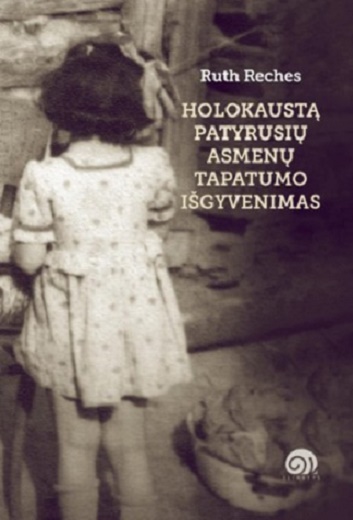
Thinking about the public tension the corona virus has caused, the lack of clarity on how the education process will take place if there is a second wave of the virus which might cost lives, I remember the book by the renowned thinker, humanitarian and psychotherapist Viktor Frankl describing his experiences during the Holocaust. Frankl was a professor of neurology and psychiatry at the University of Vienna in Austria as well as a practitioner and world-class thinker. In describing his experiences, he also pointed to significant things which helped him survive.