Religion

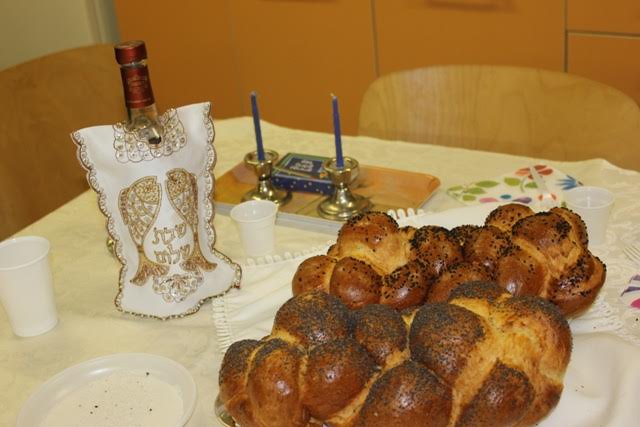
Kaunas Jewish Community Celebrates Rosh Hashana

Kauno žydų bendruomenė švenčia Roš ha Šana

A large contingent of Kaunas Jewish Community members came out to ring out the old and usher in the new year, 5777, wishing one another harmony, health, positive changes and good ideas. The evening of celebration was unusually warm, cozy and family-like. The Levita group of young musicians from France contributed with some great music performed extraordinarily well. The vocalist Vita Levina is the daughter of long-time Kaunas Jewish Community member Leonidas Levinas and began her musical career in Kaunas.

Greetings from LJC Chairwoman Faina Kukliansky for New Jewish Year 5777

faina-ros-hasana2

Happy New Year to all members of the Community, young and old! We are ushering out what was a successful year, and we have reason to be happy and proud of it, and now we look forward to an even better year. I wish everyone strong health and a sweet and successful year ahead for you and your families. I invite everyone to do at least on good deed for the community over the coming year, and I especially invite those to do this who believe there are things that aren’t right within the community. Do what you think is right, don’t be afraid to do good deeds and let’s not fear the consequences. I wish you love of the country in which you live, to love Israel, and to raise your children as Jews, the future members of our community.

שנה טובה ומתוקה

How Much Can Happen in Seven Seconds: Rosh Hashana 5777

portrait_of_determinism_by_relaxeder
by Andrés Spokoiny

In 2007, at Bernstein Center for Computational Neuroscience in Berlin, scientists conducted a troubling experiment. They put people into an MRI machine and asked them to press one of two buttons in front of them. The subjects were told to do this several times, and to choose freely which button to press.

One part of the results was nothing new: around a second before the button was pressed, the parts of the brain associated with conscious decision-making lit up. But looking more carefully, the scientists noted that there was a pattern of neural activities around six or seven seconds before the decision was actually taken. That pattern predicted with great accuracy the decision that the person ended up taking.

The researchers were shocked, because these findings suggest that decisions are not really conscious. Rather, they are subconscious neural processes that are complete before our “command and control” functions ever activate. We may think that we’re about to consciously decide something, but in fact, our subconscious has already (and irrevocably) decided.

Fifteen Ways Being Jewish Is Meaningful

by David Harris

Surveys reveal a disturbingly large number of American Jews who feel disconnected from their Jewish identity. How painfully sad! In response, and with the High Holy Days just around the corner, let me share, as I have on occasion in the past, what being Jewish means to me.

1. It means championing what is arguably the single most revolutionary concept in the annals of human civilization—monotheism—introduced to the world by the Jews, and its corollary, the inherent belief that we are all created in the image of God (in Hebrew, B’tzelem Elohim).

2. It means embracing the deep symbolic meaning the rabbis gave to the story of Adam and Eve. Since all of humanity descend from the “original” couple, each of us, whatever our race, religion, or ethnicity, shares the same family tree. No one can claim superiority over anyone else.

3. It means entering into a partnership with the Divine for the repair of our broken world (in Hebrew, Tikkun Olam), and recognizing that this work is not to be outsourced to a higher authority, or to “fate,” or to other people, but that it’s my responsibility during my lifetime.

4. It means affirming life – “I have set before you life and death, blessing and curse, therefore choose life, that both you and your descendants may live” (Hebrew Bible) – and the moral choice that lies in the hands of each of us to bring a little closer the Jewish prophetic vision of a world at peace and in harmony.

5. It means celebrating the fact that Jews were early dissidents, among the very first to challenge the status quo and insist on the right to worship differently than the majority. Today, we call this pluralism, and it is a bedrock principle of democratic societies. It also ought to be an essential component of Jewish communities everywhere.

6. It means welcoming the pioneering Jewish effort to establish a universal moral code of conduct and seeking to act as if that code of conduct were my daily GPS—to pursue justice, to treat my neighbor as I would wish to be treated, to welcome the stranger in our midst (and, I might add, the newcomer to the Jewish people), to be sensitive to the environment, and to seek peace. It’s not by accident that America’s Founding Fathers chose words from the Hebrew Bible for our nation’s Liberty Bell: “Proclaim liberty throughout all the land and unto all the inhabitants thereof.” Or that the Ten Commandments continue to be an ethical guidepost for so many around the world.

LJC Youth Programs in September

Ilan Club and their youngest group leaders opened the club for fall. Children returning from the summer camps were full of emotion, and the counselors were filled just as much with enthusiasm and new ideas.

On September 18 the Ilan club officially opened for the fall and about 30 of our youngest friends turned out for the event. The first activity was getting to know the new club members and the counselors. During the activities session the children participated in skits where children’s favorite things were showcased–cartoons, music, games, etc. During play the children had the chance to introduce themselves to the group and to play as teams. After the skit there was our weekend ceremony and a symbolic dinner with many delicious items.

Lithuanian Jewish Community Position on the Reconstruction of the Great Synagogue in Vilnius

The following is an official letter sent by the Lithuanian Jewish Community to concerned government agencies.

September 27, 2016

To:
Remigijus Šimašius
mayor, city of Vilnius

Alminas Mačiulis
Government chancellor

Šarūnas Birutis
minister of culture

Linas Linkevičius
minister of foreign affairs

Diana Varnaitė
director, Cultural Heritage Department under the Ministry of Culture

On the Reconstruction of the Great Synagogue

As public interest has grown recently in the history and cultural legacy of Lithuanian Jews (Litvaks) and specifically regarding artifacts uncovered at the site of the Great Synagogue in Vilnius, we feel it our duty to again present our view, that of the Lithuanian Jewish Community, regarding the issue of the conservation of surviving parts and the possible reconstruction of the Great Synagogue, a building with extraordinary significance to the Lithuanian and the global Jewish community.

As we have said before many times, we support all meaningful initiatives to preserve, protect and commemorate the legacy and heritage of the Jews of Lithuania, but we do not support unreasonable projects to rebuild non-existing buildings which are carried out in the name of Jews. It seems that is what we are facing again in the idea developing over many years by certain government institutions and possibly including hidden business structures to rebuild the Great Synagogue complex in Vilnius.

In 2015 the municipal government enterprise Vilniaus Planas was commissioned by the municipality’s Urban Development Department to prepare draft construction proposals for a memorial to the Great Synagogue under pre-project proposals submitted by the architect Tzila Zak. The terms of reference of the planning task itself revealed the client’s attitude towards the rebuilding of the Great Synagogue as an attractve real estate development project: the primary task presented to planners was to submit a list of the buildings proposed for rebuilding, to name the rooms and premises slated for reconstruction and to calculate floor space.

Let’s Do Something Good

logo-telsiu-zinios

by Aurelija Servienė

Last week was special for Jews. On September 23 the Day of Genocide of Lithuanian Jews was marked. To mark the day, a club of mentally disabled people in Žemaitija called Telšių Atjauta [Empathy of Telšiai] under their chairman Kazimieras Mitkus did a good deed: they cleaned up the Jewish cemetery in Telšiai.

Mitkus said the club engages in activities which are unusual for similar organizations. He said they strive to make the activities meaningful for the community as well as organization members.

“One of the sectors we care for and maintain is the Telšiai Jewish cemetery. Last week was special, in that we took the initiative without waiting for anyone else and cleaned up the cemetery. In the belief that there might be guests coming this special week,” the club chairman commented.

Prize Recipients Chosen for Best Final Academic Work on Ethnic Minorities in 2016

Išrinkti 2016 m. Premijos už geriausią baigiamąjį mokslo darbą tautinių mažumų tematika laimėtojai

On September 14 the Academic Council of the Lithuanian Department of Ethnic Minorities selected the winners of a new prize created this year for best final academic work on ethnic minorities.

Department of Ethnic Minorities director Dr. Vida Montvydaitė made the final decision on recommendations from her Academic Council and selected Julijana Leganovič in the first nomination category for her bachelor’s work “Comparative View of the Development of the Vilnius and the Kaunas Jewish Communities in the Interwar Period.”

The second category was for master’s work and the winners were Rūta Anulytė with her “Heritage Protection and Maintenance of Historical Jewish Cemeteries in Lithuania: Practice and Recommendations” and Mantas Šikšnianas with his “Jews of Švenčionys from the mid-18th Century to the mid-20th Century: Shtetl, Sabbath, Shoah.”

Full story in Lithuanian here.

LJC Chairwoman Faina Kukliansky Speaks at Ponar September 23, 2016

LŽB pirmininkės F. Kukliansky kalba Paneriuose Holokausto aukų pagerbimo ceremonijoje

Dear participants,

I am sincerely thankful that you have gathered here today together with the Jewish Community to honor the memory of Holocaust victims.

But can we truly speak about honoring Holocaust victims when multiple streets in Lithuania are named after Kazys Škirpa, there is a school named after Jonas Noreika and the monument to Juozas Krikštaponis has still not been torn down?

We don’t have public spaces named after Ozer Finkelstein, Katz Motel or Volf Kagan. How many know the name of Liba Mednikienė, a scout in the Lithuanian battles for independence? Despite her service, she was murdered by Lithuanians during the Holocaust.

This and similar fates awaited the victims at Ponar. Our younger generation still doesn’t know about 650 years of Jewish history in Lithuania, before, during and after the Holocaust. Will the history textbooks teach this to the young citizens of Lithuania someday?

The Lithuanian Jewish Community has more questions than answers. The only sure thing is that an irreversible process has taken place and the country will never again be what it was before the Holocaust. But the Jewish Community is still here, and as long as it is, it will seek justice. But the highest value, truth, can only be restored when Lithuania works up the courage to name the perpetrators of the Holocaust. To remain silent about the Holocaust perpetrators, to forget the victims of the Holocaust and to disregard the living Jewish community is the same thing as killing the Jews again.

Today we mark the 75th anniversary of the beginning of the mass murder of the Jews in Lithuania. Our hope is that the smaller towns of Lithuania will remember their lost Jewish communities all year round, not just during Holocaust commemorations. From sporadic, random and often simply superficial events, memory of the Holocaust needs to become general knowledge, to become an integral part of the worldview of every conscientious citizen of Lithuania.

Thank you all who are not indifferent to the memory of the Holocaust, the Jewish tragedy, Lithuania’s tragedy.

Lithuanian Jewish Genocide Victims Honored at Ponar

Paneriuose pagerbtos Lietuvos žydų genocido aukos

lrkm.lrv.lt

A ceremony to honor the victims of the genocide of the Jews of Lithuania was held at the Ponar Memorial Complex on September 23. The event was organized by the Ministry of Culture, Ministry of Foreign Affairs, National Defense Ministry, the Lithuanian Jewish Community, the International Commission to Assess the Crimes of the Nazi and Soviet Occupational Regimes in Lithuania and the Vilnius municipality.

A minute of silence was observed and wreaths and flowers were laid at a monument to Holocaust victims. Students sang the Vilnius ghetto anthem. Vilnius ghetto inmates shared their thoughts. A cantor performed kaddish and an Israeli choir performed songs and hymns.

Before the ceremony participants in the Way of Memory civic initiative read the names of people murdered at Ponar, including the age and profession of victims, bringing the dead and the living closer together.

Kaunas Jewish Community Visit Balbieriškis and Prienai

Kauno žydų bendruomenė lankėsi Balbieriškyje bei Prienuose.

The Kaunas Jewish Community visited Balbieriškis and Prienai, Lithuania at the invitation of Balbieriškis Tolerance Center director Rymantas Sidaravičius on the European Day of Jewish Culture, September 4. The delegation toured a Balbieriškis Tolerance Center exhibit on the history of the Jews of the town and reflecting the center’s current relationships and friendships with Jews from around the world. They also toured the town, where Jewish homes and buildings from before the war still stand, and honored the memory of the dead with a prayer at the old Jewish cemetery in Balbieriškis.

Representatives then went to Prienai and honored Holocaust victims there. In Prienai they attended a museum event dedicated to the European Day of Jewish Culture. The museum event included a stirring presentation of the history of the Jews of Prienai, funny stories from Jewish life from before the war, significant achievements, good relations between Jews and other town residents and the Holocaust. The event included passages in Hebrew and Yiddish. The hosts made the delegation feel right at home at every stop on their visit, as if they were visiting old friends.

Former Alytus Synagogue to House Museum

Buvusi sinagoga taps muziejumi

lzinios.lt

Renovation has begun on a century-old synagogue in Alytus, Lithuania. The building was used to store salt in the Soviet era and is now set to become a city community center and museum of Jewish culture. The Lithuanian Jewish Community, the Cultural Heritage Department and Israeli ambassador to Lithuania Amir Maimon who visited the town all gave their approval to the plans by Alytus. Support was pledges to secure funding to set up the museum of Jewish culture there and to acquire the necessary exhibit items.

Full story in Lithuanian here.

LJC Olameinu International Children’s Camp 2016

LŽB tarptautinė vaikų stovykla Olameinu 2016

Lithuanian Jewish Community youth programs coordinator and camp programs director Pavel Gulyakov reported the only negative at the camp this year was some not-so-great weather, it rained, preventing the children from visiting beautiful Lake Asveja at times. The camp went international this year with children from Jewish communities in all three Baltic states.

Jewish Street Gets New Sign in Yiddish, Hebrew

Vilniuje Žydų gatvės pavadinimas užrašytas dar dviem kalbomis – ir יידישע גאס (jidiš klb.), ir רחוב היהודים (hebrajų klb.)

Žydų gatvė (Jewish Street, aka Yidishe Gas, aka ulica Żydowska), where the traditional Jewish quarter and the Great Synagogue of Vilnius was located, got a new sign in Yiddish and Hebrew Tuesday.

This was one in a continuing series of new signs in foreign languages, a controversial effort by Vilnius mayor Remigijus Šimašius to showcase the multicultural identity of the Lithuanian capital. Earlier signs in “minority” languages included ones for Islandijos [Iceland] street, Washington Square, Varšuvos [Warsaw] street, Rusų [Russian] street and Totorių [Tatar] street in Vilnius.

Jewish Street in Vilnius to Get Trilingual Street Sign

Žydų gatvė (Jewish street, aka Yidishe gas, aka ulica Żydowska), where the traditional Jewish quarter and the Great Synagogue of Vilnius was located, is about to get signs in Yiddish and Hebrew.

The special event to unveil the new sign is scheduled for 11:30 A.M., Tuesday, September 20 at Žydų street no. 2.

The program includes a performance of a piece by the Jewish song and dance ensemble Fayerlakh, followed by Vytautas Mitalas, chairman of the Vilnius municipal council’s culture, education and sports committee, presenting Vilnius mayor Remigijus Šimašius. Šimašius is to present a small speech. Mitalas will then introduce Lithuanian Jewish Community chairwoman Faina Kukliansky, who will also deliver a small speech. The mayor and the chairwoman will then unveil the new street sign. Fayerlakh is then scheduled to perform another song.

The historic street and a neighboring street were cleared of their mainly Jewish residents in 1941 when the Nazis and Nazi collaborators set up the Vilnius ghetto. The residents were murdered and a large population of Jews from other parts of the city were forced into the cramped quarters there. It was part of the so-called Small Ghetto in Vilnius, liquidated in October of 1942. Žydų gatvė was the site of the Shulhof, the collection of buildings built around the location of the residence and study of the Vilna Gaon and the Great Synagogue.

Lithuanian Jewish Community Demands Halt to Construction Work

Lithuanian Jewish Community


September 7, 2016 No. 319
September 6, 2016 No. 1-/6/P-007

To:

Tomas Pauliukonys, director
Vestata
V. Kudirkos street no. 18, Vilnius 03105

Arvydas Avulis, chairman of board of directors,
Hanner
Konstitucijos prospect no. 7, Vilnius 09308

cc:

Diana Varnaitė, director
Cultural Heritage Department under the Ministry of Culture
Šnipiškių street no. 3, Vilnius 09309

REGARDING WORK AT RINKTINĖS STREET NO. 3, VILNIUS


It has come to our attention that by order of companies under your direction during the last days of August of this year there was earth dug without permission during demolition and construction at the site of the former Žaligiris Stadium within the protected zone of the old Vilnius Jewish cemetery in Šnipiškės (cultural heritage register number KVR 31812, henceforth “Cemetery”). This is a gross violation of the signed agreement on the terms of the cultural heritage protection of the protective buffer zone of the Cemetery (henceforth “Terms”) adopted on August 26, 2009, as well as the agreement between the Lithuanian Jewish Community and the Vesata company and the Archeoligijos centras public organization (henceforth “Agreement”).

We demand an immediate halt to all work within the territory of the Cemetery and its protected zone until representatives of the Committee for the Preservation of Jewish Cemeteries in Europe (henceforth “Committee”) are able to assess the situation and decide appropriately regarding further work at the site.

According to our information, the earliest date a Committee representative could arrive is from September 12 to 15 of this year. Please respond quickly as to whether this date is appropriate for a visit, and as to whether you are willing to pay all costs associated with it.

[signed]
Faina Kukliansky, chairwoman

Same Problem Every Year at Jewish Mass Murder Sites

Kiekvienais metais ta pati problema prie žydų žudymo vietų

Every year the Panevėžys Jewish Community writes the municipal and regional administrations regarding the most tragic sites in Jewish history, sites which need continual upkeep and maintenance, the Jewish mass murder sties in the city, district and region of Panevėžys. And also in other towns such as Kupiškis, Pasvalys, Biržai, and smaller towns such as Krekenava, Pumpėnai, Raguva, Obeliai, Ramygala, Vabalninkas and others.

A large number of municipal and regional administrations consider all our requests in a spirit of goodwill and are engaged in solving the problem of maintenance at these places of tragedy, but, unfortunately, there are also a number of administrations who discover all sorts of reasons not to fulfill our requests. We believe there needs to be a common stance by government so that every year, especially in summer, cemeteries and the mass murder and mass grave sites are mowed and cleaned up. The municipal bodies of the towns of Kupiškis and Rokiškis are paying attention to the problem, while we have to beg and cajole the Pasvalys administration constantly to maintain and clean up the mass murder site in the Žadeikiai Forest there. The Jewish cemeteries in Krekenava and Raguva are in extremely bad repair.

Support the Lithuanian Jewish Community

Even your small donation today can help the Lithuanian Jewish Community achieve great things tomorrow.

The Lithuanian Jewish community has roots going back 700 years. Only a remnant survived the Holocaust. Although the current community is small, we are extremely active and are working hard to foster Jewish identity, maintain traditions and culture, commemorate Holocaust victims, provide social services to our members and promote tolerance in society.

We invite you to contribute to reviving at least a small portion of the legendary Jerusalem of Lithuania. Perform your mitzvah (good deed) today!