Learning, History, Culture

Lithuania to Investigate Jewish Treasures Stolen by Nazis

March 23, BNS–Investigation into cultural treasures the Nazis stole from Jews in Lithuania has begun, the newspaper Lietuvos žinios reports.

Last week a meeting of the International Commission for Assessing the Crimes of the Nazi and Soviet Occupational Regimes in Lithuania reached agreement on conducting several large studies, commission chairman Emanuelis Zingeris confirmed. He said the Rosenberg task force drew up lists of rare and valuable items held by Jewish organizations, libraries and museums before the war even started. “So we’re asking for additional research, which is being performed by researchers in Lithuania and abroad. I believe we will approach the German Government on with a request for clarification, because there shouldn’t be any lingering doubts regarding this,” Zingeris said.

He also spoke about the items listed in the book “Lietuvos inkunabulai” [Incunabula of Lithuania] by Nojus Feigelmanas from the Strashun library in Vilnius. “There are clear indications there were four incunabula in this library in Hebrew which the Germans took. The incunabula were printed in an Italian city in 1475. They are priceless,” Zingeris commented. His commission’s work was resumed by presidential decree in the fall of 2012. After a break of eight years, the renewed commission met again in 2013. As reported at that time, the commission only discussed technical and financial issues at that meeting. The chairman said the subcommittee investigating crimes of the Soviet occupational regime would meet in early summer this year.

BNS_logotipas

What Would Queen Esther Eat Today?

Esther, the star of the Purim story, is one of the bravest heroines for so many reasons–she not only strategized to save the Persian Jews from certain death (breaking social norms in doing so), but she also maintained a kosher diet as an undercover Jew in the Persian palace. Wait, what?

Legend has it that like many Jews today, Esther kept kosher by avoiding things like non-kosher meat, and instead enjoyed a plant-based diet full of fresh produce, grains, legumes, nuts, and seeds. For those of you with eating restrictions, you know how hard it is to turn down foods that everyone else is noshing!

In the story of Purim, food and celebration are central to her strategic success. In order to earn the favor of her husband, King Ahasuerus, she hosted two impressive (and probably extremely delicious!) banquets that set the stage for her requests of the King to save the Jews of Persia.

After all these years, delicious food and drink–like hamantaschen, Haman’s fingers, and plenty of wine–are essential parts of the celebration of Queen Esther and Purim.

If you’d like to party like Esther this Purim, click here for recipes.

Hag Purim Sameach!

OLYMPUS DIGITAL CAMERA

Purim is a happy time when sorrow, worry and fear take a vacation as the holiday of delicious food and jokes arrives. Purim is one of the most-anticipated and interesting of holidays on the Jewish calendar. It’s a celebration harkening back to the time when the Jews living in Persia were saved from destruction.

Book of Esther

The Purim story is contained in the Book of Esther in the Old Testament of the Bible. The heroine of the story is Ester, a beautiful young woman who lived in Persia, and the hero is her brother Mordecai. Ester was taken into the harem of king Ahasuerus and became queen, but the king didn’t know Ester was a Jew because she hid this from him. The villain of the story is Haman, the arrogant, egotistical vizier to the king. Haman hated Mordecai because he wouldn’t bow down and serve him, so Haman decided to destroy the Jewish people. In his well-known speech to the king, Haman said:

Poland Wrestles with Nation’s Role in Holocaust, Opens Museum Dedicated to Rescuers

Ulma atminimui

Poland’s president talks about anti-Semitism as not only a demonstration of hatred towards Jews, but also as disrespectful to the memory of those who risked their lives to save Jews during the Holocaust.

Poland’s president spoke of anti-Semitism as not only hateful to Jews, but also disrespectful to the memory of those who risked their lives to save them. Amid a public debate about Poland’s Holocaust-era record (as in Lithuania), the country’s president attended the opening of a museum for non-Jews who saved Jews during the genocide.

At a ceremony attended by approximately 2,000 people Thursday, Andrzej Duda spoke of anti-Semitism as not only hateful to Jews, but also disrespectful to the memory of those who risked their lives to save them. Those who “sow hatred between people, sow and foment anti-Semitism, at the same time trample upon the grave of the Ulma family,” he said of the family who gave the new museum in the southeastern town of Markowa its name: the Ulma Family Museum of Poles Who Saved Jews. On March 24, 1944, German police murdered eight Jews and several people who hid them: Jozef Ulma, his pregnant wife and their six children. The Ulmas were recognized in 1995 as Righteous among the Nations for their actions by Yad Vashem, Israel’s Holocaust museum.

Ulma šeima
Righteous Gentiles Jozef and Wiktoria Ulma

The Markowa museum’s opening is one of several new government initiatives to commemorate the Righteous, including plans and funding for a monument to be located next to the All Saints Church on Warsaw’s Grzybowski Square. Another monument, which is controversial for its location, is planned near the Museum of the History of Polish Jews at what used to be the Warsaw Ghetto. The Polish government allocated this year $53,000 for building a chapel in Torun near Bydgoszcz in central Poland dedicated to the Righteous.

At the same time, Poland’s rightist government, elected in 2014, has courted controversy by taking steps which are seen as inhibitive for confronting the actions of Poles who participated in the murder of Jews during the Holocaust.

President Duda in January requested a re-evaluation of the Knight’s Cross of the Order of Merit medal, which was given in 1996 to Jan Gross, author of the controversial 2001 book “Neighbors” about the 1941 pogrom perpetrated against Jews by their non-Jewish countrymen in the town of Jedwabne.

Full story here.

jpost

Post-War Vilnius: Legless Beggars, Bread Lines and Accusations of Murdering Christ

SamYosman

Mažoji leidykla publishing house, 2016

I am a post-war child. I was born in Vilnius October 8, 1946. I remember my life from about the age of four. Lithuanians, Jews (including Jews from the ghetto), Poles and Russians, we lived in an old building at the intersection of K. Giedrio and J. Garelio streets (now Šv. Ignoto and Dominikonų streets). Above us there lived Mr. Valteris, a former translator for the Gestapo. No one spoke to him about that, but everyone knew he had collaborated with the Germans.

For those living behind the iron curtain, for BBC radio listeners, Sam Yossman, who did the popular program Babushkin Sunduk (Grandmother’s Chest) and Perekati Pole (Tumbleweed), was better known by the pseudonym Sam Jones. Born and raised in Soviet Lithuania, Yossman decided after many years to record his memories in the book “Šaltojo karo samdinys” (Cold War Hired Hand).

Read more in Lithuanian here.

Prosecutor Responds to LJC Request to Investigate Priest Jonas Žvinys and Bronius Žvinys

March 10, 2016 No. 46

Office of Prosecutor General
Republic of Lithuania

March 8, 2016 No. 17.2. -3073
re: February 29, 2016 No. 190

To: Faina Kukliansky, attorney, chairwoman,
Lithuanian Jewish Community

Pylimo street no. 4
01117 Vilnius

cc:

Teresė Birutė Burauskaitė, general director
Center for the Study of the Genocide and Resistance of the Residents of Lithuania

Didžioji street no. 17/1
01128 Vilnius

On Assessing the Basis for the Rehabilitation of the Priest Jonas Žvinys and on the De-Rehabilitation of Bronius Žvinys

Upon examination of a request sent by the Lithuanian Jewish Community to assess the actions of the priest Jonas Žvinys and Bronius Žvinys and received at the Office of Prosecutor General, and having examined according to our competency that part of the request demanding the Prosecutor General, in light of conclusions and material supplied by the Center for the Study of the Genocide and Resistance of the Residents of Lithuania (hereafter CSGRRL), investigate whether the Supreme Court of Lithuania justly rehabilitated Jonas Žvinys, we respond to the applicant by explaining that such a demand can only be undertaken after the CSGRRL performs archival research on the general assertions (without any factual information) made in the request and provides its conclusion to the Office of Prosecutor General. The Prosecutor General has no information about the repression of, the reasons for the repression of or the restoration of civil rights (rehabilitation) of Jonas Žvinys.

Stories about Rabbis: Exhibit of Pastel Work

The Jewish Culture and Information Center’s Shofar Gallery (Mėsinių street no. 3, Vilnius) presented an exhibit of pastel works by Kęstutis Milkevičius called “Stories about Rabbis” March 17.

pAroda-rabinai

The collection on exhibit was formed at the initiative of the leader of the Kaunas Jewish religious community, Maushe Bairak. Artist Raimundas Majauskas commented on Milkevičius’s artworks:

“The old portraits of wise Jewish rabbis are suffused with time and come down to us from a modified Rembrandtesque chromatic environment. The artist is a master of line and composition. The individualized, artistically realistic works betraying a deep aesthetic foundation are part of the cultural and communal life of Kaunas and Lithuania.”

Litvak cultural heritage scholar Asia Gutermanaitė opened the exhibit. The opening including stories and interesting tales about rabbis. The exhibit will run until April 12.

Lecture Series

judaism

The Sunday lectures continue at 12:00 noon on March 20:

Subject: Sacred Text
by Rabbi Shimshon Daniel Isaacson

Third floor, Lithuanian Jewish Community, Pylimo street no. 4

Remember the Victims of the Children’s Aktion in Kaunas

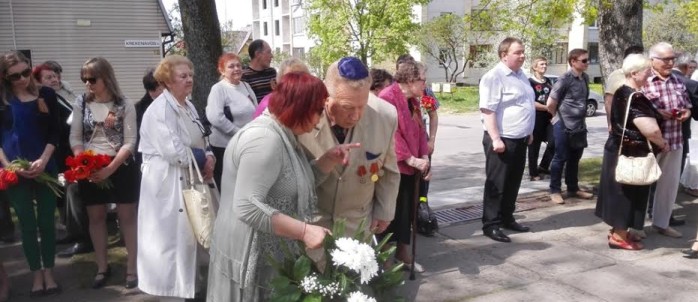
A ceremony to mark the 72nd anniversary of the Children’s Aktion in the Kaunas ghetto will be held at 4:00 P.M. on March 25, 2016, at E. Ožeškienės street No. 13 in Kaunas. We will never forget the horror of that day when over 2,000 children were torn from their families and brutally murdered.

Goodwill Fund Granted Greater Freedom to Spend

March 17, BNS–The Lithuanian parliament Thursday adopted fast-track amendments to allow the Goodwill Fund administering compensation for Jewish religious community property to allocate funds more freely. The vote was 81 MPs for, 1 against and 5 abstentions. Under the new amendment, the Goodwill Fund will be allowed to cover its administrative costs using monies from the state. It suggests fixing administration costs so they never exceed 10 percent of the annual amount of compensation paid out by the treasury according to the annual state budget.

Last year the fund spent 125,942 euros on expenses, but the Office of State Comptroller warned the law didn’t allow the fund to use state allocation for administrative costs. The amendments also allow the fund to invest monies paid into the fund but not used. Such a move would require careful consideration of investment security, liquidity, annual profits and other factors.

Kaunas Jewish Community Honors Most Active Members

Kau7

Continuing a long-standing tradition, the Kaunas Jewish Community invited its most active members to a party to thank them. Participants in various clubs, students of Yiddish, people seeking a deeper knowledge of Jewish history and traditions and volunteers in different campaigns, events and cultural activities gathered for a dinner, live music and lively conversation. Kaunas Jewish Community chairman Gercas Žakas thanked everyone and said since Jews are known as the People of the Book, he was passing out books as well, about Jewish history and other Jewish topics.

A Yiddish Play in Russian Translation

poo

Under the Skin
(a drama based on real events)

Written by: Jonathan Calderon
Directed by: Rakefet Benjamin

Tel Aviv during the first Gulf War. A young German reporter knocks on the door of an elderly Holocaust survivor and starts questioning her about the secret affair that took place between her and her SS officer. Throughout the play, the Tel Aviv scene is cut into flashbacks to the concentration camp in which the reporter from Germany also plays the prisoner Charlotte while the elderly Holocaust survivor becomes the Nazi officer.

Old Jewish Cemetery in Klaipėda Added to Registry of Cultural Treasures

klaipeda cemetery 2

The old Jewish cemetery in on Sinagogų street in Klaipėda has been given legal protection, the Culture Heritage Department under the Ministry of Culture reports.

Although there used to be several dozen cemeteries in Klaipėda, only a few survive. “The only Jewish cemetery in the city is the one from the early 19th to mid-20th century period. It used to be bigger than what has survived and listed on the registry of cultural treasures. It’s now about 13,000 square meters. But what has survived obviously enriches the history of the city of Klaipėda and is an important part of the city,” Audronė Puzonienienė, director of the Klaipėda office of the Cultural Heritage Department, said.

Puzonienienė cited Jonas Tatoris’s book “Senoji Klaipėda. Urbanistinė raida ir architektūra iki 1939 m.” [“Old Klaipėda. Urban Development and Architecture till 1939”] as the richest source of information about the old Jewish cemetery in the Lithuanian port town formerly known as Memel. The author of that book says there were 22 cemeteries in Memel/Klaipėda in the period from the 16th century to the early 20th century. At the beginning of the 19th century a ravelin—part of the earthen fortification for the defense of the port city— was allocated for the Jewish cemetery. The Jewish cemetery first appears on the city map in 1840, as a still rather small area surrounded by hedgerows. It was enlarged in the early 20th century. “The layout of the Jewish cemetery was different from the Lutheran cemetery: it didn’t have a central square and intersecting paths, and the territory was divided up into rectangular blocks,” Tatoris says.

Vytautas Mikuličius, Journalist and Son of Righteous Gentiles, Has Died

With deep sadness we note the passing of journalist Vytautas Mikuličius who with his parents Petras and Ona rescued Julija Remigolskytė-Flier, now a Canadian violinist, during World War II.

Petras and Ona lived with their three children at Minkovskių street no. 110 in Kaunas. Jews from the Kaunas ghetto were used as forced labor near their home, including Klara Gelman. During the winter of 1942-1943 Klara asked Ona and Petras to save her two-year-old daughter Julija. Petras and Ona took her in and raised her as their won. The little girl quickly learned to speak Lithuanian, and her foster parents told the neighbors she was the daughter of Ona’s dead sister.

From Vytautas Mikuličius’s recollections:

Our family had many friends and acquaintances. Our mother was very involved with the women in the area especially. Russians, Jews, Poles… When the Nazis put their regime in place, mother didn’t drop her girl friends, but visits became brief and secret.

Canadian Jews Demand Deportation of Ukrainian Member of Nazi Death Squad

oberlander

Jewish groups are calling on Canada to strip citizenship from a 92-year-old man who was once a member of a Nazi death squad.

In a letter to Citizenship Minister John McCallum, the groups say it is time to conclude a 20-year battle to deport Helmut Oberlander.

“As has been clearly established, Mr. Oberlander was a member of one of the most savage Nazi killing units, responsible for the murder of more than 90,000 Jewish men, women, and children during the Holocaust,” states the March 9 letter. “He is here illegally, was associated with a horrific and murderous enterprise for which he has neither demonstrated nor expressed any remorse, and he ought to have his Canadian citizenship revoked immediately,” it adds.

Born in Ukraine, Oberlander immigrated to Canada in 1954 and became a citizen in 1960. Ottawa began trying to strip him of his citizenship in 1995, prompting a protracted court battle.

Argentine Director Returns to Jewish Roots with “The Tenth Man”

In his new movie, filmmaker Daniel Burman explores the Buenos Aires of his youth and the people who live there
by Igal Avidan

Daniel-BURMAN_Credito_Marcos_Lopez-e1457359753841

BERLIN–Usher, who heads a Jewish welfare foundation in Buenos Aires, is an unlikely movie star. But the middle-aged Argentinean Jew, whose real name is Oscar Barilka, is the central figure in Jewish-Argentinian director Daniel Burman’s new feature film, “El Rey del Once” (The Tenth Man).

Usher, playing himself, is almost always off-camera, but he is often heard as he works to bring his son Ariel (played by actor Alan Sabbagh) back to his roots.

“Usher is a real tzadik [righteous person] who doesn’t even know he is one,” says award-winning writer-director Burman, who won the Grand Jury Prize in 2004 for his film “El Abrazo Partido” (Lost Embrace), a comedy-drama about the grandson of Polish Holocaust refugees.

Jewish Students Deliver Donations to Developmentally Disabled Infant Center

ŠA

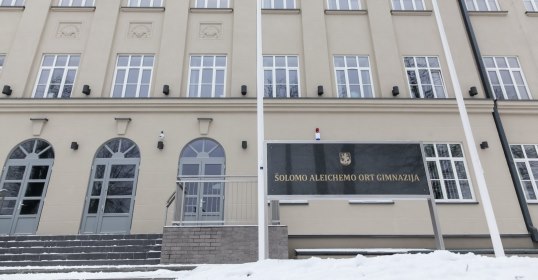
Representatives of the Vilnius Sholem Aleichem ORT Gymnasium visited the Vilnius Developmentally Disabled Infant Center March 8 and were warmly received by director Viktorija Grežėnienė. The students delivered donations and visited some of the small wards of the center. The donations included a sofa-bed, musical mobiles and educational games which the students purchased with funds raised by a food and crafts fair held on the Tu b’Shvat holiday. Students made their own dishes and snacks as well as art works and sold them to other students during the fair.

ŠA1

Rain and Low Turnout at Annual Vilnius Neo-Nazi March

101_3997sm

The parade of nationalists and neo-Nazis which has marred Lithuanian independence day celebrations for 7 years in a row went forward this March 11 as well.

Despite attempts by organizers to make the event acceptable and mainstream by calling it “traditional” and “patriotic” and to play down the swastikas and calls for the death of ethnic minorities prominent in earlier years, this year’s march was smaller than last year’s.

From 200 to 300 people, according to estimates by outsiders, gathered at the statue on Cathedral Square at around 4:00 P.M. on March 11, the more important of Lithuania’s two independence days which marks the date in 1990 when the Lithuanian Supreme Soviet parliament declared independence from the Soviet Union. The square was the final point by another march earlier in the day dedicated to celebrating Lithuanian independence and tolerance, which travelled the same route but in the opposite direction, from Independence Square outside the Lithuanian parliament to Cathedral Square. A large trailer painted military colors behind the gathering at the statue for the 4 o’clock march was outfitted with an oven and volunteers dressed as Lithuanian soldiers were still passing out free hot food to children as a variety of Lithuanian ultranationalists, neo-Nazis, biker gang members and various followers milled about waiting for the march.

Major American Jewish Leader Changes His Mind about Israel

An Amazing Turn for a Major Leader of the American Jewish Mainstream: David Gordis Rethinking Israel

David Gordis has served as vice president of the Jewish Theological Seminary of America and of the University of Judaism in Los Angeles (now American Jewish University). He also served as executive vice president of the American Jewish Committee and was the founding director of the Foundation for Masorti Judaism in Israel. He founded and directed the Wilstein Institute for Jewish Policy Studies which became the National Center for Jewish Policy Studies.

David Gordis is president emeritus of Hebrew College where he served as president and professor of Rabbinics for fifteen years. He is currently visiting senior scholar at the University at Albany of the State University of New York. Here is the article he submitted to Tikkun. We publish it with the same sadness that Gordis expresses at the end of this article, because many of us at Tikkun magazine shared the same hopes he expresses below for an Israel that would make Jews proud by becoming an embodiment of what is best in Jewish tradition, history, and ethics, rather than a manifestation of all the psychological and spiritual damage that has been done to our people, which now acts as an oppressor to the Palestinian people. For those of us who continue to love Judaism and the wisdom of our Jewish culture and traditions, pointing out Israel’s current distortions gives us no pleasure, but only saddens us deeply.
–Rabbi Michael Lerner

Reflections on Israel 2016
David M. Gordis

While reading Ethan Bronner’s review of a new biography of Abba Eban, I was reminded of a time when in a rare moment I had the better of a verbal encounter with Eban. It happened about thirty years ago at a meeting of the Conference of Presidents of Major American Jewish Organizations, which brought together leaders of American Jewish organizations, sometimes to hear from a visiting dignitary, in this case Eban, Israel’s eloquent voice for many years. I was attending as Executive Vice President of the American Jewish Committee. Eban had a sharp wit as well as a sharp tongue. He began his remarks with a mildly cynical remark: “I’m pleased, as always, to meet with the Conference of Presidents of Major American Jewish Organizations, though I wonder where the presidents of minor American Jewish organizations might be.” I piped up from the audience: “They are busy meeting with minor Israeli government officials.” A mild amused reaction followed and Eban proceeded with his remarks.