

On March 20 long-time LJC member Riva Špiz celebrated her 95th birthday. She is an active participant in the Day Club as well as a great mother, grandmother, great-grandmother and war veteran. We send our warm wishes and sincere congratulations to Riva, and wish her happiness, strong health, love and long life. May you live to 120! Mazl tov!
Kaunas Ghetto Children’s Aktion Commemoration
On March 28, 2019, the Kaunas Jewish Community will commemorate the 75th anniversary of the Children’s Aktion in the Kaunas ghetto during which, over one day, about 1,700 children and elderly were rounded up and murdered.
The commemoration begins at 4:00 P.M. at the “Children’s Torah” statue at E. Ožeškienės street no. 13 in Kaunas. The commemoration continues at 5:00 P.M. in the concert hall of the J. Gruodžio conservatory at J. Gruodžio street no. 6, Kaunas. The program includes a performance of “The Jewish Girl and Her Three Mothers” by the drama theater of the Aušra Gymnasium (directed by N. Žilinskienė) and a concert by the J. Gruodžio conservatory’s string orchestra (conducted by K. Domarkienė). Aleksandras Rubinovas will serve as MC.
Markas Petuchauskas’s Price of Concord at Leipzig Book Fair
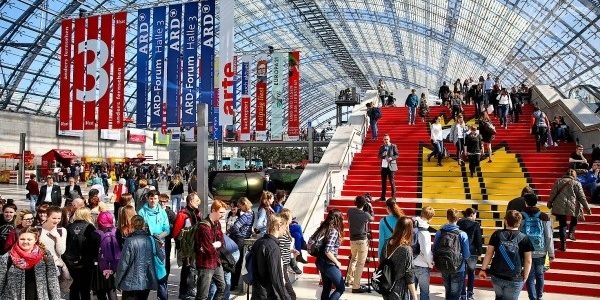
Markas Petuchauskas’s book Price of Concord has been translated to German and will be presented at the Leipzig Book Fair taking place from March 21 to 24. The Leipzig Book Fair is the second largest book fair in Germany after the Frankfurt Book Fair.
The new translation has been published by the LIT Verlag publishing operation in Berlin. The translation was financed by the Lithuanian Culture Institute. The German version of the book, Der Preis der Eintracht, is to be presented at 1:00 P.M. on March 23 during the OstSüdOst forum at booth E501 in Hall 4 with translator Markus Roduner, author Markas Petuchauskas and moderator Joachim Tauber. The book presentation is scheduled to run until 1:30 P.M. Another presentation will take place at 6:00 P.M. the same day with the same participants at the Jewish Culture Center at Ariowitsch-Haus located at Hinrichsenstraße no. 14, Leipzig. The main LIT Verlag booth is booth G208 in Hall 3 at the book fair.
Lego Engineering at Ilan Club
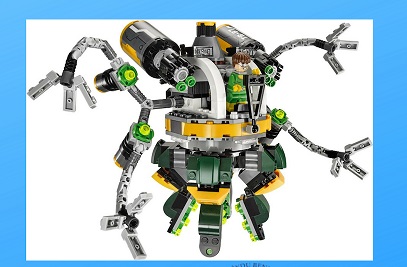
All young inventors are invited to a special program of Lego engineering at the Ilan Club in the Lithuanian Jewish Community. We will make insect robots out of legos and race them. The activity will take place at 1:30 P.M. on March 24 in the Ilan Club on the second floor of the LJC at Pylimo street no. 4 in Vilnius. Registration is required. To register and learn more, send an email to sofja@lzb.lt or call 8 672 57540.

Bagel Shop Café Celebrates Purim with Hamentashen
The Bagel Shop Café has made a tradition out of offering Litvak-style hamentashen pastries on Purim and this year is no different. Purim, the 14th and 15th days of the month of Adar on the Jewish calendar, falls on March 20 and 21 this year. The Bagel Shop Café is located at Pylimo street no. 4 in Vilnius inside the Lithuanian Jewish Community but with its own street-level entrance.
Lecture Series Continues
Roza Bielauskienė will speak on the topic of the “The United Kingdom: King David” at the Lithuanian Jewish Community at 1:00 P.M. on Sunday, March 24.
US Embassy Tallinn Condemns Attack on Rabbi
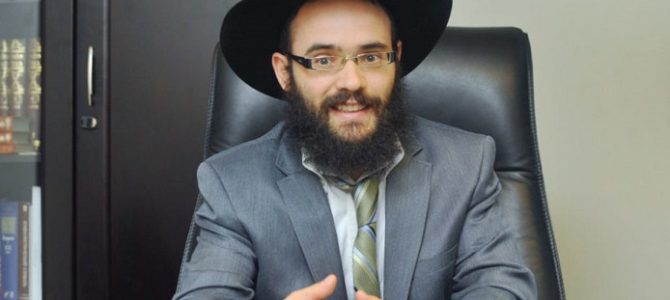
The United States embassy in Tallinn condemned an incident in the Estonian capital during which a man hurled insults at Rabbi Efraim Shmuel Kot.
A 27-year-old was being detained by traffic police Saturday for riding the tramway without a ticket when Rabbi Kot and family walked past on their way to shul. The man reportedly yelled “Heil Hitler,” “Sieg heil” and “What are you staring at, Jew? You’re going into the oven” in Estonian.
The US embassy issued a statement condemning the verbal assault, calling it hate speech, and saying it had no place in modern society. The embassy warned words matter and can turn into action if ignored.
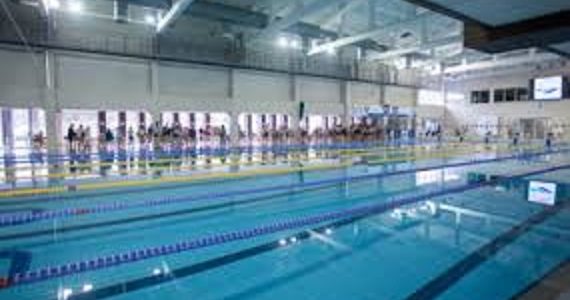
Regulations for the Makabi Swimming Championship
Competition Goals and Tasks
To popularize the sport of swimming among members of the Lithuanian Makabi Athletics Club. To select the best swimmers for competition at the international Maccabiah Games.
Time and Location
The competitions will be held from 11:00 A.M. to 1:00 P.M. on March 31, 2019, at the multifunctional sporting and entertainment complex Girstutis, at Kovo 11-osios street no. 26, Kaunas. Competitors are to arrive by 10:30 A.M.
Participants
Swimmers of all ages may participate who after making application will be divided into age groups.
The cost to participate is 3 euros for those born after 2000 and 5 euros for those born in and before 1999.
Applications can be e-mailed to makabilita.duskes@gmail.com providing the age of the applicant, an e-mail address and a mobile telephone number before 12 midnight on March 27, 2019.
The coordinator in Vilnius is Artiom Perepleica at artiom.perp@gmail.com
Competition Program and Prizes
25-meter free style
50-meter breast stroke
All participants will receive souvenir medals.
Prize-winners in their age groups will receive special prizes.
M. Duškesas, executive director
Lithuanian Makabi Athletics Club
Holocaust Distortion

by Efraim Zuroff
The situation regarding Holocaust commemoration and education in Lithuania is likewise extremely problematic.
It was only slightly more than a year ago that Holocaust distortion, which has been going on undisturbed for the past almost 30 years, and is currently rampant throughout post-Communist Eastern Europe, suddenly became an issue in Israel. The reason was the uproar over the by now infamous Polish Holocaust bill, which made use of the term “Polish death camps” or the attribution of any Holocaust crimes to the Polish state, a criminal offense punishable by two years in prison. Prime Minister Benjamin Netanyahu responded that “Israel would not tolerate Holocaust distortion,” the first public denunciation by an Israeli leader of the systematic efforts being made for decades by many of the new democracies of Eastern Europe to whitewash the crimes of their nationals during the Shoah.
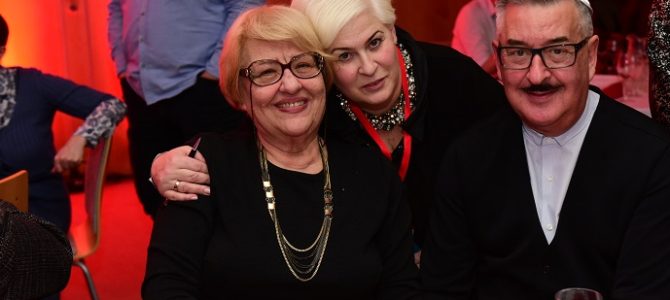
Limmud 2019 in Druskininkai
The Limmud tradition is about Jewishness and identity. Once per year the LJC organizes the traditional Limmud conference so members can come together, celebrate Sabbath together, take in many interesting lectures. Limmud comes from the Hebrew word “to learn.”
LJC programs director Žana Skudovičienė, veteran Limmud organizer, says this tradition demands a lot of work, energy and ingenuity.
This year our Lithuanian Limmud was held at the Europe Royal Hotel in the southern Lithuanian spa town Druskininkai with heavy attendance by LJC members and guests and young families with toddlers. Skudovičienė said some of the parents had themselves attended Limmud as children decades ago.
This year’s Limmud seemed more intimate than in former years, according to attendees, with Jews gathering from all over Lithuania, less formal speeches and more music, dance and fun–with a real spirit of yidishkayt.
List of Speakers and Performers for Limmud 2019
Speakers and performers to include:
Ilya Kalmanovskiy, journalist, teacher, educational program enthusiast and moderator (Moscow)
Boruch Gorin, journalist, writer, editor of Lekhaim magazine (Moscow)
Juriy Tabak, religious studies expert, translator, author (Moscow)
Aleksandr Dukhovny, senior rabbi of progressive Jewish congregations (Kiev)
Sasha Galitsky, artist, author (Israel)
Regina Pats, cinema expert, to speak on new program of Israeli films (Tallinn)
Dr. Lara Lempertienė, scholar, director of Lithuanian National Library’s Judaica Studies Center
Bar/Bat Mitzva Ceremony at Choral Synagogue in Vilnius
A bar and bat mitzva ceremony was held at the Choral Synagogue Monday, March 11, conducted by Rabbi Sholom Ber Krinsky. Five young people sat at the set table and listened intently to the rabbi’s talk and congratulations on their rite of passage from youth to adulthood.
Parents and children gathered for this important religious ritual. Boys aged 13 and girls aged 12 are considered adults according to Jewish tradition. Bar mitzva literally means “son of the law” and bat mitzva “daughter of the law” because this is the age at which people become responsible for following all the laws of the Torah.
The young adults received symbolic gifts and the celebration continued with a feast at the table.
Bar and bat mitzvas are more than just a family celebration, they’re celebrated by the entire Jewish community. Congratulations to all the participants!
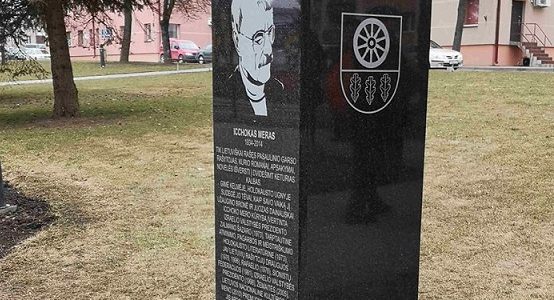
Monument to Icchokas Meras Unveiled in Kelmė
A statue was unveiled to commemorate the fifth anniversary of the death of Icchokas Meras. The ceremony and monument were the work of the Lithuanian Jewish Community, the Lithuanian Jerusalem Vilnius Jewish Community, the Jakovas Bunka support fund and the Kelmė regional administration. It took place on March 13 at Icchokas Meras Square in Kelmė. Students and teachers from the neighboring Jonas Graičiūnas Gymnasium, Kelmė municipal representatives, fans of Meras’s work and visitors from Vilnius, Kaunas, Šiauliai and Panevėžys and members of those Jewish communities attended.
Feliks Dektor arrived from Israel for the ceremony. He translated to Russian Meras’s novels “Ant ko laikosi pasaulis” and “Lygiosios trunka akimirką” as well as a collection of short stories called “Geltonas lopas,” some of the first literary works about the Holocaust to be published in the Soviet Union.
MP Emanuelis ZIngeris was unable to attend but sent a message which was read out loud:
“Icchokas Meras his entire life spoke for the silenced ghettos of Kelmė, Vilnius, Kaunas and Šiauliai. In his work he didn’t stand for the isolation of the ghetto, rather he scaled to the heights and plumbed the extraordinary depths of humanity. In Soviet times everyone looked forward to the appearance of his novels and stories in the magazines Pergalė and Nemunas. This was a protest hurled against the Soviet reality. Because Icchokas Meras was and remained a Lithuanian writer who modernized the language of Lithuanian prose and invented new ways to express himself.
Jonas Noreika? Let’s Talk about Cucumbers Instead
by Arkadijus Vinokuras
In reply to the Genocide Center
I read the reply from the Center for the Study of the Genocide and Resistance of Residents of Lithuania to my article “Why Is Genocide Center Defending a Lie?” The Genocide Center’s reply was unpleasantly surprising. The position of the person quoted was confused with my own personal position. Instead of polite discussion it turned quickly to ad hominem. Therefore to the honorable director of this institution I say: do not allow scribblers to reply to articles by professional journalists and writers.
Because this [reply], fallen into Communist hysteria, as if it weren’t 2019 at the present time but gloomy Stalinism instead, written in the KGB style with anti-Semitic glee, places all critics and opponents of the Genocide Center into one “anti-Geno-Centro-underground organization.” This does shame to the institution itself. Take a pill, calm down and remember that the Genocide Center is not some private headquarters of extremist nationalists but an institution of a democratic state. The parliament has tasked this institution with discovering the truth, not engaging in politics.
Full text in Lithuanian here.
Lithuanian President Visits YIVO
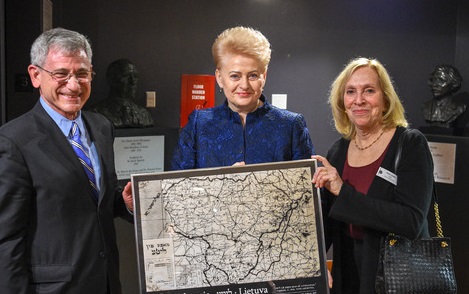
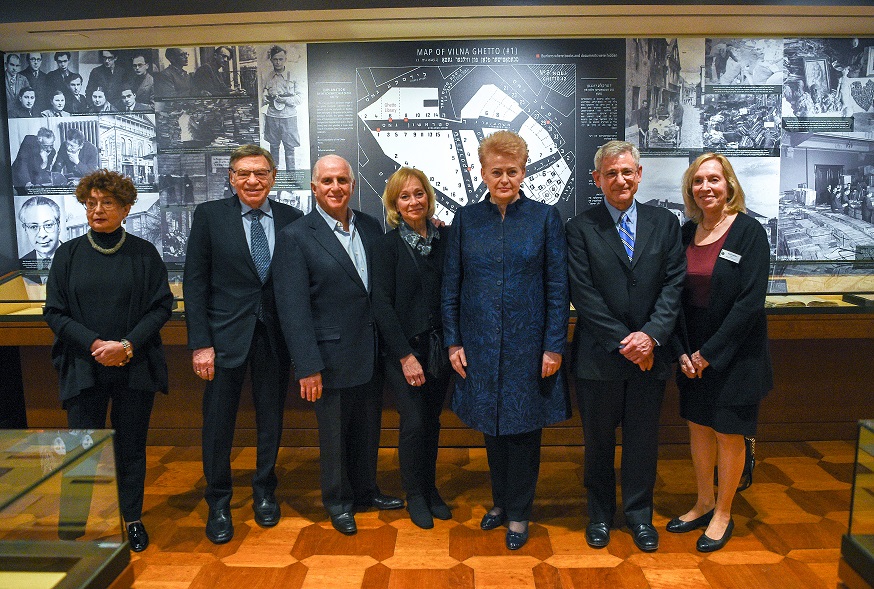
Lithuanian president Dalia Grybauskaitė visited YIVO in New York City March 13.
The YIVO institute was founded in Vilnius in 1925, collecting a large library of books and documents, Yiddish literature and material on Jews in Central and Eastern Europe. It moved to New York in 1939 when founder Max Weinreich was caught in Denmark as Nazi Germany invaded Poland on September 1 of that year. The New York branch became the headquarters as the Nazis looted YIVO archives in Vilnius.
YIVO director Jonathan Brent met the Lithuanian leader and spoke to her about the Strashun collection and important documents YIVO conserves.
The Lithuanian president said she was impressed by the collections demonstrating the priceless Litvak heritage and also by the courage and nobility of the people–Lithuanians and Jews–who saved the important documents.
Full press release in Lithuanian here.
Work Continues on the Žemaičių Naumiestis Synagogue
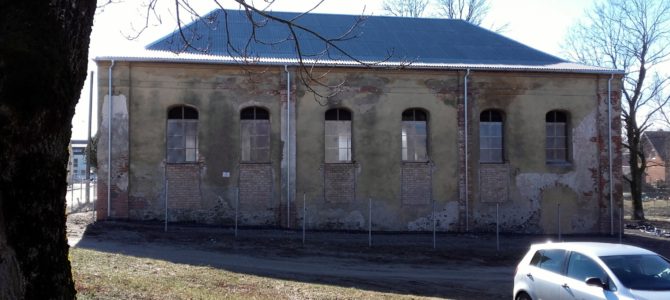
Work to restore the synagogue in Žemaičių Naumiestis, Lithuania, began in 2018 and on March 6, 2019, the work to date was surveyed.
The Šilutė regional administration allocated almost 100,000 euros for the renovation work.
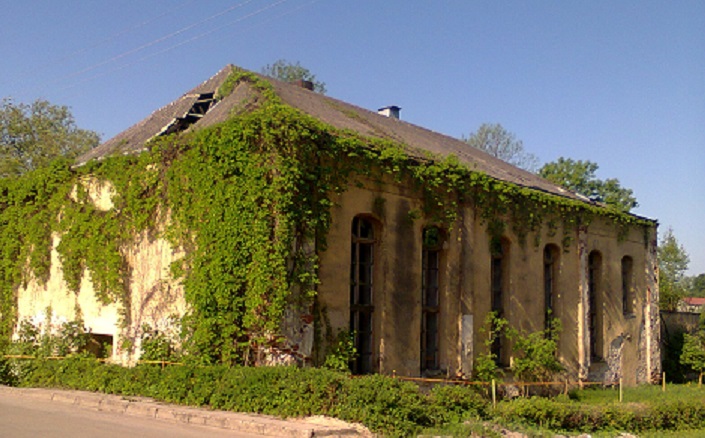
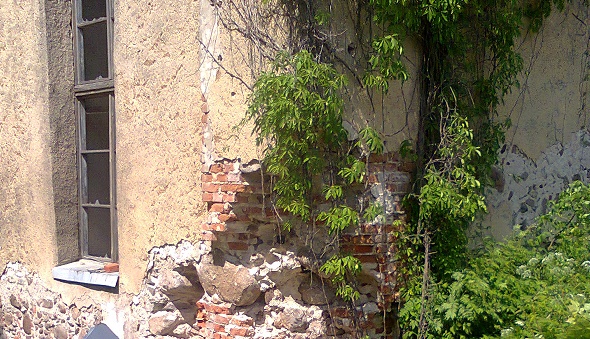
Photos from before work began
The town had a large Jewish population before the Holocaust who built this brick synagogue in 1816. In the Soviet era the synagogue was used as a Palace of Culture.
American Zionist Movement Biennial Assembly Held in New York
The American Zionist Movement held their once-every-two-years assembly in New York on March 10 and 11, 2019. This assembly’s theme was Unity and Community: Bringing Together the Many Voices of Zionism.”
Lithuanian Jewish Community chairwoman Faina Kukliansky was invited to speak about the Zionist movement in Lithuania.
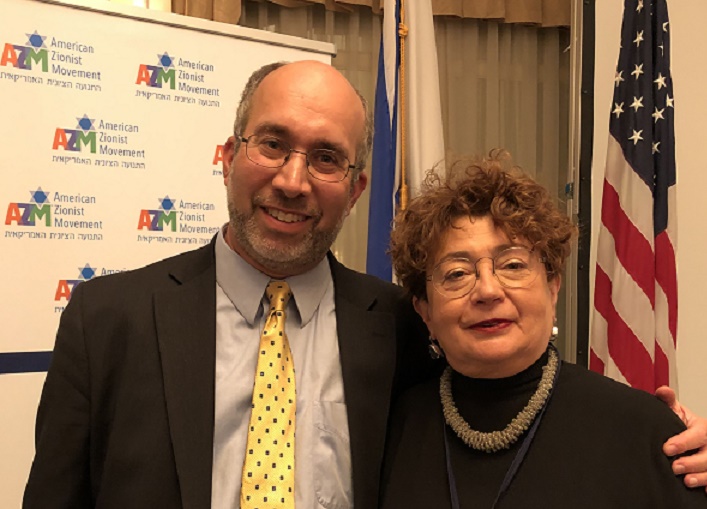
LJC chairwoman Kukliansky with AZM executive director Herbert Block
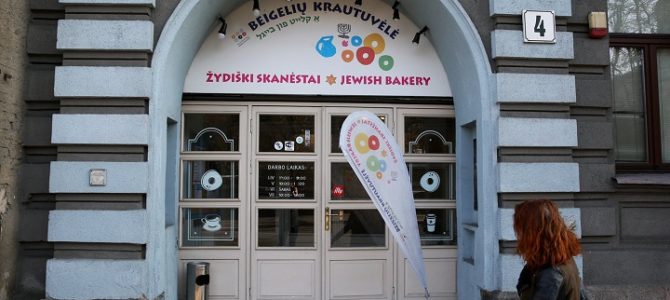
Success Story: Bakery Making Forgotten Treats Has Special Aura
by S.Viltrakytė-Varkalienė, Lietuvos rytas
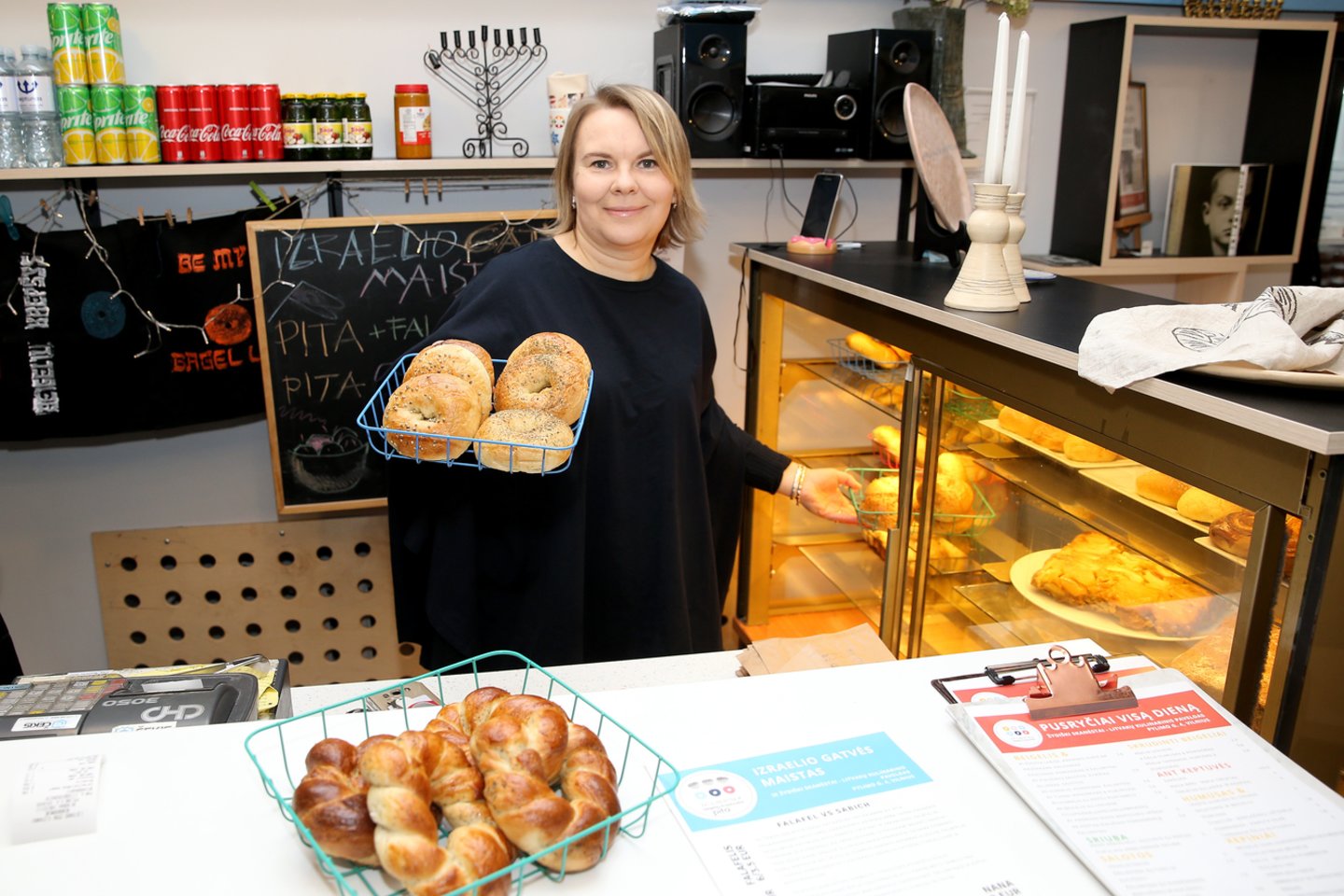
“The cult of food is very useful for us, but that doesn’t mean that when we opened everyone came to buy bagels,” Bagel Shop projects director Dovilė Rūkaitė said at the café’s third birthday party.
Although the café depends on support from the Lithuanian Jewish Community, Rūkaitė said she has no doubts that the kosher food outlet is very much a success story. Interest in traditional Jewish cuisine has raised the idea of a restaurant as well. Although no opening date has been announced, preparations are taking place behind the scenes.
For now you can try kosher find in the humble café inside the Lithuanian Jewish Community. You won’t find a filling lunch here, the kitchen is too small for the five-person collective to make such things. But you can sample shakshuka, soup, salads, bagels and cakes.
Full story in Lithuanian here.

Celebrating Lithuanian Freedom
On March 11, 1990, many Lithuanian Jews became witnesses to an important and unforgettable event when the Supreme Soviet of the Lithuanian Soviet Socialist Republic almost unanimously (of 130 delegates 6 abstained, none voted against) the act for the restoration of Lithuanian independence. The Republic of Lithuania submerged by foreign powers in 1940 had resurfaced. This allowed for the restoration and work of the Lithuanian Jewish Community as well. Happy Independence Day!
News from the Noreika Trial
The Vilnius District Administrative Court began deliberation of a case Grant Gochin filed against the Center for the Study of the Genocide and Resistance of Residents of Lithuania Tuesday, March 5. Gochin, a Lithuanian citizen and member of the Lithuanian Jewish Community, is seeking remedy for the Genocide Center’s “historical finding” exonerating Lithuanian Holocaust perpetrator Jonas Noreika. Gochin wants the Center to reconsider its exoneration in light of newly discovered documents which he says the Center has ignored.
Active LJC member Geršonas Taicas attended the trial and shared his impressions, translated below.
§§§
“The plaintiff’s attorney read quickly a 25-page document presented which lists new historical facts about Noreika’s crimes. …