
Holocaust

We Remember

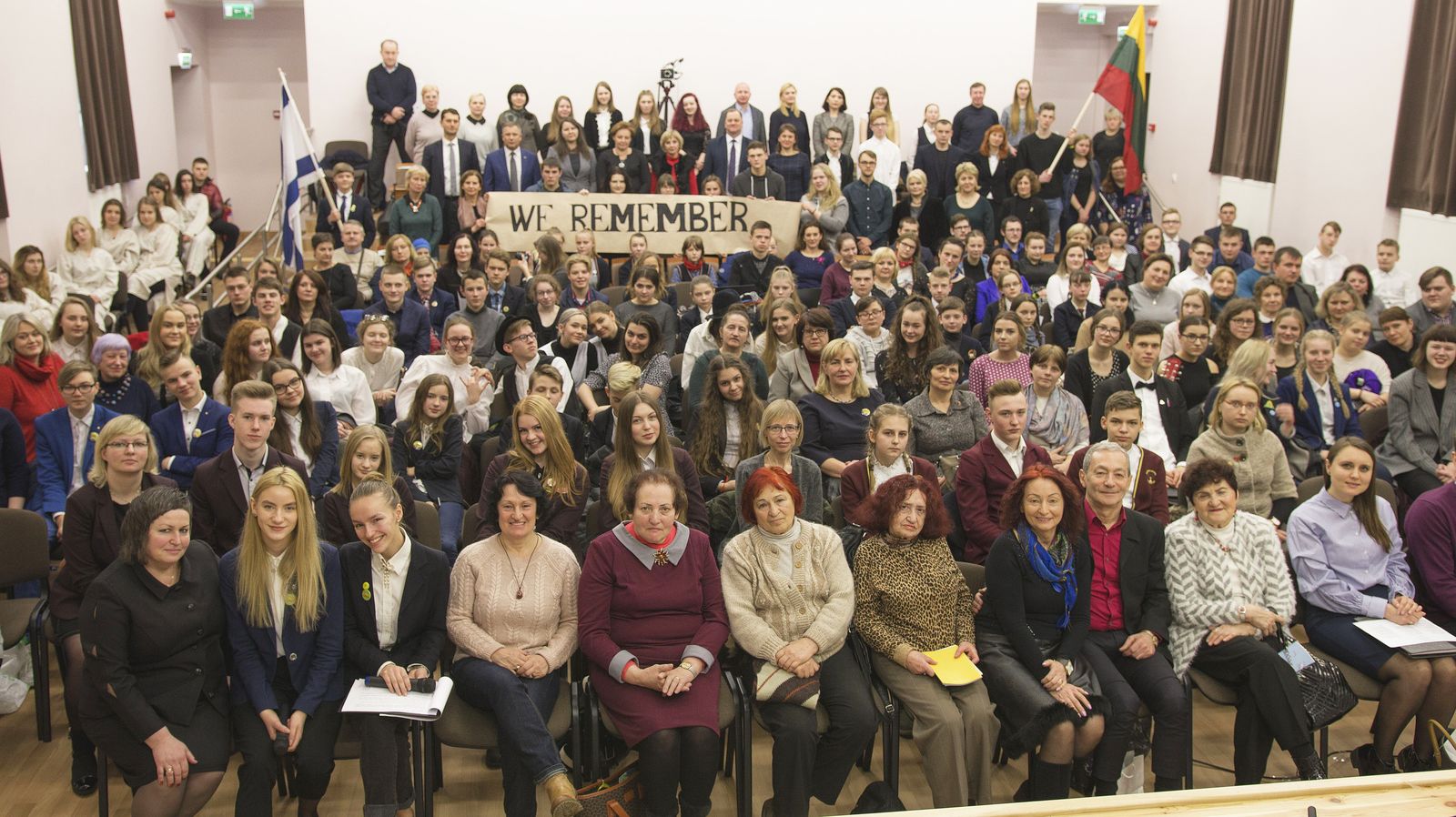
The World Jewish Congress has launched this initiative for the second year in a row, with active participation by the Lithuanian Jewish Community. The campaign runs from January 8 to January 27, 2018. To be part of it, take a photo of yourself holding the inscription “We Remember” or “I remember” and post it on social media with the hashtag #WeRemember.

The campaign will run through International Holocaust Remembrance Day at the end of January, culminating with a live projection of all participant photos, interviews with Holocaust survivors, and messages from influencers from varied backgrounds, professions, ages and religions on the grounds of Auschwitz-Birkenau January 24 to January 27.

Last year the initiative had 25 million participants around the world.

Full story here.

On Kaunas, Sugihara and Lithuanian-Japanese Relations Past and Present


by Simonas Jazavita
Bernardinai.lt

Lithuania came under the Japanese media spotlight January 14. The small Sugihara museum on Vaižganto street became known to Japanese, but also to readers of major papers in Israel, the USA, France and other countries. Prime minister of Japan Shinzo Abe found the time on his tour of Eastern and Central Europe to visit this museum which showcases Japanese diplomat Chiune Sugihara who worked here, in the provisional capital of Lithuania, in 1939 and 1949 and saved the lives of over 6,000 Jews.

Just because of Sugihara’s story, Kaunas and Lithuania are becoming a nice place dear to Japanese people. It’s not a coincidence that Abe’s portraits in the global media are often taken in Kaunas, even though he visited Latvia and Estonia first. If we make use of that historical tie, we could bring more of Japan’s attention to bear upon us rather than towards our neighbors, and make the tie stronger.

Full story in Lithuanian here.

Learn to Embrace the Simple Past Tense: A Concert to Commemorate the Holocaust

You are invited an event to commemorate victims of the Holocaust with a presentation by tenor Rafailas Karpis, pianist Darius Mažintas and Sergejus Kanovičius called “Embrace the Simple Past Tense.”

Is it possible for the Yiddish and the Lithuanian language to meet under one roof?
Is it possible to feel a lullaby even if you can’t understand the words?
Is dialogue possible between sung Yiddish and Lithuanian work read out loud?
Can love, longing and remorse meet in memory?

Come, feel it and find out the answers on the last Sunday in January:

PLACE: Third floor, Lithuanian Jewish Community, Pylimo street no. 4, Vilnius
TIME: 5:00 P.M., January 28.

Discussion on Maintaining Žaliakalnis Jewish Cemetery in Kaunas

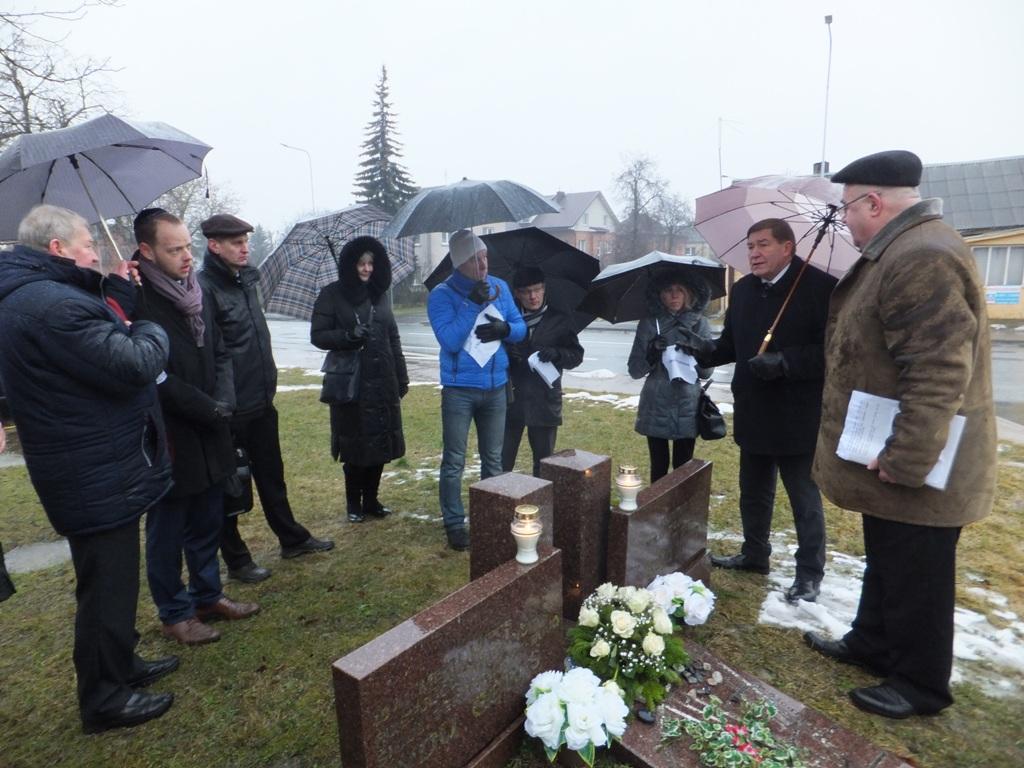
Work has begun on restoring a monument to Holocaust victims at the mass grave at the Žaliakalnis Jewish cemetery in Kaunas. Members of the Kaunas Jewish Community, representatives of the Kaunas municipality, Lithuanian Jewish Community executive director Renaldas Vaisbrodas, LJC heritage specialist Martynas Užpelkis and architect, designer and museum specialist Victoria Sideraitė-Alon met to discuss the issue, after which they visited Sugihara House and its new exhibit “Casablanca North: Kaunas 1939-1940” on the newly renovated second floor of the museum with a guided tour by Sugihara House director Simonas Dovidavičius.

Sugihara House is also exhibiting a show and film about Swedish diplomat Raoul Wallenberg, who saved about 20,0000 Hungarian Jews during the Holocaust.

One Century out of Seven Exhibit a Hit with Jews in Chicago

The cultural center of the Lithuanian consulate in Chicago is hosting an exceptional exhibition starting at the end of November called “One Century out of Seven: Lithuania, Lite, Lita.” The exhibit covers the history of Litvaks from the first arrivals and settlement of Jews in the Grand Duchy of Lithuania to the present day. The exhibit is now circulating in Chicago and suburbs. On January 12 it was presented to the Jewish community of Highland Park.

Exhibit author Pranas Morkus was able to present remarkable details of the relationships between Jews and locals and included a number of notable Litvaks, the most notable and best known being the Vilna Gaon, who is credited with making Vilnius the Jerusalem of Lithuania.

On January 15 the exhibit opened at the North Suburban Beth El Synagogue. Visitors sent photos to facebook and they may be viewed on the LJC webpage.

A large number of Jews with roots in Lithuania live in America and are proud to call themselves Litvaks.

The exhibit was the result of work by Pranas Morkus, the Lithuanian Foreign Ministry, the Lithuanian Jewish Community and the designers Victoria Sideraitė-Alon and Jūratė Juozėnienė from the JUDVI design studio.

Lithuanian consul in Chicago Mantvydas Bekešius said the exhibit demonstrates Jews were, are and will always be an important part of the story of Lithuania.

When Will Kaunas Have a Monument to Holocaust Rescuers?

More than a decade ago Jewish community representative and Rotary Club member Michailas Duškesas proposed erecting a monument to Righteous Gentiles in Kaunas.

At that time some world-famous architects said they were interested in the memorial project. Michailas Duškesas said at the time erecting the statue would have cost less than 1 million litas, and the Rotary Club and Jewish organizations in Lithuania, Europe and Israel would have paid the total sum, according to him.

“Everything was headed in the right direction. Kaunas Regional Judaic Religious Community chairman Josifas Kacas was getting ready to fly to meet Daniel Libeskind to discuss all the details when, unfortunately, just a few days before the flight, he died, and everything seemed to fall apart,” Kaunas Jewish Community chairman Gercas Žakas recalled. Now he and Rotary Club member Ignas Miniotas are reviving the project to commemorate Righteous Gentiles.

Full story in Lithuanian here.

Japanese Prime Minister Abe Visits Sugihara House in Kaunas

Japanese prime minister Shinzo Abe visited Sugihara House in Kaunas Sunday accompanied by Lithuanian foreign minister Linas Linkevičius.

The Sugihara House museum is located at the site of the Japanese consulate where Chiune Sugihara rescued Jews by issuing transit visas in 1939 and 1940.

Kaunas mayor Visvaldas Matijošaitis, other city officials and several dozen children greeted the prime minister outside. Mr. Abe viewed the office where Sugihara worked and signed the guest book before touring the rest of the museum.

Suihara House director Simonas Dovidavičius told BNS said the visit was a very important one as the museum struggles to develop. “This site has virtually no permanent financing because we are an NGO,” Dovidavičius said.

Full text in Lithuanian and more photos here.

Japanese PM Abe to Visit Sugihara House in Kaunas


Photo of Japanese diplomat Chiune Sugihara and an old Japanese flag on display at the Sugihara House Museum in Kaunas which housed the Japanese Consulate from 1939 to 1940. Photo: AFP-JIJI

KAUNAS, LITHUANIA–A Japanese diplomat who saved 6,000 European Jews from the Holocaust by issuing visas so they could escape war-torn Lithuania will be hailed by Japan’s prime minister decades after defying Tokyo to help the refugees.

Prime minister Shinzo Abe will pay tribute to Chiune Sugihara on Sunday when he visits the two-story building that housed the consulate where he worked in the Baltic state’s second city Kaunas.

Sugihara is thought to be among around 15 diplomats who issued visas to European Jews during World War II and is often called “Japan’s Schindler”–a reference to German industrialist Oskar Schindler, who is credited with saving 1,200 Jews during the Holocaust.

Happy Birthday to Irena Veisaitė

Lithuanian Jewish teacher, scholar and theater expert Irena Veisaitė is not just a legend among students. Elegant, with an inherent sense of communicability, a woman of broad erudition, at home in any number of languages and filled with an inner inspiration, Irena is able to engage in warm conversation in any circle.

Her biography is full of the experience of tragedy, which she survived unbroken. The entire Jewish community remembers her words as a kind of mantra: “While even one anti-Semite still lives, I will be a Jew.” As a child during World War II imprisoned in the Kaunas ghetto, she lost her mother. Stefanija Ladigienė became her adoptive mother, rescuing Irena and raising her in her own home as her own daughter. Irena still calls all rescuers holy people, to whom Lithuania has still not erected a single monument.

Dear Irena, the Lithuanian Jewish Community wishes you a very happy birthday. May you always enjoy strong health, much joy and days of happiness! May your heart never age. Mazl tov! May you live to 120!

Positive Factors in Holocaust Survival

by Izabelė Švaraitė
manoteisės.lt


Ruth Reches, photo: Jonas Kliučius

An understanding of the Holocaust is incomplete without the psychological point of view. So says Ruth Reches, doctoral candidate at Mykolas Romeris University, who is researching the experience of Jewish genocide by survivors. While most researchers stress the negative consequences of this historical trauma, Reches is also researching positive aspects, those which allowed survivors to carry on.

The Holocaust Isn’t One Person’s Trauma

In Lithuania psychologists do investigate historical trauma such as deportation, Soviet oppression and war, but Reches is one of the first in the country to research the experience and survival of the Holocaust. She has interviewed Jews in Israel and Lithuania who managed to survive. The long-term study of trauma has led to a basic assessment of the consequences of the Holocaust, and Reches’s interviews with some of the subjects have had a therapeutic effect on the latter, who have opened up and talked about their childhoods during the war for the first time ever.

Grief Support for Families of Holocaust Survivors

Miami, January 7, 2018–While all grieving is individual, there are grief issues surrounding the loss of Holocaust survivors that are unique to the families of survivors. Until now, however, there has not been a dedicated approach to grief support for this population. Metropolitan Jewish Health System (MJHS) Hospice and Palliative Care based in New York is working to develop a grief support group to support families impacted by Holocaust trauma, and Targum Shlishi is supporting this much-needed initiative.

The Need

“We have found that the children of Holocaust survivors ask for grief support that is specific to their experience as members of the second generation. There are aspects of the grieving process that are uniquely different among family members of Holocaust survivors due to lifelong patterns of communication and behaviors in families of survivors,” explains Toby Weiss, MJHS’s director of cultural diversity and Jewish programming.

MJHS cares for a large number of Holocaust survivors at the end of life, and, by extension, it cares for the family members. As a hospice with a focus on family-centered and holistic care, MJHS also provides pre- and post-bereavement support for thirteen months. Although MJHS has long offered support groups, before now none have been tailored specifically to families of survivors. But as more people began asking for this service, MJHS researched the topic and found a marked lack of grief support groups dedicated to this population.

“This is a very real and unfortunately unmet need until now,” says Aryeh Rubin, director of Targum Shlishi. “We applaud MJHS for recognizing this problem and for taking the initiative to address it. These are the types of projects that, as a foundation, we are honored to support. People need this service and MJHS has the wherewithal not only to provide it to its constituents, but to create a model that it will share with others.”

Condolences

Užuojauta, netekus Pasaulio Teisuolės Lilijanos Binkytės

Righteous gentile Lilijana Binkytė has passed away. Our sincere condolences to her entire family and to daughter Sofija Ligija “Iga” Makutėnienė. The Binka family name will be forever associated with bravery and the triumph human decency.

Delegation Visits Alanta Wooden Synagogue

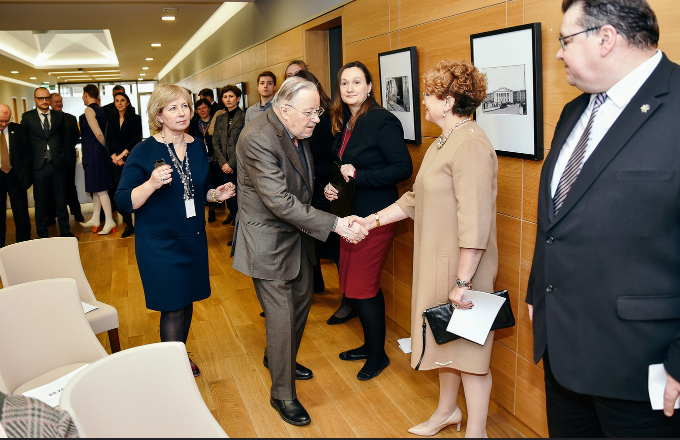
A delegation including Israeli ambassador Amir Maimon, US ambassador Anne Hall, Lithuanian Jewish Community chairwoman Faina Kukliansky, deputy Lithuanian foreign minister Darius Skusevičius, Cultural Heritage Department heritage expert Alfredas Jomantas and Molėtai regional administration head Stasys Žvinys visited the Alanta wooden synagogue near Molėtai, Lithuania, on December 3. The synagogue is listed on the Lithuanian registry of cultural treasures and is in dire need of restoration, according to members of the delegation. The Molėtai regional administration webpage carried details of that discussion:

Israeli ambassador to Lithuania Amir Maimon said: “It is important to all of us that history is remembered and all sites important and significant for history are restored. We’re talking today about Lithuanian heritage, not Jewish heritage. This is your history, this is my history.”

US ambassador to Lithuania Anne Hall said: “In recent times the Lithuanian Cultural Heritage Department has done great work in initiating the restoration of synagogues, churches and other important historical buildings. It is really impressive. This is one of the buildings whose restoration we look forward to, and I know many Americans are looking for a way back to Lithuania, Lithuanian and Jewish émigrés.”

Molėtai regional administration head Stasys Žvinys said the administration lacks funding for the synagogue’s restoration, although it is the only synagogue still standing in the entire region. He asked the Israeli ambassador to take the lead in solving the problem. “Although this is our shared responsibility, unfortunately the administration cannot at this time allocate from its budget the resources appropriate for restoring this synagogue. The synagogue is maintained to the extent the community is able to maintain it,” he said.

Faina Kukliansky, chairwoman of the Lithuanian Jewish Community, said: “Even if monies were found for putting the synagogue in order, there has to be content for this synagogue. Logically, if the building is restored but not used, not heated, not used for some purpose, then the money is wasted,” she commented.

The LJC has approached the Cultural Heritage Department about the wooden synagogue and applied for financing for restoration, but cultural heritage conservation specialists say there are many abandoned historical buildings in Lithuania and priority is given sites which have a foreseen use and function.

US Ambassador Anne Hall Continues Tour of Lithuania Visiting Sites of Jewish Life and Death

US ambassador to Lithuania Anne Hall continued her tour of Lithuania in late December with a stop at Šeduva where she met with people from the Šeduva Jewish Memorial Foundation and learned about their Lost Shtetl project, which has invested more than 3 million euros so far in restoring the old Jewish cemetery on Žvejų street there. Project director Sergejus Kanovičius recalled how they cleared the 1.3-hectare territory of weeds and bushes before cataloging and restoring headstones.

Lithuanian sculptor Romualdas Kvintas’s work commemorates the lost Jewish community and mass murder sites. There are three Holocaust mass murder sites around the town.

The cemetery restoration was just the first phase of the project and was completed in 2014. The project received honorable mention in European Union heritage preservation awards. A museum celebrating Lithuanian Jewish life is planned for 2018.

US Ambassador Anne Hall Visits Oldest Wooden Synagogue in Pakruojis

Seniausią Lietuvoje medinę Pakruojo sinagogą aplankė JAV ambasadorė Anne Hall

US ambassador Anne Hall with Lithuanian Jewish Community chairwoman Faina Kukliansky and the chairmen of the Panevžys and Šiauliai Jewish Communities toured the renovated Pakruojis wooden synagogue in late December. The oldest wooden synagogue in Lithuania was restored using period photography. The synagogue features unique paintings on the ceiling and wall paper. The interior and primitive paintings have been the subject of much interest. The restored synagogue has become a draw for Jews, Lithuanians and tourists from different countries.

The small synagogue on the banks of the Kruoja River was built in 1801 and operated as a synagogue until the Holocaust when the Pakruojis Jewish community was murdered. After the war it was used a recreation center and then as a movie theater. At some point it was used a gym. It caught fire several times, doing great damage. The Pakruojis regional administration and the Lithuanian Cultural Heritage Department went to great efforts to save the building.

The Pakruojis regional administration and the Lithuanian Jewish Community signed a 99-year use agreement on January 21, 2011, on the synagogue’s administration and adaptation for cultural use.

The Pakruojis Jewish community formed in the early 18th century. Most of the resident Jews were merchants who contributed to the economic development of the town. The growing Jewish population also influenced the overall development of the town and its public life.

There are no Jews living in Pakruojis now.

Joint Statement by European Jewish Congress and Lithuanian Jewish Community


The European Jewish Congress and the Lithuanian Jewish Community acknowledge the important contribution of Lithuania in creating a positive climate for Jewish life and Jewish tradition to flourish.

We also commend Lithuania for pursuing friendly relations with the State of Israel. This is undoubtedly a positive example for many European countries.

We encourage further respectful discussion on the topic of the tragedy of Lithuanian Jews during the Holocaust in order to allow for the restoration of historical justice. Those who try to reopen the dark pages of the history of Lithuanian collaboration, such as the renowned author Rūta Vanagaitė, should not be victimized or persecuted; instead, their efforts should be acknowledged.

We praise Lithuanian historians such as prof. Saulius Sužiedėlis, Dr. Valentinas Brandišauskas and Dr. Algimantas Kasparavičius who have spoken out on many occasions and written extensively on the topic of the Lithuanian Activist Front’s role in perpetrating the Holocaust in Lithuania. There is a lack of such content, however, to this day in Lithuanian textbooks. Neither is there sufficient mention of the vast Jewish contribution to Lithuanian society over the centuries. In a pluralist society those who speak out on the largest tragedy in European history should not be rendered incapacitated by inappropriate measures taken against them.

Having just concluded the celebrations of Hanukkah which signifies the victory of the mind and the soul against coercion, and just a few days after International Human Rights Day, we wish a happy and peaceful festive season to all the people of Lithuania and call for continued respectful discussion to enable the Lithuanian people to come to terms with their past.
https://eurojewcong.org/ejc-in-action/statements/joint-statement-european-jewish-congress-lithuanian-jewish-community/

Relations between Israel and Lithuania Important to Jewish Community and Foreign Ministry

Lithuanian public television’s Sunday news program featured successful efforts by Lithuanian foreign minister Linas Linkevičius to get EU foreign ministers at the same table with Israel’s prime minister Binyamin Netanyahu. The overture for the first informal meeting with an Israeli PM in 22 years came before US president Donald Trump’s controversial decision to move the US embassy from Tel Aviv to Jerusalem. Linkevičius said he was motivated by the need for face-to-face contact between the parties, even if they do not agree on all the issues. President Trump’s decision made the meeting more urgent in the search for ways to control increased tensions. After the meeting Linkevičius presented Netanyahu a replica of the statue of a small girl the Šeduva Jewish Memorial Foundation commissioned from sculptor Romas Kvintas and erected in central Šeduva to commemorate the former Jewish shtetl there.

The television program also featured an interview with Lithuanian Jewish Community chairwoman Faina Kukliansky. An excerpt translated to English follows.

“We are very glad our foreign minister invited Mr. Netanyahu. We are very glad a Lithuanian representative has become the leading mediator between the Israeli prime minister and the European Union. Relations between Lithuania and Israel are very important to us. This is quite natural. Lithuania is our homeland but Israel is our historical homeland. It should be said that since Lithuanian independence relations between Lithuania and Israel have never been better than they are now. …”

Greetings, Thank-You Note and Mittens from Righteous Gentiles Elvyra and Regina in Biržai

The Lithuanian Jewish Community received the following wonderful holiday greetings, thank-you note and accompanying mittens:

We sincerely congratulate you on the upcoming holidays. May the purity of snow fill your days. Let success and strength follow you all of your days. We wish you strength and determination. Our sincerest thanks for your sympathy and understanding.

Elvyra Čyžauskienė and Regina Kežienė

Professor Dr. Adolf Bolotin on Quantum Physics, Restitution and the Lithuanian Jewish Community


lzb.lt

Professor Dr. Adolf Bolotin is an honored member of the Lithuanian Jewish Community and the former chairman of the Vilnius Jewish Community. He also holds a doctorate in physics and mathematics, is the recipient of the Republic Prize, has received awards as a Lithuanian teacher and is a member of the Israeli and New York Academy of Sciences. He is now 92 years old. Most of his life has been centered around Vilnius University. Aspirantura, doctorantura followed by successful defense of his work, earning him a doctorate in quantum physics. He has published more than 250 and “raised” more than 20 doctors of the sciences. He has two children he raised together with his wife. He is highly respected by his friends, colleagues and the Lithuanian scientific community in general.

We spoke with Dr. Bolotin about the Jewish community and Jewish life.

“Very soon my book translated to English should appear in America. I have written a textbook for students on how to solve problems in quantum mechanics, not just about theory, but how to do this practically, with examples. I imposed upon one of my former students who now lives in the USA to translate it. The translation was sent to a publisher I was not familiar with and we received the immediate reply: ‘Great, we will publish it within one year, if you want to change anything.’ The book ‘Solution of Certain Problems in Quantum Mechanics’ by Adolf Bolotin should hit the shelves very soon.

“The publisher paid me, I didn’t pay them to publish it. They came up with the agreement and paid me under very good conditions.

“My wife and I lived together 71 years until her death. I am a widower; my daughter lives with me. I don’t lack anything, I am well taken care of, I get a good pension and I can’t complain about anything. Now I feel it has become difficult to fix the car, even though I have good hands, and I like to work on things because I graduated from university as an experimental physicist and then transferred to theoretical physics later.”