
Holocaust

Vilnius Religious Jewish Community Chairman Inspects Electrical Work at Synagogue, Discovers Nobel Prize Winner by Accident

Vilnius Religious Jewish Community Chairman Inspects Electrical Work at Synagogue, Discovers Nobel Prize Winner by Accident

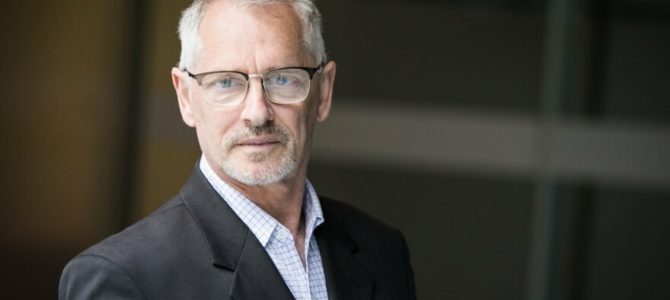
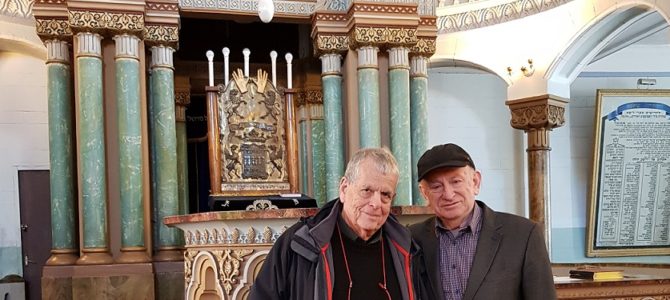
Around noon on Wednesday I went to take a look at the progress of the electrical wiring being installed in the prayer hall of the Choral Synagogue in Vilnius. I noticed a man who was looking over the synagogue carefully. I greeted him in Hebrew and he immediately began asking me questions about synagogue operations, Lithuanian Jewish life and in general “how are you living in Lithuania?” A usual Jewish question.

As a Jew I of course responded to his questions with questions: where are you from, why are you interested in the synagogue, are you perhaps in need of tefillin? … Then the visitor humbly introduced himself, explaining he was attending an academic conference at Vilnius University and had given himself an extra day especially for going to the synagogue, hoping to meet a Jew and get a chance to talk, maybe even in Yiddish, and then walk around the Vilnius Old Town a bit.

His family came from Poland and Vilnius looks a lot like where they came from. Then he said almost in passing, “I was invited to Vilnius University because I’m a Nobel prize winner…” I thought it was quite a good joke! In Yiddish I asked him to tell me the story of his life and how he had come to be the recipient of this most prestigious prize in the world.

Grigoriy Kanovich’s Devilspel Candidate for EBRD Prize

Grigoriy Kanovich’s Devilspel Candidate for EBRD Prize

The new English edition of Litvak writer Grigoriy Kanovich’s novel Очарованье сатаны (Jerusalem, 2002) titled Devilspel is in the running for a European Bank for Reconstruction and Development’s literature prize created especially for translated literature and worth 20,000 euros, according to publisher Noir Press.

The prize was instituted two years ago to underline the importance of translations of literature. There are 10 contenders this year, including works by Boris Akunin.

According to the publisher’s website: “Devilspel evokes the lost world of Lithuanian Jews during the Second World War. From the lives of Grigory Kanovich’s vividly drawn characters emerges a panorama of world events that shook eastern Europe and the world. The subtle art of Kanovich is his ability to create characters in the town of Mishkine, like the feisty Danuta Hadassah, the idealistic Elisheva and the complex and empathetic Catholic Cheslavas, who live within us long after the chronicle of their lives has ended. The book is more than a novel. Its story touches the heart and questions human and divine justice in a world gone mad.”

Six finalists–three writers and three translators–will be announced at the awards ceremony to be held in London April 22. The €20,000 prize is to be divided equally between writer and translator. Two runners-up and their translators will also receive a prize of €1,000 each.

Do You Want to Drive the Jews out of Lithuania? That’s Fine, Lithuanian Police Say

Do You Want to Drive the Jews out of Lithuania? That’s Fine, Lithuanian Police Say

by Vytautas Bruveris, www.lrytas.lt

“You little Jewess, there is no place for you here.” This sort of statement, even made publicly to a woman of Jewish ethnicity, is nothing more than the impolite, unethical implementation of the constitutional right to self expression and freedom of belief.

This phrase in no way means the person who uttered it is predisposed against people of Jewish ethnicity, wants to sow discord against them or wants to discriminate against them. This is the firm belief of no less than the Lithuanian police. It turns out the police in such cases see no basis not only for punishing the author of such statements, but not even for launching an investigation.

Insult Made at Parliamentary Ceremony

Lithuanian Jewish Community chairwoman Faina Kukliansky said she was called “žydelka” [little Jew-girl] and told “there is no place” for Jews in Lithuania at the Lithuanian parliament on January 13 this year when she attended events there to mark the day when protestors were murdered at the Vilnius Television Town back in 1990, a national day of mourning. Kukliansky said an older man came up to her dressed in a uniform and made the statements. She didn’t recognize what sort of uniform it was, but thought it was most likely from the Lithuanian Union of Riflemen.

Association of Lithuanian Jews in Israel Sends Open Letter to Lithuanian Ambassador

Association of Lithuanian Jews in Israel Sends Open Letter to Lithuanian Ambassador

To the honorable Lithuanian Ambassador to Israel Mrs. Lina Antanavičienė
12 Aba Hillel Silver Street, 17th Floor
Ramat Gan 5250606

Re: Republic of Lithuania Independence celebration

Dear Ambassador Antanvicienė,

Thank you for the ”save the date” to the Lithuania Independence Day celebration to be held on March 16, 2020. Unfortunately, we shall not attend. The Association of Lithuanian Jews in Israel made a decision within its board of directors meeting of February 20, 2020, not to participate in the festivities until we have a sound solution to the proposed resolution to the Seimas by Mr. Gumuliauskas to absolve Lithuania and Lithuanians of their active participation in the Holocaust and in the murder of Jews during the period of World War II.

We have cooperated fully with the restored Independent Republic of Lithuania regimes in combating anti-Semitism and promoting historical recognition of that dark period of World War II between the years 1941-1945.

New US Ambassador Visits LJC

New US Ambassador Visits LJC

Robert Gilchrist, a career diplomat appointed by president Trump to serve as the United States’ ambassador to Lithuania and confirmed by the Senate in late December, made an informal visit to the Lithuanian Jewish Community February 19.

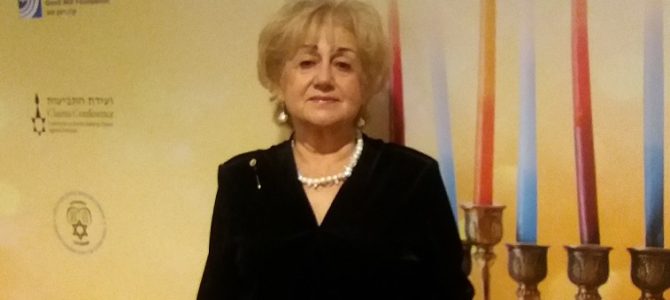
During the visit he met chairwoman Faina Kukliansky, received a tour of the Community building from her, chatted with senior citizens and learned about their club and met Holocaust survivors, including Jewish partisan Fania Brancovskaja.

He also visited the Bagel Shop Café and met children engaged in LJC activities during their winter break from school.

Chairwoman Kukliansky also showed the new ambassador an exhibit on display at the Community on the Righteous Gentiles who rescued Jews from the Holocaust in Lithuania.

Appointed by US president Donald Trump in July, Gilchrist was only confirmed by the Senate in late December after heated questioning about his position on Russia. During his confirmation he called Lithuania one of America’s most loyal allies and said becoming the US ambassador to Lithuania was the honor of his life.

The Truth Heals: Grigoriy Kanovitch Interviewed by Son Sergejus

The Truth Heals: Grigoriy Kanovitch Interviewed by Son Sergejus

As the Vilnius Book Fair ramps up this year, Grigoriy Kanovitch’s “Miestelio romansas” (the Lithuanian translation of his “Shtetl Love Song”] is reappearing on bookshop shelves. The novel tells the stories of people in small-town Lithuania, including Jews, Lithuanians, Poles and Russians, in the period between 1920 and 1941. Kanovitch’s son Sergejus, also an accomplished author, interviewed him in a press release for the book fair.

How does Shtetl Love Song fit in the context of your entire corupus? How important is it that the Lithuanian edition has gone into its second printing?

Shtetl Love Song is my most personal book. It’s the most biographical. I wouldn’t say I’m spoiled by second editions. Of course there have been some. But I should consider the additional publication of Shtetl Love Song the most important. News of this made me extraordinarily happy.

Book about Samuelis Kukliansky Presented at Vilnius Book Fair

Book about Samuelis Kukliansky Presented at Vilnius Book Fair

An autobiography in Lithuanian by noted Lithuanian attorney Samuelis Kukliansky who miraculously survived the Holocaust is available at the Vilnius Book Fair. His story is about maintaining human dignity and keeping alive that core of humanity in every person. The book “Samuelis Kuklianskis- teisininkas” [Samuelis Kuklianskis, Attorney] is for sale at the Vilnius Book Fair at the Adrena booth, booth no. 5D01, in hall 5.

BBC Looks at Holocaust Denial in Lithuania

BBC Looks at Holocaust Denial in Lithuania

The BBC’s channel 2 aired “Confronting Holocaust Denial” Tuesday night in Great Britain, a personal documentary about the current state of denial by son of survivors David Baddiel. Baddiel begins with the Allies suppressing the fact of Jewish extermination for strategic reasons, moves on to the upsurge in Holocaust denial in the 1970s and then what he perceives as an anti-Semitic backlash following NBC television’s miniseries the Holocaust viewed in America by 120 million people in 1978 and subsequently shown in Europe. He devotes some time to the Holocaust denial case against German-Canadian Holocaust revisionist Ernst Zündel (1939-2017) and David Irving’s libel suit against Deborah Lipstadt in the UK.

Following two interviews with Lipstadt, Baddiel travels to Vilnius and looks at controversy surrounding the removal of the plaque commemorating Jonas Noreika by Vilnius mayor Remigijus Šimašius. Trying to understand the Lithuanian nationalist position, he visits Kęstutis Mackevičius, the son of a murdered partisan, who claims Noreika was not a Nazi collaborator and only wanted to free his country. Baddiel examines the documents more carefully, including authentic documents posted by Noreika’s granddaughter Silvia Foti which clearly show he was involved in the extermination of Jews and the theft of their property in Lithuania. Baddiel concludes Lithuanians might be afraid they won’t have any heroes at all if they exclude collaborators, and that Lithuanian lionization of perpetrators is a response to Soviet distortions of history.

The documentary was filmed before nationalists replaced the plaque with their own version and only shows flowers and candles at the impromptu shrine Lithuanian nationalists set up outside the library of the Lithuanian Academy of Sciences where the plaque hung formerly.

More information about the film is available here.

Interesting Discussions at Vilnius Book Fair

Interesting Discussions at Vilnius Book Fair

This year’s annual Vilnius Book Fair will feature some interesting presentations involving Jewish topics.

At 3:00 P.M. on Thursday, February 20, Moi Ver’s “Ghetto Lane in Wilna” album will be presented by Dr. Mindaugas Kvietkauskas, Lolita Jablonskienė, Nissan N. Perez, Yossi Raviv and Sigutė Chlebinskaitė in Hall 3. The discussion will be held in Lithuanian and English.

At 12 noon on Friday, February 21, Matilda Olkinaitė’s book “Atrakintas dienoraštis” will be presented by editor Dr. Mindaugas Kvietkauskas with Dr. Irena Veisaitė, Laima Vincė and Neringa Danienė participating.

At 6:00 P.M. on Friday, February 21, Dr. Lara Lempertienė, Dr. Mindaugas Kvietkauskas and Rimantas will present “Dešimt eilėraščių/Ten Poems,” a selection of poems by Abraham Sutzkever, at the Writers’ Corner.

At 3:00 P.M. on Saturday, February 22, the book “Žydų kultūra paveikslėlių knygose: Karaliaus Motiejuko karalystė (pagal Januszą Korzcaką)” will be presented by Anna Czerwińska and Iwona Chmielewska at conference hall 5.3. The discussion will be held in Polish and English.

Righteous Gentile, Librarian and Local Legend Ona Šimaitė Commemorated at Former Workplace

Righteous Gentile, Librarian and Local Legend Ona Šimaitė Commemorated at Former Workplace

A commemorative event was held in honor of Righteous Gentile Ona Šimaitė February 12 in the Vilnius University library where she once worked.

As a librarian, Šimaitė carried books back and forth into and out of the Vilnius ghetto, and also messages. She also hid Jews and Jewish cultural treasures. Risking her life every day to help others, she was eventually discovered, arrested and tortured, but survived. She was one of the first Lithuanians to receive Yad Vashem’s Righteous among the Nations award in 1966.

Those attending the commemoration included Lithuanian Jewish Community chairwoman Faina Kukliansky, Julija Šukys, poet, writer and translator Marius Burokas, editor Saulius Repečka, Judaica Studies Center director Dr. Lara Lempert, poetess Aušra Kaziliūnaitė, writer Saulius Stankevičius, literary critic Virginija Cibarauskaitė, members of the Jewish community and numerous others. Modestas Saukaitis, who does art restoration professionally, unveiled his own portrait of Šimaitė in the antechamber of the Lithuanian Studies Reading Room at Vilnius University during the commemoration.

Eugenijus Bunka Named Tolerant Person of the Year

Eugenijus Bunka Named Tolerant Person of the Year

Eugenijus Bunka was named Tolerant Person of the Year February 2 in Kaunas. Bunka is the creator of the Litvak Memorial Garden, a regional historian, writer and journalist. At the awards ceremony he said he was carrying on the work of his father, Jakovas Bunka. The Bunka welfare and support fund finances children’s camps, meetings at schools and other events.

The award comes from the Sugihara Foundation/Diplomats for Life, which has been giving the award since 2001. They said Bunka received the distinction for his many years directing the Jakovas Bunka fund and carrying out civic and educational initiatives, commemorating the Jews of Plungė, Žemaitija and Lithuania both in his own region and around the world.

The foundation said Bunka in 2019 undertook active educational work, refuting the wartime and postwar stereotype of Jews as Communists specifically in the administration in Plungė using arguments and facts. They also noted his research into Louis Armstrong’s Litvak foster parents in America, Leiba and Tilė Karnovskiai from Vilkija, Lithuania.

Israeli Ambassador Yossi Levy Visits Kaunas

Israeli Ambassador Yossi Levy Visits Kaunas

Israeli ambassador to Lithuania Yossi Levy visited Kaunas at the end of January, where he visited the Ninth Fort Museum and honored Holocaust victims there. He also visited Sugihara House, the museum where Japanese diplomat and Righteous Gentile Chiune Sugihara lived and worked.

Ambassador Levy also paid his respects at the memorial at the Lietūkis garage site where Jews were tortured and murdered on June 27, 1941. After that he went to the site of the former residence of Litvak poetess Lea Goldberg in whose courtyard is an art installation commemorating former Jewish life.

Ambassador Levy and deputy ambassador Adi Cohen-Hazanov met with Kaunas mayor Visvaldas Matijošaitis and the mayor’s team. Later the Israeli delegation met Daiva Citvariene and her team from the Atminties biuras [Office of Memory] group working on the Kaunas 2022 European Cultural Capital program. They discussed ways to commemorate the history of the Jews of Kaunas together.

Donskis Prize Winner Linas Vildžiūnas’s Acceptance Speech

Donskis Prize Winner Linas Vildžiūnas’s Acceptance Speech

LRT.lt

The Leonidas Donskis prize was awarded this year to Linas Vildžiūnas, the director of the “7 meno dienos” [Seven Days of Art] weekly newspaper, by the board of directors of the Sugihara Foundation/Diplomats for Life and Jolanta Donskienė.

On February 2 the Sugihara Foundation/Diplomats for Life announced their annual award for Tolerant Person of the Year at Vytautas Magnus University in Kaunas. This year that person was Eugenijus Bunka. They also awarded the Donskis prize to Linas Vildžiūnas. Leonidas Donskis was a philosopher, professor, the author of numerous books, a television personality, an advisor to the Lithuanian president and an important voice in the modern Republic of Lithuania.

Vildžiūnas was awarded the distinction “for his meaningful presence on the cultural scene which was unaffected by regime changes and fashion, and for his continuous reminder culture is a fundamental value whose quality is enriched by supporting dialogue and discussion. [And] for his long-time battle against forgetfulness, reminding us that only the maintenance of memory, however uncomfortable it might be, strengthens dialogue and empathy, that the memories of our grandparents and great-grandparents is of value for the younger generation rather than a fading memory. [And] for his belief and the example he set, showing that a strong civic attitude is able to withstand tendentious attacks, manipulations and efforts to ‘nationalize’ it.”

This is the speech Linas Vildžiūnas gave on acceptance of the Donskis prize:

§§§

Dear Mrs. Jolanta Donskienė, honored members of the board of directors of the Sugihara Foundation/Diplomats for Life, ladies and gentlemen,

In accepting from your hands this honorable award in recognition of my humble efforts, I am deeply moved and at the same time disturbed. The Leonidas Donskis prize set a very high standard, bearing in mind his irreplaceable role in our public life and academic discourse and his novel insights which have added to our lexicon of philosophy and sociology (take just for example his and Zygmunt Bauman’s idea of “liquid evil” in the final book coauthored by both thinkers). We all feel that void which appeared in public life on the loss of Leonidas Donskis, who was the most remarkable and sometimes the only voice of our intellectual elite.

Jewish Quarter of Vilnius: From Grand Duke’s Privilege to Soviet Demolition

Jewish Quarter of Vilnius: From Grand Duke’s Privilege to Soviet Demolition

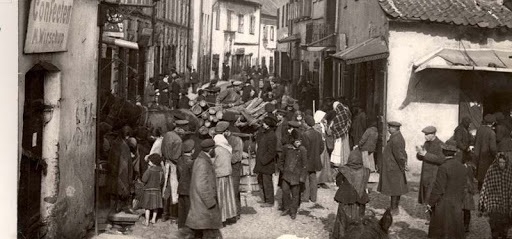
Photo: Antokolskio street, 1940/Mečys Brazaitis

The spacious square by Žydų (Jewish) Street in central Vilnius now contains little else than a children’s playground, parking lots and a derelict kindergarten, but it was densely packed with houses before World War Two. Most of the houses were occupied by Jews and the area was the center of the city’s Jewish quarter.

Lithuania has dedicated the year 2020 to the Vilna Gaon and the History of the Jews of Lithuania. LRT English together with Vilnius University and Jewish Heritage Lithuania bring you a series of stories exploring Litvak history.

The official beginnings of the Jewish quarter of Vilnius date back to the 17th century when king of Poland and grand duke of Lithuania Wladyslaw Vasa granted a privilege [charter] to the Jews to reside in this quarter. Jewish Street had this name even before that, so it is likely Jewish residents already lived there.

Full story here.

Šiauliai Regional Jewish Community Commemorates Holocaust Victims

Šiauliai Regional Jewish Community Commemorates Holocaust Victims

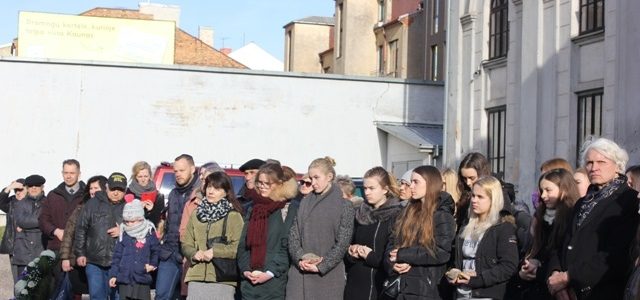
Local Jews and others gathered to commemorate International Holocaust Day on January 27 at a monument marking the ghetto gate at the intersections of Trakų and Ežero istreets n Šiauliai.

Members of local Jewish organizations, representatives of the Šiauliai municipal and regional administrations, students and non-Jewish local residents participated. Among those attending were Holocaust survivors Ida Vileikienė and Romualda Každailienė, former inmates in the Šiauliai ghetto.

Participants lit candles and laid rocks and flowers at the ghetto gate marker, and took photos for the #WeRemember International Holocaust Day campaign.

LJC Members Gather to CommemorateInternational Holocaust Day

LJC Members Gather to CommemorateInternational Holocaust Day

In 2005 the UN General Assembly proclaimed January 27 the International Day of Commemoration in Memory of the Victims of the Holocaust. On that day in 1945 the Red Army liberated the prisoners at the Auschqitz-Birkenau death camp.

All survivors were invited to invited to come to the commemoration at the Lithuanian Jewish Community.

An exhibit of paintings by Levas Saksonovas called Holocaust was unveiled on the third floor of the LJC, at the initiative of active LJC member, doctor and photo artists Robertas Skalskis and social programs director Žana Skudovičienė. The artist’s son Danilias and art historian and researched Vera Kalmykova presented the exhibit.

Lithuanian Foreign Ministry Commemorates Holocaust Victims

Lithuanian Foreign Ministry Commemorates Holocaust Victims

On January 28 the Lithuanian Foreign Ministry and the Lithuanian Jewish Community held a commemoration of International Holocaust Day at the ministry.

“The Holocaust is a horrid scar on humanity, on the face of Lithuania. It is a wound which likely will never heal. Let’s hope and try so that humanity never experiences this again. We are endlessly grateful to all the survivors of the Holocaust who are with us here today. In celebrating the 300th anniversary of the birth of the Vilna Gaon, we hope Vilnius will again become a center of gravity for the Jews of the entire world, as the Jerusalem of Lithuania once was,” foreign minister Linas Linkevičius said after presenting red roses to Holocaust survivors attending the event.

A student choir from the Sholem Aleichem ORT Gymnasium performed three songs in Yiddish and Lithuanian.

Lithuanian President Commemorates Holocaust Victims in Poland

Lithuanian President Commemorates Holocaust Victims in Poland

Lithuanian president Gitanas Nausėda and his wife Diana Nausėdienė attended a commemoration of the 75th anniversary of the liberation of the Auschwitz concentration camp in Poland on the International Day of Commemoration in Memory of the Victims of the Holocaust. Fifty heads of state, royal family members, government representatives and ambassadors attended the ceremony.

“I came to Oświęcim, to Poland, to express sincere respect for the millions of Jews who lost their lives during the Holocaust in World War II. I bow down in memory as well of more than two hundred thousand victims of our nation. This is a tragedy for Lithuania and the entire world. We cannot bring the innocent victims back to life, nor can we minimize the pain their families experienced. All we can is to preserve the memory of these people and to seek for historical justice,” the Lithuanian president said.

Lithuanian Parliamentary Speaker Says Participation at World Holocaust Forum Was Appropriate

Lithuanian Parliamentary Speaker Says Participation at World Holocaust Forum Was Appropriate

Lithuanian public radio and television radio program Ryto garsai, January 27, 2020

Speaker of the Lithuanian parliament Viktoras Pranckietis en route to a Holocaust commemoration at the Auschwitz-Birkenau concentration camp told LRT.lt this was a day for commemorating the 75th anniversary of the liberation of the camp. He said Lithuania’s participation both at Auschwitz and the World Holocaust Forum in Israel were steps which strengthened bilateral ties with the Jewish community.

The United Nations declared January 27 the International Day of Commemoration in Memory of the Victims of the Holocaust in 2005 in a resolution condemning all forms of Holocaust denial.

The Lithuanian speaker of parliament said the day is important to other peoples besides Jews.

Israeli Litvaks Protest Lithuanian MP Gumuliauskas in Tel Aviv

Israeli Litvaks Protest Lithuanian MP Gumuliauskas in Tel Aviv

Photos: Dr. Andrejus Aron from Vilnius, resident in Israel

Litvaks held a protest January 24 at the Lithuanian embassy to Israel in Ramat Gan, a neighborhood of Tel Aviv.

The Association of Lithuanian Jews Living in Israel under the leadership of former Vilnius resident Arie Ben-Ari Grodzenskis sponsored the protest, which was mainly attended by elderly Litvaks, most of whom were born after the war, their grandparents having been murdered in Lithuania in the Holocaust.

Despite cold weather and rain, they gathered to remember the 220,000 Jews who lived in Lithuania before the Holocaust and built the Jerusalem of Lithuania.

The picket was aimed specifically against Lithuanian MP Arūnas Gumuliauskas, the chairman of the Lithuanian parliament’s Battles for Freedom and State Historical Memory Commission who announced in mid-December he was drafting a parliamentary resolution proclaiming the Lithuanian state and nation innocent of participating in the Holocaust, because the state and the people were under occupation, first by the Soviets and then by the Nazis.

One of the signs at the protest read: “Gumuliauskas: no law can wash away Jewish blood.”