Holocaust

Jewish Street Gets New Sign in Yiddish, Hebrew

Vilniuje Žydų gatvės pavadinimas užrašytas dar dviem kalbomis – ir יידישע גאס (jidiš klb.), ir רחוב היהודים (hebrajų klb.)

Žydų gatvė (Jewish Street, aka Yidishe Gas, aka ulica Żydowska), where the traditional Jewish quarter and the Great Synagogue of Vilnius was located, got a new sign in Yiddish and Hebrew Tuesday.

This was one in a continuing series of new signs in foreign languages, a controversial effort by Vilnius mayor Remigijus Šimašius to showcase the multicultural identity of the Lithuanian capital. Earlier signs in “minority” languages included ones for Islandijos [Iceland] street, Washington Square, Varšuvos [Warsaw] street, Rusų [Russian] street and Totorių [Tatar] street in Vilnius.

Names of Jews Murdered To Be Remembered in Lithuania

vardai7

On September 22 and 23, the 75th anniversary of the mass murder of the Jews of Lithuania, the names of Holocaust victims will be read out loud on the eve and day of the Day of Remembrance of the Jewish Genocide Victims of Lithuania. The civic initiative VARDAI [NAMES] invites the public to remember the brutally exterminated citizens of Lithuania by uttering their names and surnames at the locations where they once lived.

VARDAI coordinator and museum specialist Milda Jakulytė-Vasil said: “A person is not a number. The reading of the names is a personal expression of commemoration and empathy. It only takes five minutes. We welcome everyone who wants to remember.” Participants at the events have said this kind of Holocaust victim commemoration helped them comprehend the scope of the tragedy in a very personal way. When you say a person’s name, it’s no longer possible to pretend that person never existed, and the statistics telling us 90 percent of 220,000 Jews living in Lithuania were murdered becomes more than just a number.

This will be the sixth annual reading of the names in Lithuanian cities and towns, to include more communities than ever before. At least several dozen cities and towns are participating in reading the names this year, including Vilnius, Kaunas, Marijampolė, Ukmergė, Merkinė, Molėtai, Jonava, Kėdainiai, Švėkšna, Dieveniškės, Eišiškės, Kretinga, Jurbarkas, Žemaičių Naumiestis and others. Many of these events include additional components, such as cleaning up mass murder sites, visiting old Jewish cemeteries and meetings with survivors.

Jewish Street in Vilnius to Get Trilingual Street Sign

Žydų gatvė (Jewish street, aka Yidishe gas, aka ulica Żydowska), where the traditional Jewish quarter and the Great Synagogue of Vilnius was located, is about to get signs in Yiddish and Hebrew.

The special event to unveil the new sign is scheduled for 11:30 A.M., Tuesday, September 20 at Žydų street no. 2.

The program includes a performance of a piece by the Jewish song and dance ensemble Fayerlakh, followed by Vytautas Mitalas, chairman of the Vilnius municipal council’s culture, education and sports committee, presenting Vilnius mayor Remigijus Šimašius. Šimašius is to present a small speech. Mitalas will then introduce Lithuanian Jewish Community chairwoman Faina Kukliansky, who will also deliver a small speech. The mayor and the chairwoman will then unveil the new street sign. Fayerlakh is then scheduled to perform another song.

The historic street and a neighboring street were cleared of their mainly Jewish residents in 1941 when the Nazis and Nazi collaborators set up the Vilnius ghetto. The residents were murdered and a large population of Jews from other parts of the city were forced into the cramped quarters there. It was part of the so-called Small Ghetto in Vilnius, liquidated in October of 1942. Žydų gatvė was the site of the Shulhof, the collection of buildings built around the location of the residence and study of the Vilna Gaon and the Great Synagogue.

I’m Not Jewish: A Western Response

Some Call Lithuania First Eastern European Country to Admit Holocaust Complicity

The Frankfurter Allgemeine newspaper printed an editorial on August 29 positively portraying Lithuanian attempts to speak openly and honestly about the Holocaust. Lithuanian ambassador to Germany Deividas Matulionis pointed to the many friendly and constructive comments left under the article in German.

Warsaw-based Frankfurter Allgemeine correspondent Gerhard Gnauck’s feature article of August 29 is provided in rough translation below.

Commemoration in Lithuania
Our Own People


Lithuania commemorates the mass murder of the Jews, and even the president wants to be there. This is a big step in a land silent for so long about the pogroms.

litauen-stellt-sich-seiner
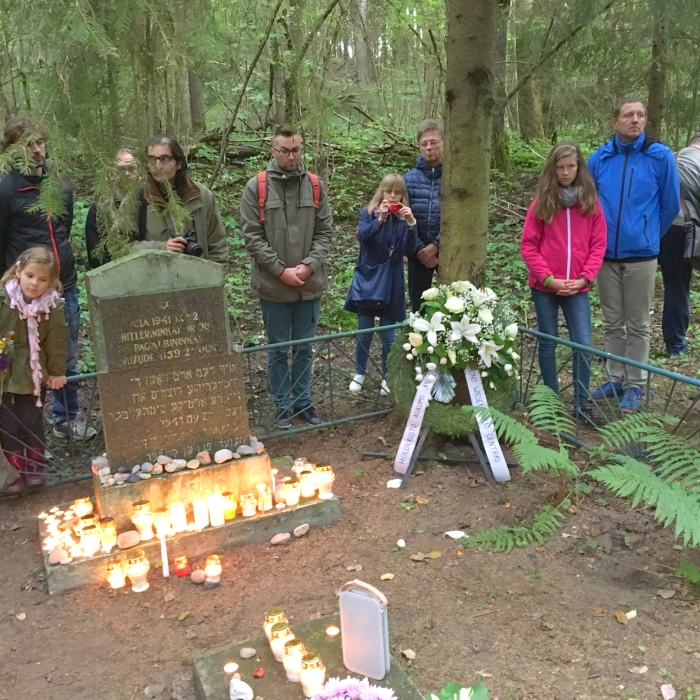
Lithuania faces her past: remembering Holocaust victims in Vilnius in May. Some 70,000 Jews were murdered at Paneriai.

For forty years Lithuanian writer Marius Ivaškevičius in his own words “had been living for 40 years in complete ignorance, on the margins of a gigantic tragedy without even sensing it existed.” Ivaškevičius was born in 1973 in Molėtai, a small and seemingly idyllic town about an hour’s drive north of the capital Vilnius. A paradise of dachas surrounded by lakes. But then something must have gotten into him, he was stung by a wasp. Or at least his fellow residents thought so.

Last week the time had come for Ivaškevičius to declare: “I’m not Jewish,” and that was the title above the text he posted on the popular Baltic Internet portal delfi.lt. It wasn’t a wasp, it was a tick which had bitten him at the Jewish cemetery in Warsaw, the author wrote ironically. Since his visit there he had been “infected.” He concerned himself with the history of his hometown, Molėtai, where two-thirds of the residents were murdered 75 years ago, on August 29, 1941. Lithuanians wielded the weapons.

Reminder about Cemetery Clean-Up

Dear LJC members participating in the September events,

This is to remind you that we are going to the Jewish cemetery on Sudervės road in Vilnius at 2:30 on September 20 to do a clean-up. The bus will leave from the Lithuanian Jewish Community at Pylimo street no. 4 in Vilnius.

Please wear clothing appropriate for the work and the weather!

Thank you for taking part! If you have any questions, please contact us.

Sincerely,
Lithuanian Jewish Community administration

telephone: +370 5 261 3003
email: info@lzb.lt

Same Problem Every Year at Jewish Mass Murder Sites

Kiekvienais metais ta pati problema prie žydų žudymo vietų

Every year the Panevėžys Jewish Community writes the municipal and regional administrations regarding the most tragic sites in Jewish history, sites which need continual upkeep and maintenance, the Jewish mass murder sties in the city, district and region of Panevėžys. And also in other towns such as Kupiškis, Pasvalys, Biržai, and smaller towns such as Krekenava, Pumpėnai, Raguva, Obeliai, Ramygala, Vabalninkas and others.

A large number of municipal and regional administrations consider all our requests in a spirit of goodwill and are engaged in solving the problem of maintenance at these places of tragedy, but, unfortunately, there are also a number of administrations who discover all sorts of reasons not to fulfill our requests. We believe there needs to be a common stance by government so that every year, especially in summer, cemeteries and the mass murder and mass grave sites are mowed and cleaned up. The municipal bodies of the towns of Kupiškis and Rokiškis are paying attention to the problem, while we have to beg and cajole the Pasvalys administration constantly to maintain and clean up the mass murder site in the Žadeikiai Forest there. The Jewish cemeteries in Krekenava and Raguva are in extremely bad repair.

Support the Lithuanian Jewish Community

Even your small donation today can help the Lithuanian Jewish Community achieve great things tomorrow.

The Lithuanian Jewish community has roots going back 700 years. Only a remnant survived the Holocaust. Although the current community is small, we are extremely active and are working hard to foster Jewish identity, maintain traditions and culture, commemorate Holocaust victims, provide social services to our members and promote tolerance in society.

We invite you to contribute to reviving at least a small portion of the legendary Jerusalem of Lithuania. Perform your mitzvah (good deed) today!

I’m Not Jewish

marius-ivaskevicius
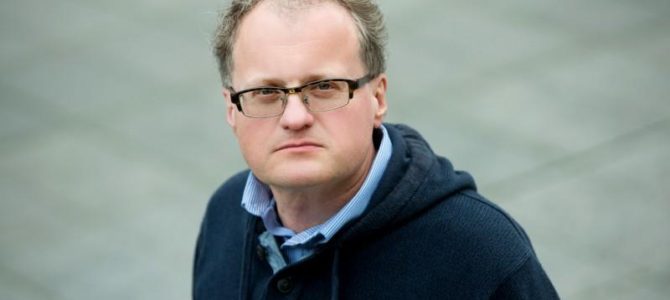
by Marius Ivaškevičius

That’s what I want to tell everyone who the last three months have tactfully asked this of my friends and relatives. I am not Jewish at all, I don’t have a drop of Jewish blood. So why is he casting his lot with those Jews, what wild insect bit him? That’s another question heard often.

I can answer it almost by rote: I was bitten by a tick. Three years ago I filmed one scene at the old Jewish cemetery in Warsaw and it sucked my blood there. Furthermore, I got Lyme disease. And it so happened, or perhaps it was decided beforehand by that treacherous Jewish tick, that when I was taking antibiotics I became interested in the Jews in my town, their fate in my native Molėtai. And my hair stood on end and I got goose-bumps when I realized I had been living for 40 years in complete ignorance, on the margins of a gigantic tragedy without even sensing it existed. I knew there had been Jews, they had lived here, because their old cemetery still exists in Molėtai, as does their old “red bricks,” a long building, the oldest in the town, of connected shops, a sort of shopping mall of the period. I knew some unknown number of them had been killed, since, as I thought, some of them had been involved in Communist activities.

LJC Chairwoman Faina Kukliansky Thanks European Day of Jewish Culture Organizers

LŽB pirmininkė F. Kukliansky dėkoja Europos žydų kultūros dienos Lietuvos žydų (litvakų) bendruomenėje organizatoriams
Photo: Dr. Mindaugas Kvietkauskas, director, Lithuanian Literature and Folklore Institute, reads poems by Abraham Sutzkever

The European Day of Jewish Culture was celebrated September 4 in Vilnius with a klezmer music concert and Yiddish poetry readings. We are glad it was such a real holiday, and proud of its organizers!

Lithuanian Jewish Community chairwoman Faina Kukliansky thanks everyone who contributed to organizing the event and who sacrificed their time for the Jewish community’s benefit.

Faina sveikina

“Thank you to the staff of the Bagel Shop Café who prepared special Jewish treats for everyone. Only though joint effort can our small community organize celebrations of such high caliber and take pride in them along with a large group of friends and guests. Thank you to the small group of volunteers who truly helped. Thank you to the Vilnius Sholem Aleichem ORT Gymnasium, fostering students who honor and are interested in their roots and culture, the young Europeans for whom understanding of tolerance and civic-mindedness is an urgent matter. Thank you to the gymnasium students who took part in the celebration,” chairwoman Kukliansky said.

Film Gitel Looks at Lithuanian Holocaust

gitel

A cinematic premiere has been added to list of important events to honor Lithuania’s Holocaust victims. British director Robert Mullan’s film Gitel, filmed in Lithuania and elsewhere, will open at cinema theaters September 23. The film looks at the mass murders of 1941 through the eyes of a female survivor who has lost her family.

Litvak Wit in Yiddish Sayings

Dita Sperling2 2016

It’s important for people to hear the sound of Yiddish. There are many interesting sayings. My grandma used to say “one butt can’t be at two fairs at once.” Takhrikhim is a linen cloth used as a burial shroud. I remember I had this rich uncle who was stingy. Something needed to be purchased for the bathtub, but he’s not buying it. I said to him: “Uncle, takhrikhim have no pockets. And what do we keep in our pockets? Money. When they are burying you, you can’t take your money with you.” After I said that, uncle went and bought everything right away. Incidentally, pockets in Yiddish are “keshenes,” almost the same as Lithuanian “kišenės.”

Aphorisms, sayings and etc.

On Sunday I thought I’d go on Monday, but I put it off, and I didn’t go on Tuesday, either, because there was market on Wednesday. And why should I go on Thursday, since Friday is the start of Sabbath?

When the mouse is full, the flour is bitter.

No man scratches his head without reason: either he has worries, or lice.

Molėtai Holocaust Procession Draws Record Crowd

eisena-skirta-iszudytiems-moletu-krasto-zydams-pagerbti-faina

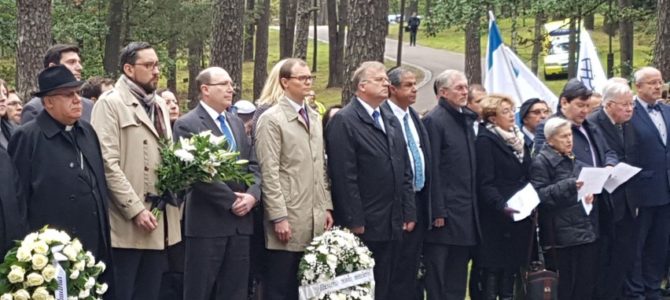
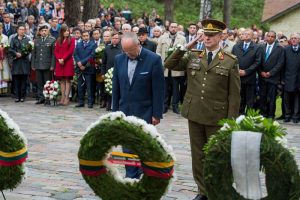
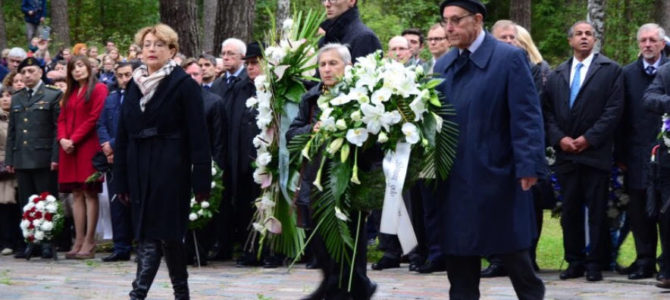
More than 2,600 and perhaps as many as 4,000 people attended a rally and walked the route along which 2,000 Jews were marched to their deaths 75 years ago in the sleepy Lithuanian town of Molėtai Monday. The population of Molėtai was roughly 6,400 when last counted in 2011.

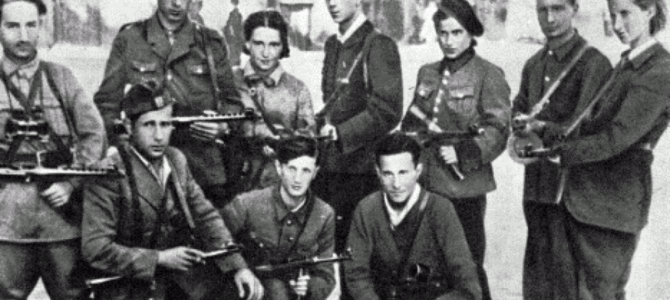
The town center and surrounding streets were filled with local residents and people from around the world, including Holocaust survivors and their descendants. Many Lithuanians brought their children and there were people from Estonia and a number of Lithuanian officials in the crowd. One group of young people waved Polish flags–the Polish Armia Krajowa operated in the area in 1944. A small group of Lithuanian boy and girl scouts attended, while another small group carried a Lithuanian flag, and others sported Israeli flags. A monk in black robes stood by the stage, on the other side of which there was a long line of people holding posters with names, faces and descriptions. A central area contained about twenty folding chairs for elderly and distinguished guests, including Vytautas Landsbergis and Holocaust survivor Irena Veisaitė. Lithuanian MP Emanuelis Zingeris, a Litvak, also attended. The priest Tomas Šernas was also there, as was Lithuanian Jewish partisan Fania Brancovskaja. Other distinguished guests included Conservative Party and parliamentary opposition leader Andrius Kubilius, Lithuanian defense minister Juozas Olekas and deputy foreign minister Mantvydas Bekešius.

Record Turnout for Biržai Holocaust Commemoration

Around 200 people attended an annual commemoration of the Holocaust victims of Biržai, Lithuania Sunday, August 28, 2016. In prior years those travelling to the rural town near the Latvian border numbered in the dozens. Only members of four families survived the Holocaust in Biržai. Their descendants now live in other locations in Lithuania and Israel and have been making the pilgrimage back to honor their murdered relatives since the end of World War II.

A Holocaust historian who attended said larger interest this year was likely the result of publicity for the Molėtai Holocaust commemoration on August 29.

Ten speakers spoke at the commemoration, including a moving speech by Lionginas Virbalas, the Catholic archbishop of Kaunas who was born and grew up in Biržai. Lithuanian Jewish Community chairwoman Faina Kukliansky also spoke eloquently about the past and the future. Israeli ambassador Amir Maimon spoke and a representative from the US embassy whose Jewish family roots are in Biržai also participated.

There wasn’t a formal march to the killing site. Instead there was a walking tour of Jewish sites in Biržai, including the former synagogue, Jewish houses and buildings and the old Jewish cemetery, where a portion of the Jews of Biržai were murdered. The group then moved to the killing site about 2 kilometers outside town where prayers were said by representatives of different religious communities.

Thank You Card for Ema Jakobienė

A thank you card to Ema Jakobienė for her contributions as one of the directors of the LJC project to support Lithuania’s aging Righteous Gentiles.

padėka

Dear Ema,

We thank you very much for your wonderful project, for your concern and your love of your fellow human beings.

Thanks to you, we received a [debit] card–this is a great gift and support to our family.

Thank you!

So please keep going, keep working and touch those people who are already slipping from our fingers…

May God grant you health, strength of soul and smiling eyes…

In gratitude,

Antanas Poniškaitis
Staselė Poniškaitienė
September, 2016

Events by Tolerance Center of Dukstyna Grade School in Ukmergė for September 23

Program of events by the Tolerance Center of Dukstyna Grade School in Ukmergė (Vilkomir) for September 23:

8:00-9:00 traditional “Memory Track” jog in Pivonija woods; candle lighting ceremony to honor the dead;

11:00 Ukmergė Old Town Architecture: Past, Present, Personal Stories (walking tour of sites)

12:00 Lesson at regional history museum; screening of parts of the film The Dark with discussion to follow; meeting Stasė Staputienė, daughter of Righteous Gentiles Kazimieras and Marcijona Ruzgys.

Information provided by Tolerance Center coordinator Vida Pulkauninkienė

Ramūnas Bogdanas: How Many Lithuanians Are Still Peeking out the Window

R. Bogdanas. Kiek lietuvių tebežiūri pro langą

Almost all Jews in Lithuania were exterminated in the Holocaust. It sounds correct, but I tend to say it differently: the Jewish part of Lithuanian society was exterminated during the Holocaust. It seems the same, but there’s an essential difference which demonstrates one’s attitude towards the country and its past. In the first case it is admitted that, besides Lithuanians, Jews lived in this land, who did not survive. Their history ended, while ours, so far, continues. Two separate paths. In the second case, we say that Jews, while different from Lithuanians, are part of that same Lithuania, like an arm and a leg; while separate, still part of the same body. While Jews lived in a rather closed community, their centuries of proximate existence and work made them part of Lithuania. It seems like the simple truth, but it’s so hard to accept it. Because then there will come a time to explain what madness possessed Lithuania that one of her arms cut off the other and pulled the gold rings from its cold, dead fingers.

Full editorial in Lithuanian here.

Wooden Synagogues: Lithuania’s Unique Ethnic Architectural Legacy

Medinės sinagogos – unikalus etninės Lietuvos architektūros paveldas

The relicts of the Jewish cultural landscape created over more than 600 years in cities, towns and villages throughout Lithuania can be placed in four categories: mass murder sites; cemeteries; synagogues and other heritage buildings; monuments and other commemorative markers. Martynas Užpelkis, Lithuanian Jewish Community heritage protection expert delivering a lecture at an event dedicated to the European Day of Jewish Culture, said: “The Lithuanian Jewish Community, almost exterminated during the Holocaust, is not able to maintain and protect heritage sites throughout Lithuania alone today. The role of the Lithuanian state and municipal institutions, NGOs and citizens is crucial. Many challenges are arising, but great results have been achieved in cooperation with the Cultural Heritage Department and the municipalities.”

To what use should the synagogue buildings be put?

About 80 synagogues survive in Lithuania today, and 43 of them are listed on the register of cultural treasures. There are only two working synagogues and all other buildings are being put to other uses or are not being used at all. The LJC owns 13 synagogues and synagogue complexes. Most of the buildings are not in use and are in serious disrepair.

Awards by European Association of Archaeologists

At the opening ceremony of its 22nd annual meeting in Vilnius on August 31, 2016, the European Association of Archaeologists awarded the European archaeological heritage prize to L’Unité d’archéologie de la ville de Saint-Denis for exemplary achievements which unite archaeological heritage management and research with local community outreach, and to Dr. Caroline Sturdy Colls for her innovative contribution to research on Nazi German terror in concentration camps and mass murder sites.

The European Association of Archaeologists awarded its student award for best student paper presented at the EAA conference to Sian Mui for her “Positioning Ritual: Death and Representation in Early Medieval England,” and to Shumon Hussain for his paper “Gazing at Owls? The Role of Human-Strigiform Interfaces in the Gravettian of East-Central Europe.”

Sylvie Kvetinova, administrator
EAA Secretariat

The 18th European Archaeological Heritage Prize
The Student Award of the European Association of Archaeologists 2016

European Day of Jewish Culture 2016

European Day of Jewish Culture 2016
Vilnius speaks Yiddish again!

Sunday, September 4, 2016
Lithuanian Jewish Community, Pylimo street No. 4, Vilnius, September 4

Program:

10:00 Bagel breakfast Boker Tov-בוקר טוב – A guten morgn – Labas rytas!
Location: Bagel Shop Café, Pylimo street No. 4, Vilnius

11:00-11:45 Hebrew lessons for kids and parents with Ruth Reches, author of the Illustrated Dictionary of Hebrew and Lithuanian for Beginners, registration required
Meet at the Bagel Shop Café, Pylimo street No. 4, Vilnius

12:00-12:45 Rakija Klezmer Orkestar performance
Location: White Hall, LJC