Religion

Israeli Antiquities Chief Equates UNESCO with ISIS

EID
A March 31, 2016 picture shows the remains of the Temple of Bel’s “Cella” in the ancient Syrian city of Palmyra, blown up by Islamic State jihadists. (AFP/Joseph Eid)

by Ilan Ben Zion

UN cultural body’s resolution on Jerusalem akin to jihadist group’s destruction of Palmyra, says Yisrael Hasson

The director of the Israel Antiquities Authority slammed UNESCO on Wednesday for its resolution on Jerusalem holy sites, comparing the UN cultural body to Islamic State jihadists.

Speaking at the opening of the new IAA headquarters in Jerusalem, director Yisrael Hasson said the resolution adopted last week and confirmed on Tuesday put the UN organization in the same league as ISIS jihadists who have destroyed and looted hundreds of archaeological sites in Syria and Iraq to fund their caliphate.

Four Arrests in Beating of Rabbi in Ukraine

photo_2016-10-07_18-06-51
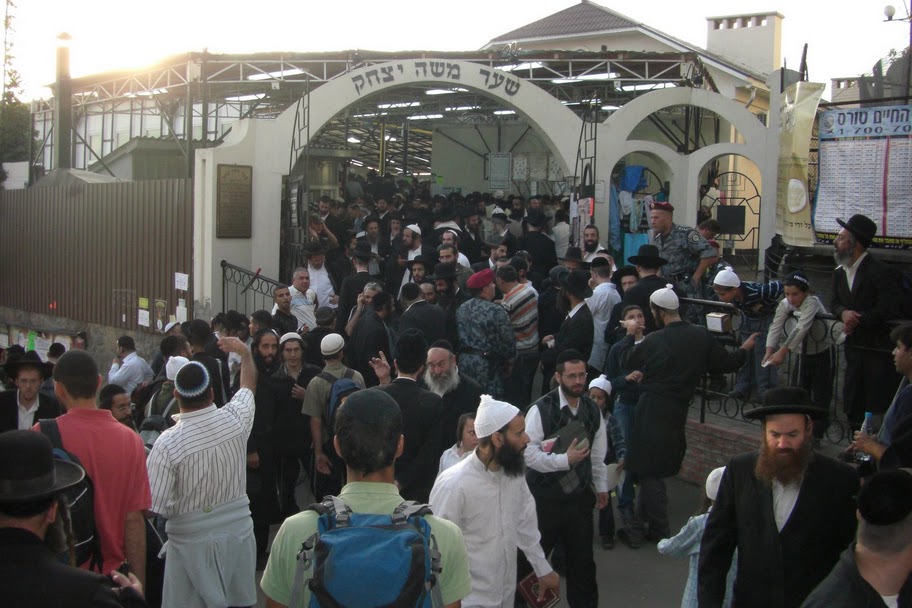
Mendel Deitsch is in serious but stable condition after a violent assault earlier this month.

Ukrainian police arrested four suspects, two of them minors, in connection with the brutal assault of Rabbi Mendel Deitsch in the Ukrainian town of Zhitomir earlier this month.

Deitsch, who serves as Chabad Lubavitch emissary to the former Soviet Union, remains in serious but stable condition at an Israeli hospital after a group robbed and beat him in the early hours of October 7.

According to reports in Ukrainian media, two males and two females from the Carpathian mountain region attacked Deitsch outside Zhitomir’s main train station, a chabad.org press release reported.

Anti-Semitism on Steroids

Pasaulio žydų kongreso prezidentas S.R. Lauderis pavadino UNESCO balsavimą dėl Jeruzalės “antisemitizmu, kuris stiprėja nuo steroidų”

World Jewish Congress president Ronald Lauder has characterized a UNESCO resolution on Jerusalem as “anti-Semitism on steroids.”

The UNESCO resolution appears to deny Christian and Jewish ties to the city. Lithuania voted against.

Israel has frozen ties with the UN agency following the vote.

jerusalem-temple

WJC president Lauder condemned the resolution on Jewish holy sites and called it shameful, but cautioned against taking the Palestinian-initiated resolution too seriously, since there is no argument about Jewish ties to Jewish holy sites in the city.

“What happened today in Paris is anti-Semitism on steroids. It is a total travesty and an insult to the Jewish people to pretend that the holy sites in Jerusalem are only Muslim sites, and to ignore the fact that Temple Mount was already the holiest place of Judaism well before the advent of Islam,” Lauder declared.

Israel Freezes Ties with UNESCO

Baltic News Service reports Israel has frozen ties with UNESCO, the United Nations Educational, Scientific and Cultural Organization, following the adoption of two resolutions on occupied East Jerusalem in the run-up to an important vote next week. In a letter to UNESCO director-general Irina Bokova, Israeli education minister Naftali Bennett accused the organization of ignoring millennia of Jewish ties to the holy city and of supporting terror in this manner. He added the Israeli National UNESCO Commission had been instructed to cut all ties with the international organization.

NGO Monitor, an organization which monitors the activities of anti-Israeli and pro-Palestinian NGOs, issued a statement on related activities in the Security Council the day after UNESCO adopted the controversial resolution:

“NGO Monitor’s research has focused on the disproportionate political impact of Israeli NGOs and the role of funding provided by European governments. From this perspective, we note the debate over and political responses to the presentation by the director of B’Tselem [the pro-Palestinian Israeli Information Center for Human Rights in the Occupied Territories ] at a UN Security Council special session (convened by Egypt, Malaysia, Venezuela, Angola and Senegal) on Friday October 11. In this highly politicized statement, he implored the UN to take ‘decisive international action’ against Israel, and made no mention of Palestinian terror attacks or incitement. This event highlights the ways in which influential NGOs distort reality for ideological objectives and contribute to international political campaigns against Israel, under the façade of human rights, bypassing Israel’s internal democratic processes.”

Mini-Limmud 2016

The LJC and the EJF Mini-Limmud educational conference on Judaism will take place November 25 to 27, 2016, at the Trasalis resort and spa in Trakai near Vilnius, Lithuania. Participants must register between October 19 and 28. For more information contact Žana Skudovičienė, telephone +370 678 81514, email mini.limmud@gmail.com

Happy Sukkot!

sukkot-lzbSukkah at Bagel Shop Café on central Pylimo street in Vilnius

Sukkot, the Jewish feast of tents which is often translated in English as the feast of tabernacles, begins on the evening of October 16 this year, or Tishrei 15 on the Jewish calendar. A booth is built for Sukkot called a sukkah where for seven days the family has dinner, children play and as much time as possible is spent. That’s how it works in warmer climates, and today there are sukkah houses outside homes across Israel. Many Jews build the shelters in their yards or even on apartment balconies.

Why spend time in temporary shelters? The answer comes from Leviticus (Vaikra) 23:42-43: “Ye shall dwell in booths seven days; all that are Israelites born shall dwell in booths: That your generations may know that I made the children of Israel to dwell in booths, when I brought them out of the land of Egypt: I am the Lord your God.”

It’s traditional to place the four species or arba minim in the tent or booth during the holiday. These are the etrog (a specific kind of citrus fruit), and branches from palm trees, willows and myrtle trees. Leviticus 23:40: “And ye shall take you on the first day the boughs of goodly trees, branches of palm trees, and the boughs of thick trees, and willows of the brook; and ye shall rejoice before the Lord your God seven days.” The branches and fronds are traditionally used to decorate the booths and waved during the holiday.

Jews often take their evening meal in the shelter and recall the flight of their people from Egypt. However you choose to celebrate the holiday, the Lithuanian Jewish Community wishes you and your family a happy Sukkot!

sukkot3

The Junta, the Park, and the Sukkah: A Lesson in Community Architecture

building-windows-e

by Andres Spokoiny

We’re more affected by architecture than we might want to believe. The built environment conditions our thoughts and behaviors. Every building sends a message.

Totalitarian regimes know this well; they often have explicit architectural doctrines. Stalinist architecture favored monstrous, colorless buildings, exalting the collective over the individual. Creating monumental structures for Nazi rallies, Albert Speer evoked submission, aligning the crowd toward a single leader, rather than fostering talk among the people.

I have personal experience with totalitarian architecture. Argentinean juntas didn’t build huge buildings (mostly because they embezzled the money allocated for that), but they did renovate many Buenos Aires squares and parks. One of the most emblematic is Plaza Bernardo Houssay, tucked amid University of Buenos Aires buildings. The junta redesigned this space to make it impossible for students to stage demonstrations. The square was filled with irregular steps and levels. A water basin and a new church were built to leave no room for large crowds on the lawn. Beautiful art nouveau benches were replaced by uncomfortable concrete seats, placed so as not to face each other. Ancient jacaranda trees were uprooted, making it unappealing for students like me to fraternize under the baking sun. The traditional Spanish square, which serves as a focal point for diverse people to meet, chat, play dominoes, and philosophize, was no more.

The Jewish people is not particularly known for its architectural exploits. Our most important building in the world is a patched-up, badly eroded wall. Yes, there are great individual Jewish architects, but as a people, words are our forte — not bricks. As we celebrate Sukkot, however, suddenly Jews are forced to become architects. And it’s worth asking: if a building always sends a message, what does the sukkah tell us?

Lithuania Stands with Israel in Battle over Temple Mount at UNESCO

temple-mount-and-wailing-wall

UNESCO, the United Nations’ Educational, Scientific and Cultural Organization, gave preliminary approval to a resolution which denies Judaism’s two most holy religious sites, the Temple Mount and the Western Wall, are Jewish in a 24-6 vote Thursday.

Prime minister Benjamin Netanyahu slammed the vote stating: “The theater of the absurd continues at the UN.”

“Today UNESCO adopted its second decision this year denying the Jewish people’s connection to the Temple Mount, our holiest site for more than 3,000 years,” he said. “What’s next? A UNESCO decision denying the connection between peanut butter and jelly? Batman and Robin? Rock ‘n’ roll?”

Twenty-six nations abstained from the vote and two were absent.

The six countries who voted in support of Israel were Estonia, Germany, Great Britain, Lithuania, the Netherlands and the United States. The resolution specifies Jerusalem is holy to three religions, but that the Temple Mount is exclusively a Muslim holy site.

Full story here.
jpost

Rabbi in Ukraine Assaulted

On October 7 the National Coalition Supporting Eurasian Jewry’s representative in Kiev Ilya Bezrychko reported a Chabad rabbi in the western Ukrainian city of Zhitomir had been beaten severely. No motive for the attack is known.

Rabbi Mendel Deitsch, an emissary in France and Israel, was assaulted at the city’s central train station early Friday morning, October 7. Media reported that the rabbi remained in hospital after undergoing surgery.

NCSEJ pledged to monitor the situation and issue updates about any new developments in connection with the attack.

ncsej.org

Vytautas Magnus University Students Join City’s Effort to Revive Old Jewish Cemetery in Žaliakalnis Section of Kaunas

In the last several days work was completed in a month-long project to photographically document almost 6,000 headstones. “We are grateful to the Vytautas Magnus University community for this good-will contribution to restoring historical heritage in Kaunas. Eight students responded to our call and truly performed a great and significant deed. Each headstone was photographed from several angles so now we have several thousand photographs total. They will be included in a common data base which will serve in continuation of the project to restore the old Jewish cemetery. Additionally, a web page is being set up right now especially for this project where all the students’ work will be on display as well,: Kaunas city council member and project initiator professor Jonas Audėjaitis said.

The decision to inventory and identify the graves at the old Jewish cemetery in the Žaliakalnis neighborhood of Kaunas was made last fall. To do so comprehensively according to methods required, efforts to renovate the graveyard were undertaken first. The municipal enterprise Kapinių priežiūra [Cemetery Maintenance] removed brush and unwanted bushes, cut the grass, fixed up the fence and did other work urgently needing to be done, and the enterprise plans to continue fixing up the cemetery. Now video surveillance cameras have been placed around the perimeter of the location.

At the end of July there was a volunteer clean-up campaign. In order to revive the abandoned space and commemorate it, Kaunas city leaders and several dozen volunteers cleaned headstones and counted more than 5,800 graves. The decision was made not to move monuments knocked over by vandals at the present time.

Rules for the Vilnius Jewish Religious Community’s Taharat ha’Kodesh aka Choral Synagogue

Vilniaus žydų religinės bendruomenės Taharat ha‘Kodeš sinagogos taisyklės

Adopted by a meeting of the executive board of the Vilnius Jewish Religious Community on September 22, 2016, act no. 06

Introduction

The rules have been put in place in light of ever-more-frequent attacks against Jews in Europe and the growing danger posed by terrorism around the world. These rules must be followed strictly and are aimed at insuring the physical safety and spiritual dignity of those who pray at the Taharat ha’Kodesh aka Choral Synagogue.

The mitnagedim Taharat ha’Kodesh synagogue, built in 1903 and belonging to the Vilnius Jewish Religious Community, is the only synagogue in Vilnius which has survived the Holocaust and the Soviet occupation.

Every Jew has the right to visit and pray at the Taharat ha’Kodesh synagogue on the condition she or he follow the rules provided below.

Rules of Behavior at the Taharat ha’Kodesh Synagogue

1. The synagogue is public place of worship where the proper human respect for the site and the congregation is shown.

2. All synagogue activities, prayer and services are based on mitnagedic traditions.

3. Public order must be maintained during all prayer services and afterwards in the synagogue. Public order means the general rules of public behavior operating in society based on principles of morality and mutual respect.

4. Adherence to these rules insures the normal course of life in society, tolerant communication, civilized manners of resolution of conflicts arising between people and abstinence from aggression in pursuing individual interests. The following are banned in the synagogue: rude or belligerent behavior, issuing threats, demonstrating disrespect to those around you or the location itself through mockery or acts of vandalism, disturbing the public order and peace, use of profanity or lewd behavior, disrupting services, making noise or otherwise disturbing prayer.

5. Prayer services are performed exclusively in one of the halls, rooms and spaces of the synagogue.

6. A person who wants to make a public address at the synagogue must receive permission to do so from the rabbi working at the synagogue.

7. Personal arguments as well as arguments over the performance of prayers and other religious rites are banned in the synagogue. Suggestions on the performance of prayers and other religious rites may be discussed with the rabbi only when prayer and other religious rites are not happening. These rules also apply to the Kiddush and lecture room.

8. The opening and closing times of the synagogue are set by the executive board of the Vilnius Jewish Religious Community and are publicly announced. Security and technical personnel are hired and their working hours are set based on these times. In special circumstances they may be subject to the discretion of the chairman of the Vilnius Jewish Religious Community.

9. The person reading the Torah, leading the prayer service, is designated and hired by the chairman of the Vilnius Jewish Religious Community with the approval of the executive board of the Vilnius Jewish Religious Community. All people in the synagogue during that time must adhere to this established order.

10. People visiting the synagogue must be dressed appropriately. For men, that means wearing a yarmulke (kippah), a hat or a scarf to cover their head. Mobile or cell telephones are prohibited during prayer.

11. People armed with firearms or other weapons, or items which could be used as weapons, are not allowed to enter the synagogue (except for security guards). Also, intoxicated people or people arousing suspicion are not allowed to enter. It is also forbidden to bring in bags containing food products and larger packages (backpacks, purses, suitcases, luggage or other packages). These must be left with the person on duty at the entrance.

12. Without permission from the chairman of the Vilnius Jewish Religious Community, it is forbidden to hold meetings, protests and rendezvous in the synagogue, or to set out a table with food, or to engage in commercial activity.

13. Members of the congregation and visitors to the synagogue are required to obey the directions of the chairman, elder and security personnel operating in the name of the executive board of the Vilnius Jewish Religious Community.

14. People who violate these rules are asked to leave the synagogue and might be barred from entry in the future. Violation of public order and other actions prohibited by the laws of the Republic of Lithuania could also incur legal accountability.

15. The keys to the synagogue and entry to all communication are protected and managed by the chairman of the Vilnius Jewish Religious Community.

16. All people inside the synagogue must obey the orders of security personnel. The security guard is equivalent to the person in charge of performing the functions of public administration.

Shmuel Levin, chairman
Vilnius Jewish Religious Community

Greater Security Measures in Vilnius Following Terrorist Attack at Moscow Synagogue

maskvos-sinagoga

The Lithuanian Jewish Community is alarmed by the armed terrorist attack at a synagogue in Moscow on October 1 and in order to insure greater security has announced a set of rules for the Choral Synagogue in Vilnius, in light of ever-more-frequent attacks against Jews in Europe and the increasing danger posed by terrorism around the world. These rules must be followed strictly and are aimed at insuring the physical safety and spiritual dignity of those praying at the Taharat ha’Kodesh (aka Choral) Synagogue in Vilnius. The rules may be found here: http://www.lzb.lt/en/2016/10/07/rules-for-the-vilnius-jewish-religious-communitys-taharat-hakodesh-aka-choral-synagogue/

On October 1 a synagogue in Moscow was attacked. A security guard was wounded during the attack. There are reports the attacker might have been suffering mental illness. He has been arrested. Armed with a gun, the attacker stormed the synagogue with a canister of flammable liquid as well and threatened to burn down the Jewish house of prayer. He shot the security guard in the head and chest after he tried to refuse the attacker entry.

maskvos-sinagoge

The attacker has been arrested but the police are not reporting any motive for the attack or further details, except that he has been identified as Ivan Lebedev, aged 40, and has been hospitalized for mental illness in the past. About 150 people were gathered at the synagogue for Sabbath services. The attacker reportedly demanded to meet with Moscow’s Chief Rabbi Pinkhas Goldschmidt.

Anti-Semitic attacks of this nature have been rare in Russia and are more often committed in Western European countries with large Jewish communities such as Great Britain and France.

The Holocaust Wound That Never Heals in the History of the World

by Algis Jakštas, Švenčionių kraštas

We will probably never find an answer to why expressions of mass genocide [sic] keep repeating in human history, why people are murdered for their ethnicity, race and religion. A few years ago as I watched the film Salt of the Earth (2014) about the photographer Sebastião Salgado who has spent many years photographing genocide committed around the world at the end of the 20th and in the early 21st century, I recalled the Holocaust carried out by fascists against the Jewish people as well. I have spoken many times with Moise Preis who lives in Švenčionys and who passed through all the brutality of the ghettos and concentration camps and through a miracle survived. Sometimes as I listened to his stories I found it hard to even imagine how a person could bear such atrocities and survive, and preserve his humanity.

LJC Camp Counselor Seminar in Dubingiai

LŽB Vadovų (madrichų) seminaras Dubingiuose

The recreation and conference center ORO Dubingiai hosted a seminar of LJC camp counselors in September. The seminar was intended to raise the qualifications of counselors and better coordinate the Ilan, Knafaim and Regional Clubs. Attendants were the team of counselors and experienced coordinators who shared their knowledge with the young group directors.

The counselors were able to demonstrate their leadership characteristics and other talents and abilities, revealing themselves as good people capable of working in a team. They demonstrated that teamwork playing group games and preparing a program for period until the next season, the winter children’s camps. The coordinators were able to come up with interesting programs for children and adolescents to make this season a memorable one and attract more participants next year.

Kaunas Jewish Community Celebrates Rosh Hashana

Kauno žydų bendruomenė švenčia Roš ha Šana

A large contingent of Kaunas Jewish Community members came out to ring out the old and usher in the new year, 5777, wishing one another harmony, health, positive changes and good ideas. The evening of celebration was unusually warm, cozy and family-like. The Levita group of young musicians from France contributed with some great music performed extraordinarily well. The vocalist Vita Levina is the daughter of long-time Kaunas Jewish Community member Leonidas Levinas and began her musical career in Kaunas.

Greetings from LJC Chairwoman Faina Kukliansky for New Jewish Year 5777

faina-ros-hasana2

Happy New Year to all members of the Community, young and old! We are ushering out what was a successful year, and we have reason to be happy and proud of it, and now we look forward to an even better year. I wish everyone strong health and a sweet and successful year ahead for you and your families. I invite everyone to do at least on good deed for the community over the coming year, and I especially invite those to do this who believe there are things that aren’t right within the community. Do what you think is right, don’t be afraid to do good deeds and let’s not fear the consequences. I wish you love of the country in which you live, to love Israel, and to raise your children as Jews, the future members of our community.

שנה טובה ומתוקה

How Much Can Happen in Seven Seconds: Rosh Hashana 5777

portrait_of_determinism_by_relaxeder
by Andrés Spokoiny

In 2007, at Bernstein Center for Computational Neuroscience in Berlin, scientists conducted a troubling experiment. They put people into an MRI machine and asked them to press one of two buttons in front of them. The subjects were told to do this several times, and to choose freely which button to press.

One part of the results was nothing new: around a second before the button was pressed, the parts of the brain associated with conscious decision-making lit up. But looking more carefully, the scientists noted that there was a pattern of neural activities around six or seven seconds before the decision was actually taken. That pattern predicted with great accuracy the decision that the person ended up taking.

The researchers were shocked, because these findings suggest that decisions are not really conscious. Rather, they are subconscious neural processes that are complete before our “command and control” functions ever activate. We may think that we’re about to consciously decide something, but in fact, our subconscious has already (and irrevocably) decided.

Fifteen Ways Being Jewish Is Meaningful

by David Harris

Surveys reveal a disturbingly large number of American Jews who feel disconnected from their Jewish identity. How painfully sad! In response, and with the High Holy Days just around the corner, let me share, as I have on occasion in the past, what being Jewish means to me.

1. It means championing what is arguably the single most revolutionary concept in the annals of human civilization—monotheism—introduced to the world by the Jews, and its corollary, the inherent belief that we are all created in the image of God (in Hebrew, B’tzelem Elohim).

2. It means embracing the deep symbolic meaning the rabbis gave to the story of Adam and Eve. Since all of humanity descend from the “original” couple, each of us, whatever our race, religion, or ethnicity, shares the same family tree. No one can claim superiority over anyone else.

3. It means entering into a partnership with the Divine for the repair of our broken world (in Hebrew, Tikkun Olam), and recognizing that this work is not to be outsourced to a higher authority, or to “fate,” or to other people, but that it’s my responsibility during my lifetime.

4. It means affirming life – “I have set before you life and death, blessing and curse, therefore choose life, that both you and your descendants may live” (Hebrew Bible) – and the moral choice that lies in the hands of each of us to bring a little closer the Jewish prophetic vision of a world at peace and in harmony.

5. It means celebrating the fact that Jews were early dissidents, among the very first to challenge the status quo and insist on the right to worship differently than the majority. Today, we call this pluralism, and it is a bedrock principle of democratic societies. It also ought to be an essential component of Jewish communities everywhere.

6. It means welcoming the pioneering Jewish effort to establish a universal moral code of conduct and seeking to act as if that code of conduct were my daily GPS—to pursue justice, to treat my neighbor as I would wish to be treated, to welcome the stranger in our midst (and, I might add, the newcomer to the Jewish people), to be sensitive to the environment, and to seek peace. It’s not by accident that America’s Founding Fathers chose words from the Hebrew Bible for our nation’s Liberty Bell: “Proclaim liberty throughout all the land and unto all the inhabitants thereof.” Or that the Ten Commandments continue to be an ethical guidepost for so many around the world.

LJC Youth Programs in September

Ilan Club and their youngest group leaders opened the club for fall. Children returning from the summer camps were full of emotion, and the counselors were filled just as much with enthusiasm and new ideas.

On September 18 the Ilan club officially opened for the fall and about 30 of our youngest friends turned out for the event. The first activity was getting to know the new club members and the counselors. During the activities session the children participated in skits where children’s favorite things were showcased–cartoons, music, games, etc. During play the children had the chance to introduce themselves to the group and to play as teams. After the skit there was our weekend ceremony and a symbolic dinner with many delicious items.