
Holocaust

Commemoration of Šeduva Shtetl in Lithuania and Abroad

Milda Jakulytė-Vasil,
museum curator,
Šeduva Jewish Memorial Fund

The beginning of the Šeduva Jewish community should be dated to the first half of the 18th century when Šeduva, having received Magdeburg charter self-government rights and after becoming a city, underwent rapid development the Jewish population grew remarkably. In 1793 the writer Fridrich Schulz (1762-1798) in his description of his impressions of visits to Poland (Fridrich Schulz “Reise eines Livländers durch Polen,” 1793) described Šeduva as a small town very similar to many he’d seen along the way. The traveller’s eyes didn’t miss the fact that almost none of the homes in the town had chimneys. Of course this sort of observation in a travelogue probably wasn’t intended to kindle the interest of readers and get them to visit the location, and beyond being an observation by the writer and traveller probably only meant that fires could and often did ravage these sorts of towns and cities.

In essence Šeduva wasn’t especially known for anything in the 18th, 19th and 20th centuries. We can say Šeduva was a typical town where Jews formed a significant part of economically active residents, and if their activities didn’t cause urban development, they at least had an influence over it. There were many such shtetlakh/towns in Lithuania, but upon closer inspection each has surprising and interesting events and stories, and the descendants of these towns are found now around the world.

In the shtetl of Šeduva in the period between the wars, constituted of about 900 Jews, the residents knew (or at least recognized) each other. The historian Saulius Kaubrys found the entire Jewish population Šeduva fit more or less along three streets, and this dense residency led to more intimate mutual interaction. There’s a story which illustrates the maxim that there are no secrets in a small town: “Shlomo had a brother named Nisan, an old man, about 60, but in his father’s eyes he was still ‘the kid,’ so he took him to buy a pair of shoes once. The two entered the shop and the father told the shopkeeper: ‘Give me some kid shoes.’ The shopkeeper looked around, but where was the child? At that point the father pointed to his 60-year-old son, ‘the child.’ Of course the entire shtetl knew about ‘the kid’ (that’s how it is in the shtetlakh)… They also lived in Šeduva.”
Zavl Shul Opens Doors to Public Briefly

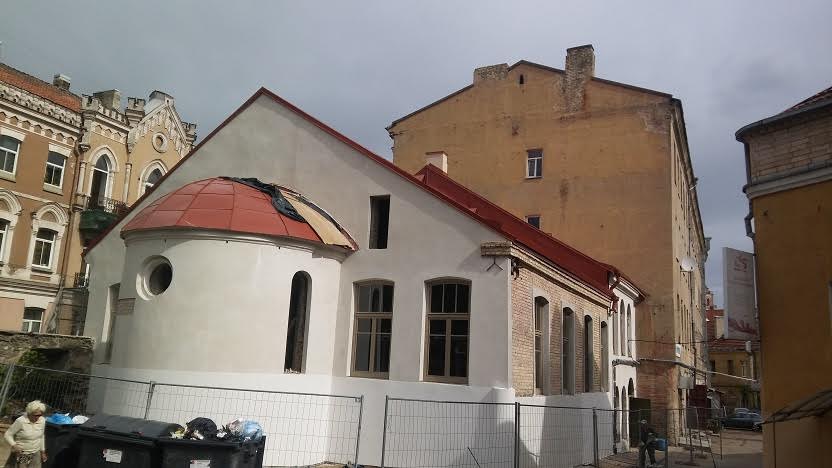
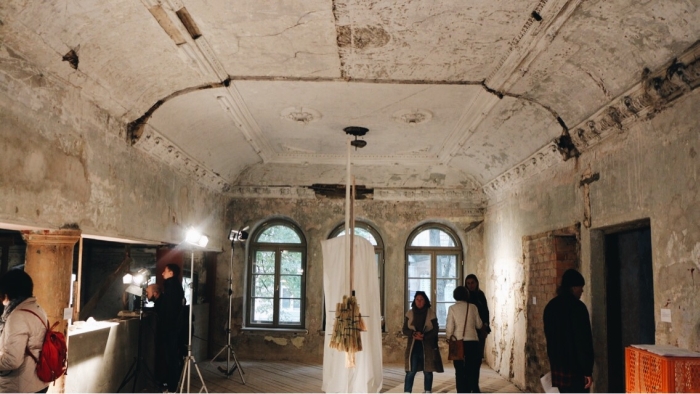
The historic Zavl synagogue near the Vilnius train station opened its doors to visitors briefly Sunday, October 1.

The building has been undergoing extensive repairs and a full restoration over the last several years after it was returned to the Lithuanian Jewish Community. Initially the LJC undertood emergency measures to fix the roof after a wind storm displaced shingles and a gaping hole appeared. Several years on now the entire external façade including walls, windows, cupola and roof have been restored to something approximating its authentic appearance before the Holocaust.

The public event featured a series of humble and eclectic art installations by a group of designers located in the women’s gallery and on the main floor.

Descendants of Victims and Perpetrators Tell the Same Story


Reglindis Rauca accidentally learned the true story of her grandfather and it changed her writing and her relationship with her family. Photo: Romas Jurgaitis/Lietuvos žinios

by Gintarė Čiuladaitė
© 2017 Lietuvos žinios

Reglindis Rauca, writer, actress and granddaughter of Helmut Rauca, the butcher of the Kaunas ghetto, is visiting Lithuania. She learned of her grandfather’s war crimes by accident in 2003 when she was searching the internet for information about her maiden name.

“It was completely accidental that I learned the true story about my grandfather Helmut Rauca. The discovery of these horrific crimes and their significance caused great shock and became an important theme in my life and work,” Reglindis Rauca said.

She met Vilna Gaon State Jewish Museum director Markas Zingeris in Vilnius. The latter also wrote about Helmut Rauca in his novel “Grojimas dviese” [Performing as a Duet] published in 2002, describing him as a fanatic servant of the Third Reich and the perpetrator of fantastic crimes.

“Reglindis Rauca is a brave woman who has considered these heavy issues and was driven by them to travel to Lithuania. She visited the Ninth Fort in Kaunas and other World War II and Holocaust memorial sites. I realized both us were painfully affected by him, just in different ways,” Zingeris said.

Frau Finkelstein

Hello, Frau Finkelstein. You’ll forgive me if I continue to call you that, the way it’s written here, Frau Finkelstein? Thank you.

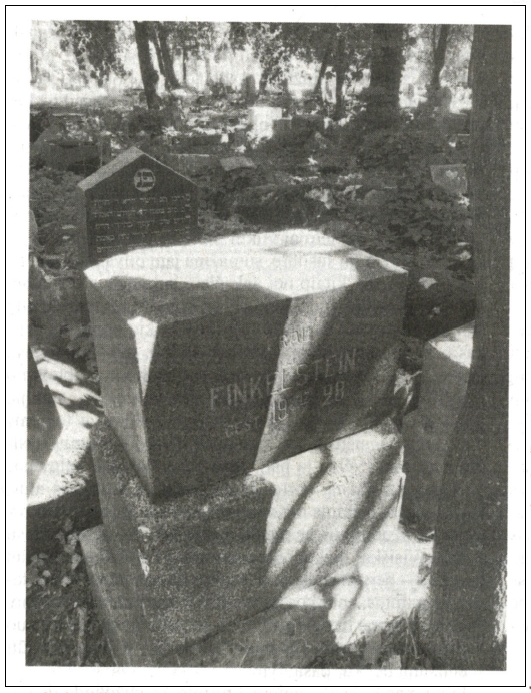
Don’t be angry, Frau Finkelstein, that it’s happening like this. It just turned out that way. By the way, why did they record you this way here, in the Jewish cemetery in Kaunas, not in Hebrew but in Roman characters, and as if that weren’t enough, why did they add “frau?” Was your husband German, Frau Finkelstein? Well, OK, fine, I know it’s none of my business. It’s just interesting, you know–you don’t even meet such a frau in the Jewish cemeteries in Lithuania. It’s too bad there’s no photograph of you. I guess there probably used to be. All that remains of you, Frau Finkelstein, is part of a headstone, the top portion of which is probably now part of some stairway or maybe a card table–black marble, candle flame, a glass of red wine, a deck of cards and the queen of spades, instead of your photograph, and they are playing poker there, which is at least an intellectual game, not some kind of “go fish.” … What? You say that’s cynical? Do you really believe so, Frau Finkelstein? God protect us, this is no cynicism, Frau Finkelstein. What does it say here on your remains–October 17, 1928. Hold on for a second, Frau Finkelstein, I want to check my mobile to see which day of the week that was.

New LJC Calendar for 5778 Features Lithuanian Synagogues

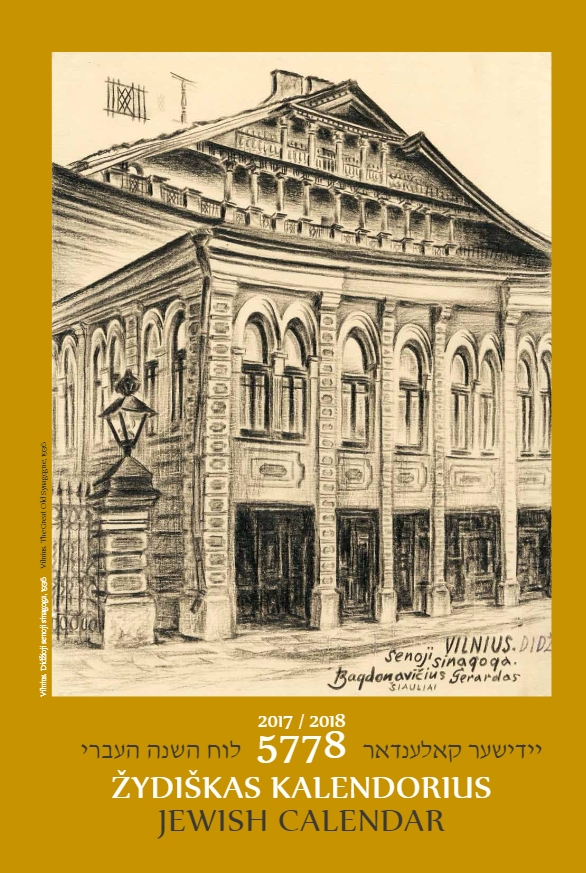
The new calendar for the Jewish year 5778 published by the Lithuanian Jewish Community features graphic representations of the synagogues of Lithuania in the drawings by Gerardas Bagdonavičius.

Bagdonavičius (1901-1986) was an artist working in drawing and painting, an illustrator, a theater designer and teacher. His legacy, a corpus of more than 4,000 works, is preserved at 11 Lithuanian museums, with the majority at the Aušra Museum in Šiauliai, the collection to which the illustrations in the new calendar belong.

Of the hundreds of synagogues once gracing the Lithuanian landscape, only several dozen remain. There were more than one hundred synagogues in Vilnius alone before the Holocaust. Currently 44 synagogues and synagogue complexes are listed on the registry of Lithuanian cultural treasures. The majority have disappeared forever, in many cases leaving us no picture of how they looked. The Bagdonavičius drawings of synagogues featured in the calendar are a rich source of information, drawings he made during different ethnographic expeditions in the period between the two world wars.

Only two of the synagogues portrayed in the calendar are still standing: the synagogue of the Chaim Frankl leather factory in Šiauliai and the synagogue in Pakruojis. The latter belongs to the LJC with whom the Pakruojis regional administration has a use agreement. It was only reopened to the public in the spring of 2017 after extensive renovation over several years. It is the first wooden synagogue restored after the Holocaust in Lithuania.

Renovation work is being performed on three more synagogues which belong to the LJC: the Choral Synagogue in Vilnius, the Zavl kloyz on Gėlių street in Vilnius and the wooden synagogue in Žiežmariai.

LJC Chairwoman Faina Kukliansky’s Speech at Presidential Ceremony to Honor Rescuers

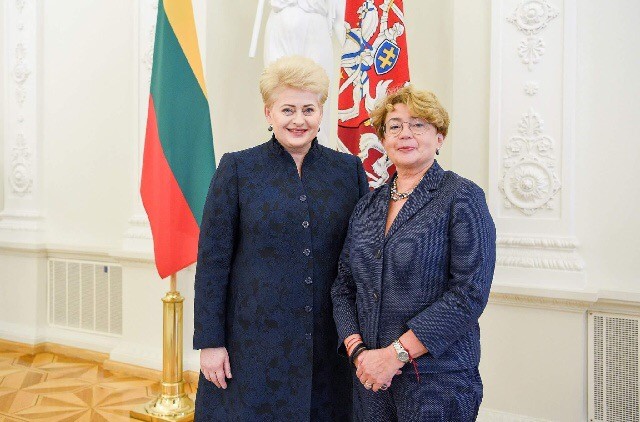
As Lithuanian marked the 76th anniversary of beginning of the Holocaust, president Dalia Grybauskaitė September 27 bestowed awards on 43 Lithuanians who rescued Jews during World War II. Lithuanian Jewish Community chairwoman Faina Kukliansky spoke at the ceremony.

Faina Kukliansky:

It is a great honor for me to be here and to honor the true heroes of Lithuania together. They provided the haven of goodness, they lit the hope of life in the darkness of the dogma of hate, they provided reason in the irrationality of brutality, they became guardians of life and the teachers of humanity.

“They said it’s like this: if I cut my finger, it won’t be painful for him,” this is the insight of a person who lived near the Treblinka death camp. Assuming the role of perpetrator or passive observer seemed to many to be the natural choice. Because of this choice, or more precisely, this moral surrender, Lithuania lost entire shtetls or towns with all of their intellectual potential, the cultural and economic nucleus of Lithuania was destroyed, the destinies of whole families were cut short and the agony of the Holocaust and culpability in the mass murder of Jews became our inheritance, our legacy for centuries.

Unlike others, those who rescued Jews didn’t see the situation at that time as hopeless and without solution. Even as they suffered the worst conditions, they never thought of compromise or collaboration, but instead performed the sacred mission fate entrusted to them, the saving of lives. Without weapons these people fought for humanity without thought of risk, without succumbing to fear, without becoming hostage to the decision to shed blood.

The names of the rescuers must be known and spoken, and their memory celebrated. Our heroes have done their work, and now it is time for Lithuania to do hers. I hope that fourteen years now after the late Icchokas Meras appealed to Lithuania leaders, a monument will grace the capital, before which children will say the names of the rescuers, before which those who were rescued and their descendants may pray. A monument which will be only a small symbol of our eternal gratitude. The gratitude of the Jewish people for the life given them, and the gratitude of the Lithuanian people for their rescued honor.

Lithuanian Prime Minister Commemorates Holocaust Victims in Ponar

From the web page of the Government of Lithuania

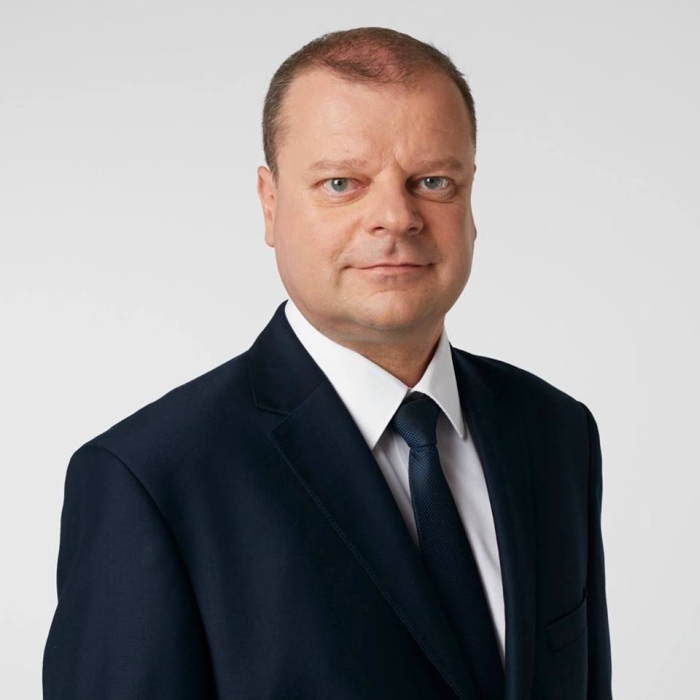
Prime Minister Saulius Skvernelis commemorated Jewish victims of genocide and placed a wreath at the Ponar memorial [September 25, 2017]. Members of the Lithuanian Jewish Community, the ambassadors of Israel and other countries, representatives from the Vilnius municipality and members of parliament participated in the solemn ceremony to honor Jewish victims of genocide.

“All of us together are witnesses to the tragedy of the Jewish people, which is the tragedy of our entire Nation. This is the blackest page in our history. We must speak openly and bravely about the fact that together with the Nazis our local murderers participated in this blood-curdling crime. We lost part of our history, part of the identity of Lithuania. This is an historical lesson to u sall. So we must do everything in our power that it never happens again,” the prime minister said at the memorial in Ponar.

Lithuanian Jewish victims of genocide are commemorated on the date when the Vilnius ghetto was liquidated, September 23, 1943. Tens of thousands of Jews in the ghetto were murdered in Ponar and sent to Nazi concentration camps. During World War II 90 percent of the Jews of Lithuania were murdered, approximately 200,000 people.

Full statement in Lithuanian here.

Zavl Shul Design Concepts

You’re invited to a sneak-peak of the newly renovated Zavl synagogue located at Gėlių street no. 6, Vilnius. at 4:00 P.M. on Sunday, October 1, 2017.

The synagogue on Gėlių street is one of only eight such buildings which survive in Vilnius. It is currently undergoing extensive restoration work.

We have brought together a team of young designers to address some important issues concerning the re-emergence of the building into the life of 21st-century Vilnius. It likely will play a role in the continuity of Jewish life in the city, but so far its future function hasn’t been determined.
The designers come from different backgrounds and have different ideas about “what design can do.” Most are alumni from the Vilnius Academy of Arts and six studied at the Design Academy in Eindhoven, the Netherlands, one of the world’s leading institutions for critically examining the role of design in society. Two Eindhoven graduates previously studied in Israel.

The presentation on Sunday will consist of ideas, associations and suggestions, not definite projects. They are all connected to the long history of the building and the Jewish presence in Lithuania but they are not intended as memorials. Instead, the presentations are intended to serve as a jumping-off point for future projects dealing with issues facing many communities in a globalized world: how to weave strands of culture, tradition, heritage, religion, identity and history into the fabric of contemporary life.

The presentation starts at 4:00 P.M. at Gėlių street no. 6, Vilnius.

We would very much appreciate your presence.

Koen Kleijn, Design Academy Eindhoven
Vytautas Gečas, Performance Design Association, Vilnius
Martynas Užpelkis, Lithuanian Jewish Community

Screening of Molėtai Film at LJC

There will be a free public screening of a film about the march in Molėtai at 5:00 P.M. at the Lithuanian Jewish Community in Vilnius.

The documentary film “Paskutinis rugpjūčio sekmadienis” [Last Sunday in August] has received much praise following its premiere August 29, the date the Jewish population was murdered in Molėtai during World War II. The audience for the first screening included the Lithuanian ambassador to Israel and the Israeli ambassador to Lithuania.

Inter-Institutional Cooperation for the Preservation of Lithuanian Jewish Heritage

A paper delivered by Lithuanian Jewish Community chairwoman Faina Kukliansky at the conference “Diaspora and Heritage: The Shtetl” held to mark the European Day of Jewish Culture and the Lithuanian Day of Remembrance of Jewish Victims of Genocide at the Lithuanian parliament on September 25, 2017.

The Lithuanian Jewish Community and the Jewish Heritage Today

According to the census of 2011, there are 3,050 Jews living in Lithuania. Other sources say the number is up to 5,000 Jews, of whom 2,000 live in the city of Vilnius. For comparison, in the mid-19th century there were 250,000 Jews living in what is now the territory of Lithuania. Lithuania lost more than 90% of her Jewish community in the Holocaust.

Today Lithuanian Jews are united in 28 non-governmental organizations which are in turn united in the association the Lithuanian Jewish Community. Heritage, although it is very important, is only one of the Lithuanian Jewish Community’s areas of endeavor. The Lithuanian Jewish Community is actively working in providing constant social support to Community members in seven regions of Lithuania, organizes educational programs, keeps alive the memory of Holocaust victims, is carrying out various project activities and is engaged in human rights advocacy.

Returning to the topic of heritage, Litvak heritage means relics of the cultural landscape created over more than 600 years by the community which once reached a quarter million people, spread throughout almost all the cities and towns in Lithuania today. This includes almost 200 cemeteries, more than 200 mass murder/mass grave sites and more than 40 synagogues which have been declared cultural treasures.

The Need for and Experience in Cooperation

The current, post-Holocaust Lithuanian Jewish Community would never be able to guard and conserve that which has been created over centuries throughout the country without the help of governmental and municipal institutions, NGOs and active citizens.

Commemorating Lithuanian Day of Holocaust Remembrance

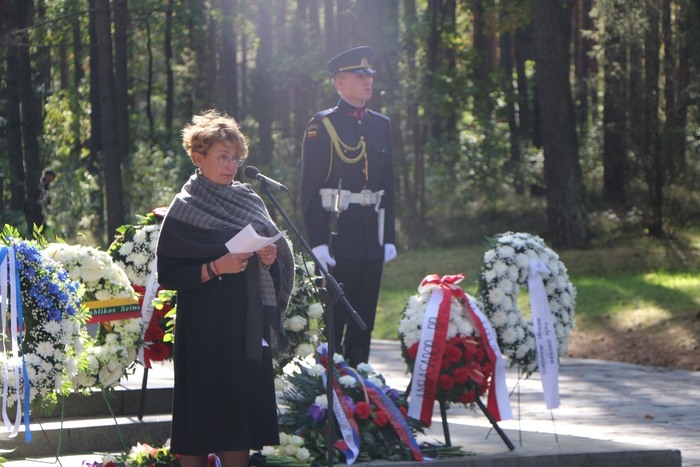
At 1:00 P.M. on September 26 the public gathered at the main monument at the Ponar Memorial Complex to mark the Lithuanian Day of Remembrance of Jewish Victims of Genocide. The day is marked on September 23, the anniversary of the liquidation of the Vilnius ghetto, but the 23rd fell on a Saturday this year.

Boris Traub began the commemoration with a violin solo, followed by several young girls who read heart-wrenching Holocaust poetry in Lithuanian. Next Lithuanian prime minister Saulius Skvernelis spoke, pledging the Lithuanian people would never forget the Holocaust. This was followed by the laying of wreaths, first using an honor guard in the name of Lithuanian president Dalia Grybauskaitė. The Lithuanian Ministry of Culture also laid a wreath, as did Vilnius mayor Remigijus Šimašius and by Ronaldas Račinskas personally, the executive director of the International Commission to Assess the Crimes of the Soviet and Nazi Occupational Regimes in Lithuania. Foreign embassies and the Lithuanian Jewish Community, the Vilna Gaon State Jewish Museum and others also laid wreaths at the base of the monument in Ponar. The medium-sized parking lot at the memorial complex was almost filled with automobiles bearing diplomatic license plates. Some sported national flags, including those of Estonia, the Czech Republic and the Russian Federation.

Israeli ambassador to Lithuania Amir Maimon spoke with a very soft musical accompaniment in the background and reiterated the victims had names, and are not a statistic.

Stella Maris Didn’t Just Rescue Those Lost at Sea: How Father Galdikas Saved Jews

by Romualdas Beniušis
Pajūrio najienos

Stella Maris-Marija. Mary, the star of the sea. That’s what the brothers Galidkas—priest Jurgis (1883–1963) and Lithuanian volunteer soldier Valentinas(1902–1966)—called the wooden chapel they paid for and built in Pašventys village on the banks of the Šventoji River. The Catholics of Šventoji, Būtingė and the surrounding area had no church of their own and they had to go to Palanga, Laukžemė or Darbėnai to attend church.


Galdikas in exile in Germany, ca. 1918

Jurgis Galdikas was born in Lazdininkai village in the Kretinga district in 1883 to the family of an average farmer. He went to school in Lazdininkai and the Darbėnai primary school, then the Palanga pro-gymnasium, and upon graduation chose to enter the priesthood and entered the Kaunas Priests Seminary. He was consecrated as a priest after being graduated in 1907, then continued to study theology in Austria, Belgium and Switzerland. He defended his thesis to become a doctor of philosophy in 1911. After returning to Lithuania he was the vicar in Šiauliai and was then appointed parish priest after the outbreak of World War I. He established and headed a gymnasium there. In 1916 the occupational regime of Kaiser’s Germany deported him with a group of Lithuanian priests to Germany where he spent two years. Returning to Lithuania in 1919, he was appointed director of the Kražiai pro-gymnasium, whose curriculum was based on etiquette, ethics and morality and which became the Žiburys gymnasium in 1924. He was sent to Telšiai in 1927 to become a canon of the capitulum (collegium) in the Telšiai diocese and from 1927 to 1932 he was a teacher and inspector at the Telšiai Seimnary.

Dream about the Vanished Jerusalem

by Grigory Kanovich
translated from Russian by Yisrael Elliot Cohen

It seems that I dreamed about it when I was still in the cradle, long before I first saw it for real. Long before 1945, when it took me into its bleeding embraces that still reeked of the smoldering embers of war. Long before one could see there a burial hillock whose mud besmirched all my joys and forever stained, with a poison-yellow tint, all of my sorrows, because it was there that my mother (may her memory be blessed) found peace or perhaps did not find it.

In the course of my now already hardly short life, I have visited many cities — New York and Paris, London and Geneva, Toronto and Berlin, Turin, Prague and Warsaw. But not one of those majestic, inimitable, attractive cities ever entered my dreams.

I only dreamed about a single city in the whole world.

Week of Names Events to Commemorate Holocaust This Year

In the run-up to the Day of Remembrance of the Lithuanian Jewish Victims of Genocide, organizers of the civic initiative NAMES invite you to remember and honor the victims of the Holocaust. Now for the seventh year, the reading of the names of those murdered will include different groups and occupy an entire week.

The series of events will begin in Merkinė. On September 17 residents will read out loud the names of members of the community murdered more than 70 years ago, commemorating the tragedy which took place in the town.

On September 20 the reading of the names will take place at two locations in Vilnius: outside the former ghetto library (Žemaitijos street no. 4) and at the “memory stone” commemorating Fania and Lazar Lewando, founders and owners of a vegetarian restaurant (Vokiečių street no. 14).

On September 23 the names will be read out in Kaunas.

On September 24 residents of Lithuania are invited to visit Jewish mass murder sites located nearest to them.

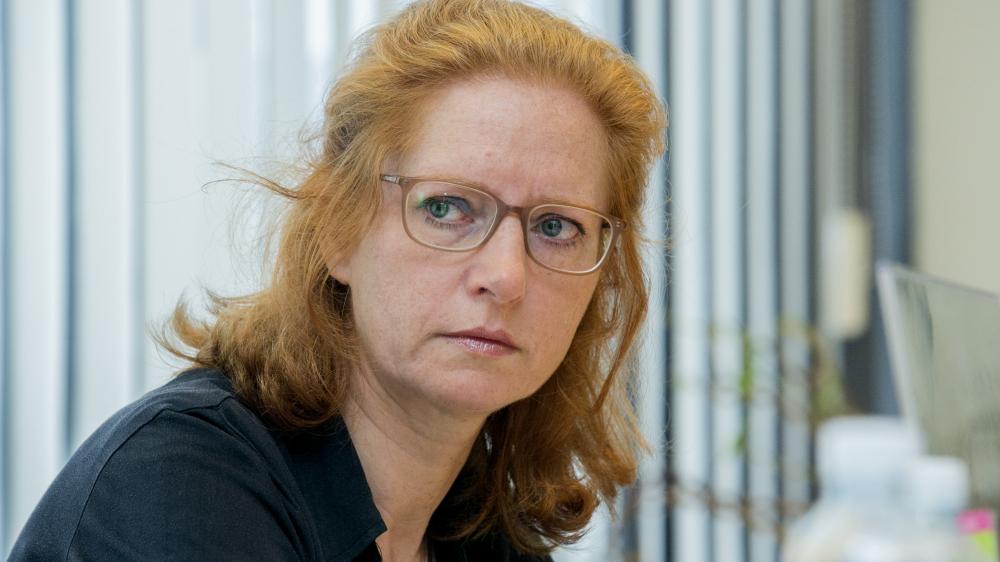
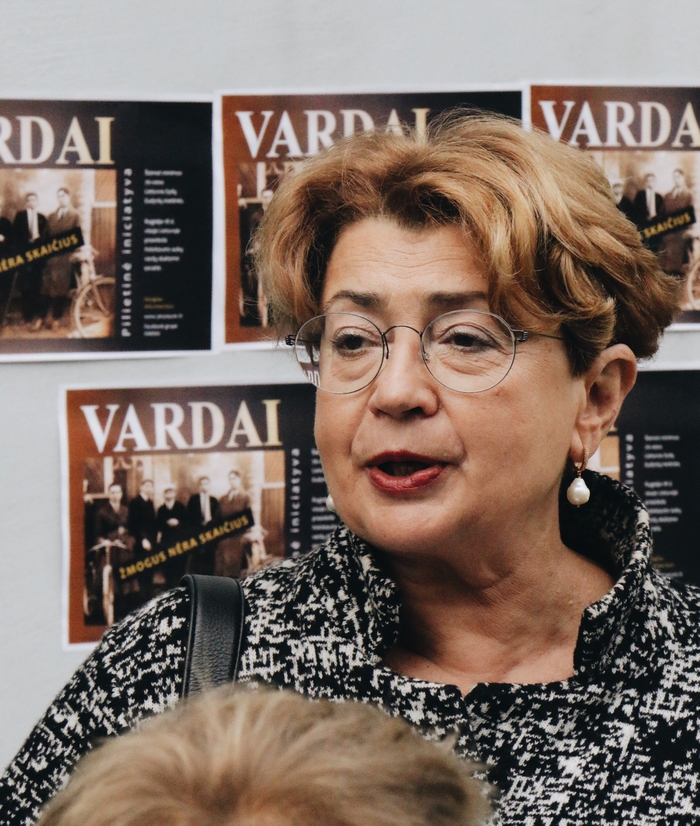
“The Holocaust is one of the most painful topics in the history of Lithuania. Only by remembering and talking about the unpleasant past can we open up to the world. I think these readings are a strong and personal expression of this kind of remembrance and freedom,” NAMES coordinator Milda Jakulytė-Vasil says.

The list of initiatives isn’t final: all who want to may contribute by selecting an important location for Holocaust commemoration. The names and surnames of those murdered can be found in museums, libraries and institutions concerned with the preservation of Jewish heritage. More information about the readings and how to organize them yourself can be found here.

The period of one week isn’t coincidental; over this week several important Jewish religious and cultural holidays take place. Rosh Hashanah takes place on September 21 and 22 this year. This is, the Jewish New Year, a time for reflection. The Lithuanian Day for the Remembrance of Lithuanian Jewish Victims of Genocide falls on the Sabbath this year; according to Jewish custom it is forbidden to visit graves on this day.

Lithuanian Day for the Remembrance of Lithuanian Jewish Victims of Genocide is marked on September 23. This was the day in 1943 when the Vilnius ghetto was liquidated.

NAMES on facebook

Naming the Names


Photos by Dovilė Abromavičiutė

The seventh annual Names event is taking place from September 17 to 24 in cities, towns and rural locations in Lithuania. On Wednesday morning one of several groups in Vilnius met to read out loud the names of Holocaust victims. That group included schoolchildren, members of the media, Israeli ambassador to Lithuania Amir Maimon, Lithuanian Jewish Community chairwoman Faina Kukliansky, LJC executive director Renaldas Vaisbrodas and the organizer of the civic initiative Names Project in Lithuania, Milda Jakulytė-Vasil, among others.

As the schoolchildren began to read from the list, ambassador Maimon addressed them, saying the names might appear strange to them, and that his name, Amir, might as well, but that the people on the list were real people who lived right there in the neighborhood. Chairwoman Kukliansky also tried to bring home to the children that those murdered were real people, including young victims.

All Names events are public and everyone is invited to come and read out the names.

For more information, see:
https://vardu.wordpress.com/d-u-k-f-a-q/
https://www.facebook.com/holokaustoaukuvardai/

Did Abba Kovner Hide His Place of Birth?


The Riddle of History: When and Why Did Abba Kovner Alter His Biography?

by Pinchos Fridberg

This article could (and should) have been published a year ago, in August 2016, if I had treated more seriously the brief article I wrote in Russian about the new edition of the book “Vilnius: In Search of Traces of the Jerusalem of Lithuania.”

All Sources (apart from the New York Times) Say Abba Kovner Was Born in Sevastopol

All sources I’m aware of, with the one exception of the New York Times, state Abba Kovner (Yiddish: קאוונער אַבאַ) was born in Sevastopol [Crimean Peninsula]. Here I will give some examples of the most important publications:

1. A monograph entirely dedicated to Abba Kovner’s life and work.
Porat, Dina. “Fall of a Sparrow. The Life and Times of Abba Kovner” (originally published in Hebrew in 2000). Translated and edited by Elizabeth Yuval. English translation 2010. Stanford University Press.

The first chapter “Childhood in Sevastopol and Youth in Vilna” starts with the statement “Abba Kovner was born in Sevastopol…” (p. 3).

Note: This is not supported by a reference to an archival excerpt from the register of births of Jews born in Sevastopol in 1918.

Rauca’s Granddaughter Meets Survivors in Kaunas


The granddaughter of Helmut Rauca, the notorious war criminal from the Kaunas ghetto who hid in Canada for years before being deported to West Germany to stand trial in 1983, has paid a visit to the Kaunas Jewish Community. Rauca, the top SS official in occupied Kaunas, was personally responsible for selecting those doomed to be murdered at the Ninth Fort on Democrat Square in the Kaunas ghetto on the day over 10,000 Jews were killed, the Grosse Aktion or Great Action. Reglindis Rauca only learned of her grandfather’s crimes against humanity relatively late in life. The shock led her to write a book about it. The author and actress wanted to meet eye-witnesses and Holocaust survivors in Kaunas. Although initially she appeared nervous about the meeting, her warmth, simplicity and sincerity were obvious and overcame any potential barriers to communication and mutual understanding.

You can find out more about Reglindis Rauca and her novels here and here.

More about Helmut Rauca in Canada here.

One Nation, Two Sufferings


by Arkadijus Vinokuras
photo © 2017 Edvard Blaževič
Alfa.lt

Lithuania remembers the victims of the Holocaust on September 23. The beastly crime carried out by the Nazis during World War II was directed namely against one people, the Jews. The goal was obvious: the final destruction of the Jewish people. The extermination was industrialized. We find no analogue in human history to this scale of mass murder as an assembly line, in gas chambers. On the other hand history is full of seemingly good neighbors suddenly becoming murderers of innocent men, women and children.

Lithuania was not able to escape this painful experience. Nor was Lithuania able to avoid another tragedy, the Soviet occupation, mass murders and deportations of Lithuanian citizens to the gulags. Judging from the fact flags hung on every building feature a black ribbon in memory of the deportees but that these flags are not flown to honor the victims of the Holocaust (although by law they should be), it’s clear something very bad lurks in the Lithuanian mind regarding these historical tragedies.

Put another way, the ethnic Lithuania is afflicted by the story of two sufferings, in which one, the Holocaust, is still alien, still someone else’s suffering. No place is left for sympathy for the other’s agony and it is still having a difficult time making inroads in the psyche of fellow Lithuanian citizens.

How could this have happened? How could the political, spiritual and commercial elite of the Lithuanian state restored in 1918 manage to foster such hatred by Lithuanians for their fellow Jewish citizens that a decorated Lithuanian soldier, farmer or attorney would volunteer to take part in the mass murder and looting of 1941-1944? Even the priest consecrated the weapon used for the mass murder of innocent people, never mind the illiterate class or bandits who took part in the Bacchanalia of the mass murder of innocent people. In which people got drunk not on wine, but from the orgy of blood.