The city council of West Hollywood has passed unanimously a resolution condemning Lithuania for minimizing and denying Lithuanian participation in the Holocaust.

Sholem Aleichem Gymnasium Principal Ruth Reches Greets Teachers, Students and Parents for New School Year
This school year is a challenge for all of us. I have been asking myself why I as the new principal am always facing unexpected obstacles which have to be overcome. But this is more of a rhetorical question, because I feel new challenges are interesting. They aren’t frightening because I see I have not been left on my own to overcome them. ALL school staff are working to insure the school year begins smoothly.
The members of our collective stay at school into the late evening, come to work on Saturday and solve work questions by telephone and on vacation, and late into the night without being asked. Just because they care. I feel very strong support with this team in place and I know we will all lead the school forward together no matter how the situation changes.
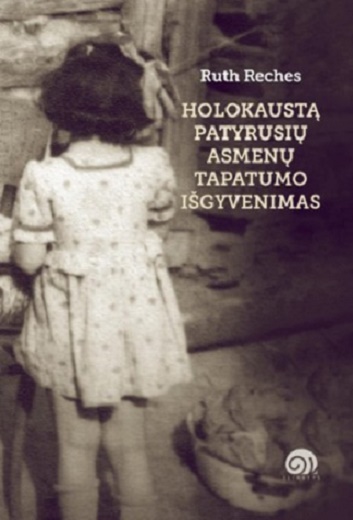
Thinking about the public tension the corona virus has caused, the lack of clarity on how the education process will take place if there is a second wave of the virus which might cost lives, I remember the book by the renowned thinker, humanitarian and psychotherapist Viktor Frankl describing his experiences during the Holocaust. Frankl was a professor of neurology and psychiatry at the University of Vienna in Austria as well as a practitioner and world-class thinker. In describing his experiences, he also pointed to significant things which helped him survive.

AJC Tells Lithuanian Government: This Hypocrisy Must End
by Vytautas Bruveris
Back to the drawing board: Lithuania again has become the target of a wave of international criticism because of the country’s relationship with the Holocaust. This time, because of the appointment of publicist and public activist Vidmantas Valiušaitis to the leadership of the Center for the Study of the Genocide and Resistance of Residents of Lithuania [Genocide Center].
The country’s Jewish community as well as an influential international organization, the American Jewish Committee (AJC), reacted sharply to this announcement. Leaders at the AJC even called the Lithuanian Government’s actions in the area of Litvak history and Holocaust commemoration hypocritical.
At the same time the Genocide Center is getting an ever darker reputation in the international area, that of an ideological right-wing nationalist bunker rather than an authoritative and academically objective institution.

The Metamorphoses of Adas Jakubauskas
by professor Pinchos Fridberg, Vilnius
Is ethnicity important in Lithuania today? Here’s why I ask.

In Place of a Foreword
I follow almost all material in the Lithuanian media on the topic of the Holocaust in Lithuania. I make copies of the most interesting, and to avoid misquotes I save it. I have over ten thousand such items saved.
Below I present some “unique” screen captures which would have remained in my archive alone if the Lithuanian Jewish Community hadn’t published the following article:

Valiušaitis’s Appointment Worries Historians and Jewish Community

Photo: honoring victims of Soviet-era occupation, genocide and repression. Photo courtesy J. Stacevičius/LRT.
by Modesta Gaučaitė, LRT.lt
The Lithuanian Jewish Community and historians are raising questions about Vidmantas Valiušaitis’s new appointment as an advisor at the Center for the Study of the Resistance and Genocide of Residents of Lithuania [Genocide Center]. Valiušaitis says he won’t try to vindicate himself because he says his work speaks for itself.
New Genocide Center director Adas Jakubauskas took over two months ago and began assembling his team. Besides a deputy director, Jakubauskas also appointed two advisors, one them being Vidmantas Valiušaitis, a long-time journalist, publicist, author of books, for several years the director of the Laisvoji Banga radio station and who in 2017 began working as a methodologist and researcher at the Documentary Heritage Research Department of the Lithuanian National Martynas Mažvydas Library.
His new appointment has caused dissatisfaction on the part of the Lithuanian Jewish Community and has raised questions for historians.

Simnas Celebrates Title of Tiny Capital of Lithuanian Culture for 2020
On August 23 the largest event so far this year took place in Simnas, Lithuania: the Simnas church celebrated its 500th anniversary and the town of Simnas celebrated its recognition as the Tiny Capital of Lithuanian Culture for 2020.
Lithuanian Jewish Community chairwoman Faina Kukliansky and Catholic cardinal Sigitas Tamkevičiusattended events there, which included a book launch, consecration of a new cross at the church, Catholic Mass, a performance by opera singer Rasa Juzukonytė and a performance by the Lithuanian Ground Forces orchestra. A procession left the church for the town square where the formal opening ceremony of the event took place only then. There followed vocal and instrumental concerts and a fair featuring religious items, folk art and crafts.
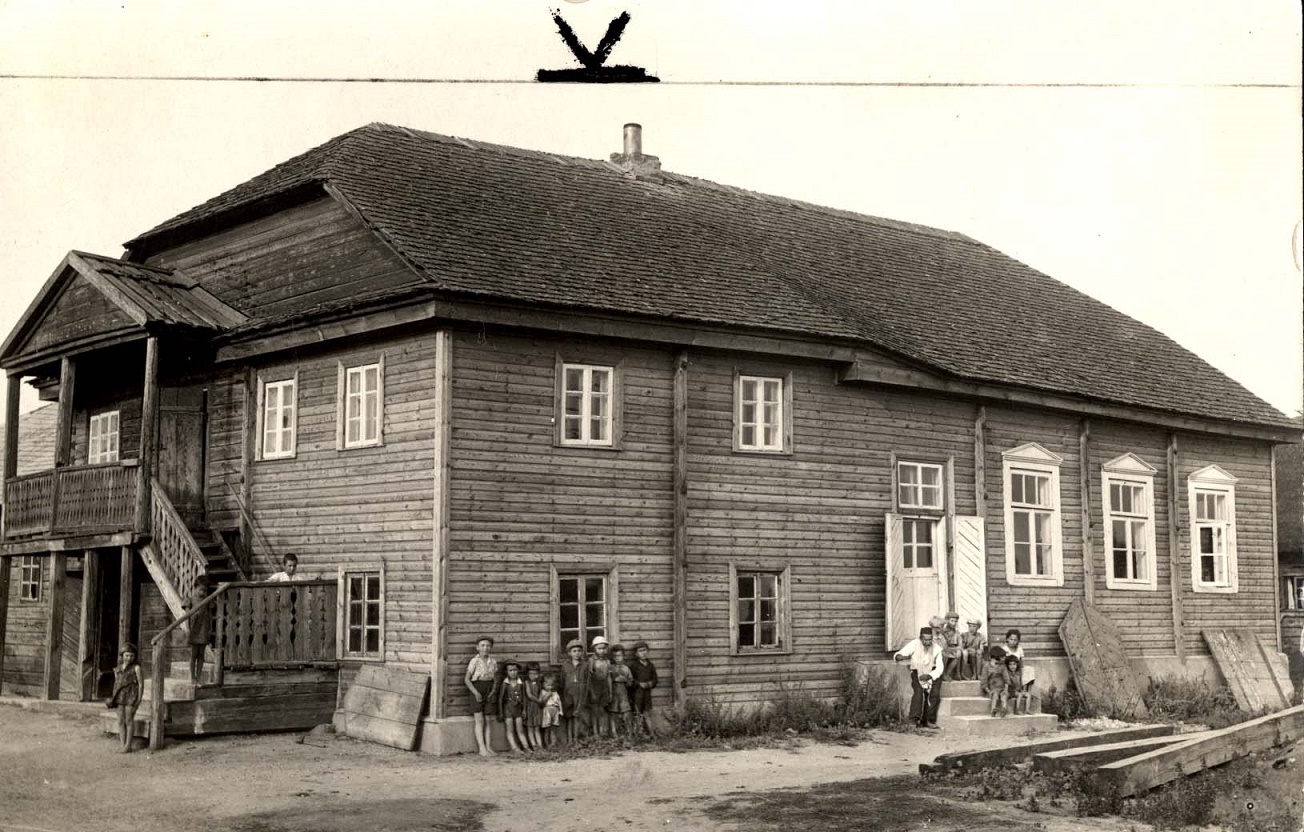
A synagogue in Simnas has been restored and renovated. It was built in 1905. There was a school on the second floor and the prayer hall was arranged so worshipers prayed facing in the direction of Jerusalem. A Soviet palace of culture operated there after World War II, followed by an athletics hall. Consideration is on-going on how to utilize the synagogue space.

Field Trip to Alytus and Merkinė
Over a weekend in mid-August the Kaunas Jewish Community sponsored a field trip for its members to the town of Merkinė and the city of Alytus, the capital of the Lithuanian ethnographic region of Dzūkija in the southeast quarter of Lithuania.
Teacher and friend of the Community Meilė Platūkienė provided the travellers a tour of Alytus, including sites witnessing to the once-large Jewish community there. They took in the balconies of the former Singer family home there, entrance lions there, former movie theaters in the city and on Beiralas hill the restored synagogue and cemetery (the headstones have long since disappeared and the cemetery plot is only marked with an information stand). The tour also visited what is, sadly, a feature of every Lithuanian city, town and village: a Jewish mass murder site in the surrounding forest.
Travelling on to Merkinė, Merkinė Regional History Museum director Mindaugas Černiauskas provided a guided tour of the small but interesting museum collection and the history of the town, which included members of royal families and the once-large Jewish community there. A visit to the local manor estate featured a meeting with celebrity chef Vytaras Radzevičius who operates an eatery there and who entertained the travellers with his cooking, wit and energy.

Lithuanian Jewish Community Concerned by Vidmantas Valiušaitis’s Appointment as Senior Advisor of Genocide Center
According to the official website of the Center for the Study of the Genocide and Resistance of Residents of Lithuanian (Genocide Center), the person occupying the post of senior advisor to the general director of the Genocide Center performs the following functions:
“…provides consultation on the physical and spiritual genocide of residents of Lithuania carried out by the occupational regimes between 1939 and 1990 as well as resistance to these regimes, and issues surrounding the processes of resistance to and the policies carried out by the occupational regime in the Vilnius district between 1920 and 1938, and consults on issues involving the direction of the Genocide Center’s research and programs regarding the genocide of residents of Lithuania and their resistance to the occupational regimes from 1939 to 1990” (source: http://genocid.lt/UserFiles/File/Pareiginiai/Direkcija/Vidmantas_Valiusaitis.pdf).
We would like to point out that in several recent publications Vidmantas Valiušaitis intentionally distorted the facts and publicized these falsehoods concerning the anti-Semitic activities of the Lithuanian Activist Front and the Lithuanian Provisional Government of 1941. Moreover, Vidmantas Valiušaitis basically denied the conclusions arrived at by the International Commission for Assessing the Crimes of the Nazi and Soviet Regimes in Lithuania regarding the clearly anti-Semitic views and actions of these organizations and their leadership directed against the Jews of Lithuania.

Kaunas Jewish Community Holds Training for Home-Care Workers
Elderly Kaunas Jewish Community members and their children always welcome the help provide by home-care workers.
Staff at the Social Programs Department of the Lithuanian Jewish Community coordinate this activity for every regional community, who face new challenges because of the virus.
LJC Social Commission member and epidemiologist Dr. Ela Gurina and Social Programs Department coordinator Snieguolė Zalepūgienė held special training classes for home-care providers in Kaunas, focusing on the corona virus, the correct use of personal protection and how to work under these extreme conditions.
Amehaye 2020
The Amehaye summer camp has been holding camps for children for two weeks in the summer for several years now. The program was just as rich and interesting this year and the children failed to grow bored over two weeks of learning and friendship. Special attention is giver to Jewish traditions at the camp. In summer the main and most fun events take place in nature and everyone seemed to enjoy the games and sports. Educational discussions were also held in nature.
The program included a lesson on Israel and how to make humus. Some of the boys celebrated their mar mitzvahs at camp. The young campers also learned how to prepare other Jewish dishes from matzoh and how to make challa for Sabbath. They also celebrated Sabbath with the traditional rituals, prayer and lighting of candles.
A children’s psychologist visited the camp and delivered an interesting lesson. Campers also entered the chemistry laboratory and took part in incredible experiments. Two excursions also took place: one to the Safari Park in Anykščiai, Lithuania, and the other to Druskininkai, Lithuania, where the young people learned to make the Lithuanian pastry šakotis.
A bubble party was held the last day of camp and the official closing ceremony included releasing balloons into the sky after making a wish, followed by the Sabbath celebration.

Tomas Venclova: Conscience is Greater Than Independence
by Gabija Strumylaitė, 15min.lt
After spending forty years in exile, the professor returned to Vilnius in 2018; here he actively participates in Lithuanian cultural life and courageously expresses his opinion on topics important to the country and the world. The website 15min.lt spoke with Tomas Venclova about the meaning of independence, principles of liberalism, historical memory, ethnic minorities and other issues.
This year has also been named the Year of the Vilna Gaon and of Litvak History. What do you think, do Lithuanians understand and appreciate sufficiently the Jewish legacy? What should we be doing to honor these people? Do we need, for example, to rebuild the Great Synagogue, or establish a modern museum of Jewish history?
In this regard I think we are doing better compared to the situation over ten years ago, never mind earlier periods. I’m not just thinking about Jewish affairs, but those of other ethnic minorities as well: Poles, Russians, Belarussians, Karaïtes, Tartars.
There is a large amount of latent distrust of minorities in Lithuania overall. I will mention another minority about which there has been a lot of concern lately: the Roma. The great majority of the Lithuanian public are prejudiced against them, and this is senseless and unnecessary, and needs to be corrected.

Lauder on Leadership: You Have to Stand Up and Fight Every Single Day
If ever there were a Jewish leader who puts his money where his mouth is, it is Ronald Lauder, president of the World Jewish Congress and arguably the de facto leader of the Jewish world.
Thanks to him, thousands upon thousands of Jewish children in central and eastern Europe have received an education; the fight against continued and renewed antisemitism remains front and centre of the Jewish world’s priorities; enormous amounts of art, once looted by the Nazis, have been returned to many heirs of Jewish victims of the Holocaust; and funding has been put in place for both maintenance of the Auschwitz-Birkenau Memorial, and the proposed memorial to the dead at Babi Yar, the site of the notorious 1941 massacre of almost 34,000 Jews in Ukraine.
And yet, as Lauder, in his trademark New York growl, tells it, it could all have been so different. “What would have happened to me,” he wonders, “if I had not gone to Vienna?”
Full interview here.

WJC Applauds Facebook Banning M’Bala for Anti-Semitism
NEW YORK–The World Jewish Congress (WJC) welcomes Facebook’s decision to ban Dieudonné M’Bala M’Bala, a French extreme political activist notorious for spreading anti-Semitic hate speech, Holocaust denial and violent ideology. Facebook informed the WJC of its decision to ban Dieudonné from Facebook and Instagram. Dieudonné has been condemned by French courts on several occasions and again recently for negationist and ant-Semitic statements. Previously YouTube removed a channel linked to Dieudonné.
WJC president Ronald S. Lauder said, “The World Jewish Congress has been on the forefront of urging social media platforms to exercise their authority to block those who disseminate anti-Semitic hate, including Dieudonné. Dieudonné has been using social media to do harm for far too long. Freedom of expression by no means gives anyone the right to incite hatred and anti-Semitism, online or anywhere else.
“While we welcome Facebook’s actions, Dieudonné is just one notorious case among many others. Countless others continue to spread hate and antisemitism on social media platforms. The World Jewish Congress urges Facebook and other platforms to prioritize banning those who spew dangerous anti-Semitic rhetoric. Our safety and future is dependent upon social media companies taking this hate seriously.”
###
About the World Jewish Congress
The World Jewish Congress (WJC) is the international organization representing Jewish communities in 100 countries to governments, parliaments and international organizations.

Evening of Poetry and Music with Sergei Kanovich and Boris Kizner
The Lithuanian Jewish Community invite you to a attend an evening of poetry and music with writer Sergei Kanovich and violinist Boris Kizner at the Choral Synagogue in Vilnius. Sergei Kanovich will read passages from his poems and prose and Boris Kizner will perform works from his repertoire on violin. It begins at 6:00 P.M. on Tuesday, August 11, at the Choral Synagogue located at Pylimo street no. 39 in Vilnius. Entry is free to the public and no RSVP is required. Visitors will be required to wear face masks and the event will be filmed.

LJC Member Leonidas Melnikas Interviewed
The Catholic newspaper and website Bernardinai has published an interview with long-time Lithuanian Jewish Community member and pinaist professor Leonidas Melnikas as part of a series of articles and interview about ethnic minorities in Lithuania partially financed by Lithuania’s Department of Ethnic Minorities.
“In childhood when we used to visit homes as guests and we didn’t find a piano in a home, that was strange to me, how people could live without a musical instrument. In general at the time the profession of musician was highly esteemed, and musicians were a bit freer than people in other professions. If you’re playing Bach, Mozart and Beethoven all the time, no one can complain about your politics, only about your music.
“From the very first grade I attended the Mikalojus Konstantinas Čiurlionis School of Art in Vilnius. It was my parents’ joy I did music, and their encouragement helped me overcome the initial barriers, but later some inertia came up, it came up in the 8th grade which was competitive, and they had to chose who stayed and who would pursue something else. I stayed. There weren’t many people in my class, we graduated, it seems, eleven of us, so the relationship between student and teacher was very familiar and friendly, there was a lot of attention. We studied a somewhat different curriculum than they did at other schools, we studied musical things from the first grade and they kept increasing, and in the 10th grade we completed general education disciplines–chemistry, physics, mathematics–and in the 11th grade we only had social and humanitarian topics left, and music of course.”
Full story in Lithuanian here.

Indian-Lithuanian Friendship Celebrated in Rusnė
An awards ceremony to present the award “For Contributions to Friendship between India and Lithuania” was held in Rusnė, Lithuania, recently. The recipient this year was Vytautas Toleikis who researched and published the story of the friendship between the father of modern India Mohandas Gandhi and Rusnė-resident Litvak Hermann Kallenbach.
Gandhi and Kallenbach’s friendship was commemorated in a sculpture by the late Romas Kvintas which was placed on the bank of the Atmata River in Rusnė in 2015. The Lithuanian embassy to India contributed to erecting the statue.
On July 25 Toleikis was presented a miniature of this statue at the awards ceremony attended by Lithuanian Jewish Community chairwoman Faina Kukliansky, Indian ambassador Tsewang Namgyal, Israeli ambassador Yossi Levy, US ambassador Robert Gilchrist, German ambassador Matthias P. Sonn, Lithuanian ambassador to India Julius Pranevičius, Indian honorary consul Rajinder Chaudhary, Šilutė regional mayor Vytautas Laurinaitis and Rusnė alderwoman Dalia Drobnienė. Chairwoman Kukliansky congratulated Toleikis on winning the award.

Members of Panevėžys Union of the Blind and Visually Impaired Interested in Jewish History
The Panevėžys Jewish Community continues its educational outreach efforts despite difficult times. This time an elderly group from the Union of the Blind and Visually Impaired visited the Panevėžys Jewish Community. They have been following the weekly installments in the newspaper Panevėžio balsas dedicated to Jewish life, and requested a face-to-face meeting to learn firsthand about Jewish history before the Holocaust. In late July Panevėžys Jewish Community chairman Gennady Kofman spoke to them about the prewar history, but also what happened during the war and after. The guests said they realized the idea of Jews as money-lenders was a stereotype and that many important and famous Jews had lived in Panevėžys. They expressed surprise when they were told about the Joint Distribution Committee. THey also learned of the famous rabbi Josef Kaufman who restored the Ponevezh yeshiva which still operates today in Israel.
The guests asked different questions and heard about Jewish businesspeople, teachers and doctors, including famous Panevėžys doctor Abraham Mer and others. Plans were made for a next meeting, and guests and hosts exchanged gifts. The guests left entries in the guest book.

Šolom, Akmenė! Project a Big Success
Four-and-a-half-days and the results was, according to the local Akmenė newspaper Vienybė, “a great success.”
Participants and guests from Šiauliai and Vilnius said the same thing about the “Šolom, Akmenė” activities and events last week. There was the same positive reaction towards the Friday evening conference dedicated the remembering the shtetl, lessons on Sabbath traditions with treats and the concert.
There was a creative workshop for youth held before, with visiting and cleaning-up Jewish cemeteries in Vegeriai, Klykoliai, Viekšniai and Tryškiai, in a grand plan to digitize the grave epitaphs there.

Vilna Gaon Statue Vandalized Again
For the second time in two months, the stone statue commemorating the Vilna Gaon located at what is thought to have been his residence in Vilnius was vandalized by application of an unknown liquid.
Police reported they received a report of the newest act of vandalism at 5:20 P.M. local time on Sunday. Vilnius district police department representative Julija Samorokovskaja told Baltic News Service a tourist guide reported an unknown liquid, possibly some acid, had been poured over the monument.
“A report was received that sometime during a two-day time period acid possibly had been poured on the Vilna Gaon statue. A tourist guide made the report,” she said. She also said an criminal investigation had been launched for incitement to hatred, and that the physical damage done would be calculated more accurately later.

Lithuanian Governments Sells Great Synagogue Ruins to Goodwill Foundation

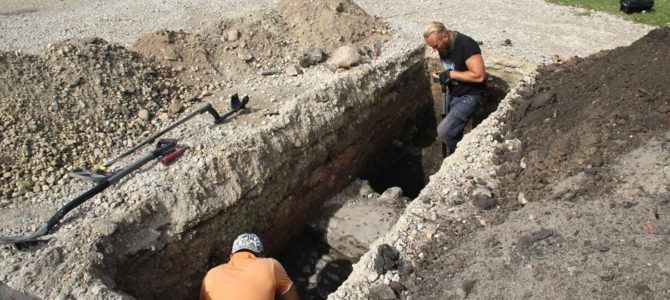
The Lithuanian Government has sold the remains of the Great Synagogue of Vilnius to the Goodwill Foundation which administers compensation from the Lithuanian state for Jewish property seized in the Holocaust.
Lithuanian culture minister Dr. Mindaugas Kvietkauskas reported the remains of the building were sold to the Goodwill Foundation by reducing compensation paid to that organization by 1,244 euros. “These are the ruins, the foundation, uncovered during archaeological digs. The buildings were damaged during World War II and razed during the Soviet era,” Kvietkauskas said. The minister reported the Goodwill Foundation requested the sale indicating the ruins would be used to commemorate the former Great Synagogue, “to fulfill Jewish cultural and religious goals.” In 2017 the ruins were listed on the registry of cultural treasures. Annual archaeological digs at the site have uncovered spectacular and unique finds.
Last spring the Government transferred administration of the site to the Cultural Heritage Protection Department.
Archaeological digs have been taking place regularly at the Great Synagogue complex since 2011, with partial financing from the Goodwill Foundation. In July last year two rooms were discovered containing old books, and exploration of the mikvot or ritual baths continued. There has been discussion on how best to commemorate the site for many years. Vilnius mayor Remigijus Šimašius said the former synagogue complex will be commemorated in 2023 when Vilnius marks its 700th birthday. The brick-and-mortar synagogue was built in the 17th century, replacing an earlier wooden one. It has been said the Great Synagogue of Vilnius was the largest and most decorative synagogue in the Polish-Lithuanian Commonwealth.
Full story in Lithuanian here.