

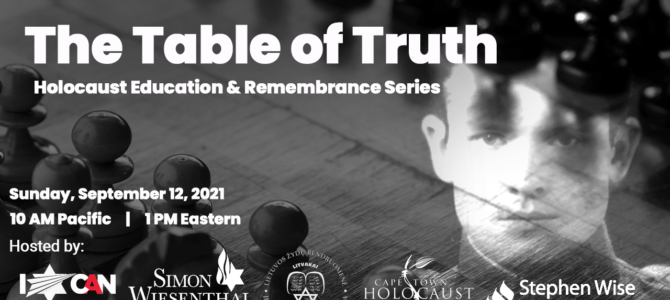
Table of Truth Web Event
About the event
Learn about the extraordinary connection to one chess table with Faina Kukliansky, chairwoman, Lithuanian Jewish Community; Shulamit Rabinovich, San Francisco engineer; Dudu Fisher, Israeli-based world-renowned entertainer; Grant Gochin, South African wealth Manager and Silvia Foti, Chicago journalist.
We will reveal recently discovered facts about the Holocaust in Lithuania, Holocaust denial by the Lithuanian Government, and present new paths to education about the horrors of the past.
The table WILL talk.
We will conclude the program with Dudu Fisher chanting Kaddish.
When: 10:00 A.M. PST, 1:00 P.M. EST, 7:00 P.M. South Africa, 8:00 P.M. Israel, September 12, 2021
Representatives of the Lithuanian Government have also been invited to attend and speak.
For more information and to register, see http://israelusa.org/table-of-truth/

Black Honey: A Film about Abraham Sutzkever
The Vilnius Jewish Public Library will screen the film Black Honey about Vilnius partisan and Yiddish poet Abraham Sutzkever created by his granddaughter and actress Hadas Kalderon of Israel. She will retell stories she heard directly from him and talk about film and filming. The screening is open to the public and will take place at 7:00 P.M. on August 8. The Vilnius Jewish Public Library (not affiliated with the Lithuanian Jewish Community) is located at Gedimino prospect no. 24 in Vilnius with entry through the alley and to the right.
Register by calling (8-5) 219 77 48 or sending an email to info@vilnius-jewish-public-library.com
The film is in English, Hebrew and Yiddish with English subtitles.
Evening of Poetry and Music
The Lithuanian Jewish Community invites you to an evening of poetry and music at the Choral Synagogue in Vilnius at 6:00 P.M. on Tuesday, August 11. Sergejus Kanovičius will read selections of his prose and poetry accompanied by Boris Kirzner on violin.
US Seizes Scrolls, Manuscripts Stolen from Jews during Holocaust
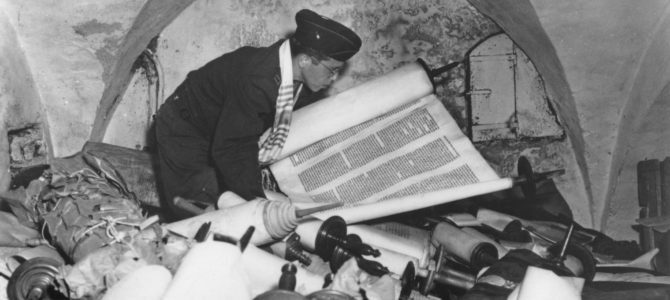
A US Army chaplain examines one of hundreds of Jewish Torah scrolls, stolen from all over Europe by Nazi forces, in Frankfurt, Germany in 1945. Photo: Irving Katz/US Army Signal Corps/FPG/Hulton Archive/Getty Images
Seventeen scrolls, manuscripts, and community records [pinkasim] which were stolen from Jewish communities in Eastern Europe during WWII have been recovered, the Department of Justice announced Thursday.
Why it matters: “The Scrolls and Manuscripts that were illegally confiscated during the Holocaust contain priceless historical information that belongs to the descendants of families that lived and flourished in Jewish communities before the Holocaust,” acting US attorney Jacquelyn Kasulis said in a statement.
• “This Office hopes that today’s seizure will contribute to the restoration of pre-Holocaust history in Eastern Europe.”
The big picture: The documents were found through a Brooklyn auction house which had them for sale. In addition to the 17 artifacts recovered, four more are believed to exist: three in upstate New York and one in Israel.
• The records date from the mid-19th century to World War II and were looted from Jewish communities in Romania, Hungary, Ukraine and Slovakia.
• According to an affidavit in the case, the artifacts were believed to be “lost for all time” prior to being offered for sale at the New York auction house.
Full article here.
Jewish Scouts Camping
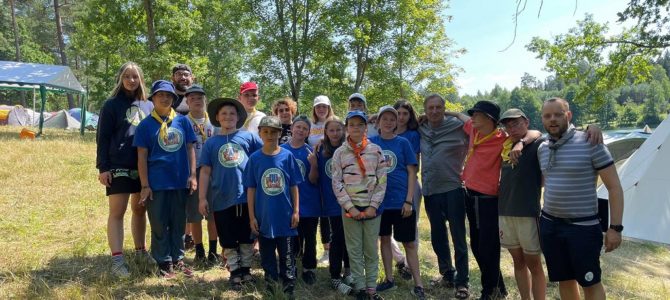
The Jewish scouting troupe is camping beside a lake in the Trakai region, enjoying the sun, the great outdoors, friendship and scouting activities.
Scout leader Renaldas Vaisbrodas reported: “The Jewish scouts have invited me for a new adventure. Somehow naturally it has become my calling. I believe in the scouting movement and I hope Jewish young people in Lithuania would revive one of the largest youth organizations in Lithuania in the period between the two world wars. Why? Because life is stronger than death. This hike is special. For one day an artifact from 1931 will return to the town of Žiežmariai connected with local Jewish scouts. The most important thing is to have fun with a goal, no matter what the weather.”
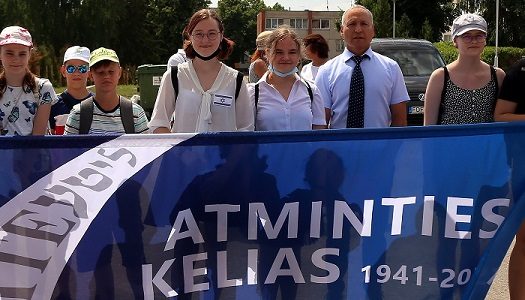
Lithuanian Media Report US, Israeli, Danish Ambassadors Attend Road of Memory March in Šiauliai

Lrytas.lt
The Lithuanian daily newspaper and news website Lietuvos rytas reports the Road of Memory march on Sunday to mark the 80th anniversary of the beginning of the Holocaust in Šiauliai was attended by the US, Danish and Israeli ambassadors as well as Lithuanian members of parliament.
Besides members of the Šiauliai Regional Jewish Community, MPs Emanuelis Zingeris and Rima Baškienė, US ambassador Robert Gilchrist, Israeli ambassador Yosef Avny-Levi, Danish chargé d’affaires Jakob Greve Kromann, Lithuanian Jewish Community executive director Michailas Segalis, Vilnius Religious Jewish Community chairman Simas Levinas, Kaunas Religious Jewish Community chairman Mauša Bairakas, a representative of the Vilnius Jewish Community and others.
The event was staged by Lithuania’s International Commission to Assess the Crimes of the Nazi and Soviet Occupations Regimes in Lithuania as part of their “Road of Memory 1941-2021” project.
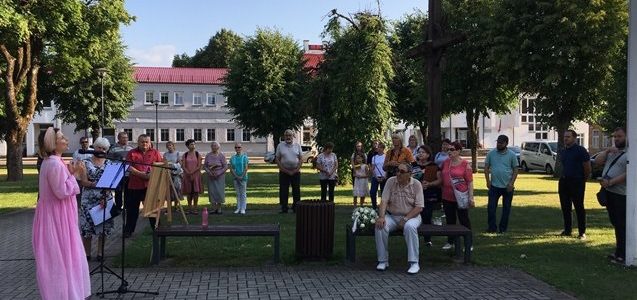
Šiauliai Regional and Klaipėda Jewish Communities Commemorate Holocaust Victims in Ylakiai
Members of the Šiauliai Regional and Klaipėda Jewish Communities attended an event to commemorate the 80th anniversary of the Holocaust in Ylakiai, Lithuania, on July 6. The town center hosted an exhibit called “The Homes They Lived In” about Jewish families, businesses and activities. During the commemoration opera soloist Olga Šardt-Žarova sang “Our Father” and other works in Hebrew. After a minute of silence, a procession set off for the mass murder site and the old Jewish cemetery. Candles were lit and flowers placed at the site of the former synagogue, as were stones as well at the mass murder site, where kaddish was also performed.
According to the census at the end of the 19th century, 57% of the town’s population were Jews. Before World War I there were 150 Jewish families there. The town was heavily damaged during that war and many buildings include the synagogue burned to the ground. The town was rebuilt with large contributions made by Jews and in 1923 Jews constituted 41% of the population then. Many Jewish residents engaged in trade, light production and even agriculture before World War I. There were two mills with Jewish owners. Commerce took place at the weekly market and the large fair held once every five years. According to a government survey in 1931, there were 20 shops there, of which 17 belonged to Jews.
Jewish Summer Camp Update
Additional registrations are being accepted for young people aged 13 to 17 to attend the Amehaye Jewish summer camp with overnight stays from August 2 to August 6. The cost is 140 euros per person. For more information call +37060146656 or send an email to amehaye2021@lzb.lt

Forgotten Names: The Symbol of Lithuania in Works by Musicians Scattered around the World
The spiritual formation of an artist is impossible without a creative environment. This is indivisible from the specific people who set a great example, who direct the artist, enrich the artist spiritually, and support and encourage the artist. That sort of environment is exactly what existed in Vilnius in the early 20th century, giving rise to wonderful musicians including Jascha Heifetz, the Schneider brothers, the Reizenberg sisters, the great Hofmekler family and others.
Some left Lithuania and made incredible careers, others remained and became known in their homeland. Their lives were different, but their legacy is very clear. Let’s remember them, let’s enjoy their works. We will discover a world we didn’t know which was hidden from us for almost a century.
During the event we will learn about the lives of these renowned musicians and their works will be presented.
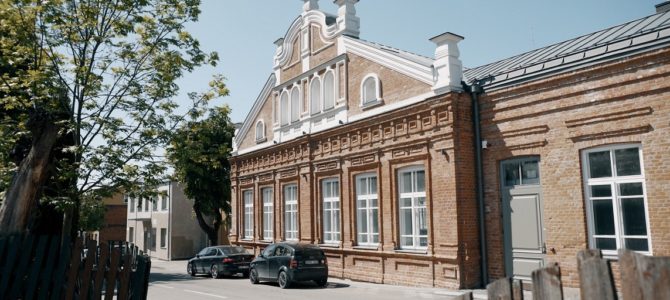
Jewish Sacred Cultural Heritage: The Telz Rabbis Seminary Yeshiva and Synagogues
Bernardinai.lt
Telšiai became an important economic and cultural center in the late 19th century. The large Jewish community which had lived there since ancient times had great influence on the growth and success of the city. Its members harmoniously merged with the city’s cultural, economic and political activity and were active participants in it.
In Telšiai as in other Lithuanian towns and cities Jews mainly engaged in mercantilism and traditional trades; there were also many Jewish doctors and dentists as well as Jews offering other services. Services and light industry were an important source of income for the Jews of Telšiai. For many others, however, the Jewish spiritual seminary–the yeshiva and its synagogues where hundreds of students from all over the world studied–became the way of making a living.
It wasn’t just the residents but the entire atmosphere of the community which demonstrated the spirit of the Jews of Telšiai. Here the ancient past the present lived alongside one another, proponents of tradition and of the Enlightenment, the orthodox and the secular and social activists. There were Torah sages and highly-educated people among the Jews of Telšiai. The city was filled with creative energy and spirituality and materiality merged into a perfect whole there. The crooked narrow streets and the old buildings were miraculous, a world filled with enchantment where thousands of Jewish families lived.
Utyan Jews Speak about Holocaust and Post-War Years in Lithuanian Translation of Zakhor Book
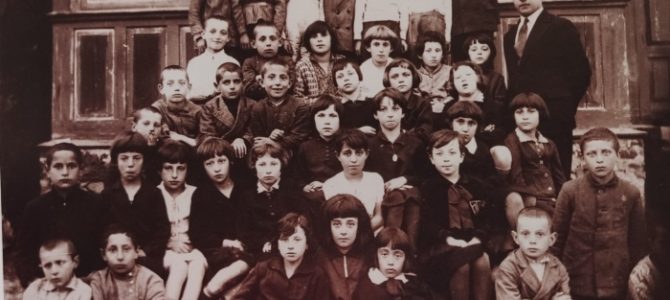
The A. and M. Miškiniai Public Library in Utena (Utyan in Yiddish), Lithuania, hosted a presentation of the only Lithuanian translation of a zakhor or memorial book in Yiddish about the city and region of Utena (the region includes Molėtai, Anykščiai, Vyžuonos and other locations. Incredibly, it took the book 42 years to reach the Lithuanian reading public: it was published in Tel Aviv by Nay Leben in 1979 under the title “Yishker-bukh Utyan un umgegnt.”
The translation and publication was the initiative of cultural historian Sandra Dastikienė as part of her project “Old Neighbors” to educate the public about the Jewish community, Jewish culture and the Litvak legacy in the Utena region.
“The old neighbors return to their towns in different ways–as works of art on the streets, through live appearances–but we are really missing the authentic history. This book fills that gap. It’s not an academic work, not an historical study, but the real memories of Jews who survived the Holocaust or left Lithuania before it. It raises more questions and presents a lot of answers,” Sandra Dastikienė said.
The recollections were collected into a single zakhor book from 1945 to 1979 in Israel. Roma Jančauskienė has long been interested in the history of the Utyan Jews and when she learned of the existence of this book tried over an extended period to buy a copy on the internet, unsuccessfully. About four years ago she finally did buy a copy on eBay, in Yiddish of course.
Šiauliai Regional Jewish Community Celebrates 100 Years of Makabi
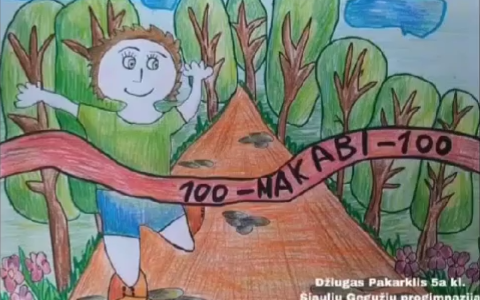
On June 23, 1921, the first Jewish athletics league Makabi began operating, giving rise to the Jewish athletics movement in Šiauliai. In 2021 the Šiauliai Jewish sports association Makabi is celebrating its 100th birthday. To mark the milestone year, the Šiauliai Regional Jewish Community, the Aušra Museum and the Gegužių pre-gymnasium in Šiauliai carried out a project in May and June of this year called “Sport: An Indivisible Part of Life of the Successful Person.”
On May 25 the young chess players from the area competed in a virtual chess championship, organized by the Community and local Makabi Club chairman Eduard Šer. Nine teams from eight local schools competed. Aušra Museum historian Antanas Jankūnas shared interesting facts about sports in Šiauliai before the matches began.
On June 9 a large gathering of local students attended a virtual event to celebrate Šiauliai Makabi’s 100th birthday. The students learned the story of athletics in Šiauliai from historian Antanas Jankūnas and took part in a quiz about sports.
Common Language of the Peoples Amateur Music Festival
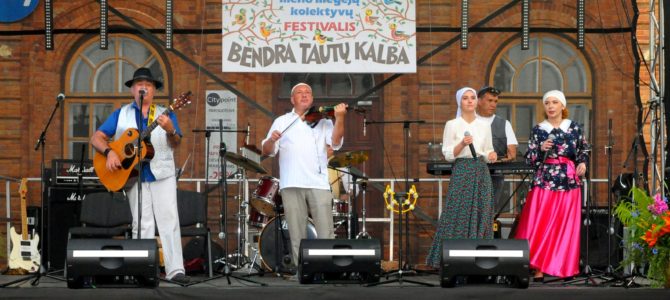
The second “Common Language of the Peoples” festival of ethnic minority amateur song and dance groups has taken place in the city of Švenčionėliai, Lithuania, and the Fayerlakh Jewish song and dance collective directed by Larisa Vyšniauskienė participated.
The second annual festival took place June 23, supported by Lithuania’s Ethnic Minorities Department.
The Culture Center of the City of Švenčionėliai presented cakes and wreaths of wild flowers to all groups participating in the festival.
The representatives of different ethnic groups from Lithuania presented folk costumes and spoke about the characteristics of their ethnic group and their special foods.
The audience applauded every group heavily and the festival again demonstrated the need for more such ethnic community events.
Photos from the Road of Memory Procession in Jurbarkas
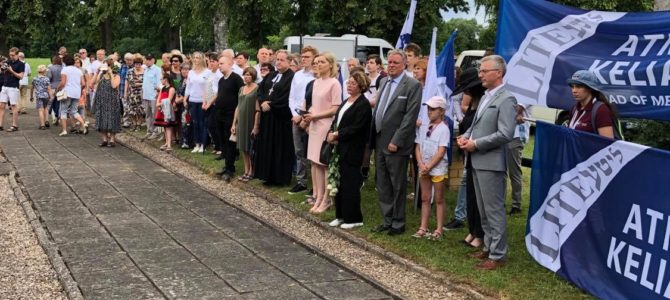
The Road of Memory procession to mark the 80th anniversary of the extermination of the local Jewish community took place in Jurbarkas, Lithuania, on July 4. The event is one in a series of “Road of Memory 1941-2021” events by Lithuania’s International Commission to Assess the Crimes of the Nazi and Soviet Occupational Regimes in Lithuania and the Tolerance Training Centers founded by this commission, and other partners.
Photographs by Ignas Skridla here:
https://www.flickr.com/photos/ignas2/sets/72157719493108108/with/51289725584/
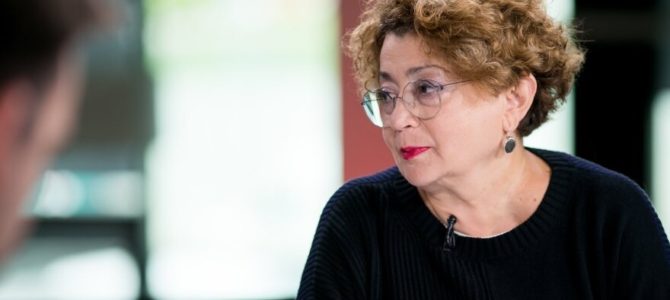
Faina Kukliansky Re-Elected Head of Lithuanian Jewish Community
ELTA, July 8, 2021
A general meeting of the members of the Lithuanian Jewish Community held Wednesday voted for a third time to elect Faina Kukliansky the chairwoman of the organization. Twenty-six members of the LJC’s executive board were elected at the same time.
The chairperson of the Community is elected for a four-year term by a majority of the regional Jewish communities and associate members constituting the LJC. Of the 32 organizations under the LJC umbrella, 31 representatives took part in Wednesday’s ballot. Kukliansky received 30 votes out of the possible 31, according to a press release from the LJC.
Kukliansky said her most important task as chairwoman is to inspire unity among the different Jewish communities in Lithuania. She said the LJC’s other priorities haven’t changed, but life is changing: the generation which experienced the horrors of World War II is growing old and dying, and so caring for them is becoming even more crucial.
“We are continuing to strengthen the activity of our social center, taking care of those requiring support, employing people with disabilities and engaging them in Community activities. Another important priority is preservation and putting to use the surviving Jewish cultural heritage: we have wonderful examples of restored synagogues being used as cultural activity centers,” Faina Kukliansky said.
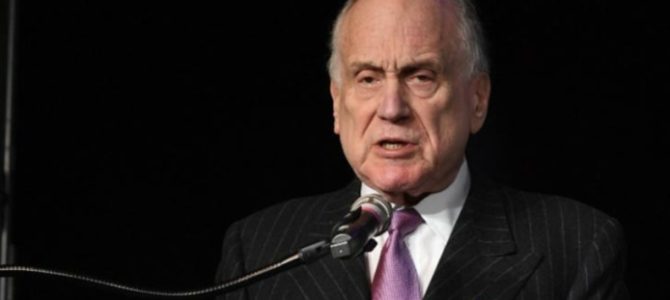
WJC President Ronald Lauder: Jewish Community Should Reevaluate Relationship with Polish Government
WJC president Ronald Lauder calls Polish legislation a “slap in the face” to what remains of Polish Jewry
World Jewish Congress president Ronald Lauder called on the Jewish community worldwide to rethink its relationship with the Polish government over the weekend after the country’s lower house of parliament passed a draft law which would severely limit any ability by Polish Jewish Holocaust victims to recover their stolen property.
“This law is a slap in the face to what remains of Polish Jewry and survivors of Nazi brutality everywhere. It also sets a terrible precedent throughout Europe as survivors and descendants continue to seek justice,” said Lauder, who’s WJC represents Jewish communities in 100 countries. “It pains me to say this, but I think that the time has come for the international Jewish community to reevaluate our relationship with a government that is behaving with unimaginable callousness and is emulating the worst traditions in Polish history rather than the best and most uplifting ones.”
While most post-Communist countries have sought to right historical wrongs and address the issue of stolen Holocaust-era Jewish property, Poland has lagged behind. The Sejm’s new legislation will make it impossible for Jewish claimants or their descendants to recover or be compensated for what was taken from them in Poland.
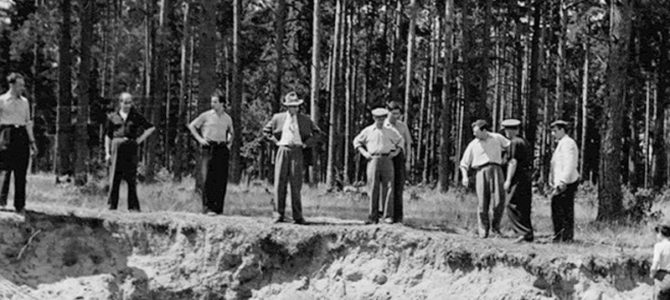
Association of Lithuanian Jews in Israel Letter on 80th Anniversary of the Beginning of the Extermination of Lithuanian Jewry
Association of Lithuanian Jews in Israel
Letter to friends on the 80th anniversary of the beginning of the extermination of Lithuanian Jewry
Eighty years ago, on June 22, 1941, the Germans invaded Lithuania. The Lithuanians immediately declared independence and formed a “temporary government” consisting of members of the “Lithuanian Activists Front”–an underground group headquartered in Germany and composed of nationalist elements who prepared plans for the extermination of Jews and waited for an opportunity to act. The opportunity came on June 22, 1941, with the start of Operation Barbarossa. Before the Nazi army entered the cities and towns of Lithuania, the extermination of Lithuanian Jews began–a 600 year history of coexistence ended in the great tragedy that has no precedent in human history.
Within the first 10 days of the invasion thousands of Lithuanian Jews were murdered. During the Nazi occupation 95% of Lithuanian Jewry were brutally murdered.
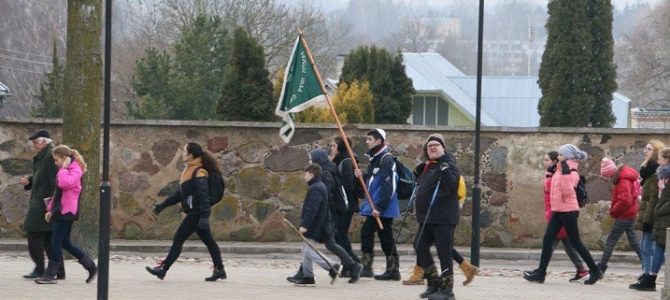
Jewish Scouting Camp This Summer
The camp is for children and young adults aged 13 and above. In order to participate, applicants need permission from their parent, parents or legal guardian(s) and proof of payment by electronic transfer of funds. Please note that payments for the camp will not be refunded (although for unavoidable reasons beyond the power of the parents or applicant to stop, LJC will consider reasonable requests).
Payment information:
Recipient: Lithuanian Jewish Community
Corporation code: 190722117
Bank: SEB Bank
Account: LT097044060000907953
For: Scouting Camp 2021, child’s name and surname and which specific fee is being paid
For more information contact Viljamas at viljamas@lzb.lt or by telephone at+370 67250699
Registration form: https://forms.gle/66KHQmVpUXJJV9WbA
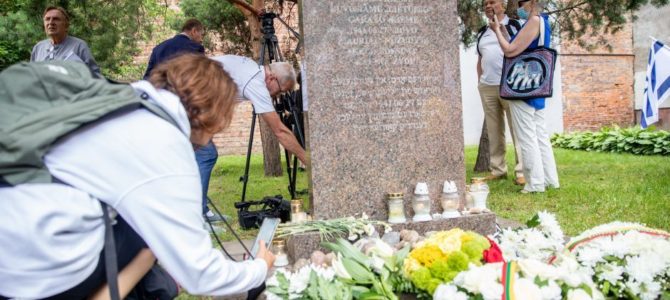
Lietūkis Garage Massacre 80 Years Ago Commemorated in Kaunas Schoolyard
Kauno diena
The 80th anniversary of the Lietūkis Garage massacre, one of the most brutal mass murders in Lithuanian Holocaust history, was marked in what is now an athletics pitch in the courtyard of two schools in Kaunas. The court in the yard shared by the Startas athletics school and the Steponas Darius and Stasys Girėnas Gymnasium was locked Monday symbolically. Athletes including basketball players and swimmers neither warmed up nor played. Instead Lithuanian actress Kristina Kazakevičiūtė recited a poem by Aleksandras Bosas about the site of the mass murder.