Illustration: Shavuot: The Harvest by Harry Lieberman, c. 1934
Greetings on Shavuos (Shavuot) or the Feast of Weeks with an educational video in Lithuanian about the holiday.

Illustration: Shavuot: The Harvest by Harry Lieberman, c. 1934
Greetings on Shavuos (Shavuot) or the Feast of Weeks with an educational video in Lithuanian about the holiday.

by Birutė Vyšniauskaitė, lrt.lt

“It was very cozy and even fun because all the neighbors gathered in one hiding place. We also took in a married couple from the neighboring building because they didn’t have anywhere to hide after the danger signal,” Litvak woman Dusia Lan Kretchmer told Lrytas.lt about the Hamas rocket attacks on Tel Aviv Wednesday night. She left Lithuania about 50 years ago.
Kretchmer said she was in disbelief Hamas rockets were targeting Lod, the city on the way towards Israel’s main Ben-Gurion International Airport, on Wednesday.
“I have taught chemistry for twenty years in this city. Over that entire time I have witnessed Jews and Arabs living together in peace. Many times I have celebrated holidays with the city’s communities, Arabs celebrated their holidays with Jews, Jews with Arabs. So many Arabs live there, I can’t wrap my head around why Hamas would take aim at their own people,” she said.
Full story in Lithuanian here.

We invite you to a virtual Sabbath discussion at 7:00 P.M. on May 15 of the Jewish holiday of Shavuot or Shavuos, moderated by Vijamas Žitkauskas. We will discuss the significance and traditions of the Feast of Weeks as it is known in English. The discussion will be held in Russian and prior registration is required. Registration form here.
We are ad to report the death on May 13 of long-time member Lidija Kazmina. She was born in 1927. We extend our deepest condolences to her children and grandchildren.

The renovated synagogue in Žiežmariai will become a new cultural center. The first synagogue in appeared sometime between 1690 and 1696. In the 19th century there three synagogues. Not surprising, since the majority of the population were Jewish. This synagogue which has survived and has now been renovated stands in the southern part of town between Vilniaus and Žalgirio streets, with the Strėva river flowing from southeastward from there. This synagogue was build in the mid-19th century and is one of only a handful of surviving wooden synagogues in Lithuania.
The plan is to use the refurbished synagogue to host cultural exhibits and events.
“At first there was doubt the synagogue could even be saved. It was so abandoned and ruined. Even so, we resolved to renovate it and now we are very proud we have such a beautiful building,” director of the Strategic Planning and Investment Department of the Kaišiadorys Regional Administration Ramutė Taparauskienė said.

Members of the Šiauliai Regional Jewish Community remembered the victims of World War II on May 9. Thank you to all the heroes who fought the Nazis from 1939 to 1945 for the sake of freedom and peace, for our future and for the opportunity given us today to take joy in each new day.

Lithuania’s Orwellian-named Center for the Study of the Genocide and Resistance of Residents of Lithuania, more commonly abbreviated to Genocide Center, lived up to their reputation of ignoring the Holocaust by reportedly issuing a special computer-graphic propaganda poster on facebook May 8, presented below with a translation into English.

Translation:
The Work of the Red Liberators
[photos of corpses, coffins and a Soviet train]
The End of World War II in Europe on May 8
The Red Liberators Liberated Europe and the Baltic States, and This is What Their Liberation Brought Lithuania:
20,000 murdered partisans
110,000 deported Lithuanians
The self-immolation of Romas Kalanta
500 arrested during the Kaunas Spring
14 Lithuanians murdered on January 13
7 officials murdered at the Medininkai border post
World War II ended in Europe on May 8.
After Germany surrendered unconditionally
the Soviets marched into Berlin on May 9
and proclaimed to the entire world “Victory Day” which for many
countries including Lithuania brought only fear,
pain and death.


On May 9, Israel will celebrate Yom Yerushalayim. Tell us more about this day and its significance.
Prior to the founding of the State of Israel, Jerusalem had different rulers, but it was always part of the prayer and the identity of the Jewish people. We have always called Jerusalem our eternal capital.
All the synagogues of the world are built in such a way that the prayers are directed towards Jerusalem, and during our two most important festivals–Pesach and Yom Kipur—we wish to meet each other in Jerusalem next year. Today, Jerusalem is also mentioned in our anthem: “The Land of Zion and Jerusalem” (in Hebrew, Zion is used as a synonym for the city of Jerusalem and the land of Israel).
On June 27, 1967, Israel won the Six-Day War and regained its historic capital, Jerusalem, which was later recognized as the official capital of Israel by the country’s parliament. Twenty years later, on the 28th day of the month of Iyar in 1998, Yom Yerushalayim was declared a public holiday.

On May 6 the Atomic Bunker military heritage museum in Kaunas put on display three exhibits featuring items from museum founder Julius Urbaitis’s personal collection which he called a part of the history of Kaunas as the Lithuanian provisional capital in the interwar Republic.
The three exhibits are:
1. Goods and items from the D. Rozmarin manufactory and colonial goods [dried and canned goods and non-perhishables in general] store;
2. Ironworks and smithing equipment from the heirs of B. Rabinovitch;
3. Charming amateur and academic works commemorating anniversary of grand duke Vytautas the Great celebrated in 1930.
Kaunas mayor Matijošaitis, LJC chairwoman Kukliansky, Kaunas Jewish Community chairman Žakas, Volfas Engelman brewery general director Horbačauskas, Rūta company director Pridotkas and other honored guests attended the opening of the three exhibits.
Our respect and gratitude go to Julius Urbaitis for his concern for Jewish history and the contribution Jews made in establishing the first independent Republic of Lithuania. LJC chairwoman Kukliansky presented Urbaitis the commemorative medallion of the Lithuanian Year of the Vilna Gaon and Litvak History for this initiative of his and its implementation.

Lithuanian Jewish Community chairwoman Faina Kukliansky personally visited World War II veterans in their homes to congratulate them on Victory Day. There are only six such veterans known to be resident in Vilnius. Warm wishes and congratulations to RIva Spiz, Aleksandr Asovski, Boris Lipnicki, Fania Brantsovksaya, Eliziejus Rimanas and Tatyana Arkhipova-Efros.
Holocaust survivor and historian and Jewish partisan Yitzhak Arad died May 6 at the age of 95 in Israel. He was one of the founders and the first director of the Yad Vashem memorial institute in Jerusalem. He also achieved the rank of brigadier general in the IDF. He was born in Švenčionys (Shventsian), Lithuania, in 1926, moved with his parents to Warsaw and escaped back into Lithuania with his sister at the onset of World War II. He escaped the Švenčionys ghetto and joined partisans in the forests in Belarus. In 1945 he went to Israel where he fought in four wars and was later appointed director of military education. He served in the Israeli military for 25 years and was appointed to head Yad Vashem in 1972. He earned a doctorate at Tel Aviv University and taught Jewish history, authoring numerous books about the Holocaust.
Our deepest condolences to his family and friends for their loss.

Brussels, December 2, 2020–European Jewish Congress president Moshe Kantor applauds the European Union Council Declaration on mainstreaming the fight against anti-Semitism across policy-areas, adopted unanimously by EU member states.
“This is an important decision, one that appreciates the sad growth of anti-Semitism and how it not only targets Jews, but is corrosive for any society,” Kantor said. “The EU firmly states that anti-Semitism is against European values and commits itself to a holistic program to eradicate it from the continent.”
“We are delighted that our strong message that fighting anti-Semitism robustly at all levels, that we have consistently delivered in our meetings and activities, is received.”
“The declaration adopted by the German presidency of the Council affirms several principles, including that anti-Semitism is an attack on European values, that protecting Jewish life and making it more visible as part of Europe’s identity is essential and that it is necessary to combat anti-Semitism head-on in all its forms, including in the context of the COVID-19 pandemic.”
“The importance that the EU is placing on protecting and emboldening Jewish life is also very important,” Dr. Kantor continued. “Jews have been a part of Europe for millennia and continue to contribute at all levels, so it is very gratifying to hear that our leaders will ensure that Jewish life will not only be protected but making it more visible.”

The Lithuanian internet news site 15min.lt is reporting what everyone already knew: the new head of Lithuania’s so-called Genocide Center, appointed by secret ballot in the Lithuanian parliament following an internal power struggle, will maintain the status quo at the state institution whose mission is commemorate the alleged genocide of Lithuanians under the Soviets, not the genocide of the Jews in the Holocaust.
Arūnas Bubnys in the 15min.lt interview maintained the party line formed and maintained by the Center for the Study of the Genocide and Resistance of Residents of Lithuania over the last three decades: Lithuanian heroes such as Jonas Noreika are sensitive, tortured and complicated individuals who cannot be judged one way or another. In other words, you still can’t call Lithuanian Nazis Nazis at Lithuania’s new and improved but still fake Genocide Center.
Full propaganda interview in Lithuanian here.

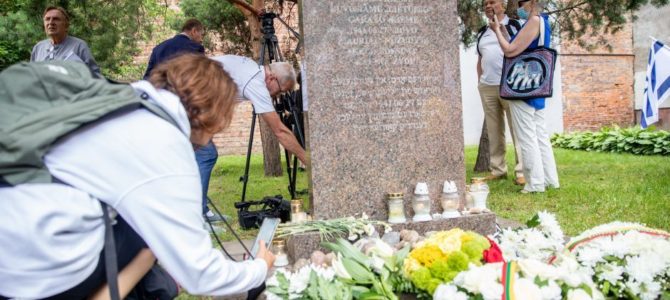
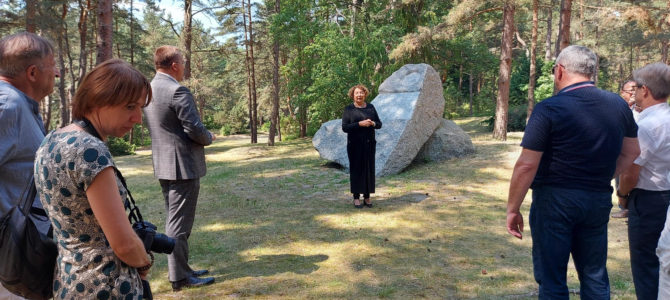
A small, closed ceremony will be held at noon on May 7 to commemorate the victims of World War II at the Sudervės road Jewish cemetery in Vilnius. LJC chairwoman Fainia Kukliansky, LJC representatives and foreign diplomats are scheduled to attend a wreath-laying ceremony at monuments commemorating ghetto victims and lost children. Because of wide-spread fears of viral contamination the ceremony won’t be open to the public and no further official commemoration ceremony to mark Victory Day will be held in Vilnius this year.

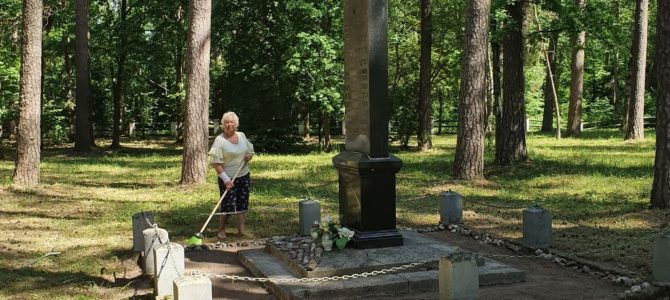
The Lithuanian Jewish Community sincerely thanks Team 10 of the King Mindaugas Riflemen of the Lithuanian Riflemen’s Union for heeding our call for help and turning out to clean up the Sudervės road Jewish cemetery in Vilnius.
Thank you!

We wish Adasa Skliutauskaitė a happy birthday this milestone year and have sent her a bouquet of flowers in the name of the Community.
We sincerely congratulate the accomplished painter, graphic artist and puppeteer and wish her many warm moments in daily life, wonderful pictures and that she continue to enchant us with her extraordinary enthusiasm and colors. May the passage of the years never change the warmth of your eyes and heart. We wish you a long and beautiful life.
Be healthy and happy.
Mazl tov. Bis 120!

Lithuanian foreign minister Gabrielius Landsbergis visited the site of the Lost Shtetl Museum being built in Šeduva in central Lithuania May 4.
“The future modern museum in Šeduva will better showcase the extraordinarily rich history and legacy of the Litvaks for Lithuanians and the world. I sincerely thank the initiators and executors of the project,” he said.
The private initiative is supported by the Šeduva Foundation created by Jews with roots in the town and is being carried out in cooperation with the Radviliškis regional administration.
The Lithuanian Jewish Community’s series of virtual Sabbath telebridges continues this Friday, May 7, at 8:00 P.M. with a Zoom meeting with Rabbi Nathan Alfred of the European Union for Progressive Judaism. To participate, register here.

New York Times newspaper reports Eli Broad, a businessman and philanthropist whose vast fortune, extensive art collection and zeal for civic improvement helped reshape the cultural landscape of Los Angeles, died last Friday at Cedars-Sinai Medical Center in Los Angeles at the age of 87.
Eli Broad was born in the Bronx on June 6, 1933, the only child of Jewish immigrants from Lithuania. When he was 7 the family moved to Detroit, where his father opened a dime store, the New York Times reported.

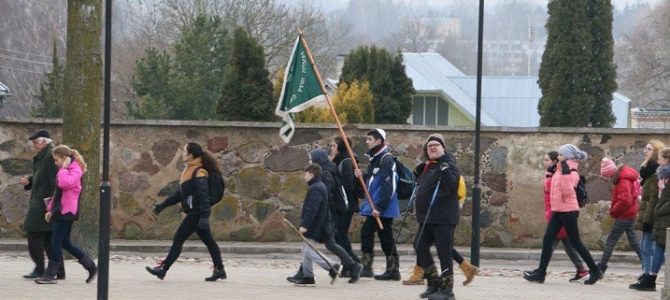
Lithuanian Jewish Community chairwoman Faina Kukliansky sends a big thank-you to all the students, parents and family members of students who responded to the call by the principal and teachers of Sholem Aleichem Gymnasium to come help clean up the Jewish cemetery on Sudervės road in Vilnius. The winter wasn’t kind to the cemetery and visitors have been few. Despite the cool weather and the fact it was Mother’s Day in Lithuania, many helpers arrived to pick up garbage and fallen branches and generally tidy the graveyard up for spring in the Lithuanian tradition of talka, a joint volunteer effort to put the environment in order. Students at Sholem Aleichem can also use the experience to get credits now required for community service, so to those of you who couldn’t make it, don’t be shy next time!
Thank you!