

Litvaks

Benefits of Lithuanian Citizenship from the South African Litvak Perspective

by Claire van den Heever, the Lithuania Tribune

“South Africa is more Litvak than Lithuania itself,” Markas Zingeris, the Lithuanian playwright and novelist once remarked. And as one of very few members of Lithuania’s Jewish community to remain in the country he would know. The vast majority of Lithuanian Jews have found good reason to leave at one time or another in history, whether it was unrest in Europe between 1868 and 1914, or the economic hardship that characterized the period from Lithuania’s independence in 1918 until June 1940 when the Soviet army took control. It was during this time that thousands of Lithuanians came to South Africa in search of a more peaceful life. And it is here where many have remained.

“Today 80% of South Africa’s 70,000 Jews are of Lithuanian descent, making this country the third largest Lithuanian diaspora community in the world,” says Gary Eisenberg, an acclaimed immigration lawyer and Lithuanian citizenship specialist at Eisenberg & Associates.

In Lithuania, Jewish culture underwent decades of systematic destruction during both the Soviet and the Nazi regime. In South Africa it found space to breathe and fluoresce. Zingeris himself recognized this fact, remarking that “we see our culture and society have been preserved there.”

Full story here.

Holocaust Escape Tunnel

At ground zero for the final solution, scientists uncover a story of hope and bravery.
Airing April 19, 2017, at 9 P.M. on PBS

Program Description

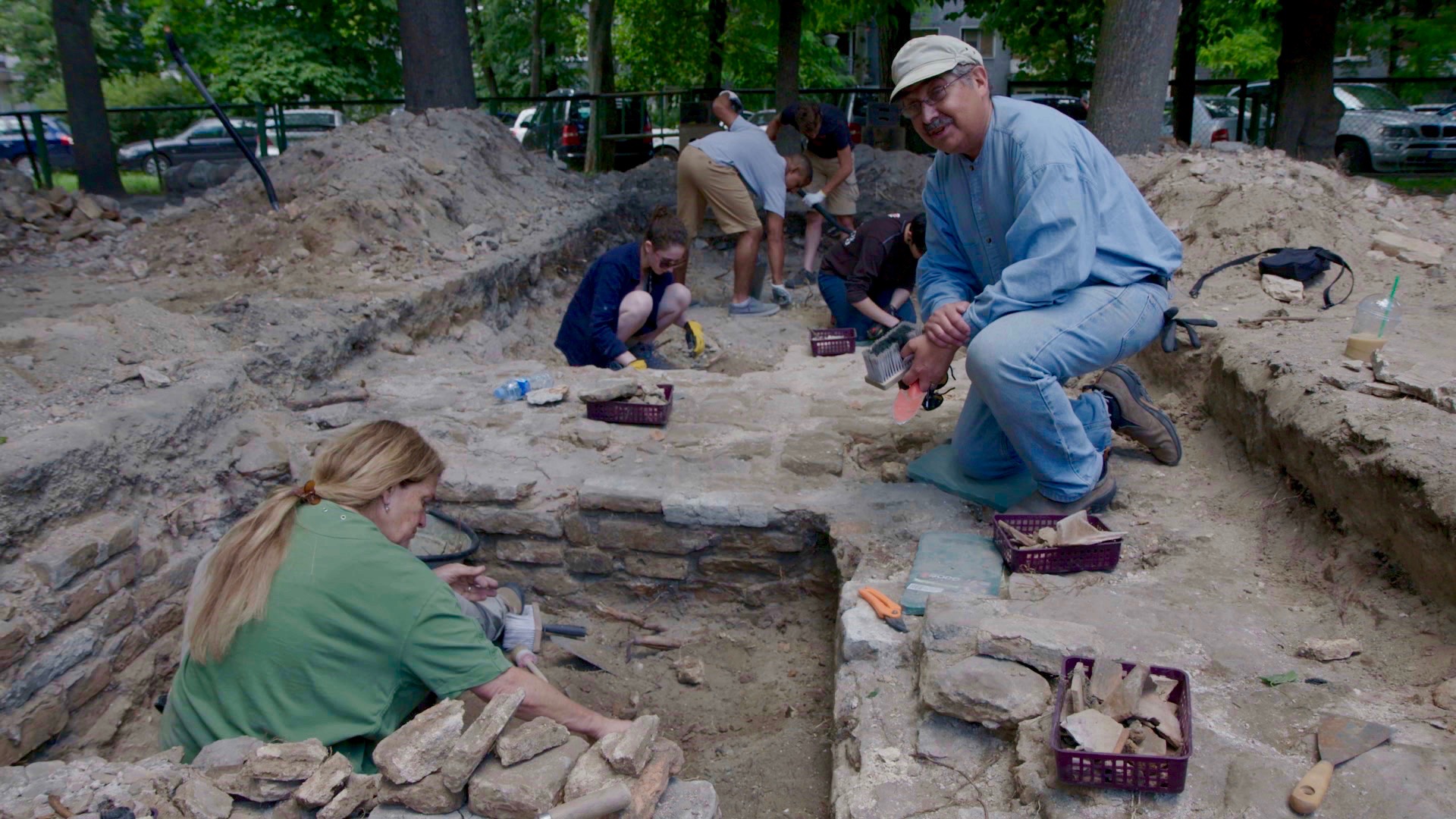
For centuries, the Lithuanian city of Vilna was one of the most important Jewish centers in the world, earning the title “Jerusalem of the North” until World War II, when the Nazis murdered about 95% of its Jewish population and reduced its synagogues and cultural institutions to ruins. The Soviets finished the job, paving over the remnants of Vilna’s famous Great Synagogue so thoroughly that few today know it ever existed. Now, an international team of archaeologists is trying to rediscover this forgotten world, excavating the remains of its Great Synagogue and searching for proof of one of Vilna’s greatest secrets: a lost escape tunnel dug by Jewish prisoners inside a horrific Nazi execution site.

PBS program announcement here.

For more, see:
http://www.lzb.lt/en/2016/07/01/picking-up-the-pieces/
http://www.lzb.lt/en/2016/07/24/israeli-antiquities-authority-reports-major-finds-in-lithuania/
http://www.lzb.lt/en/2017/01/02/new-york-times-ponar-top-science-story-in-2016/

Great Attendance at LJC Seder

About 200 people gathered for the Lithuanian Jewish Community Passover Seder at the Radisson Blu Hotel Lietuva in Vilnius Saturday. LJC chairwoman Faina Kukliansky gave a short welcome speech, large flower bouquets were passed out to a number of Community members whose volunteer work has been outstanding and Rabbi Shimshon Isaacson led the assembly in the Passover rituals, without a microphone since Sabbath hadn’t ended yet. Žana Skudovičienė and Julija Lipšic really gave their all as organizers and made sure everyone felt welcome and got what they needed. Žana Skudovičienė also helped the rabbi with the ritual. Jewish song and dance ensemble Fayerlakh performed as well. There were no new faces, just regular attendees from past years, although former acting LJC executive director Simonas Gurevičius unexpectedly attended with his wife. Gurevičius is contesting the post of chairman in upcoming elections within the Community, but the evening wasn’t about politics of the current day and everyone seemed to get along great. There were fewer children this year than at previous LJC Seders but a sufficient number to conduct the treasure hunt.

More photos here.

Passover Greetings from Lithuanian Jewish Community Chairwoman Faina Kukliansky

Passover is a wonderful time to give thanks to the Most High for our release many years ago from slavery, to give thanks for what we have now and to think about the future.

It’s better not wait for manna to fall from heaven, but rather to get to work ourselves now. All Jews in the community need to do this. I say the word “community” in the broad sense. I have always said that our community concept extends beyond that of membership. Recently, however, as if by the instructions from a stage director (and the scene being acted out is, sadly, rather cliché), a large number of hitherto unseen, unknown members have been flooding the Community. We didn’t think there were so many Jews in Vilnius. Since members of the Vilnius Jewish Community receive a box of matzo without charge, we might run out.

We hope the new members will be active not just during the coming election for the post of chairman of the Vilnius Jewish Community, but also in everyday activities. We need to work, not to expect a miracle with outstretched hand, a miracle which might not be repeated.

I wish everyone a beautiful Passover holiday.

AJC Delegation Tours Žiežmarai Wooden Synagogue


LJC chairwoman Fainia Kukliansky and Kaišiadorys mayor Tomkus, Žiežmarai, April, 2017

The ruined wooden synagogue in Žiežmarai, Lithuania, is being reborn for a new life. During the Holocaust it was used as a concentration point for imprisoning Jews awaiting execution. A large number of Jewish houses still stand near the synagogue, whose owners were murdered. The wooden synagogue is still an important heritage site, even if there is no one left to pray there. The Lithuanian Jewish Community contacted the mayor and council of Kaišiadorys about reconstructing the synagogue. Initially that request was denied, the council objected, and it took much effort to convince the local government the old synagogue really is a heritage site which besides holding interest to Jews around the world would also attract tourism and could be put to public use by the local population.

The Kaišiadorys city council approved the idea of adapting the building for public use in 2015 and applied for EU structural funds for renovation. A technical plan for renovating the Žiežmarai synagogue using funds from the Lithuanian state budget and the Goodwill Foundation was prepared and necessary studies conducted. After renovation the synagogue will serve as a monument to the murdered Jewish communities in Kaišiadorys and surrounding areas, and will be maintained to serve cultural functions for the local population.


An AJC delegation visiting Lithuania toured the synagogue site.

According to the Architecture and Urban Studies Center of Kaunas Technical University, the first synagogue in Žiežmariai might have appeared in 1690 following the granting of a charter of rights to the Jewish community there. This synagogue is mentioned in 1738. A 1782 description of the local church district and town says the synagogue was built under the grant of rights by Jan Casimir (noting it had to have been obtained before 1668) and that were two Jewish cemeteries. In 1868 Žiežmariai had a population of 1,190, of whom 604 were Jews, the majority. In 1897 there were 2,795 residents in Žiežmariai, of whom 1,628 were Jews. It is mentioned that all three synagogues in Žiežmariai suffered from the fire in 1918.

AJC Supports Idea of Jewish History Museum in Vilnius


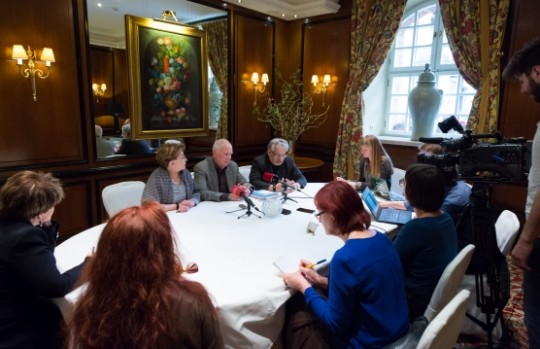
Vilnius March 31, BNS—The American Jewish Committee supports the idea of establishing a Jewish history museum in Vilnius, representative Sam Kliger says.

Speaking at a press conference Friday, the committee director of Russian affairs said his organization believes it is an important initiative which could become real with the Lithuanian Government’s help. He recalled his delegation’s visit to a museum in Warsaw a few days prior and called it impressive. A Jewish museum would be a good start or a good continuation of Lithuanian-Jewish relations, he told reporters. He also said Israeli ambassador to Lithuania Amir Maimon expressed support for the idea during a meeting Friday.

Chairwoman of the AJC board of directors Harrieta P. Schleifer said the museum should cover more than the Holocaust and include Lithuania’s rich Litvak legacy. It should include history from the beginning through the present to the future, not just the Holocaust, she said.

Vilnius Seniors Visit Panevėžys

A group of members of the Vilnius Jewish Community’s Seniors Club, directed by Žana Skudovičienė, visited the Panevėžys Jewish Community. Panevėžys Jewish Community chairman Gennady Kofman spoke about the history and life of the Panevėžys Jewish Community in a pleasant setting, sipping tea around a table with fresh bagels brought from the Bagel Shop Café in Vilnius. Several of the Vilnius members’ parents had lived and worked in Panevėžys and were greatly interested in the Panevėžys Jewish Community’s Museum of History. Mutual interest led some of the seniors to tell about the life and fate of their parents in greater detail.

Guests visited the site of the Panevėžys Jewish cemetery and heard about its tragic destruction in 1966, and how headstones were used as decoration for the wall of the Juozas Miltinis Theater.

Žana Skudovičienė in the name of all club members expresses their gratitude for the warm reception.

Most Brutal Lithuanian Holocaust Mass Murder Operation Remembered

To never forget, to always remember and to seek to make sure it never happens again–these are our duties. We often repeat these words in commemoration Holocaust victims. We repeated them again in the afternoon on Friday, March 24, in Kaunas when we remembered the victims of the most horrific mass murder operation in the Kauinas ghetto, the Children’s Aktion.

Horrific also because, as Israeli ambassador to Lithuania Amir Maimon said at the commemoration, it is incomprehensible how a human being can turn into a murderer of innocent children, of babies who don’t even understand what is going on in the world around them. Horrific and painful because it impossible to imagine what the parents felt when they returned home to the ghetto after forced labor and found their only joy, their children, were missing. Administrative director of the Kaunas municipality Nijolė Putrienė cried speaking about the unrealized dreams of the murdered children, about the murder of their futures and about Lithuanian citizens who could have made a difference. Survivor of the Children’s Operation Ela Glinskienė spoke of her memories. Kaunas Jewish Community chairman Gercas Žakas led the event and long-time Kaunas Jewish Community friend, the daughter of a rescuer of Jews, actress Kristina Kazakevičiūtė and flautist Artūras Makštutis provided music and poetry.

Vilnius Synagogue Map Launched

“When we speak of Jewish cultural heritage, we don’t mean a foreign people who lived apart from everything and one day decided to move. We’re talking about what was in Lithuania, about the Lithuanian nation’s heritage, not just of the Jews,” Israeli ambassador to Lithuania Amir Maimon said Friday at the launch of map of the synagogues of Vilnius held at the ambassadorial residence. One of the goals of the map project was to show just how interconnected Jewish and Lithuanian history is.

Of 135 Synagogues, Only One Remains

The map contains a total of 135 sites of synagogues which operated before the Holocaust. Most of the synagogues were located in the Vilnius Old Town, around the Jewish area of the city centering on the Great Synagogue and spreading along Vokiečių, Gaono and Stiklių streets. There were more than 30 synagogues located in that compact area, but none of them remain. The synagogues were razed and other buildings built in their place, or the sites were used as public spaces.

Full story in Lithuanian here.

Condolences

Donald Jay Rickles passed away at his home in Beverly Hills, California, April 6 from kidney failure at the age of 90. He is survived by his wife Barbara Rickles (formerly Sklar), his daughter Mindy Rickles and two grandchildren Ethan and Harrison Mann. His wife was at his side as he died. Their son Larry, born in 1970, passed away in 2011.

He was born to Jewish parents in Queens, New York, on May 8, 1926. His father Max Rickles emigrated in 1903 with his Litvak parents from Kaunas (then Kovno in the Russian Empire) and his mother Etta Feldman was born in New York City to Austrian immigrant parents. Rickles grew up in Jackson Heights, New York.

Vilna Gaon Museum on New Jewish Museum Proposal

The Vilna Gaon State Jewish Museum has issued a statement via press release about a recent proposal by Lithuanian officials to set up a Holocaust-free new Jewish museum in the Palace of Sports or next to it on land which contains the centuries-old historic Jewish graveyard of Vilnius.

Let’s Create a Strategic Strategy for Jewish Heritage, Not Disneyland

The Vilna Gaon State Jewish Museum was disappointed by information appearing in the press last week about plans by government institutions to establish another Jewish museum in the Lithuanian capital instead of assuring support for existing projects.

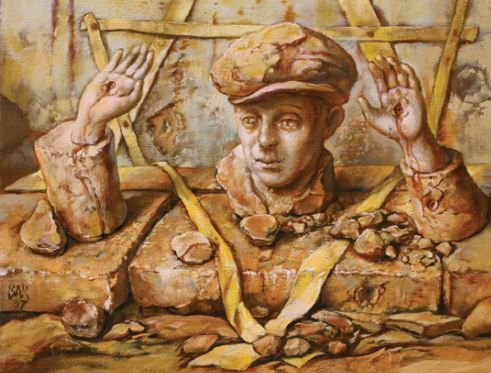
The Vilna Gaon State Jewish Museum, whose sections are housed in authentic buildings closely connected with the Jewish history of Vilnius, has recently been undergoing an intense and productive period. We host international events at the highest level, for example, the International Holocaust Remembrance Alliance conference held on March 22 and 23, and the number of visitors is constantly growing. New permanent exhibitions are being created for installation in our historic buildings, including the opening this fall of a new Samuel Bak Museum, showcasing the Litvak painter’s life and works, and in the near future we also intend to open the Museum of Lithuanian Jewish Culture, aka the Litvak Center and a dedicated Lithuanian Holocaust and Vilnius ghetto memorial museum, which has attracted the attention of international museum organizations including ICOM.

The latter museum is to be housed in the historical building on Žemaitijos street (former Strashun street) which was listed as a cultural treasure last month. This is the building which housed the Mefitsei Haskalah library before World War II and the Vilnius ghetto library during the war. which organized cultural events inside the ghetto and served as a secret meeting place for members of the ghetto resistance organization. In 1945 Holocaust survivors established the short-lived Jewish Museum in the building, quickly shut down by the Soviet government. The Vilna Gaon State Jewish Museum intends to reutilize the building for Holocaust education. After the museum has these additional sections, a unique route will be created for the visitor to explore Jewish Vilna.

Vilnius Mayor, Lithuanian PM Decree: And There Shall Be Built a Jewish History Museum Next to the Palace of Sports

Vilnius, March 30, BNS–Lithuanian prime minister Saulius Skvernelis said there are deliberations on changing the project for the reconstruction of the Palace of Sports to include a equip a building to host a Jewish history museum and for conferences. There was consideration on holding concerts and other cultural events in the project initiated by the former Government.

Vilnius mayor Remigijus Šimašius proposed setting up a Litvak History Museum next to the Palace of Sports which the Government is planning to renovate. “I think the Government has done the right thing in halting the untransparent bid begun earlier. But there should be a conference center there without any doubt. We just discussed that it would be more sensible if next to the conference center or partially integrated with the conference center there were a museum of Litvak history. It is probably this could be accomplished wonderfully and would become an attraction. We agreed to develop the idea further. I’m glad my opinion and the prime minister’s coincide on this,” the mayor of Vilnius told BNS after meeting with Lithuanian prime minister Saulius Skvernelis Thursday.

“It should be able to be used for conferences. Now there is a concept, a conference and concert hall, so it should be conferences and a museum,” the prime minister told reporters at parliament.

Lithuania’s Shoah Whitewash Project

Efraim Zuroff of the Simon Wiesenthal Centre in Jerusalem has said the Lithuanian authorities were “very culpable.”


A derelict shul in Vilnius (Getty Images)

Lithuanian parliamentary ombudsman Augustinas Normantas has refused to open an investigation into a complaint that his country’s Genocide and Resistance Center presents a revisionist version of wartime history.

Instead, the ombudsman said that the center itself must address the issue first, and “if its answer is disputed, then in a court of law.”

The complainant, Grant Gochin, has challenged the Genocide Center’s description of Lithuania’s wartime treatment of its Jews, calling it “a distortion of history and an insult to the Jewish citizens of Lithuania.”

Anti-Semitism in Soviet Lithuania: The Case of the Vilnius Money-Changers

Antisemitizmas Sovietų Lietuvoje. Vilniaus „Valiutininkų byla“

Bernardinai.lt

by Justas Stončius, doctoral candidate and lecturer at the Institute of the History and Archaeology of the Baltic Region, Klaipėda University

Fifty-five years ago on March 22, 1962, death sentences were issued to three Jews from the Lithuanian Soviet Socialist Republic. They were accused of violations in exchanging currency. The local press reported the trial in detail and the Western press covered it as well, viewing it (correctly) as traditional anti-Semitism, whose existence in the USSR was denied. Klaipėda University doctoral candidate Justas Stončius discusses the motivations and history of the Vinius Money-Changers Case.

The trial of the “Vilnius money-changers” lasted from January 30 to March 22, 1962. The Supreme Court of the Lithuanian Soviet Socialist Republic tried eight people of Jewish ethnicity who were accused of violating the rules for exchanging currencies and of currency speculation. The decision was made to hold a public trial and a special group of correspondents was formed to cover the trial in newspapers and magazines. Invitations were distributed at Vilnius city factories to the more active workers and activists in the production sector. During sentencing the death sentence was given Aron Reznitsk, Mikhail Rabinovich and Fyodor Kaminer, while Basia Reznitsk was sentenced to 15 years’ imprisonment, decreased to 10 years 6 years later.

The Vilnius Money-Changers Case received much attention in the West. On April 17, 1962, French newspaper Le Progrès reported “by order of the Vilnius Tribunal three Lithuanian Jews have been put to death” and noted the events had caused unrest in the Jewish community of the Soviet Union. France’s Le Monde newspaper stated Jews of the USSR were afraid “that they, too, might become scapegoats for the rampant lack of food stuffs in the Soviet Union…”

Full story in Lithuanian here.

Ponar Mass Murder Site Three Times Larger than Memorial Complex

Paneriuose nacių įkurta žudymo bazė buvo tris kartus didesnė nei dabartinis memorialas
Then-president of Israel Shimon Peres at Ponar in 2013. Photo: AFP/Scanpix

Vilnius, March 27, BNS–The mass murder site established by Nazi Germany in Ponar outside Vilnius during World War II was three times larger than the memorial complex there now, Lithuanian historians have discovered.

“The memorial is only a small part of the Ponar murder operation site. It might have covered 65 hectares, but the memorial complex/museum there occupies 19 hectares,” Lithuanian History Institute researcher Saulius Sarcevičius told BNS Monday. He said researchers working at the site since last year have discovered five new mass murder pits and additional research is being carried out on two of them.

German Historian Raises Painful Question of Lithuanian Collaboration


Dr. Christoph Dieckmann. Photo by Karolina Pansevič, © 2017 Delfi.lt

Effective cooperation between Germans and Lithuanians became a fatal trap for Lithuanian Jews. It was patriots–ethnic nationalists–who murdered the Jews in Lithuania, hoping to form a strong nation-state without Jews, Russians and Poles.

So German historian Christoph Dieckmann said in an exclusive interview with Delfi.lt. Dieckmann, who works at the Fritz Bauer Institute in Frankfurt, is the author of the two-volume Deutsche Besatzungspolitik in Litauen 1941-44 published in 2011. As a member of the Lithuanian International Commission to Assess the Crimes of the Nazi and Soviet Occupational Regimes, Dieckmann raises a painful moral question: why didn’t the Lithuanian people, seeing and hearing the Jews being murdered around them, protest? He believes it’s largely due to the position of the Church, which he believes was only concerned with what to do with the property of Jewish converts to Catholicism.

Full story in Lithuanian here.

Panevėžys Jewish Community Passover Celebrations

The Panevėžys Jewish Community greet you on the upcoming holiday of Passover and invite you to a series of events for the holiday:

April 6 Concert “From a Forgotten Book” at the Gabrielė Petkevičaitė-Bitė Panevėžys Regional Public Library, Respublikos street no. 14 at 5:00 P.M.

April 10 First Passover Seder at the Rojaus paukštė café, Respublikos street no. 4A at 6:30 P.M.

April 11 Second Passover Seder at the Panevėžys Jewish Community, Ramygalos street no. 18 at 2:00 P.M.

April 14 Third Passover Seder and Sabbath at the Panevėžys Jewish Community, Ramygalos street no. 18 at 2:00 P.M.

Israeli Exchange Students Feel at Home in Kaunas, Lithuania

For a decade now there has been a club for Israeli young people studying in Kaunas. The club meets at what is called the Kaunas Jewish Center in the center of town. Currently about 130 students from the Lithuanian Health Sciences University attend regularly and all Jewish students in Lithuania are welcome.

The center features a synagogue, the student club and a kosher food restaurant for students, and hosts events and holiday celebrations. A mikvah for married women is to be set up before Shavuot this year. Rabbi Moshe Sheynfeld and his right-hand man Aleks Minin run the center. Minin helps with the daily tasks and making new ideas real. The founder, financial supporter and tutelary spirit of the center is William Shtern, who says he’s happy the students have found a small piece of Israel in Kaunas, their second home, where they can further their own identities, but he says he is even more glad they are meeting one another, becoming friends and even starting families.

The Kaunas Jewish Community has been working with Shtern and his center for several years now and acts as partner in certain center projects, and people from the center attend Kaunas Jewish Community events. Every Friday people from the center donate fresh challa bread for the Kaunas Jewish Community’s Sabbath dinner.

You can find out more about the Kaunas Jewish Center here.