Litvak Resettlement in the Novorossiysk Area of Krasnodarsk Region in the First Half of the 19th Century, by G. Baranova
12 noon, Sunday, November 29


Litvak Resettlement in the Novorossiysk Area of Krasnodarsk Region in the First Half of the 19th Century, by G. Baranova
12 noon, Sunday, November 29
Among the 60 or so experts from more than a dozen countries at the multi-disciplinary conference on Jewish cemeteries in Europe organized by the Rothschild Foundation (Hanadiv) Europe and hosted by the Lithuanian Jewish community on October 25-28 in Vilnius, Lithuania, was Samuel Gruber. Gruber is a cultural heritage consultant who has consulted in the drafting of various documents, scientific research, conservation, exhibition and educational projects in the USA and Europe. He is an historian of architecture and an archaeologist, and an expert on Jewish artistic, architectural and historical sites. He is also a prolific blogger. His blog contains copious posts on Jewish sites, commemorative monuments and issues in Lithuania.
Some of his more recent postings include:

During the official opening ceremony for Fredrikstad Animation Festival 2015, held at Litteraturhuset, Ilja Bereznickas was awarded the Golden Gunnar Lifetime Achievement Award for his contribution to the Nordic-Baltic animation industry. Chairwoman Trine Vallevik Håbjørg presented Bereznickas with the award, highlighting the following as the reason for the board’s decision:
“On behalf of the festival board, we would like to honour a person who’s had a major impact on the Nordic-Baltic animation scene. Ilja Bereznickas is a key figure within Lithuanian animation and has for over four decades had a career within the animation industry. His filmography includes several short films, and he is an acclaimed teacher and draughtsman. In addition to Lithuania, he’s also worked in countries such as Israel, the USA and Norway. He has worked as a director, animator and scriptwriter at the Lithuanian Film Studio since 1985, and in 2002 he initiated and became the head of the animation programme at the Vilnius Academy of Art. The festival board honours Ilja Bereznickas with a lifetime achievement award in recognition of his work within and dedication to the animation industry.”
Congratulations, Ilja!
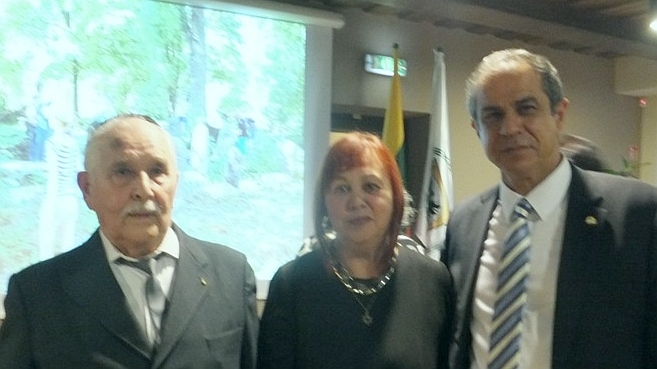
During a conference on November 13 to mark the 150th anniversary of the birth of Dr. Meir (reported here in earlier news items), a large book called “Žydai Lietuvos žemėlapyje. Biržai” [“Jews on the Map of Lithuania. Biržai”] was presented to the public in the Arsenal Hall of the Biržai Castle. Those who attended included Panevėžys Jewish Community members Yuri Smirnov and Tamara Antanaitienė, Panevėžys school teacher Asta Kurulytė and history teacher and head of the Rožynas school’s Tolerance center Genutė Žilytė. Israel’s ambassador to Lithuania, Amir Maimon, was invited and arrived early to look over the old Jewish cemetery in Biržai and pay his respects at the graveside of the last Jew of Biržai who recently passed away, Sheftel Melamed, and to visit the memorial for the Jews who were murdered in the Pakamponys Forest. Greeting the large audience who turned out for the event, the ambassador remembered the old proverb: “If you want to know where you’re going, you have to know whence you’ve come.”
Speaking of the Holocaust, the ambassador said the past cannot be forgotten so that it never happens again. “One of my priorities is the protection of Jewish heritage,” he also said. The ambassador managed to surprise even locals with his knowledge of Biržai Jewish history, citing prewar population figures and talking about the walks of life of local Jews.
Full story in Lithuanian and picture gallery here.
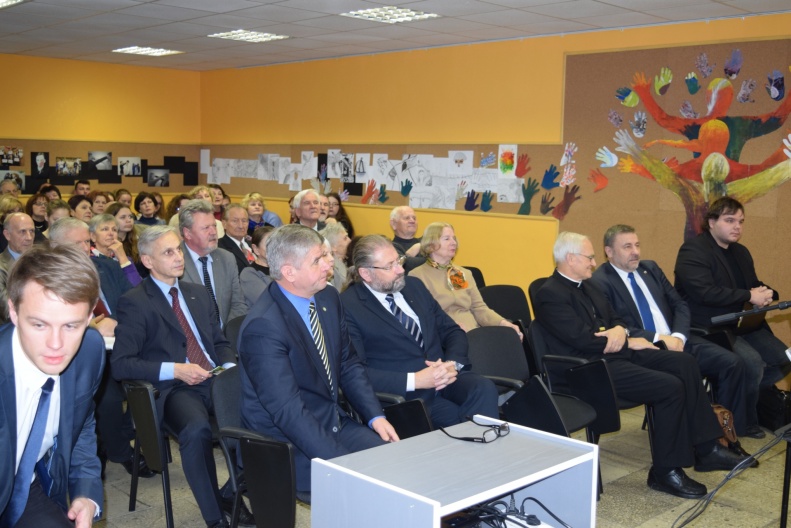
Panevėžys city mayor Rytis Račkauskas attended a conference to unveil a memorial plaque to mark the 150th anniversary of the birth of public figure and doctor Shakhnel Avrahom Meir. The project was financed by the Goodwill Fund and was supported by the Panevėžys Jewish Community and the municipality.
“The great contribution made by Dr. Meir to the life of the city is undisputed among residents. The doctor set up a hospital, clinics for children and adults and a tuberculosis dispensary. It is difficult to list all his accomplishments. But one must be mentioned: his concern for people. Meir dedicated himself to children from poor families and never discriminated against patients based on wealth or ethnicity. To him they were all the same, they were all important to him. The 150th anniversary of his birth compels us to remember and commemorate this notable person. I sincerely thank the organizers of this event for this initiative,” mayor Račkauskas told the audience.
Abramas Leščius, son of Chaim, always emphasizes he’s from Raseiniai.
This year marks 150 years since the birth and 85 years since the death of Dr. Meir.
A ceremony to honor the memory of Dr. Shakhnel Avrahom Meir will be held in Panevėžys, Lithuania on November 13, the famous Lithuania doctor’s hometown.
He studied medicine at Moscow University and began his medical practice in Chernigov guberniya in the Ukraine before returning to Lithuania in 1891, where he first set up practice in Pasvalys and then moved back to Panevėžys in 1914. He had a reputation for selflessness and devoted all his time and energy to healing everyone who needed help. He improved his skills by working in clinics abroad and kept up with the latest advances in medicine, applying them at home. The Jewish Hospital was built and opened in Panevėžys in 1919 on his initiative. It served people of all ethnicities.
Two Steps Forward, One Back
by Geoff Vasil
Readers of the Lithuanian Jewish Community website might have been surprised yesterday by a news item appearing there in which Jonas Noreika was absolved, seemingly, of complicity in the Holocaust. Noreika is one of those names which lives on in infamy among scholars of the Lithuanian Holocaust but proffered as an anti-Soviet hero by Lithuanian nationalists. The intent of the LJC, of course, was merely to report the Lithuanian news to Jews here and abroad, and not to white-wash Noreika in any way. The news item would not have been surprising even a few years ago, but now it comes as a shock exactly because Lithuanian society has moved forward so rapidly in coming to terms with the horrible loss to the country known as the Holocaust.
In summary, a Lithuanian state institution, the Center for Research on the Genocide and Resistance of the Residents of Lithuania, charged with sorting out history, issued a politicized report claiming Noreika was only involved in isolating Jews during World War II, not murdering them. The report came in response to a joint call by well known figures in Lithuania, including Tomas Venclova, to remove a plaque honoring Noreika from the wall of the library of the Lithuanian Academy of Sciences in Vilnius, a move which the LJC has long championed.
The document released this week cautions Noreika’s actions “cannot be judged categorically.”
I was included in the delegation which went together with Lithuanian president Dalia Grybauskaitė to Israel. As the chairwoman of the Lithuanian Jewish Community I participated in everything and I can say the visit was historic. Despite the tension in the air because of the terrorist attacks by Palestinians, the leaders of Israel found the time to meet with the Lithuanian president on her working visit and to discuss the most urgent issues in regional security and bilateral cooperation. The Lithuanian president also discussed measures for strengthening Israeli and Lithuanian ties with Israeli president Reuven Rivlin, who emphasized his Litvak roots. The two leaders also spoke about the situation of the Jewish community and the commemoration of Holocaust victims in Lithuania. The Lithuanian president said Jews had contributed very much to the establishment of the Lithuanian state and that the two countries could combine forces in creating their future and prosperity. I remember moving moments when Litvaks in Israel met the president with tears in their eyes and how they spoke about the most beautiful times of their lives in Lithuania. These were times of youth, of the struggle for Jewish identity and for freedom. For them, Lithuania is the land of their forefathers from the time of Vytautas the Great, the land they call home and which they often recall even now.
Before her meeting with the president of Israel, the Lithuanian head of state visited the Yad Vashem museum to commemorate Holocaust victims and planted an olive tree in the Garden of the Righteous among Nations there. In her meeting with Israeli prime minister Benjamin Netanyahu, the Lithuanian president said could help Lithuania directly with security. “Israel is prepared to help Lithuania directly in the sphere of security: by training our military personnel, in the area of cyber-security and can even organize courses for our personal protection.”
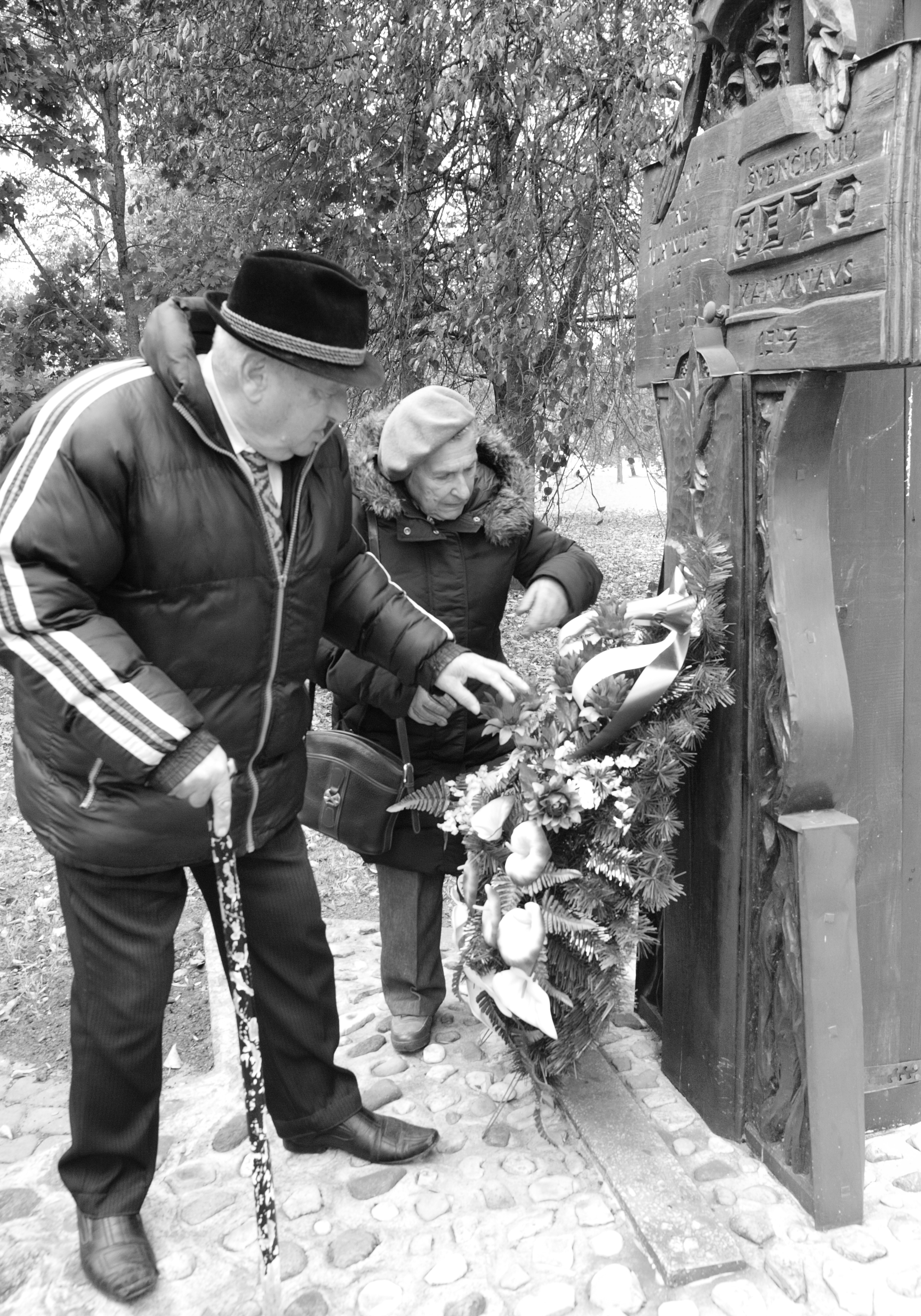
Moisejus Preisas and Fania Brancovskaja lay a wreath at the Menorah statue in Švenčionys
Every year at the beginning of October a small group of people gather at the Menorah statue in the Švenčionys City Park who remember what happened there from 1941 to 1943.
This year Švenčionys Jewish Community chairman Moisiejus Šapiro began the meeting and presented Nalšia Regional History Museum historian Nadežda Spiridonovienė, who spoke about historical events in Švenčionys and how Jewish settlement in Lithuania was a result of tragedies in Western and Central Europe in the 19th century.
“Lithuania was an agrarian country and belonged to the large non-industrial part of Russia. Most of the country people were Catholic Lithuanians, Belarusians and Poles. This was the main factor in the locals’ relationship with Jews. To Lithuanians, Belarusians and Poles, it seemed the Jew was clever and wise because of his many talents. Jews were small businessmen and craftsmen who traveled around and were much valued for spreading information as bearers of news. There were about 4,500 Jews living in Švenčionys then, they established an herbal medicine factory and had leather-working workshops in the city center. The hard work, initiative and expertise of Jewish business people expressed themselves in all areas of production.
VILNIUS, October 21, BNS–Litvaks, or Jews originating from Lithuania, played a key role in establishing both Lithuania and Israel, Lithuanian president Dalia Grybauskaitė said at the opening of the World Litvak Forum in Israel.
She said Litvaks are among the most active Israeli public, business, cultural and political figures who have worked effectively in all the parliaments of democratic Lithuania, both in the interwar period and after the country regained independence in 1990.
“Litvaks have always been among the most active Israeli public, business, cultural and political figures, they still are and will continue to be so,” the Lithuanian president said in a press release published by the presidential press service.
She applauded the Litvak contribution to the Lithuanian economy, culture and science.
President Grybauskaitė said Lithuania and Israel cherish democracy, human rights and a culture of tolerance, and that world-wide challenges including terrorism and aggression are problems the two countries share.
According to a census in 201ą, 3,000 Jews lived in Lithuania. In Israel the Lithuanian Foreign Ministry calculates there are about 200,000 Litvaks and their descendants, the world’s largest Litvak community.
BNS
The Alexander Macht Chess Tournament will be held at the Lithuanian Jewish Community at Pylimo street No. 4 at 6:00 P.M. on Sunday, October 18. The tournament was organized by the LJC and the elite chess and checkers clubs Rositsan and Maccabi.
Boris Rositsan gave the LJC website a small interview in the run-up to the tournament where, he said, at least 30 people are planning to play. Special medals have been ordered for this competition.
What does the name Alexander Macht signify?
Boris Rositsan: Alexander Macht is an historical figure and a very important person in the history of Lithuanian chess as well as Jewish. We cannot forget this sort of person, so we are continuing the tradition of tournaments. In interwar Lithuania he was Lithuanian champion seven times over. Macht lived in Kaunas and was director of the Jewish People’s Bank. He went to Israel in 1935 and directed the famous Bank Leumi there. No one wrote, said or remembered anything at all about this great chess player during the Soviet period. We have prepared a program dedicated to Litvak chess players. After we presented our book “Žydai Lietuvos šachmatų istorijoje” [“Jews in Lithuanian Chess History”] at the beginning of this year, LJC chairwoman Faina Kukliansky asked us why weren’t continuing that history. I would like to say that we are preparing to do just that in cooperation with the community. We are holding two tournaments, this is for adults, but if strong young chess players come forward, we will include them. On October 31st there will be a tournament dedicated to the memory of Itzhak Vistinietzki [Isakas Vistaneckis] and children will play in that. We are inviting children aged five and over to come and learn to play chess. We have student groups at the community for the ages of 5, 6, 7… and 13 years old. Also, elderly and retired LJC members are coming to us. Fishman is helping me with the training. Serious work is taking place, non-commercial, I really love chess and I want to revive the LJC chess movement.
A memorial plaque has gone up on the building at Vilniaus street No. 5 in Bluma Katz’s hometown of Švenčionys. Bluma Katz was the first chairwoman of the Švenčionys Region Jewish Community. City and regional administration leaders, Lithuanian Jewish Community chairwoman Faina Kukliansky, deputy Israeli ambassador to Lithuania Yehuda Gidron and local residents gathered to remember her at the ceremony to unveil the new plaque.
Katzs was born in Švenčionys in 1913, studied at a Jewish gymnasium and continued her education in Vilnius where she was an active participant in Jewish life. Her teachers included well-known Jewish scholars and writers such as Max Weinreich and Zalman Reyzen, among others. She moved to Russia with her future husband Sh. Yavich. They were both arrested there in 1937, with Bluma Katz sentenced to ten years at a Stalinist gulag in Kolyma. She returned, remarried to her second husband Segalovich, to her hometown, Švenčionys, in 1947. She completed nursing courses and worked for the next 42 years at the city hospital. After Lithuanian independence Katz formed and led the Švenčionys Jewish Community and was noted for her sincere and personal concern for every member of the community. Katz’s memoirs have been published in Lithuania and the West and she always consented cheerfully to meet students from around the world coming to Vilnius to study Yiddish. Katz also attended Yiddish workshops at Oxford University in Great Britain.
October 11, 2015. The Švenčionys Jewish Community commemorated Holocaust victims at the Menorah statue. Švenčionys city leaders, Lithuanian Jewish Community chairwoman Faina Kukliansky, Vilnius Religious Jewish Community chairman Simas Levinas, deputy Israeli ambassador Yehuda Gidron, Dr. Dovid Katz and local residents all attended the sad ceremony. Švenčionys Jewish Community chairman Moisiejus Šapiro thanked everyone for coming despite the cold weather to remember those who were murdered. Kaunas ghetto inmate Moisiejus Preisas and Vilnius ghetto prisoner Fania Brancovskaja laid flowers next to the statue. A representative from the local Nalšia regional history museum spoke about the history of the city of Švenčionys, contributions made by Jews to the growth of the city and the tragedy of the Holocaust.
The ceremony to commemorate the dead continued at a mass murder site where eight thousand Jews were murdered in the Švenčionys Forest. Deputy Israeli ambassador to Lithuania Gidron, after hearing eight thousand Jews were murdered at the site, and that six million in total were murdered over a few years, said it is difficult to comprehend those numbers. “I am glad the Švenčionys municipality is planning to erect a memorial plaque with the names of the Jews murdered next to the Menorah statue in the former ghetto territory. This is important not just for each of us, but also for everyone who lives in Švenčionys,” he said.
Lithuanian Jewish Community chairwoman Faina Kukliansky said: “We should remember not just the names of those who were murdered, but the names of those who murdered as well. This is necessary not just for condemnation or revenge, because those who are some still alive are very old, while others have passed on and stand in the court of the Almighty. I think it is necessary for all of us, their inheritors, so that our neighbors might know by whose hand the most horrific crime of the 20th century was committed. Because only when everyone whose hands were sullied with the blood of innocent victims is named and condemned, even if only in our thoughts, only then can we start to hope Lithuania might rid itself of its shameful title as a ‘nation of Jew-shooters’,” she said.
Vilnius Choral Synagogue cantor Shmuel Yatom said Kaddish for the dead.
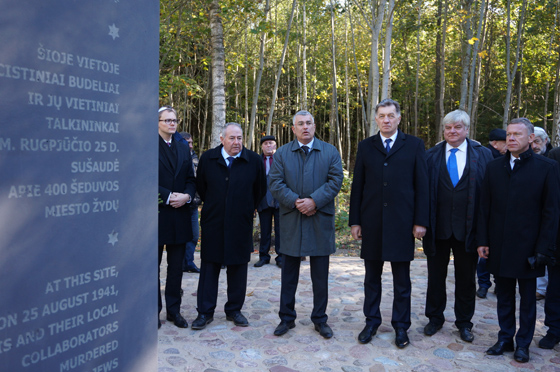
Lithuanian prime minister Algirdas Butkevičius, representatives of the Lithuanian Ministry of Foreign Affairs, foreign ambassadors to Lithuania, Radviliškis regional administration representatives and Jews from all over the world as well as local residents attended a ceremony to commemorate the murdered Jews of Šeduva, Lithuania, and a ceremony to kick off the Lost Shtetl Šeduva Jewish memorial project.
They visited the restored Jewish cemetery and three mass murder sites as well as attending the ceremony for the unveiling of a monument to the Jews of Šeduva in the town center. Under private initiatives architectural compositions by the sculptor Romuoldas Kvintas now greet visitors to two mass murder sites in the Liaudiškiai forest and one in the Pakuteniai forest.
The Antanas Žmuidzinavičius Museum of Works and Collections in Kaunas (Vlado Putvinskio street No. 64) is hosting an exhibit of original documents from the personal collection of Michailas Duškesas on Jewish life in Lithuania before the Holocaust.
This unique exhibit is being shown for the first time in Kaunas. It is dedicated to the Jews of Lithuania who were murdered in the Holocaust. A wide range of archival material, photographs, original documents and postcards show Jewish life in Kaunas and throughout Lithuania at the end of the 19th and early 20th century. Jewish activity is presented under the principles of mutual aid, sponsorship and welfare. The exhibit features notable personalities, religious organizations, banks, agencies and credit unions.
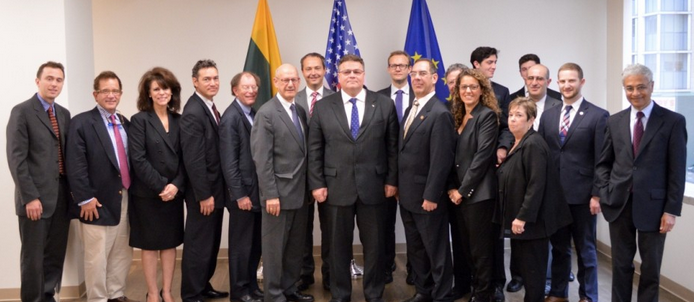
Lithuanian foreign minister Linas Linkevičius met October 2 with directors and representatives of leading US and world Jewish organizations in New York City during the current session of the United Nations general Assembly.
They discussed important issues including UN effectiveness, battling anti-Semitism and other forms of hate, policy on Iran, the Mideast peace process and current issues in safeguarding the Lithuanian Jewish heritage at the Lithuanian general consulate in New York. The Lithuanian foreign minister said ever more Lithuanians are discovering the rich Litvak heritage, understand the need to protect that legacy and take pride in the remarkable contributions Litvaks have made to world culture.
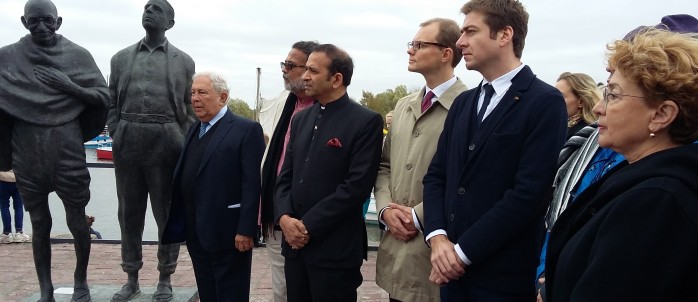
On Friday, October 2, 2015, a statue commemorating the friendship between Mohandas Gandhi and Rusnė resident Hermann Kallenbach was unveiled in Rusnė.
VILNIUS, October 2, BNS–A statue portraying Indian independence hero Mohandas Gandhi and his friend Jewish architect Hermann Kallenbach was unveiled Friday in Kallenbach’s hometown, Rusnė, located in the Šilutė region of Lithuania.
Lithuanian prime minister Algirdas Butkevičius was at the ceremony and called the bronze statue a monument to Lithuanian-Indian friendship and a testimony to the achievements of Litvaks. “Today is unveiled a monument to friendship, between two people and two peoples,” he said, standing next to the almost two-meter-tall statue of the two men on the banks of the Atmata River on the border with Russia’s Kaliningrad Oblast. Gandhi and Kallenbach, who left Rusnė in his youth, became friends in South Africa at the beginning of the 20th century.
Gandhi’s great-grandson Tushar Gandhi attended the ceremony and said non-violent resistance unite India and Lithuania. He said Kallenbach was an important spiritual influence on his ancestor.
“Lithuania is still a little-known country in India,” Lithuanian ambassador to India Laimonas Talat-Kelpša told BNS. “This is a good opportunity to bring the attention of Indian society to Kallenbach and Lithuania.”
On September 25 the Klaipėda Jewish Community visited Švėkšna for the “Let’s Save the Švėkšna Synagogue” event. A guide provided an excellent tour and told of Švėkšna, its history and important sites. Volunteers took members to the old Jewish cemetery and mass murder sites. The Klaipėda delegation met with the group from Kaunas and were treated to the songs of Vitalijus Neugasimovas.
Members of the Klaipėda Jewish Community along with the rest of the audience were much impressed with the visual presentation on the history of the Švėkšna Synagogue.
Even so, members on the return trip wondered if the money hadn’t been better spent repairing the synagogue roof.
Snapshots here:
https://www.facebook.com/klaipedajewish