History of the Jews in Lithuania

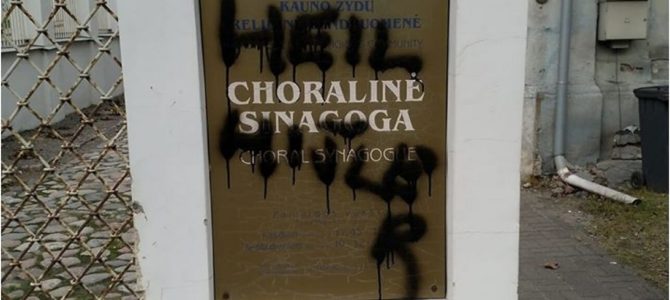
Kaunas Synagogue Vandalized with Heil Hitler Graffiti

Kaunas Synagogue Vandalized with Heil Hitler Graffiti

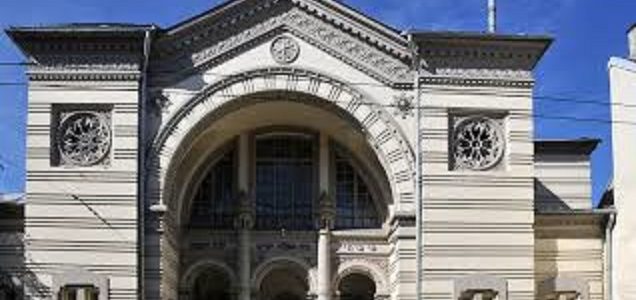
The entrance to the Choral Synagogue in Kaunas was vandalized with a Heil Hitler inscription in black paint. The desecration was discovered Saturday morning and was likely committed during the foregoing night.

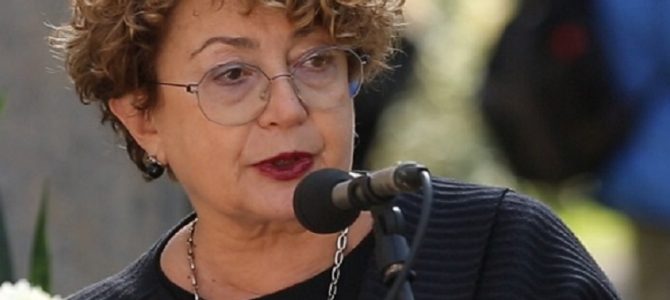
Lithuanian Jewish Community chairwoman Faina Kukliansky says this anti-Semitic attack against the synagogue in Kaunas confirms attacks on Jews are continuing. There have been five in just the last few months in Vilnius, Kaunas and Šiauliai. Despite criminal investigations, no one has been brought to account so far.

Police spokesman Ramūnas Matonis told BNS said the incidents were undoubtedly anti-Semitic. He said investigations have been started on sowing ethnic discord.

LJC chairwoman Kukliansky said the attacks coming just before important Lithuanian Jewish events were especially surprising.
Goodwill Foundation Announcement on Holocaust Restitution

November 22, 2019

Press Release

Regional Consultation on Restitution of Holocaust-Era Assets

At the beginning of December a regional conference on the restitution of Holocaust-era assets will be held in Vilnius. The experiences of returning assets of European countries will be reviewed and well-known historians will present their research about what happened in Lithuania during WWII.

The conference is dedicated to commemorate the 10th anniversary of Terezin declaration. In 2009, 47 countries, Lithuania among them, signed the document in Praha and announced a program of activities directed at securing assistance, compensation and commemoration of the memory of the victims of the Nazis. It’s noteworthy these countries stressed the importance of ensuring communal and individual property restitution.

“Noting the importance of restituting communal and individual immovable property that belonged to the victims of the Holocaust (Shoah) and other victims of Nazi persecution, the Participating States urge that every effort be made to rectify the consequences of wrongful property seizures, such as confiscations, forced sales and sales under duress of property, which were part of the persecution of these innocent people and groups, the vast majority of whom died heirless,” the Terezin declaration says.

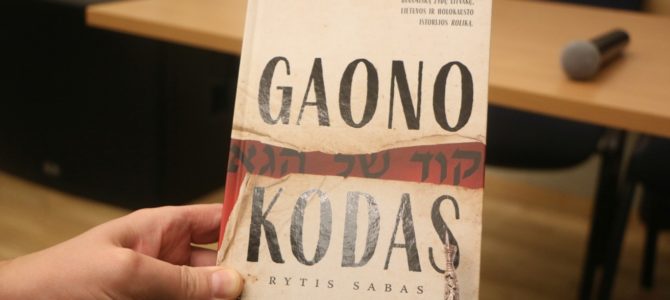
Launch of Book “Gaon Code”

Launch of Book “Gaon Code”

On Wednesday, November 20, the Lithuanian Jewish Community hosted the launch of a new book called the Gaon Code, a slightly dramatized retelling of Litvak history in Lithuania and abroad.

LJC chairwoman Faina Kukliansky introduced author Rytis Sabas and journalist and historian Rimvydas Valatka, who spoke about his media colleague and the skepticism he felt when Sabas told him he had written a book. That skepticism soon turned to enthusiasm as Valatka, who says he isn’t a literary critic, was drawn into story, which he called a thriller. Valatka played an interview he had conducted with Sabas for LNK television.

Rytis Sabas spoke briefly before presenting a slideshow on the overhead with diverse images of Jewish Lithuania. He then spoke about the book, saying it was 80% historical fact.

During questions Sabas said he had named the book Gaon Code intentionally with Dan Brown’s Da Vinci Code in mind. He said he initially wanted to write a book which would be interesting to an international audience, but after he learned more about Litvak history, he realized Lithuanians needed to learn this part of their country’s own incredible history.

Photography by Dovilė Abromavičiutė

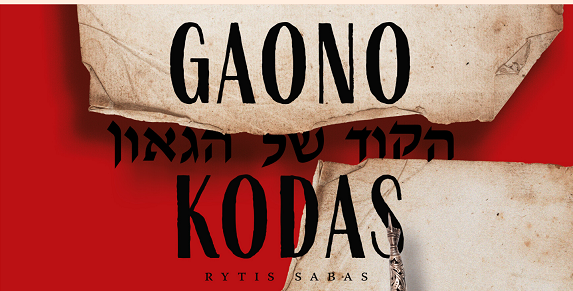
Presentation of the Gaon Code

Presentation of the Gaon Code

You’re invited to a presentation of the adventure novel the Gaon Code at 6:00 P.M. on November 20 at the Lithuanian Jewish Community in Vilnius. The novel stems from a Lithuanian man’s desire to demonstrate the significance of Litvaks in Lithuanian and world history. The book presents in an easily readable form numerous facts and stories about the Jewish communities of Vilnius, Želva and Ukmergė and about their contributions to learning and history.

Author Rytis Sabas and Lithuanian historian and journalist Rimvydas Valatka will discuss the book and its inspiration.

Rytis Sabas is also a journalist from Vilnius interested in history. He has travelled extensively including in Bosnia. Kosovo, Afghanistan and Iraq.

The book is an adventure including a plethora of historical fact and some light fiction. While it attempts to show the grandeur and influence of the Vilna Gaon, it’s intended more to showcase Litvak history and the Litvak heritage. It’s aimed at outsiders, readers who might not know much about Lithuanian Jews.

The book is written in Lithuanian and the presentation will be conducted in Lithuanian. For more information, call 8 678 81 514.

Survey of Anti-Semitism in the European Union

Dear friends and colleagues,

Tomorrow, 81 years ago, the Nazi regime ordered a concentrated pogrom against Jewish communities. At least 91 Jews were murdered, hundreds of synagogues were burnt down and thousands of Jewish-owned businesses and houses were looted. Krytasllnacht or the Night of Broken Glass would be remembered as the beginning of the Holocaust and the extermination of six million Jews. More than 75 years after the Holocaust some prefer to think anti-Semitism has been banished from our societies, yet as we witness again and again violence and murder inspired by a hatred of Jews, we can see that anti-Semitism remains deeply ingrained in Europe. The anti-Semitic attack last month on the synagogue in Halle, Germany, once again reminded us anti-Semitism remains a threat to our European values and that we must remember we have responsibilities arising from our shared history.

City of Vilnius Again Promises to Remove School from Great Synagogue Site

City of Vilnius Again Promises to Remove School from Great Synagogue Site

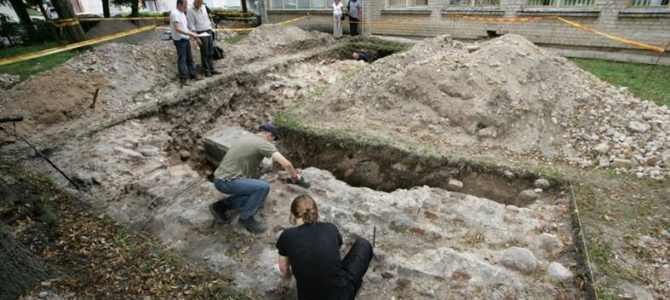
The newspaper Kauno Diena reports the Vilnius city council has voted to raze and remove a brick school building from the Great Synagogue archaeological site in the Lithuanian capital.

The school built 55 years ago hasn’t been in operation for several years but is being rented by 10 renters, following an earlier announcement by the city of Vilnius it would be completely removed. The city’s promise of the imminent removal of the school has become a standing joke among the team of international archaeologists who have been conducting digs every summer there for five years.

Lithuanian news report here.

Vil, Nor Goen: Lithuanian Mint to Issue 10 Euro Vilna Gaon Coin

Vil, Nor Goen: Lithuanian Mint to Issue 10 Euro Vilna Gaon Coin

The Bank of Lithuania is planning to issue a coin commemorating the 300th anniversary of the birth of the Vilna Gaon in 2020.

It will bear an inscription in Yiddish and Lithuania, the phrase “Vil, Nor Goen,” which is a Yiddish pun meaning: if you want, you, too can become a genius, or gaon (sounds like “vilner Gaon”). “Gaon” originally comes from the word “genius” in Greek and traditionally refers to the Jewish exarch or spiritual leader in rabbinical Judaism. The Vilna Gaon is the latest and best-known of these figures.

The reverse side of the coin features the Hebrew letter shin, which also means 300. The letter shin is featured in well-known portraits of the Gaon wearing phylacteries. The shin on the phylacteries means that besides the Sabbath, the Jewish year has 300 days devoted to prayer.

Juozas Ambrazevičius-Brazaitis Was Neither Exonerated Nor Rehabilitated

Juozas Ambrazevičius-Brazaitis Was Neither Exonerated Nor Rehabilitated

by Arkadijus Vinokuras

That was what U.S. congressman Brad Sherman told Lithuanian prime minister Saulius Skvernelis in his letter. He asked the prime minister to provide evidence demonstrating Juozas Ambrazevičius-Brazaitis, the head of the Lithuanian Provisional Government in 1941, was rehabilitated and acquitted by the U.S. Congress and the U.S. Immigration and Naturalization Service in 1974. Because this is something the Lithuanian Genocide Center has been claiming for about 10 years now. The congressman said this belief is baseless and contradicts U.S. law.

Sherman in the letter says without any doubt the Genocide Center’s findings on the exoneration and rehabilitation of the former LPG leader has no legal foundation at all. He says an investigation in 1974 was dropped because the man died and there was a lack of documents on Ambrazevičius-Brazaitis’s activities in Holocaust crimes. He said the U.S. Justice Department created a new section in 1979 which with the appearance of new information went on to investigate 60 Nazi criminals who had immigrated to the United States.

Why weren’t documents found? First, in 1944 Juozas Ambrazevičius changed his name to Juozas Brazaitis. In other words, he hid the fact of his change of surname from the U.S. immigration service. Second, the U.S. had a policy after the war of granting immunity to alleged war criminals who had information of use to the Central Intelligence Agency. Third, the section created by the Justice Department in 1979 had a staff of just three people who had no training or experience in investigating Holocaust crimes. Fourth, the Lithuanian archives only opened their doors after the fall of the Soviet empire.

Rule of Law? Not Funny

Rule of Law? Not Funny

by Arkadijus Vinokuras

Today’s Lithuania has utterly failed to give birth to political visionaries prepared to replace society’s erroneous tolerance of legal nihilism. What other explanation could there be for president Gitanas Nausėda’s reluctance to criticize the wanton behavior of the nationalists? It seems the state has been encompassed by legal paralysis again, just as in the “good old days” of the violet criminals [apparently a reference to a pedophilia scandal in Lithuania–translator].

It requires exceptional courage to change society’s flawed tenets. Especially when a portion of citizens consumed by fear still seek strength from Lithuania’s authoritarian past.

Looking back over 30 years of Lithuanian society’s process of becoming freer, one cannot fail to see this process has become stuck. Over these years no Lithuanian political party has been able to look directly without fear at Lithuanian history in the bloody years from 1941 to 1944. No political party has been able to offer an alternative to the pre-war authoritarian nationalism which holds no respect for the principles of the legal state and the rule of law.

Faina Kukliansky Proposes Special Attention Be Paid to Anti-Semitic Crimes

Faina Kukliansky Proposes Special Attention Be Paid to Anti-Semitic Crimes

Lithuanian Jewish Community chairwoman Faina Kukliansky says in light of increasing anti-Semitic graffiti recently the Lithuanian criminal code could be expanded to include acts of vandalism against Jews.

“Anti-Semitism is assigned a special article in the criminal code in Britain. I don’t know whether anyone in Lithuania is making graffiti against Tatars. But the swastika is a thing which recalls the Holocaust during which the community was exterminated. So it’s clear these crimes need to be taken care of. If we are given such exceptional treatment from the anti-Semite camp, then perhaps we should be given special treatment by the state as well,” she said.

Justice minister Elvinas Jankevičius says the criminal code currently allows for bringing to criminal account the sowing of ethnic or religious discord, and that such law would be excessive. Kukliansky told BNS there were five such incidents over the past month in Vilnius, Šiauliai and the Kaunas region, with swastikas, crossed-out stars of David and the vandalization of a statue in Šiauliai honoring 20th century industrialist Chaim Frenkel.

Full story in Lithuanian here.

Correction

Correction

Lithuanian Jewish Community chairwoman Faina Kukliansky says she and Rabbi Sholom Ber Krinsky never agreed on setting up a yeshiva in the Choral Synagogue in Vilnius. She says there was never any discussion about a Chabad Lubavitch Hassidic synagogue in Vilnius. Back in 2001 Rabbi Krinsky tried to set up a Hssidic synagogue but encountered opposition from Mitnagid Jews of Vilnius.

When Vilnius Religious Jewish Community chairman Simas Levinas announced in September, 2019, a yeshiva would be established at the synagogue, people began asking what kind of yeshiva it would be. During Rosh Hashanah Rabbi Krinsky spoke about the similarity between the Vilna Gaon and Chabad Lubavitch, but Lithuanian Jews know about the Litvaks’ opposition to Hassidism which began in the 18th century, about resistance to the movement which resulted in two groups of Jews, Hassidim and Mitnagdim.

These days Chabad rabbis are asked to work at Jewish Orthodox Mitnagid synagogues. This is acceptable. It was agreed with Rabbi Krinsky that he would conduct prayer services in the Litvak way. No one is opposed to the desire of opening a yeshiva. Chabad Lubavitch has its own building on Bokšto street [in Vilnius]. The rabbi may do whatever he likes there, for example, opening a yeshiva.

Vilnius, Jerusalem of Lithuania Jewish Community Gives New Book to Holocaust Survivors

Vilnius, Jerusalem of Lithuania Jewish Community Gives New Book to Holocaust Survivors

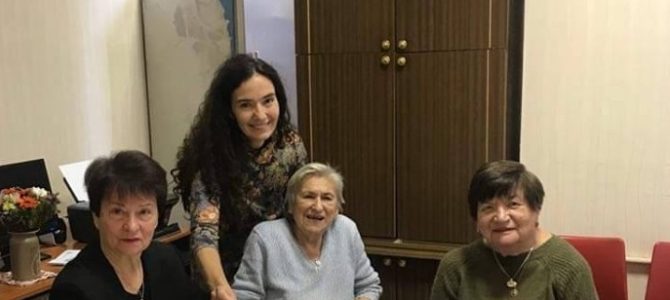
The Vilnius, Jerusalem of Lithuania Jewish Community has provided every member of the Union of Former Ghetto and Concentration Camp Inmates a copy of the Russian edition of the book “Irena Veisaitė: Life SHould Be Transpartent” by A. Švedas and translated by Anna Gerasimova, published by the Lithuanian Jewish Community. The Social Programs Department will help us distribute the book to senior citizens living outside Vilnius. Thank you!

YIVO to Lend Lithuania Vilna Gaon Synagogue Pinkas

YIVO to Lend Lithuania Vilna Gaon Synagogue Pinkas

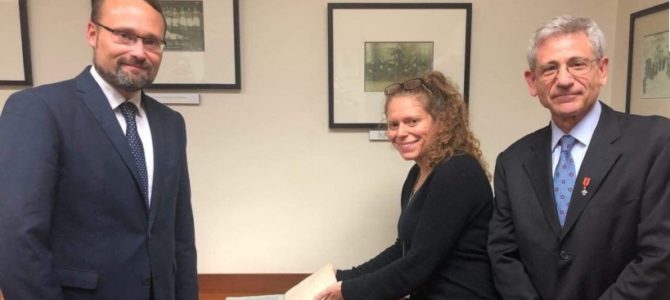
The board of directors of New York’s YIVO has voted to lend the pinkas of the Vilna Gaon synagogue to Lithuania for exhibition following a meeting with Lithuanian minister of culture Dr. Mindaugas Kvietkauskas, YIVO director Jonathan Brent said.

This is the book of vital statistics for the local Jewish community, a priceless source of information on the life of the Vilnius Jewish community. The document will be lent in 2020 as Lithuania marks its Year of the Vilna Gaon and Litvak History. The plan is to show it at the Lithuanian National Martynas Mažvydas Library.

Full story in Lithuanian here.

Story of a Man of God

Story of a Man of God

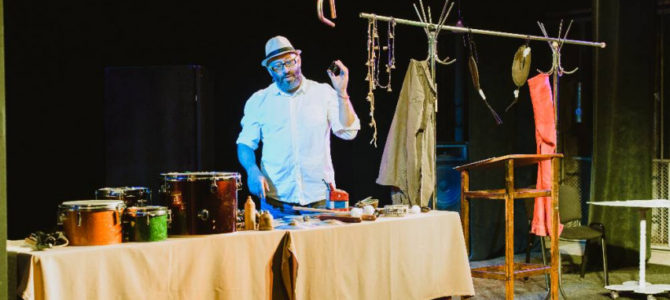
Arkadijus Gotesmanas working together with director Adolfas Večerskis and artist Linas Liandzbergis created the Story of a Man of God almost a decade ago. Author of the music and text, he was also the performer of this drama. One week ago it was presented to an audience in Uzhgorod, Ukraine. In the one-man play Gotesmanas recalled horrible, funny, sad and happy events from his own life accompanied by creative percussion, the life of one man, one family, one people marked by the tragedies of the 20th century but nonetheless filled with unconditional love for faltering humanity.

The audience in Uzhgorod listened and watched in rapt attention. Arkadijus was born there 60 years ago. The “hometown boy” appears to have impressed the audience with his high degree of creativity, talent and musical ability. Arkadijus said he only really knew about “our Uzhgorod” from his parents before this. In infancy he and his parents left the city. So the next performance of Story of a Man of God might include this trip as well.

Full story in Lithuanian here.

Thank You

Thank You

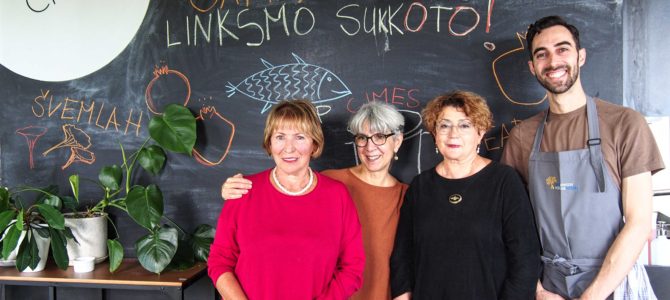
Lithuanian Jewish Community chairwoman wants to thank Bagel Shop Café director Dovilė Rūkaitė and senior cook Riva Portnaja for their wonderful idea to hold a Litvak culinary luncheon with a delegation from the Taube Jewish Heritage Tours with partial support from the Ethnic Minorities Department, and for their tireless enthusiasm in promoting and passing on the Litvak Jewish culinary heritage. Thank you to Taube delegation leader and Ashkenazi cooking expert Jeffrey Yoskowitz and to all the volunteers and guests who made this event so much fun. It was good to sit down together at a shared table and it was very delicious.

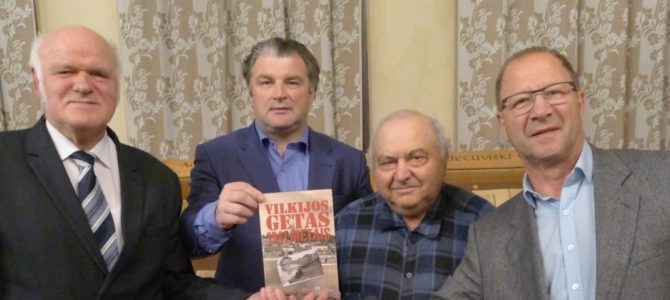
Launch of Book about Vilkija Ghetto in Kaunas

Launch of Book about Vilkija Ghetto in Kaunas

The rare books department of the Kaunas Public Library hosted the launch of the book “Vilkijos getas. 1941 metai” by Aleksandras Vitkus and Chaim Bargman. Vilkija deputy alderman Algimantas Smolenskas led the event.

Kaunas Jewish Community chairman Gercas Žakas spoke about Lithuanian Jewish community activities before 1940 and the active participation of Jews in the country’s cultural, economic and social life.

Participants discussed current commemoration policies, Lithuanian and Jewish relations, what goes into determining Nazi collaboration, education and other topics.

The Jewish community formed in the village of Vilkija, just 30 kilometers from Kaunas, in the late 18th century. According to the censuses, there were 652 Jews in Vilkija in 1766, 789 in 1847 and 1,431 out of a total population of 2,012 in 1897.

Sukkot Celebration with Guests from America and Baked Gefilte Herring

Sukkot Celebration with Guests from America and Baked Gefilte Herring

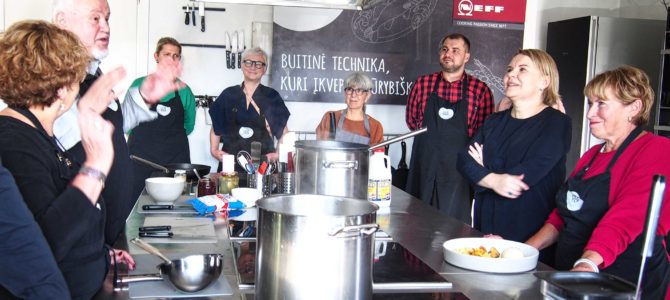
It’s long been the tradition during SUkkot to set up a booth, invite guests and treat them to various family recipes. While they say there is no traditional Sukkot dish, it does seem to be characteristic to make things which are stuffed and rolled, like the Torah scroll. Stuffed cabbage and filled pancakes are popular.

Ashkenazi cooking expert Jeffrey Yoskowitz visited the Lithuanian Jewish Community on the first day of Sukkot and made select dishes from the Litvak culinary legacy. Guests–loves of Litvak cooking–joined in and for every dish there were multiple stories and recollections from childhood. There was even a dispute on the correct form cut carrots should take.

Jeffrey Yoskowitz is leading a Taube Jewish Heritage Tours tour currently in Lithuania. He and Dovilė from the Bagel Shop Café had a long discussion on which dishes to include in cooking workshops. In the end they arrived at the solution of Litvak exceptionalism: to select the dishes which Polish Jews don’t make and which are unknown to the American Jewish community.

U.S. Rep Sends Letter to Lithuanian PM: We Never Exonerated Juozas Ambrazevičius-Brazaitis

U.S. Rep Sends Letter to Lithuanian PM: We Never Exonerated Juozas Ambrazevičius-Brazaitis

by Vilius Petkauskas, 15min.lt

Lithuanian prime minister Saulius Skvernelis has received a letter from the Congress of the United States requesting Lithuania stop claiming U.S. institutions had found Lithuanian Provisional Government prime minister Juozas Ambrazevičius-Brazaitis hadn’t been party to the genocide of Lithuanian Jews [was not a Holocaust perpetrator] in 1941.

According to information available to 15min.lt, the chairman of the [subcommittee on Asia of the] Foreign Affairs Committee [representative Brad Sherman of California] sent a letter to Skvernelis which asks the Lithuanian PM to require the Center for the Study of the Genocide and Resistance of Residents of Lithuania to stop claiming erroneously Ambrazevičius-Brazaitis had been exonerated. Prime ministerial press representative Tomas Beržinskas confirmed such a letter had been received.

“Yes, the prime minister has received such a letter. A reply has not been drafted yet,” he told 15min.lt

Full article in Lithuanian here.

Walls That Remember Art Installation Vandalized

Walls That Remember Art Installation Vandalized

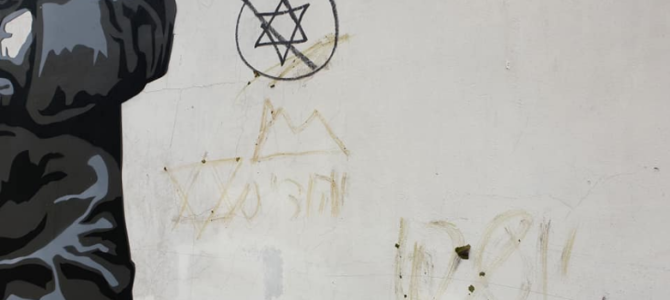
The main feature of the Walls That Remember project has been vandalized with anti-Semitic graffiti in central Vilnius.

The project aimed to remind passer-by of Vilnius’s rich Jewish past by portraying scenes from Jewish life in what was mainly the Jewish quarter of the Vilnius Old Town before World War.

Over the weekend someone added a star of David crossed out with the void symbol to the wall next to the painting. Project staff issued the following statement:

Cooperation or Collaboration: Who Deserves a Statue in Vilnius?

Cooperation or Collaboration: Who Deserves a Statue in Vilnius?

by Vytautas Plečkaitis, formerly Lithuania’s ambassador to the Ukraine and Switzerland

Seventy years having passed since World War II, disputes over collaboration with the Nazi regime in Germany continue in Lithuania, in neighboring Poland and in other Central and Eastern European countries.

The generation who grew up in the period of freedom and independence want to know the whole truth about the crimes of the Communist regime and the crimes of the German Nazis and those who collaborated with them and took part in the Holocaust. This is demanded of us by basic human nature, and historical memory of the Jewish community who lived in our land [sic] since the time of Vytautas the Great and who were annihilated hasn’t been fully taken into account.

Full text in Lithuanian here.