Religion

Thank You for Ten Productive Years Together, Madam President

Thank You for Ten Productive Years Together, Madam President

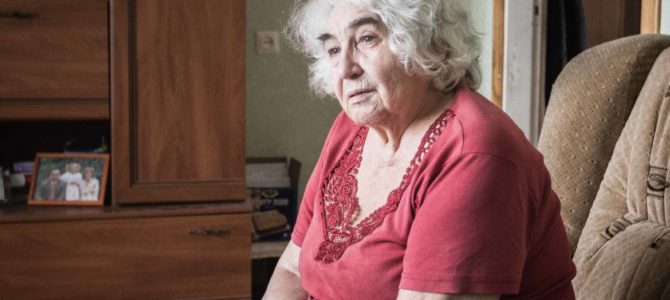
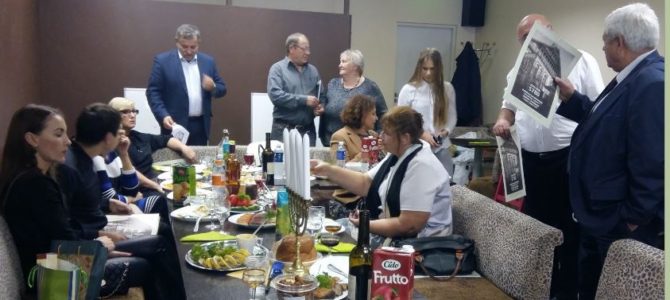
Photo: Lithuanian president Dalia Grybauskaitė, right, at photo exhibit on rescuers of Jews

Your excellency, madam president Dalia Grybauskaitė,

The Lithuanian Jewish Community send you our sincerest thanks for the ten years you have devoted to Lithuania and the people of Lithuania. We are grateful for the firm political position you’ve taken in complicated situations and your resolute decisions.

Israeli president and Litvak Shimon Peres visited Lithuania in 2013 and we witnessed the birth of a new era of close cooperation between Lithuania and Israel. The year 2013 was also the year restitution began, when Lithuania, first among the countries of the region, undertook a firm legal obligation to make compensation for Jewish communal property seized during the Holocaust and to make symbolic restitution to Holocaust victims for the losses they experienced. In 2017 you decorated Fania Brancovskaja, a member of the underground resistance in the Vilnius ghetto and one of the liberators of the ghetto, recognizing her actions as worthy of merit to Lithuania. This was another important sign of respect for the memory of the Holocaust in Lithuania. In 2018 Israeli prime minister Binyamin Netanyahu visited Lithuania, demonstrating the highest respect to the country and to the Lithuanian Jewish Community. In September of 2018 we prayed with Pope Francis, Catholics and Jews together, in memory of the victims of the Vilnius ghetto. This year, in the run-up to 2020 as the Year of the Vilna Gaon and Litvak History, we visited the archive of the YIVO institute in New York City, where a portion of the statistics on the Jewish population once kept by the Great Synagogue in Vilnius are conserved, again recalling the memory of the lost Jerusalem of Lithuania.

Thank you for the important step we have taken together on the road to mutual understanding between Jews and Lithuanians.

With respect and gratitude,

Faina Kukliansky, chairwoman
Lithuanian Jewish Community

Opening Ceremony for Synagogue Square Memorial in Jurbarkas

Opening Ceremony for Synagogue Square Memorial in Jurbarkas

The official opening ceremony for a new memorial commemorating the memory of the Jews of Jurbarkas, Lithuania, will be held at 12 noon on July 19 at Kauno street no. 64 in Jurbarkas. At 2:30 P,M. the choral group Aukuras from Klaipėda will perform at the Transfiguration of Christ Orthodox church. At 3:30 there will be a look back at the Synagogue Square Memorial Project at the Grybas Museum at Vydūno street no. 31, and at 4:30 there will be a meeting and discussion with the authors and creators of the memorial at the Jurbarkas Regional Public Library at Vilniaus street no. 4.

Grandson of Famous Rabbi Dovid Shapiro Visits Panevėžys

Grandson of Famous Rabbi Dovid Shapiro Visits Panevėžys

After a half-year of correspondence, Dovid Shapiro’s family helped fly grandson Ernest Milton (Shapiro) Hurwich with his daughters Anna Rut and Liba to Panevėžys from the USA. Ernest is the grandson of famous rabbi Dovid Shapiro and the family came to research their roots.

Rabbi Shapiro and his relatives lived the city of Panevėžys and in small towns in the region, according to documents discovered in the Panevėžys Jewish Community’s archives. More than 30 members of the Shapiro clan lived around the Jewish hospital on Ramygalos street in Panevėžys. The visitors were able to view original photographs and buildings and houses where Rabbi Dovid Shapiro and his brother Moshe were born and raised. The tumult of historical events and wars disrupted Jewish life and Panevėžys Jews entered a new phase of life after World War I when many migrated to South Africa, South America, the USA and Palestine. Dovid Shapiro’s family settled in the United States. His brother Moshe remained in Lithuania and was murdered in the Holocaust.

Anna Rut Hurwich is the genealogist in the family and is carefully investigating the family’s history.

Šiauliai Regional Jewish Community: Ona Šimaitė Commemoration in Akmenė

Šiauliai Regional Jewish Community: Ona Šimaitė Commemoration in Akmenė

A day-long commemoration of Righteous Gentile Ona Šimaitė lasting into the evening will be held in Akmenė, Lithuania, July 22. “Šimaitė Invites You to Speak” is a project dedicated to honoring the local Jewish community and Ona Šimaitė and Righteous Gentiles in general. It was initiated by the Marijus and Diana Lopaitis family with the Akmenė regional public library and with support from the Akmenė town community, the Lithuanian Cultural Council, the Jakovas Bunka support fund, the Šiauliai Regional Jewish Community and the Akmenė regional administration to be held on the birthday of the town of Akmenė.

Events will take place at the Akmenė Regional History Museum at Kasakausko street no. 17 and the Akmenė House of Culture at Sodo street no. 1 in Akmenė.

Program:

11:00 Conference “Šimaitė Invites You to Speak” (Akmenė Regional History Museum)

part 1: The history and fate of the Akmenė regional Jewish community
part 2: Ona Šimaitė: The Story of a Righteous Gentile
part 3: Official openings of exhibits including of manuscripts by Šimaitė, a photo exhibit called “Kaddish for the Wooden Synagogues of Lithuania” and carvings and the exhibit “The Litvak Literary Legacy” by the Akmenė regional public library.

Archaeological Dig Resumes at Great Synagogue Site in Vilnius

Archaeological Dig Resumes at Great Synagogue Site in Vilnius

The summer archaeological dig at the site of the former Great Synagogue in Vilnius is set to resume this year starting July 1 and running to July 19. The team includes archaeologists from Lithuania, the USA and Israel. The continuing exploration of the site is being supported by the Goodwill Foundation in partnership with the Israeli Antiquities Authority and the Lithuanian Jewish Community.

In 2011 the team discovered the exact boundaries and fragments of the former building. In 2016, 2017 and 2018 they explored the former mikvot, or bathhouses used for ritual purification and located the central bimah of the synagogue.

This year they hope to continue exploring the remains of the building and to locate the aron kodesh, the ark used to house the Torah scroll in synagogues. Within the first three days of digging the team had already uncovered the rear entrance to the main hall of the subterranean synagogue, a set of descending steps located near the mikvot.

Lietūkis Garage Victims Remembered in Kaunas

Lietūkis Garage Victims Remembered in Kaunas

The anniversary of the Lietūkis Garage massacre was commemorated on June 28, 2019. On June 27, 1941, during the first days of the Nazi invasion, the horrific torture and murder of Jewish men was carried out at the Lietūkis agricultural cooperative’s garage, now Miško street no. 3 in Kaunas.

Kaunas Jewish Community chairman Gercas Žakas led the commemoration and recalled the events. Rokas Makštutis on clarinet and vocalist Vitalij Neugasimov performed a musical rendition of the horror which moved many in the audience to tears.

The commemoration was followed by other commemorations at other mass murder sites including the Jewish cemetery in Slobodka, the Seventh Fort and the Jewish cemetery in Žaliakalnis. Kaunas Hassidic Synagogue Religious Community chairman Iser Shreiberg said a prayer in memory of the Holocaust victims.

European Commission Considers Security of European Jewish Communities

European Commission Considers Security of European Jewish Communities

A meeting convened by the European Commission to discuss challenges facing Jewish communities in Europe was held on June 20 in Brussels.

Lithuanian Jewish Community chairwoman Faina Kukliansky spoke at the meeting, thanking Lithuanian law enforcement institutions for long and productive cooperation, but stressed Lithuania is one of only a few European countries without a systematic policy for safeguarding Jewish sites and institutions.

The LJC has adopted all security measures meeting European standards by itself and with help from the Security and Crisis Center under the European Jewish Congress.

The True State of the Jewish Cemeteries in Vilnius

The True State of the Jewish Cemeteries in Vilnius

The True State of the Jewish Cemeteries in Vilnius. Part of a Proud Past Which Must Be Protected

In the international sphere there has been no respite regarding preservation of the old Jewish cemetery in Vilnius (in the historical neighborhood of Piromont, now known as Šnipiškės): petitions are being circulated, the issue has even been raised in the United States Senate and there is the attempt being made to put a halt to plans to renovate the Palace of Sports building there. But are these disputes over the now-destroyed cemetery sufficiently well-founded?

The Soviet Era Destroyed the Šnipiškės Jewish Cemetery and Buried Its Memory

It’s important to look at the history of the Šnipiškės cemetery. The old Jewish cemetery in Vilnius established in 1592 or 1593 (although other sources say 1487) was for all intents and purposes closed in 1830, after which part of the cemetery was destroyed, with another part surviving to the end of World War II.

The Executive Committee of the Lithuanian Soviet Socialist Republic adopted a resolution on October 15, 1948, to close the old Jewish cemetery. At that time it had an area of just over three hectares, a quarter of the size of the Užupis Jewish cemetery on Olandų street in Vilnius.

Yale University President Peter Salovey Visits Lithuanian Jewish Community

Yale University President Peter Salovey Visits Lithuanian Jewish Community

Yale University president Peter Salovey visited the Lithuanian Jewish Community on the last day of his visit to Lithuania on June 21.

Salovey, a descendant of the famous Soloveitchik family of rabbis who were followers of the Vilna Gaon, maintains close connection with his Litvak roots in Kaunas and Volozhin. One of his relatives was Max Soloveitchik, a Zionist who was a member of the first interwar Lithuanian parliament, an attorney and who actively fought for recognition of Lithuania’s independence at the Paris Peace Conference. He later became Lithuanian minister of Jewish affairs.

Peter Solovey is known for his theory of emotional intelligence. With John D. Mayer, he significantly expanded the scope of the concept and authored several of the field’s seminal papers, arguing people have widely ranging abilities pertaining to emotional control, reasoning, and perceptivity. In contrast to earlier theories of intelligence which held emotions in rivalry to reason, Salovey and Mayer claimed emotion could motivate productive outcomes when properly directed. He worked to develop models and tests of emotional intelligence such as the Mayer-Salovey-Caruso Emotional Intelligence Test. Salovey’s second area of research is in health psychology, where he applied social psychology principles to investigate the efficacy of information and education in promoting HIV risk reduction, early cancer detection and quitting smoking

Enchanting Pflaumen-Tzimmes

Enchanting Pflaumen-Tzimmes

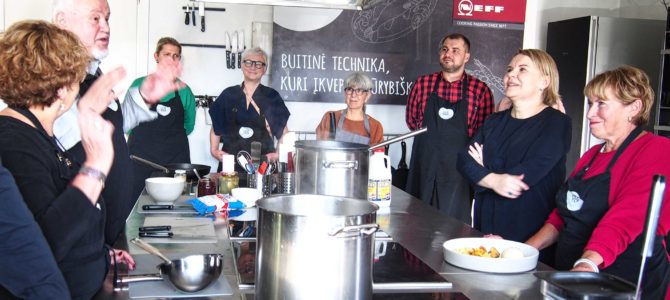
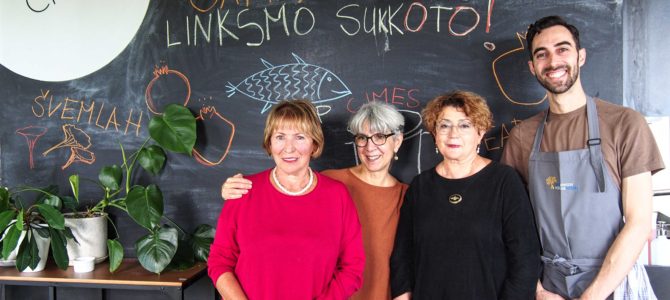
Bagel Shop Café cooks have been sharing some of the secrets of Litvak cooking this summer with the managers of a small restaurant in Merkinė, Lithuania, called Šilo kopa. They’ve been making bagels, herring and pflaumen-tzimmes together.

Pflaumen-tzimmes is a stew made of plums and beef often made for the Sabbath table and Rosh Hashanah.

Bagel Shop Café cook Riva remembers this dish well and still makes it according to a simple recipe: about 1.5 kilograms of beef (from the forequarter), bone, about 15 to 20 plums, about 1.5 kg of potatoes and 1 onion, which is later removed. Laurel leaves aren’t required, only salt. The flavor is enhanced by several tablespoons of caramelized sugar added at the end.

The beef is boiled with the onion for about 2 hours, the onion is removed, the plums are added for about an hour and later the potatoes. When everything has been boiled sufficiently, add 3 to 4 tablespoons of liquefied caramelized sugar.

Soloveitchik Family Exhibit Opens June 25 in Kaunas

Soloveitchik Family Exhibit Opens June 25 in Kaunas

Vytautas Magnus University pro-rector for international relations professor Ienta Dabašinskienė and Dr. Vilma Gradinskaitė are presenting a new exhibit about the famous Soloveitchik family of rabbis from Kaunas in Kaunas at the Valdas Adamkus Presidential Library located at Daukanto street no. 25 on June 25. Peter Salovey, an American psychologist, professor and president of Yale University, comes from this family and is scheduled to receive the regalia of an honorary doctorate at Vytautas Magnus University on June 20.

The Soloveitchik family is known for its many accomplished rabbis and Talmudic scholars. Their roots reach back to the early 18th century in Lithuania. They are Levites who are commanded by the Torah to sing in the Temple in Jerusalem. The surname comes from the diminutive of the Russian word for nightingale. The Kaunas branch of the family gave rise to the famous rabbinic dynasties in Volozhin and Brest-Litovsk.

The exhibit will run till the end of September.

International Project Connects New York and Vilnius YIVO Archives

International Project Connects New York and Vilnius YIVO Archives

Lithuanian culture minister Dr. Mindaugas Kvietkauskas has met with YIVO director Jonathan Brent and YIVO head of archives Dr. Stefanie Halpern. In the meeting they discussed the implementation of YIVO’s Vilna project, a seven-year-long international effort to preserve, digitize and connect the pre-war YIVO archives in New York and Vilnius. The project aims at recreating the Strashun Library, one of the largest Jewish collections in Europe before the Holocaust.

The Lithuanian side expressed the hope that next year, when the Baltic country marks the Year of the Vilna Gaon and Litvak History, YIVO would loan the pinkas of the Vilna Gaon shul, a book of statistics kept by the Jewish community which is considered one of the most important documents testifying to the life and history of the Vilnius Jewish community.

Full story in Lithuanian on the Lithuanian Culture Ministry webpage here.

First Modern Litvak Scouting Summer Camp Starts July 28

First Modern Litvak Scouting Summer Camp Starts July 28

Registration is underway for the first modern Litvak scouting summer camp called “History Continues”

When? July 28-August 2
Where? Kernavė forest (coordinates 54.857231, 24.868243)
Who? renginiai@lzb.lt, telephone 867216114

Lithuanian Jewish scouts will have their own sub-camp at the summer camp of the Kernavė group of Lithuanian scouts.

Cost:

First stage of registration (by July 7):

Lithuania Marks Day of Mourning and Hope June 14

Lithuania Marks Day of Mourning and Hope June 14

Mass deportations to Stalin’s camps began on this day in 1941.

About 17,500 people were deported from Lithuania between June 14 and 18, 1941, (the fates of 16,246 have been determined so far), a number derived from the 4,663 arrested and 12, 832 people officially deported. The deportations were a huge loss and tragedy for Lithuania. Not all those deported were ethnic Lithuanians: about 3,000 Jews, according to various sources, were also deported and about 375 Jews died at the camps and in exile.

Jews deported to Siberia resisted the brutality and terror of the oppressive Soviet organs with a deep spirituality and faith. In 1941 about 1.3 percent of the total Lithuanian Jewish population were deported, and as a percentage constitute the largest group by ethnicity deported from Lithuania.

Santariškės Children’s Hospital doctor Rozalija Černakova tells the story of what happened to her grandfather and family. Her grandparents were deported with their families. Rozalija’s parents were still children when they were deported: her mother 11 and her mother’s brother 8. They were sent to the Altai region. That’s where Rozalija was born.

Commemorative Plaque to Mark Site of Former YIVO HQ in Vilnius

Commemorative Plaque to Mark Site of Former YIVO HQ in Vilnius

The Lithuanian Foreign Ministry and the Lithuanian Jewish Community invite the public to attend an unveiling ceremony of a plaque to commemorate the site of the former headquarters of YIVO in Vilnius at 3:00 P.M. on June 20 at the building now located at Vivulskio street no. 18 in Vilnius. YIVO, the most significant center for the study of Jewish culture, history and languages in Eastern Europe, was located near this site from 1925 to 1941. Its founder moved its activities to New York which became world headquarters following the German invasion in 1941.

Participants at the ceremony are to include YIVO director Jonathan Brent and YIVO board of directors deputy chairwoman Irene Pletka.

Vilna Gaon Texts Placed on Lithuanian Memory of the World Registry

Vilna Gaon Texts Placed on Lithuanian Memory of the World Registry

Lithuania’s Memory of the World registry now contains the manuscripts of the Vilna Gaon and a manuscript fragment by Simonas Daukantas, the Lithuanian National Martynas Mažvydas Library reported.

The 18th century manuscripts of Elijah ben Solomon Zalman, the Vilna Gaon, are a collection of works published in different cities and countries of Europe between 1799 and 1940. They include several very rare publications and almost all of them exist as a single copy in Lithuania.

The library said the Vilna Gaon never published any of his texts, but his teaching was scrupulously written down and compiled by his students, sons and sons-in-law and were edited and published after his death.

Sabbath with Designer Agnė Kuzmickatė

Sabbath with Designer Agnė Kuzmickatė

For a number of years now the Lithuanian Jewish Community has been inviting artists and special guests to celebrate Sabbath with the community. Last Friday LJC executive director Renaldas Vaisbrodas presented Lithuanian designer Agnė Kuzmickatė to members. She holds a doctorate and is sometimes called butterfly queen because of her use of her butterflies in her designs.

Renaldas led the discussion and tendered questions to the famous young designer, starting with questions about her family. Her father is the philosopher Bronislovas Kuzmickas, PhD, who was a founding member of Sąjūdis, the Lithuanian independence movement, who went on to become a member of parliament, a signatory to the Lithuanian declaration of the restoration of independence and served as deputy to parliamentary speaker Vytautas Landsbergis.

Agnė Kuzmickatė’s grandmother Gita Jekentienė was at a children’s summer camp in Palanga, Lithuania, when World War II arrived. She and some of the other children were evacuated to safer locations in the Soviet Union. When she spoke of her family, Agnė Kuzmickatė repeatedly returned to her grandmother Gita’s experience and said she only know understood how her grandmother’s environment shaped her. She said she and her grandmother often spoke about Jewish identity, about the Yiddish language and the tragic loss of family, all of whom, except for her grandmother’s brother, were murdered at the Ninth Fort in Kaunas. Returning to Lithuania after the war, her grandmother experienced all sorts of bullying and name-calling because she was Jewish. Agnė Kuzmickatė said she had never experienced this and everyone at school respected her because of her father’s activities on behalf of independent Lithuania.

New Litvak History Exhibit in Cape Town

New Litvak History Exhibit in Cape Town

URM.lt

The Lithuanian Embassy to South Africa presented a mobile exhibit at the South African Jewish Museum in Cape Town June 6 called “One Century Out of Seven. Lithuania, Lite, Lita.” The installation informs viewers of different aspects of Jewish history in Lithuania from the time of the Grand Duchy to the present. The exhibit travelled to South Africa’s second-largest city from the Holocaust and Genocide Center in Johannesburg.

Lithuanian ambassador Sigutė Jakštonytė welcomed the large audience including members of the Cape Town Jewish community and members of the parliament of the Republic of South Africa. She told them the Lithuanian parliament had named 2020 the Year of the Vilna Gaon and Litvak History in appreciation of the Litvak contribution to the Lithuanian state and to preserve the memory of Holocaust victims. The ambassador also thanked the museum in Cape Town for four years of close cooperation.

The exhibit at the South African Jewish Museum in Cape Town runs till the end of June.

Milk and Cheese Treats on Shavuot

Milk and Cheese Treats on Shavuot

We celebrate the holiday of Shavuot on June 9 and 10. June 8 is the eve before the holiday, and the entire night is dedicated to studying the Oral and Written Torah. The Torah is read out on this night.

Shavuot is an old holiday of pilgrimage and its rituals add cohesion to the community. During the holiday, a series of milk and cheese dishes are prepared and sampled. The king among them is the classic cheese pie. In Lithuania as in other European Jewish communities pancakes with cheese are popular. During the holiday in Israel, smaller cheese makers open their doors to visitors. Shavuot tourists are also invited to attend the Northern Cheese Pie Festival held now for its third year and children are taught how to milk cows and how to make butter from fresh milk.

This Sunday the Choral Synagogue in Vilnius will celebrate with treats made by Shoshana, a mashgiach who came especially from Israel to cook for the Bagel Shop Café this year.

The Bagel Shop Café recommends making Shavuot breakfast from the best challa with cream cheese and berries.

Shavuot on Sunday

Shavuot on Sunday

Shavuot or Shavuos is the holiday marking the giving of the Torah. The Vilnius Jewish Religious Community and Chabad Lithuania invite you to come celebrate together at 11:30 A.M. on Sunday, June 9, at the Choral Synagogue in Vilnius. We will read the Ten Commandments and everyone will have the opportunity to sample delicious traditional Shavuot milk-product dishes. Children will receive small gifts. Because Shavuot is a time when studying the Torah is especially apt, traditional and successful, you are invited to an extended Sabbath dinner at Bokšto street no. 9 in Vilnius at 8:30 on June 8 where we will learn more about the Shavuot holiday.