
History of the Jews in Lithuania

Picking Up the Pieces

top
by Geoff Vasil

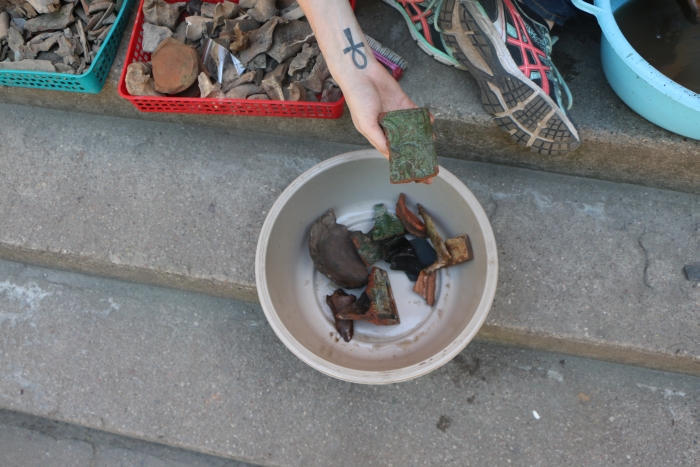
“Don’t get too close!” an attractive and sunburned young Lithuanian warned at the edge of a large pit just behind what was the Great Synagogue of Vilnius. He’s friendly and it quickly becomes clear he’s the lead archaeologist on the dig, but he’s just as quick to point out he’s formally the lead archaeologist, but Dr. Richard Freund of the University of Hartford in Connecticut is the real force behind the whole initiative.

Mantas Daubaras is doing his doctoral thesis at the Lithuanian Institute of History on a Neolithic site far to the west in Lithuania. He has no personal connection to Jewish Vilna and approaches it as he would any site, dispassionately.

“Yesterday we found what we think is the ritual bath,” he explains, pointing to a small hole in the top of what looks like a vaulted brick ceiling. They sent a camera in to take a look and found a large space terminated by rubble and fill. Does it connect to the Great Synagogue? He doesn’t know yet, but it looks as if it extends right up to the line where they think the back wall of the synagogue once stood.

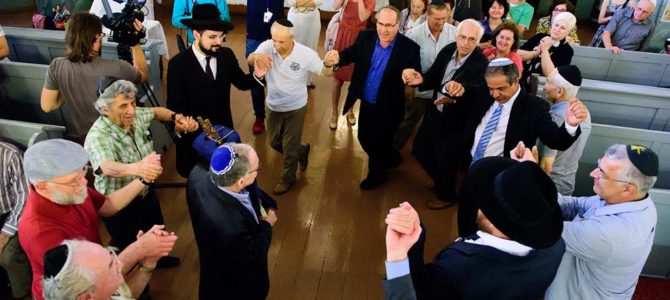
Celebration to Welcome Torah Scroll at Choral Synagogue

Toros įnešimo šventė Vilniaus choralinėje sinagogoje vyko birželio 27d.

The Lithuanian Jewish Community is tremendously grateful to Judah Passow for his initiative in bringing the 350-year-old Torah scroll back to Vilnius.

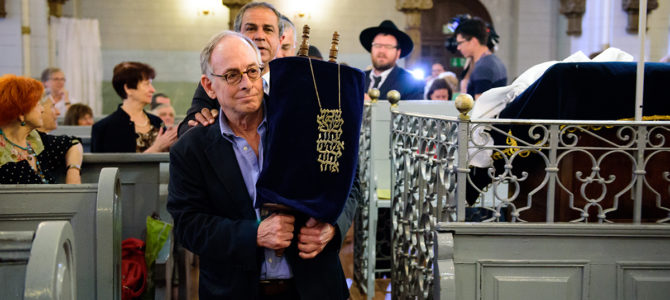
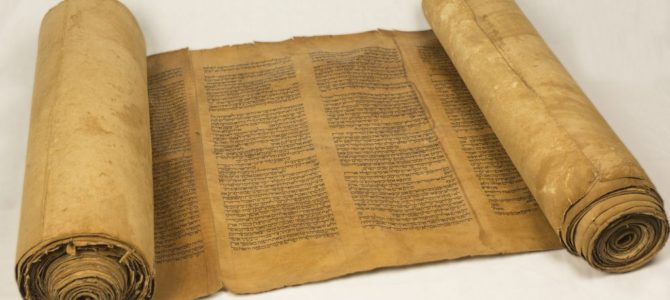
Those assembled at the Choral Synagogue in Vilnius June 27 waited in anticipation of something extraordinary: for the carrying in of a 350-year-old Torah scroll, from the period when the Vilna Gaon walked among us, a witness to the Vilnius of the 17th century, experiencing all the passages and changes together with the Jews, used for innumerable bar mitzvah ceremonies until it ended up in the Vilnius ghetto during World War II, and miraculously survived the Holocaust.

In 1960 professor Passow of the University of Philadelphia in the United States came to Vilnius after receiving support from the Rockefeller Foundation to commemorate Jewish communal life behind the iron curtain. Jews in Vilnius asked him to take with him one of two Vilnius ghetto Torah scrolls to survive the Holocaust, uncertain about the future of Jewish life in the Soviet Union. That’s how the Torah entered into the Passow family and was used in three bar mitzvahs. The family protected the scroll for 56 years. Last year the professor’s son, London-based photojournalist Judah Passow, came to Vilnius for an exhibition of his photographic works and spoke with LJC chairwoman Faina Kukliansky. This year he’s come back with the Torah scroll with a silver ornament his mother made.

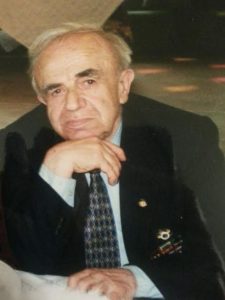
Happy Birthday to Levas Jagniatinskis on His 90th!

Jagniatinskis1

May he live in health to 120!

Levas Jagniatinskis and his family were active participants in the reestablishment of the Lithuanian and Vilnius Jewish Communities around the time of Lithuanian independence from the Soviet Union. In 1992 he was elected to the Community’s Council of World War II Veterans and worked with recompense, putting finances in order and organizing events with the veteran’s council and the executive board of the Lithuanian Jewish Community. Those first years were financially hard for the Community, and so he donated his car three times per week winter and summer, parking it in the courtyard of the LJC for use by the Community. He was very active in preparing documents for the Claims Conference and tried to find greater funding for the Community. His son was one of the organizers of the Community’s union of scholars, Vilnor, and later became its director. When he left, the union stopped operating. The family’s third generation, his granddaughters, began attending children’s events put on by the Community, and now, in adulthood, continue their activities, trying to mitigate the losses from the Holocaust.

Jacques Lipchitz Exhibit at the Tolerance Center

Skulptūros iš nacionalinio Žoržo Pompidu meno ir kultūros centro jau Lietuvoje

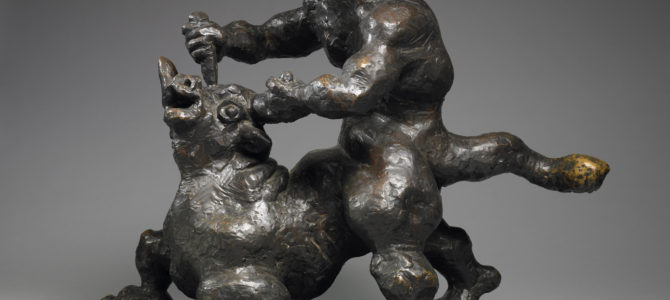
The Tolerance Center of the Vilna Gaon State Jewish Museum is proud to present an exhibit of sculpture by Jacques Lipchitz (1891-1973). The sculptures are on loan from the Metropolitan Museum in New York, the Chicago Art Institute and museums located around the world. The exhibit opens June 1.

Museum director Markas Zingeris said organizing the exhibit was fraught with difficulties. “This exhibit, dedicated to the 125th birthday of the sculptor, was carefully planned over several years. To put it playfully, it would have been easier to get the president of France here than to borrow sculptures from Paris museums. First we had to convince representatives of the Pompidou Center and the Musée d’art et d’histoire du Judaïsme to consent to the transport of 5 sculptures and 2 paintings by Lipchitz. Once we had agreement, we had to ensure proper conditions for transporting the art works, since some of the sculptures are made of very fragile materials,” Zingeris recalled.

Gaon-Era Torah Scroll Returns to Vilnius

350 m. skaičiuojatis toros ritinys grįžta į Vilniaus choralinę sinagogą

Vilnius, June 27, BNS–A 350-year-old Torah scroll used in Jewish religious services in the Vilnius ghetto has returned to Vilnius. British photojournalist Judah Passow decided to turn the scroll over to the Lithuanian Jewish Community for use in the Choral Synagogue in Vilnius.

“What’s important is not the [scroll itself], but that he decided to give the Torah to our synagogue. The Torah belonged to his family, it was safeguarded during the war and the entire time. Boys became men during bar mitzvah in front of this Torah and began to read from this Torah, so it is a great honor for us,” Lithuanian Jewish Community chairwoman Faina Kukliansky told BNS. According to Jewish religious tradition, Torah scrolls must be written by hand. Kukliansky said this Torah will replace the one currently being used, which is worn out.

Passow, whose roots are in Ukraine and Poland, told how Lithuanian Jewish community representatives gave the scroll to his father, a professor at an American university in Philadelphia, almost six decades ago when he visited Vilnius in 1960.

Lithuania: Vilnius Begins Dismantling Building Constructed of Jewish Gravestones

uzupis-cemetery-oct-20161
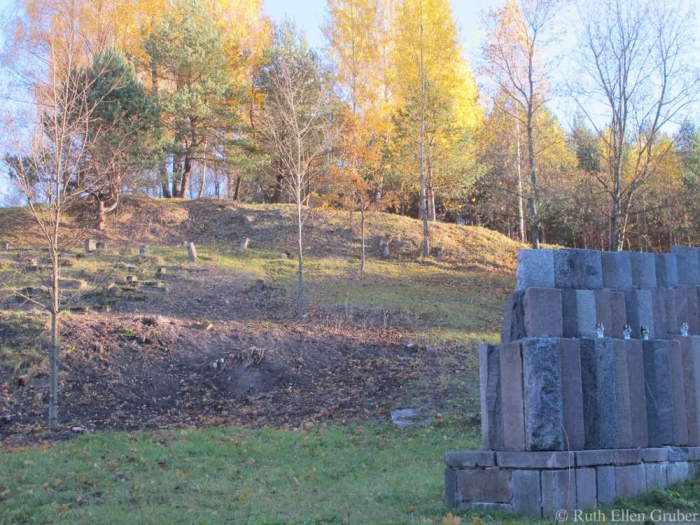
The destroyed Uzupis Jewish cemetery in Vilnius, showing part of the memorial there

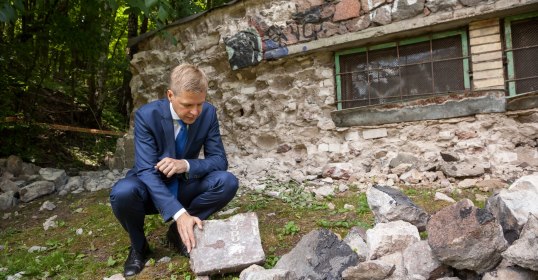
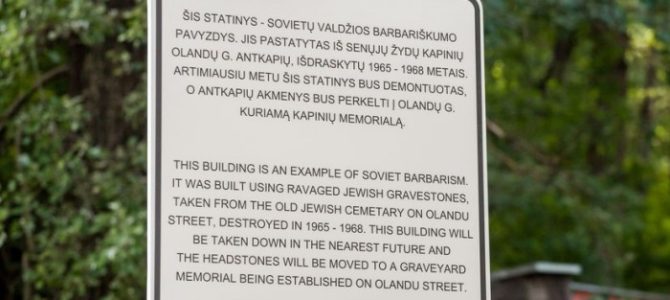
Work has begun to remove part of an electric transformer station in Vilnius which was built during the Soviet era using gravestones from Jewish graves of the once-vast Užupis Jewish cemetery on Olandu street, which was almost totally razed.

The Viilnius city web site, and the Lithuanian Jewish community web site, said Vilnius mayor Remigijus Šimašius personally surveyed work begun this week to dismantle the electric substation on Olandų street and posted a video of him (see below).

Full story here.

Samuel Kukliansky Remembered at 25th Anniversary of Lithuanian University

Minint Mykolo Romerio Universiteto 25-metį, pagerbtas Samuelio Kuklianskio atminimas

Samuel Kukliansky, father of Lithuanian Jewish Community chairwoman Faina Kukliansky, has had a tree planted in his memory at a ceremony to mark the 25th anniversary of the founding of the Mykolas Romeris University in Vilnius (known as the Law University before 2004). Samuel Kukliansky, Lithuanian attorney, scholar of law, criminology expert, was also a professor at the university and a post-doctoral fellow in social sciences.  He was born and raised in Veisiejai, Lithuania. After surviving the Holocaust, he was graduated from the Law Faculty of Vilnius University in 1953 with the qualifications of attorney. He was a life-long scholar and published more than 150 academic papers on different aspects of criminology.

On June 23 Mykolas Romeris University celebrated honored alumni and friends. The event to mark the 25th anniversary of the post-Soviet incarnation of the university included the release of a book including those who have contributed to the university along with the names of rectors, professors, teachers and students. An arboretum of Japanese cherry trees and ash trees was planted to honor past professors, alumni and friends of the university. Rector Dr. Algirdas Monkevičius said at the ceremony to open the garden it was intended as a gift from the university community to the founders and boosters of the university, to the neighborhood and to the city of Vilnius.

Discussion of Litvak Heritage Protection at Lithuanian Government

Vyriausybėje aptarti Lietuvos žydų paveldo ir istorinių vietų išsaugojimo klausimai

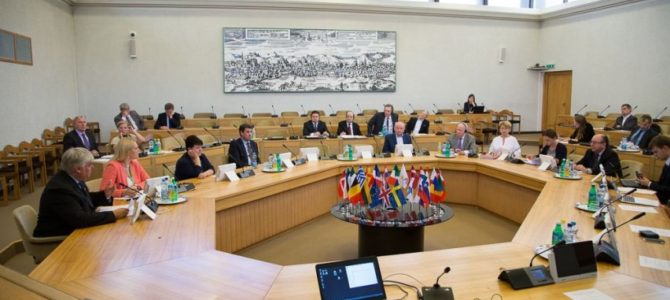
On June 23 a second sitting of the commission investigating issues associated with Litvak culture and history was held at the Lithuanian Government. Discussion included Litvak heritage, protection of Jewish cemeteries and mass graves, plans for the Ponar Memorial Complex, restoration of property and inclusion of the Lithuanian Jewish Community in centennial celebrations of the restoration of the Lithuanian state.

“Lithuania is proud of her rich history and opulent ethnic culture legacy. That includes synagogues, communal buildings, different documents and other heritage. I can say resolutely that it is very important to us to maintain existing Jewish heritage sites and to adapt them for public use,” first deputy chancellor and chairman of the commission Rimantas Vaitkus said.

Removal of Jewish Headstones from Electric Substation Begins in Lithuanian Capital

Sostinėje pradėta ardyti pastotė iš sunaikintų Žydų kapinių paminklinių akmenų
photo: Saulius Žiūra

Vilnius mayor Remigijus Šimašius is keeping his promise: now that the centralized hearing season is over, work has begun to remove part of an electric transformer station whose construction during the Soviet era employed stones from Jewish graves. The mayor today surveyed the work to disassemble the electric substation on Olandų street. After consulting with the Lithuanian Jewish Community, the decision was made to remove the headstone fragments to the site on Olandų street where a Jewish cemetery memorial is being constructed.

It’s clear that 26 years after the declaration of Lithuanian independence, it has long been time to get rid of such symbols of disrespect for our history. Today the Jewish headstones are being removed from the substation and will be used for a Jewish cemetery memorial on Olandų street. We consulted with the Lithuanian Jewish Community on how to return the fragments of gravestones in the most honorable manner, showing due respect to the memory of the dead,” Vilnius mayor Šimašius said.

Full story in Lithuanian here.

Jewish Gravestones Removed from Electric Substation

Iš elektros pastotės išimami žydų antkapių akmenys

VILNIUS, June 22, BNS–This week removal began of fragments of Jewish headstones used in the construction of an electric substation in Vilnius. The fragments will be removed to the Jewish cemetery on Olandų street to be used in a Jewish cemetery memorial to be erected there, the municipality informed BNS. “Currently work is underway to remove stones set in different walls,” Kęstutis Karosas, acting director of the city’s Heating and Water Department said. The plan is to remove all the stones by September 1.

The cost to the municipality is unknown so far. Karosas said payment will be made for work done. The electric substation on Olandų street was constructed during the Soviet period using headstones from the Jewish cemetery there. Jewish headstones, especially from the cemetery on Olandų street, were used all over Vilnius for construction during the Soviet era.

Lithuanian Parliament Begins Consideration of Amendments to Citizenship Law

VILNIUS, June 21, BNS—The Lithuanian parliament Tuesday began consideration of amendments to ensure Lithuanian Jews and their descendants who left Lithuania between the two world wars would enjoy the right to restore their Lithuanian citizenship. After initial presentation of the draft amendment, 92 MPs voted in favor of further consideration, none voted against and one abstained. The decision was adopted to put the proposed amendment up for fast-track consideration Thursday. Conservative MP Andrius Kubilius, leader of the opposition and one of the authors of the amendment, said the law needed amending because the year before last and last year Migration Department officials and courts began demanding Litvaks provide proof they or their ancestors were persecuted in interwar Lithuania.

Lithuanian Parliament to Consider Amendment for Litvak Citizenship

VILNIUS, June 21, BNS–Legislative amendments paving the way for Litvaks, i.e. Jews of Lithuanian origin, and their descendants who left the country in the interwar period to restore their citizenship rights, should be submitted to the Lithuanian Seimas (parliament) Tuesday.

Amendments to the Law on Citizenship have been drafted by the European Affairs Committee.

According to the amendments, people who left Lithuania prior to March 11, 1990, except those who changed their place of residence within the territory of the former Soviet Union after June 15, 1940, should have their citizenship rights restored.

Archaeologists Dig at Vilnius Great Synagogue

Vilniaus Didžioji sinagoga žydams buvo svarbi, kaip katalikams Vatikanas

VILNIUS, June 21, BNS–A team of experts from the United Kingdom, Canada, Israel and Lithuania is starting to investigate the remains of the Great Synagogue of Vilnius and other buried buildings.

An international team of archaeologists using non-invasive geophysical techniques plans to investigate the remnants of a mikvah buried 2 meters below the surface under a school built by the Soviet regime after 1960.

“Our geophysical studies can map below the street without destroying any infrastructure and then to identify exactly where to dig, map and retrieve artifacts to understand the historical context,” one researcher said.

350-Year-Old Torah Scroll Returns to Vilnius

350 m. skaičiuojatis toros ritinys grįžta į Vilniaus choralinę sinagogą

The Vilnius Jewish Religious Community cordially invites you to celebrate this extraordinary event, the return of the Torah scroll, at the Vilnius Choral Synagogue.

This 350-year-old Torah scroll, which survived the destruction of the Vilnius ghetto during World War II and was taken out of the country to protect it, is finally coming home.

The ceremony of bringing in the Torah is to take place at 1:00 P.M. on Monday, June 27, at the Choral Synagogue in Vilnius.

The Vilnius Jewish Community is tremendously grateful to Judah Passow for his initiative in returning the Torah scroll. The family of London-based photojournalist Judah Passow safeguarded the Torah scroll for 56 years after it left Vilnius. The ceremony will feature a short presentation of the history of the Torah and what this most important book means.

Famous Film Director Boris Maftsir Visits Panevėžys Jewish Community

Panevėžio žydų bendruomenėje lankėsi garsus režisierius Borisas Maftsiras

Maftsir was born in Riga in 1947 and made aliyah to Israel in 1971, where he works at Yad Vashem as an independent film director. He has produced over 400 documentaries for film and television and is the director of at least 30 documentary films.

He’s currently working on a new film about Lithuanian Righteous Gentiles. When he was in Lithuania in 2008 he visited the Panevėžys Jewish Community to talk about best to commemorate those who heroically rescued Jews during the Holocaust. This time Maftsir met sister Leonora Kasiulytė of the Congregation of the Love of God at the Community concerning her book and collection of material about Marija Rusteikaitė, a woman who saved 15 Jews without regard for her own life during World War II. He also met Genutė Žilytė, a history teacher from the Rožynas Pre-Gymnasium who has been doing tolerance and Holocaust educational projects for 12 years now to give greater understanding to Lithuanian society on the scope and nature of the tragedy. She’s been directing the school’s Tolerance Education Center since 2004, participating with students in projects by the International Commission and civic initiatives, collecting Holocaust survivors’ testimonies and of those who were deported to Siberia and maintaining the mass murder sites at Kurganava and Žalioji forest. Every year creative work by students at the pre-gymnasium on the topics of the Holocaust and Soviet repression of Lithuanians is presented to the people of the city and region of Panevėžys.

Remember Lietukis Garage

The Kaunas Jewish Community invite you to come and remember the 75th anniversary of the Lietūkis garage massacre in Kaunas in the early days of the Holocaust. We will gather at the monument to the memory of the victims at Miško street no. 3 in Kaunas at 3:00 P.M. on June 24, 2016.

A concert to honor the victims will be held at the Kaunas State Philharmonic at 6:00 P.M., June 26, 2016 with the male quartet Quorum. The event is free and open to the public.

Meeting the Past at a Chess Match

kazys_grinius_cropped
by Geoff Vasil

Sometimes you open a door and walk into a room expecting nothing, and the strangest things happen. I went to the Rositsan Elite Chess and Checkers Club chess tournament dedicated to the memory of chess enthusiast and interwar Lithuanian president Kazys Grinius at the Lithuanian Jewish Community on Sunday morning, June 19, and thought I saw the president himself, although he died many years ago in exile in America.

At the chess tournament held in his name, there were tables with timers and boards set up both inside the Jascha Heifetz hall and in the foyer and people of all age groups from pre-teen to people in their 80s waiting for the games to begin. I expected some sort of formal nod of the head to the former president, a cursory commemoration after which the players would get down to business. The organizers had a much different idea of what it means to honor someone. Multiple speakers took the podium, gifts were lavished, chess medallions were passed out and there was a sincere recollection of the man himself.

Borisas Gelpernas, former chess champion, spoke about how Kazys Grinius rescued his mother and father from the Kaunas ghetto. At first his father refused the offer of help, not wanting to put Grinius in danger, but the former Lithuanian president kept insisting, and after the actions–mass shootings of Jews–began, he and his wife did hide in Grinius’s own apartment for several months, along with Kristina, Kazys’s second wife.

Lithuanian Parliament Rushes to Aid of Litvaks

Lithuanian Parliament Rushes to Aid of Litvaks

By Raimonda Ramelienė

The Lithuanian parliament has heard complaints from Jews who left Lithuania between the wars and their descendants over their inability to restore Lithuanian citizenship and has begun amending Lithuania‘s law on citizenship.

Several parliamentary committees have been trying to determine since spring why the Migration Department has been rejecting requests by Litvaks and their descendants living in Israel and South Africa for restoration of Lithuanian citizenship.

Although members of parliament determined bureaucratic obstacles were hindering the process, they decided to put an end to conflicting legal opinions by amending the law. The initiator was oppoisition conservative leader Andrius Kubilius, aided by European Affairs

Presentation of Archaeological Finds from Ponar and Great Synagogue in Vilnius

Participating: professor Richard Freund (Hartford University) and Dr. Jon Seligman (Israel Antiquities Authority, Jerusalem)

This team of renowned investigators began work on the Ponar mass murder site near Vilnius in early June. Using non-invasive archaeological methods, they examined a large portion of the site of the largest mass murder in Lithuania.

The archaeologists focused on the tunnel excavated by burners’ brigade and other items of high interest according the museum specialists. A film crew travelled with professor Freund to Lithuania and plan to release a documentary called Lost Vilnius.

The Israeli-American duo also looked at the site of the former Great Synagogue in Vilnius.

The Tolerance Center of the Vilna Gaon State Jewish Museum will host their presentation of their findings June 22. The public is invited to attend. The event will be held in Lithuanian and English. The Tolerance Center is located at Naugarduko street no. 10, Vilnius.