Learning

New Museum of Jewish Culture to Open in Slonim, Belarus

Synagogue Slonim2

A new Museum of Jewish Culture will be housed in the 17th century synagogue in Slonim, Belarus, the BELITA news agency reports. The Slonim regional administration and the Slonim Jewish Association in Israel are to finance directly further restoration of the synagogue.

The synagogue, built in the mid-17th century, is located in the middle of the city of Slonim. Restoration work has been performed and the roof has been fixed. Original interior elements have been preserved.

“In earlier times Jews constituted more than 80% of the population in Slonim. Visitors from abroad continuously come to see the homes of their parents, grandparents and great-grandparents. Many visit the synagogue. The Jewish museum would be a tourist attraction and would draw more visitors to the city,” the regional administration observed.

Summer Camp Schedule and Registration

oll

Dear Parents,

Ensure your children’s place at the Dubingiai recreational site!
Camp sessions and dates:

  • First session: July 4-13, ages: 7-12
  • Second session: July 18-28, ages 13-18
  • Szarvas International Camp: August 4-21, ages: 13-17

Work to Renovate Žiežmariai Wooden Synagogue Begins

ZIEZM sin1

A ceremony was held at the unique wooden synagogue in Žiežmariai, Lithuania on May 19, 2016, to mark a new stage in its life: its resurrection. The ceremony marked the beginning of work by the Kaišiadorys Regional Administration and Lithuania’s Cultural Heritage Department to restore the house of worship and featured a concert by the Rakija Klezmer Orkestar and works of Paganini by violinist Gediminas Dalinkevičius.

An allocation of 85,000 euros from the Ministry of Culture to the Kaišiadorys Regional Administration and an additional 24,840 euros from the regional administration are to be used initially to fix the roof and repair the façade, stabilize the building and perform archaeological work. A total of 693,000 euros is needed for reconstruction of the synagogue and additional sources of funding are being sought.

“The Lithuanian Jewish Community agrees to turn the synagogue over for public use because the Jewish community of Žiežmariai no longer exists and the synagogue won’t be used as a house of prayer. The synagogue can be utilized very well for the cultural needs of the region and at the same time remain a place of commemoration for the Jewish community of the area,” LJC chairwoman Faina Kukliansky said.

Chess Tournament

The Lithuanian Jewish Community and the Rositsan and Maccabi Elite Chess and Checkers Club invite you to an amateur chess tournament!

Time: 11:00 A.M., Sunday, May 22, 2016
Location: Lithuanian Jewish Community, Pylimo street no. 4, Vilnius

Director: FIDE master Boris Rositsan

To register and for further information, contact:

email: info@metbor.lt
telephone: 3706 5543556

Jews: Lithuania’s Misfortune

moletaikids1
by Marius Ivaškevičius

It appears we can finally say exactly what all those who today speak publicly about the mass murder of Jews in Lithuania are truly seeking. Either they are doing PR for themselves through this, advertising themselves, because this is trendy in Europe, or their activities are being financed by the Jews themselves.

All of those shocking details, talk about smashing the heads of Jewish infants on trees to save bullets, is nothing other than the scratching of still unhealed wounds with dirty, dilettante fingers.

In this manner the attempt is made to traumatize yet another generation of Lithuanians, our children born in a free Lithuania, because these sorts of actions, instead of inviting repentance or at least sorrow, actually create even greater hatred of Jews, because this is how the natural defensive reaction of the nation operates. Every nation is different, so Germany’s experience doesn’t fit our situation, that is, healing and finally recovering by demonstrating and revealing through education and openness the brutality of the Nazi concentration camps. All that took place in the period after the war, when events were still vivid, but today the murderers and the witnesses have all but died off, so Lithuania must blaze her own trail. It’s not for no reason at all that our intellectuals, chroniclers and commentators say: don’t do it, don’t pick at that wound with your fingers, let it first heal, let it be forgotten. Sometimes forgetfulness is more worthwhile than remembering.

I am from Molėtai. A small town of extraordinary beauty with three lakes inside the town and another three hundred in the surrounding area. There’s no need to say much, everyone knows Molėtai, Lithuanian vacationers’ paradise. During the war, or more precisely, during one day in the summer of 1941, two thousand Jews were shot there. In other words, eighty percent of the population of Molėtai. More than two-thirds of the town’s residents vanished over the course of a few hours and were buried in a mass grave. German Nazis were in command of the massacre. Local Lithuanians did the shooting. These are the cold, hard facts and numbers.

YIVO Awarded $260,000 by NEH

YIVO Receives $260,000 Grant from the National Endowment for the Humanities
May 16, 2016

New York, NY – The YIVO Institute for Jewish Research (YIVO) is pleased to announce that is a recipient of a major grant from the National Endowment for the Humanities (NEH) for the Vilna Collections Project, a seven-year initiative to preserve, digitize and virtually reunite YIVO’s prewar archives and library located in New York City and Vilnius, Lithuania, through a dedicated web portal.

The NEH’s Division of Preservation and Access has awarded $260,000 over two years for the processing, conservation and digitization of rare archival documents rescued from the destruction of the Holocaust. The materials, looted by the Nazis and recovered with the help of the U.S. Army, were brought to New York in the late 1940s. They are a diverse resource on Jewish life, community and culture in Europe. They span the range from handwritten autobiographies by Jewish youth and humble folktales and folk songs to the archives of scholars, such as that of Simon Dubnow, known as the father of Russian Jewish history. They include photographs, Yiddish theater and political posters and the administrative records of Yiddish and Hebrew schools and yeshivas.

As City University of New York historian Jack Jacobs noted in a letter of support for YIVO’s application to the NEH, “It is simply impossible to write a dissertation or do any serious research project related to Eastern European Jewry without consulting the YIVO materials.”

Full story here.

In Memoriam Saulius Sondeckis

Sondeckis-Likimai

The Destinies series of lectures, seminars and meetings invite you to attend our 26th evening in the series,

In Memoriam Saulius Sondeckis

featuring the premiere of the film “… mūsiškiai žydai muzikai” [“…Our Own Jewish Musicians”]

In the film maestro Saulius Sondeckis shares his memories of his friends and colleagues, Lithuanian Jewish musicians.

Participants to include: the filmmaker and journalist Saulius Sondeckis and professor Silvija Silvija Sondeckienė

Moderator: Dr. Leonidas Melnikas.

Time: 6:00 P.M., Thursday, May 19, 2016.
Location: Lithuanian Jewish Community, Pylimo street no. 4, Vilnius

Event initiator and MC: LJC deputy chairwoman Maša Grodnikienė

Lithuania to Grant 30,000 Euros to Vilnius YIVO Project in 2017

maxw

The Lithuanian Ministry of Culture plans to allocate 30,000 euros in 2017 for the Vilnius YIVO project.

The Vilnius YIVO project is a seven-year endeavor to preserve, digitize and join together virtually two pre-war YIVO collections in New York and Vilnius. The project will also attempt to recreate digitally the Strashun library, one of the largest collections of judaica in pre-war Europe. YIVO, the Lithuanian Central State Archives and the Lithuanian Martynas Mažvydas National Library are partners in the project.

The project covers approximately 10,000 rare and unique books and publications and around 1.5 million documents. Material includes literary works, correspondence, memoirs, theater posters, photography, rare books, brochures, newspapers, political pamphlets and documentation of religious and communal activities.

lrkm.lrv.lt

LJC Chairwoman Speaks on Lithuanian National Radio about Citizenship for Litvaks

MILDAR-0065web

Lithuanian Jewish Community chairwoman Faina Kukliansky was one of three distinguished guests on the late morning Aktualiju studijas [News Studio] program on Lithuanian radio May 12.

“This question keeps bothering me: when did the institution of citizenship, when did that institution stop, when was it interrupted? Was it when the person was imprisoned in the ghetto? When he was transported to the concentration camp? Nobody saved those passports anywhere. You see this is such an inhumane, such an unintelligent step when you look to the future. But as the chairwoman of the Lithuanian Jewish Community I would like to say, that Litvaks are welcome in our community, with or without a passport, and we would be very proud if our Lithuanian Jewish Community grew thanks to those people who left Lithuania. So we gladly invite and welcome them without regard to their political status,” Faina Kukliansky said during the discussion.

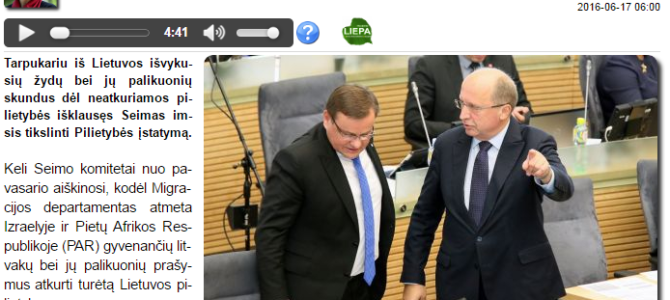
The main topic for the show as “Why don’t we want to grant citizenship to Litvaks?” The introductory blurb for the show was: “Lithuanian Jews–Litvaks–are not just people who have achieved great things in the world, they contributed greatly to the strengthening of the Lithuanian state as well. They sought Lithuanian independence and they fought in the battles for independence [in 1918-1919]. Unfortunately, almost all of them were murdered during World War II. Only a small portion survived. Today some Lithuanian bureaucrats don’t want to grant citizenship to the small group of Jews who want it. Why not?”

The other two guests were former Lithuanian prime minister, current deputy parliamentary speaker MP Gediminas Kirkilas and the historian Alvydas Nikžentaitis.

The audience was invited to call in and pose questions.

Rabbi Moshe Shapiro Visits Lithuanian Jewish Community

Shapiro1

The well-known Rabbi Moshe Shapiro, a follower of the Gaonic scholarly and Litvak tradition, has paid the Lithuanian Jewish Community a visit, where he met with chairwoman Faina Kukliansky, religious community leader Simas Levinas and Rabbi Samson Isaakson.

Illustrated Hebrew-Lithuanian Wordbook for Beginners Presented at LJC

virs3

The publication of Ruth Reches’s “Iliustruotas hebrajų-lietuvių kalbų žodynėlis pradedantiesiems” [“Illustrated Hebrew-Lithuanian Wordbook for Beginners”] is an important event for Jews and Lithuanians who want to learn Hebrew and who had to rely in the past on textbooks in Russian and English. The arrival of the book was eagerly awaited by the students of the Vilnius Sholem Aleichem ORT Gymnasium and their parents. The announcement of the book’s official launch instantly drew thousands of interested people on facebook from all over Lithuania. The author presented her book at the Community May 9.

Ruth Reches was graduated from Bar Ilan University in Israel in 1996 with a bachelor’s degree sociology, psychology and criminology. In 2001 she completed a master’s degree at Vilnius University in clinical psychology. In 2007 she received a teaching credential from Vilnius Pedagogical University. Currently she is doing doctoral work at Mykolas Romeris University, where she has been teaching psychology to students pursuing a variety of disciplines since 2001. She worked as a psychologist at the medical center of the Lithuanian Interior Ministry from 2006 to 2011. Since 1997 she has also taught Hebrew at the Sholem Aleichem Gymnasium in Vilnius and served as school psychologist. She teaches psychology as an elective to upper-level (sophomore to senior class) students there.

The “Illustrated Hebrew-Lithuanian Wordbook for Beginners” is for teaching Hebrew to children whose native language is Lithuanian. The learning aid will help pupils understand better and acquire new material, while parents can use the book to follow the progress of their children. The book is useful for adults beginning Hebrew as well.

Ten Years of Cooperation

It’s been 10 years now since the Panevėžys Jewish Community and the Rožynas Pre-Gymnasium first began carrying out joint projects to encourage tolerance, education and friendship between the peoples who call Panevėžys home. This time the project was about Holocaust commemoration in the Panevėžys region. It’s called “A Bridge between Past and Present.” The project is financed by the Goodwill Fund. Around 200 students from the upper classes participated and learned about the history of the Holocaust. The Panevėžys Jewish Community shared information with Rožynas Pre-Gymnasium pupils and administrators, history teacher Genutė Žilytė and pre-gymnasium principal Aida Adiklienė and provided the information the Panevėžys Jewish Community possesses about the Holocaust in the city and region of Panevėžys.

A Difficult Trip

by Linas Vildžiūnas

Rūta Vanagaitė’s [book] “Mūsiškiai” [“Our Own”] differs from other books about the Holocaust in Lithuania in that it was conceived and written as a best seller. As an appeal by the popular author who has a good understanding of public relations to the contemporary Lithuanian public, posing to them the most painful and urgent–although deeply repressed in the subconscious–problem of historical responsibility. The author doesn’t try to make it impersonal (and it would probably be impossible to do so anyway, because the issue involves personal attitudes and personal responsibility), and even sharpens the edges, using a macabre black humor, and also has a certain aplomb and a sense of heralding progress. The latter can be annoying, but the author has sufficient basis to do so. All of this could be perceived as an additional measure to create an effect in aiming for the top ten (or straight for the jugular), and her aim is true because it reached its mark.

Israel at 68

iid

by David Harris
May 9, 2016

Israel celebrates its 68th Day of Independence this week. Let me put my cards on the table. I’m not dispassionate when it comes to Israel. Quite the contrary.

The establishment of the state in 1948; the fulfillment of its envisioned role as home and haven for Jews from around the world; its wholehearted embrace of democracy and the rule of law; and its impressive scientific, cultural, and economic achievements are accomplishments beyond my wildest imagination.

For centuries, Jews around the world prayed for a return to Zion. We are the lucky ones who have seen those prayers answered. I am grateful to witness this most extraordinary period in Jewish history and Jewish sovereignty–in the words of Israel’s national anthem, “to be a free
people in our land, the land of Zion and Jerusalem.”

Vilnius Sholem Aleichem ORT Gymnasium Tops Ratings Again

Reitingai

The Lithuanian magazine Reitingai [Ratings] has published data from the 2014-2015 period. Around 410 Lithuanian schools were rated, both those who select their own students and those which don’t. There are just 9 gymnasia in Lithuania who do have an entrance selection process so they were rated separately. Ratings took into account final exam scores, the number of students going on to enter Lithuanian universities and higher education abroad, scores from tests of separate subjects and student grades.

Sholem Aleichem ORT Gymnasium is among those gymnasia which don’t have a selection process and has placed as the number 3 school throughout Lithuania, and number 1 in Vilnius. It is in the top ten list of the schools in Lithuania, only following behind the Lyceum, Kaunas Technological University, Žirmūnai and the Jesuit Gymnasium. Among the gymnasia in Vilnius in all categories, Sholem Aleichem is fifth behind the Lyceum, the Jesuit, the Biržiška and the Žirmūnai Gymnasium.

The Lithuanian Jewish Community congratulates school director Miša Jakobas, the teachers and all the students with their great achievement!

Learning Yiddish in Lithuania

vilna ellen cassedy

The sky above was a brilliant blue, with puffy clouds, as I crossed the courtyard of Vilnius University on my way to Yiddish class. I had come to the capital of Lithuania to learn the language once spoken by Eastern European Jews on both sides of the Atlantic, among them my grandfather and many other family members. I’d come to walk the streets my ancestors had walked. And I’d come to see how Lithuanians were engaging with the Jewish past.

“Dear students,” our teacher said, “you must study Yiddish not only with your eyes but also with your nose.” Acquiring this beloved language was not just a skill but an art, requiring not only our heads but our hearts.

Full article here.

Children’s and Youth Club Activities in April

The Ilan Club and its young directors continued their work and planned for the end of the season and children’s camps. There was a drop-off in attendance as the weather improved and parents kept their children home Sunday afternoons.

April 10, 2016: Activities at the Children’s Club of the LJC. As usual, children came to have both a fun and informative time. This time the activities centered around Jewish love and weddings. We spoke about customs and traditions.

April 17: These activities at the Children’s Club were regarding the upcoming Eilat Beach Party. We had fun, played games and tried to give a sense of the pleasantness of Eilat.

Launch of Ruth Reches’s Book for Lithuanians Beginning Hebrew

plak

Ruth Reches is launching her new book “Iliustruotas hebrajų-lietuvių kalbų žodynėlis pradedantiesiems” [Illustrated Hebrew-Lithuanian Dictionary for Beginners] for teaching Hebrew to children whose native language is Lithuanian. The learning aid will help pupils understand better and acquire new material, while parents can use the book to follow the progress of their children.

MILDAR-0777

The book is useful for adults beginning Hebrew as well.

The Jewish Disease

logo_sm2

Miami, May 3, 2016–Yom HaShoah, Holocaust Remembrance Day, is May 4–5. Targum Shlishi’s support of projects related to Holocaust awareness and education is one of its core areas of giving. For many years, this category was primarily focused on pursuing justice for Nazi war crimes—Targum Shlishi worked with Efraim Zuroff, director of the Simon Wiesenthal Center’s Israel office, on many initiatives, including partnering on Operation Last Chance. As time has passed, the focus has shifted to the critical importance of issues around awareness, education, and combatting denial.

“The Jewish Disease is not that in every generation there arises an enemy that seeks to destroy us, as we read just two weeks ago in the Passover Haggadah; that has been our destiny. Instead, the Jewish Disease is that in every generation, Jews, wherever their locale, believe that this time is different,” says Aryeh Rubin, director of Targum Shlishi. “Whether it is thirteenth-century England; fifteenth-century Spain; nineteenth-century Ukraine; twentieth-century Germany; or twenty-first century France, England, or elsewhere, anywhere that Jews have achieved an exalted status in society, a confidence sets in that blocks their sense of historical reality. The details vary—perhaps there are Jews who are advisors to their country’s rulers, or on the highest corporate levels of large multinational companies, or one serves as the finance minister in a democratic state—regardless of circumstance, the refrain is always the same. Over and over, the Jews have stated: ‘It can’t happen here.’ Holocaust Remembrance Day serves to remind us that anti-Semitism has a long history and that it can happen anywhere. And this extreme anti-Semitism of yesterday extends to Israel today.”

Expanding on this, Rubin continues: “Israel is increasingly pilloried in ways that are the current face of anti-Semitism. It is critical that on Holocaust Remembrance Day we do much more than see the Holocaust as an historic event. The terrible truth is that we are in no position to call the Holocaust history. With anti-Semitism steadily rising throughout Europe, we are all obligated to do our job in increasing awareness and knowledge of the Holocaust as well as disseminating truth and countering lies about Israel and the Jewish people. Every year we help support a series of initiatives that are dedicated to expanding awareness of the Holocaust. We are very proud of the important work being accomplished by these programs.”