Learning

Learning Yiddish in Lithuania

vilna ellen cassedy

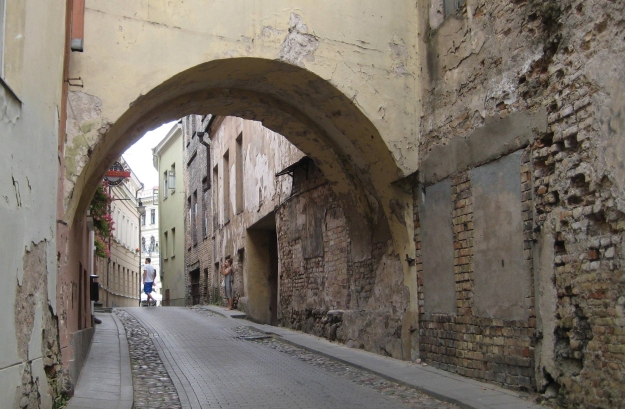
The sky above was a brilliant blue, with puffy clouds, as I crossed the courtyard of Vilnius University on my way to Yiddish class. I had come to the capital of Lithuania to learn the language once spoken by Eastern European Jews on both sides of the Atlantic, among them my grandfather and many other family members. I’d come to walk the streets my ancestors had walked. And I’d come to see how Lithuanians were engaging with the Jewish past.

“Dear students,” our teacher said, “you must study Yiddish not only with your eyes but also with your nose.” Acquiring this beloved language was not just a skill but an art, requiring not only our heads but our hearts.

Full article here.

Children’s and Youth Club Activities in April

The Ilan Club and its young directors continued their work and planned for the end of the season and children’s camps. There was a drop-off in attendance as the weather improved and parents kept their children home Sunday afternoons.

April 10, 2016: Activities at the Children’s Club of the LJC. As usual, children came to have both a fun and informative time. This time the activities centered around Jewish love and weddings. We spoke about customs and traditions.

April 17: These activities at the Children’s Club were regarding the upcoming Eilat Beach Party. We had fun, played games and tried to give a sense of the pleasantness of Eilat.

Launch of Ruth Reches’s Book for Lithuanians Beginning Hebrew

plak

Ruth Reches is launching her new book “Iliustruotas hebrajų-lietuvių kalbų žodynėlis pradedantiesiems” [Illustrated Hebrew-Lithuanian Dictionary for Beginners] for teaching Hebrew to children whose native language is Lithuanian. The learning aid will help pupils understand better and acquire new material, while parents can use the book to follow the progress of their children.

MILDAR-0777

The book is useful for adults beginning Hebrew as well.

The Jewish Disease

logo_sm2

Miami, May 3, 2016–Yom HaShoah, Holocaust Remembrance Day, is May 4–5. Targum Shlishi’s support of projects related to Holocaust awareness and education is one of its core areas of giving. For many years, this category was primarily focused on pursuing justice for Nazi war crimes—Targum Shlishi worked with Efraim Zuroff, director of the Simon Wiesenthal Center’s Israel office, on many initiatives, including partnering on Operation Last Chance. As time has passed, the focus has shifted to the critical importance of issues around awareness, education, and combatting denial.

“The Jewish Disease is not that in every generation there arises an enemy that seeks to destroy us, as we read just two weeks ago in the Passover Haggadah; that has been our destiny. Instead, the Jewish Disease is that in every generation, Jews, wherever their locale, believe that this time is different,” says Aryeh Rubin, director of Targum Shlishi. “Whether it is thirteenth-century England; fifteenth-century Spain; nineteenth-century Ukraine; twentieth-century Germany; or twenty-first century France, England, or elsewhere, anywhere that Jews have achieved an exalted status in society, a confidence sets in that blocks their sense of historical reality. The details vary—perhaps there are Jews who are advisors to their country’s rulers, or on the highest corporate levels of large multinational companies, or one serves as the finance minister in a democratic state—regardless of circumstance, the refrain is always the same. Over and over, the Jews have stated: ‘It can’t happen here.’ Holocaust Remembrance Day serves to remind us that anti-Semitism has a long history and that it can happen anywhere. And this extreme anti-Semitism of yesterday extends to Israel today.”

Expanding on this, Rubin continues: “Israel is increasingly pilloried in ways that are the current face of anti-Semitism. It is critical that on Holocaust Remembrance Day we do much more than see the Holocaust as an historic event. The terrible truth is that we are in no position to call the Holocaust history. With anti-Semitism steadily rising throughout Europe, we are all obligated to do our job in increasing awareness and knowledge of the Holocaust as well as disseminating truth and countering lies about Israel and the Jewish people. Every year we help support a series of initiatives that are dedicated to expanding awareness of the Holocaust. We are very proud of the important work being accomplished by these programs.”


An Unforgettable Concert

foto (48)

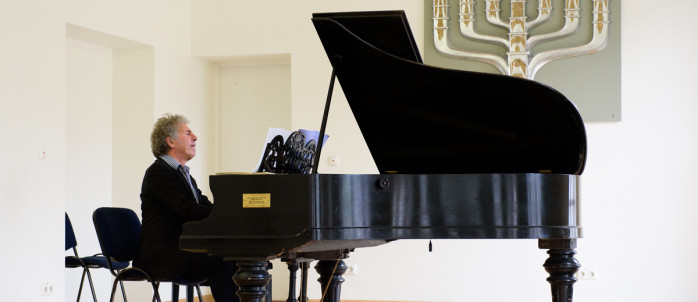
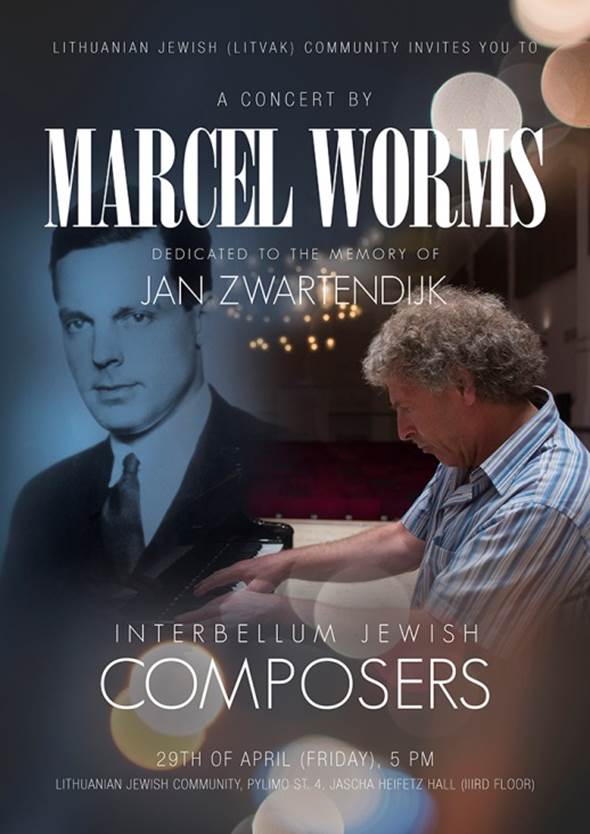
Dutch pianist Marcel Worms performed melodies by interwar Jewish composers at the Lithuanian Jewish Community on April 29, in the same hall where he played 11 years ago. Most of the composers were murdered in the Holocaust, and Worms said if their music was forgotten, they would die a second death.

Works by Rosy Wertheim, Erwin Schulhoff, Gideon Klein, Alexander Tansman, Szymon Laks, Anatolijus Šenderovas, Leo Smit, Dick Kattenburg and George Gershwin were performed. Anatolijus Šenderovas’s “Sonatina” lent a local flavor to the concert.

Concert-goers were got more than just wonderful music: the children of Dutch diplomat Jan Zwartendijk attended. Robert Zwartendijk and Edith Jes spoke about their father who helped rescue at least 2,000 Jews in Lithuania by issuing visas for the Dutch possession of Curaçao, a somewhat fictitious “end-visa” the Soviets demanded of holders of Sugihara’s transit visas through Japan. He and his sister Edith were glad their father was being commemorated and also happy to have a chance to visit Kaunas again, where the Zwartendijk family lived and which Edith, then 13, remembers well.

Rome to Open Jewish Catacombs to the Public

Villa-Torlonia-Catacombs

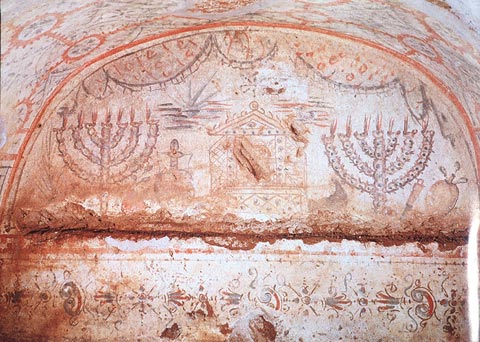
Rome plans to open the 2,000-year-old Villa Randanini Jewish catacombs to the public for the first time between May 1 and June 5 as part of a cultural initiative as one of the several initiatives taken by the Italian Cultural Ministry to promote the scope of the “Jubilee Year of Mercy” declared by the pope.

The Jewish catacombs were discovered beneath the vineyard of Villa Randanini in 1859. The maze of tunnels covers nearly 18,500 square meters (about 199,000 square feet) and has a depth of five to 16 meters (about 16 to 52 feet). The walls have inscriptions in Greek, Latin, and Hebrew providing information about people buried there. The catacombs have been vandalized over time, but still contain many colorful frescoes and tablets with Jewish candelabra depicted. The walls are covered with paintings of birds, dancing maidens, flourishes and grapevines. The catacombs also contain kokhim, a type of Jewish burial chamber.

Wooden Synagogue in Pakruojas, Lithuania

psp

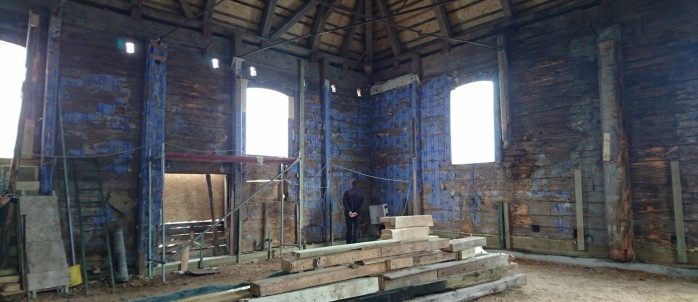
EEA and Lithuanian state support as well as from the Pakruojas regional administration has been allocated for fixing the wooden synagogue in Pakruojas, Lithuania.

The plan is to house a children’s literature section of the Juozas Paukštelis Public Library in the synagogue and to use it for educational activities and cultural events. The synagogue has no heat and will have to be outfitted with a heating system for year-round use.

A team of architectural experts, cultural heritage protection specialists, restorers and engineers visited Lithuania’s oldest wooden synagogue April 27. This mission organized by Lithuania’s Ministry of Culture was intended to come up jointly with experts the best solution to the heating problem and other outstanding issues at the site. Participants said the meeting was highly productive and hoped similar heritage issues would see the same sort of good practices applied in the future.

From EEA Grants for Culture in Lithuania

Photos from the trip here.

New Space Created for LJC Youth

The Lithuanian Jewish Student Union is pleased to announce the beta phase of the project Moadon Helimudim. We have officially opened the doors to the new educational space where young people can meet daily. It includes computers, internet, wifi connection, and coffee and tea!

Please come in and make use of the new space at Pylimo street no. 4 in Vilnius.

Contact person: Ziv Atlas
For more information write lujsinfo@gmail.com with Moadon Halimudim in the subject line.
The space is open from 5:00 P.M. onward.

Interwar Jewish Composers

image001

a concert dedicated to the memory of
Jan Zwartendijk
Dutch diplomat and Righteous Gentile

5:00 P.M., Friday, April 29
at the Lithuanian Jewish Community, Pylimo street no. 4, Vilnius

Program:

Rosy Wertheim (1888 – 1949)
6 Morceaux de Piano

Erwin Schulhoff (1894 – 1942)
Suite dansante en Jazz (1931)

Gideon Klein (1919 – 1945)
Sonata for Piano (1943)

Alexander Tansman (1897 – 1886)
Sonatine Transatlantique (1930)

Szymon Laks (1901 – 1983)
Blues

Anatolijus Šenderovas (1945 – )
Sonatina (1973)

Leo Smit (1900 – 1943)
Deux Hommages

Dick Kattenburg (1919 – 1944)
Tempo di blues (1940)
Two Waltzes

George Gershwin (1898 – 1937)
3 Preludes for Piano (1926)

Panevėžys Jewish Community Receives Guests

DSCF7806

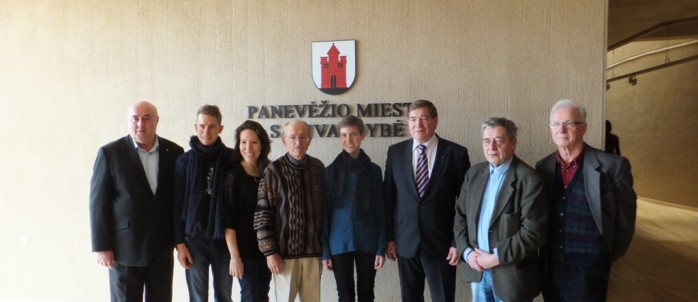
The Panevėžys Jewish Community received honored guests April 20, the family of Dr. Charles Borowsky from the USA.

Members of the Panevėžys city council, deputy mayor Petras Luomanas and Alfonsas Petrauskas received the guests over tea. Borowsky spoke about his family, the beginnings of his musical career, his travels around the world and all the famous people, politicians and scholars he’s met who are in one way or another connected with the world of music. Panevėžys Jewish Community chairman Gennady Kofman said at the meeting the Community works closely with the municipality and carry out joint projects and activities.

Deputy mayor Luomanas praised the Jewish Community for its activities. He also spoke about his family’s connection with music: his wife is a music teacher and has a small orchestra. His wife’s sister is a music teacher in Vilnius and his relatives perform in an Israeli orchestra.

Oldest Jewish Community in South Africa Looks Back over 175 Years

gardens3

The oldest Jewish congregation in South Africa, Cape Town’s Gardens Shul, celebrated its 175th anniversary recently. The community was established in 1841. The initial service was held in the house of Benjamin Norden and under the leadership of Joel Rabbinowitz the first synagogue in South Africa, the Gardens Shul, was erected in 1862. Philip Krawitz, a recipient of the prestigious Yakir award from Keren Hayesod-United Israel Appeal in Jerusalem and called “the unofficial mayor of the Jewish community in Cape Town,” in other words, the Cape Town Jewish Community chairman, spoke at the birthday celebrations.

pk

Address by Philip Krawitz
Gardens Synagogue 175th Anniversary Celebration
March 31, 2016

The Role of Jewish Business in South Africa: “A Light unto Nations”

Cast your mind back a few years… You leave your Sea Point Apartment designed by Dennis Fabian and built by the Berman Brothers. You hop into your Toyota bought from the Sanks. You pop into Pick ‘n Pay (founded by Raymond Ackerman) for some groceries. You’re off to Artscape to watch a matinee starring Aviva Pelham in La Traviata. Thereafter you’re off to the Spur (don’t tell the Rabbi!) created by Allen Ambor. (By the way, they now serve kosher burgers.) Tomorrow you’ll visit the V&A where you’ll find an outfit for your granddaughter from Jonni Katz’s Earthchild. Perhaps you’ll even get a chance to get a new down jacket from Cape Union Mart, sneakers from Barry Selby’s “The Athletes Foot” or a suit from Arie Fabian’s Fabiani. And if you’re feeling peckish, you grab a cappuccino from Ian Halfon’s Balducci. Charge it all to Kantor & Koseff’s Investec Card. Fortunately your Liberty Life Pension cheque (thanks to Donny Gordon) will more than cover your expenses. Indeed you could be forgiven for believing that the whole world is Jewish!

Kaunas Jewish Community Celebrates 125th Anniversary of Birth of Daniel Dolski

dolskis-7

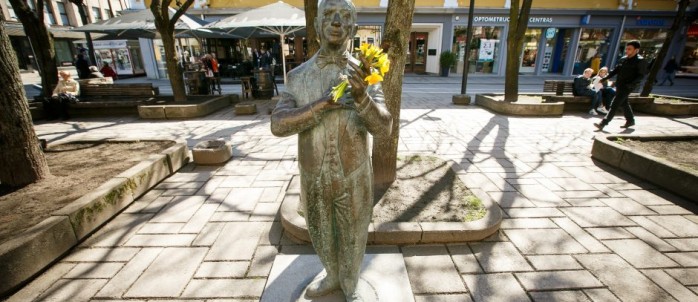
The Kaunas Jewish Community is celebrating the 125th anniversary of the birth of Daniel Dolski in Vilnius. Dolski was a pioneer of the Lithuanian stage. Highly educated and extremely charming, he debuted on the Russian stage, moved to Western Europe after the October Revolution and settled in Kaunas in late 1929, becoming a pioneer on the popular Lithuanian musical stage. He was one of the first to perform popular songs in the Lithuanian language, having learned it over the course of a half year upon his return.

Full story in Lithuanian here.

Litvaks Didn’t Suffer Enough to Deserve Lithuanian Citizenship?

Grant profile pic

by Grant Gochin

Lithuanian officials state that Jews were not oppressed in Lithuania:

In an astonishing display regarding the ignorance of rampant anti-Semitism in inter-war Lithuania, Lithuanian Foreign Minister Linas Linkevicius stated that there was “no violence, repressions or anything like that at the time”, against Jews in Lithuania during the period 1918 – 1939. Based on this assumption, Lithuania intends to deny citizenship applications for descendants of Lithuanian Jews. The belief that Jews did not suffer enough, in Interwar Lithuania, to warrant citizenship is simply preposterous.

http://www.baltictimes.com/litvaks_continually_rejected_restoration_of_lithuanian_citizenship/

At the beginning of the 20th Century, Jews represented about 14% of Lithuania’s population. In May 1915, the Czarist regime deported and exiled approximately 100,000 Lithuanian Jews to the Russian interior. After the war ended, Lithuanian Jews, who had lived in Lithuania for centuries and often constituted half of the population of many towns, were promised that the new independent Lithuanian state would be tolerant to minorities. Jews provided considerable political support for Lithuania in international forums and enlisted into the Lithuanian army to defend their country’s independence. A great many war medals were awarded to these soldiers for their extraordinary bravery and many lost their lives fighting for Lithuanian independence. In return for their contributions, the government granted full autonomy to the Jewish community and created a Cabinet-level Ministry for Jewish Affairs. Unfortunately, these promises were not kept; in 1923 funding for this Ministry was withdrawn, and in 1924 the Ministry was abolished. Sadly, the Ministry had served little purpose, because in 1923 the Lithuanian Government reportedly rounded up and expelled Jews whom they considered to be “alien”.

ISIS Destroy Ancient Gate to Biblical City of Nineveh

gog

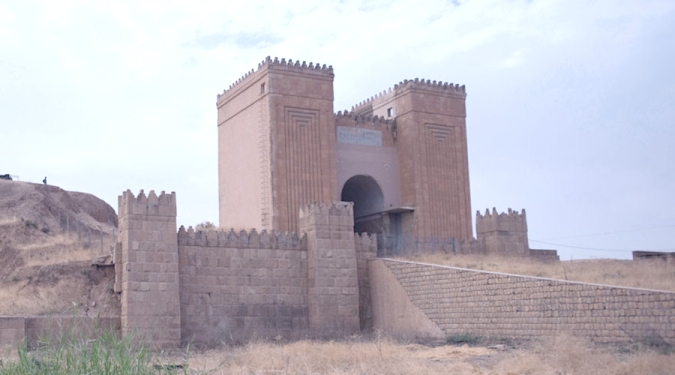
The Gate of God, also known as the Mashqi Gate, was one of a number of grand gates which guarded the ancient Assyrian city of Nineveh. Referenced in the Bible (Genesis 10:10, 2 Kings 19:36, Isaiah 37:37-38, Nahum, Zephaniah 2:13-15, Book of Jonah, as well as in the Christian Book of Tobit and the Gospels of Matthew and Luke in the New Testament), the settlement of the site which eventually became Nineveh dates back to about 6000 BC and in the 6th century BC it was the largest city in the world. Nineveh was central to the first book of the prophets, namely, Jonah, who was sent by God to make the Ninevites repent. The Book of Jonah describes the city as an “exceedingly great city of three days journey in breadth” whose population at that time was “more than 120,000.” On July 24, 2014, ISIS destroyed the tomb of Jonah in Ninveeh as part of a campaign to destroy idolatry, although Jonah has an entire chapter named after him in the Koran.

A source at the British Institute for the Study of Iraq confirmed the gate had been attacked.

The Antiquities Department in Baghdad didn’t deny the attack had happened, according to a source who also said there were unconfirmed reports the group was dismantling part of the walls of Nineveh to sell the stone blocks to antiquities collectors. There were also unconfirmed reports the Gate of God was being dismantled for sale rather than being completely destroyed.

About Taverns, the Vilna Gaon and the Shared History of Lithuanians and Jews

by Nijolė Bulotaitė

American academic Glenn Dynner is teaching a module at the History Faculty of Vilnius University called “Socio-cultural History of Ethnic Minorities in the Central and Eastern European Context.” The professor specializes in the history of Eastern European Jews and has written several books, including “Men of Silk: The Hasidic Conquest of Polish Jewish Society” (Oxford University Press, 2008) and “Yankel’s Tavern: Jews, Liquor and Life in the Kingdom of Poland” (Oxford University Press, 2014). What prompted the professor to take an interest in taverns and Lithuanian and Polish Jews, and what has he discovered? We asked him those questions in Vilnius recently.

Q. Why Poland and Lithuania exactly? Was Jewish life here somehow special?

A. When I was a naïve American student, as soon as I started professor Antony Polonsky’s class at Brandeis University I learned the majority of the world’s Jews lived in Poland and Lithuania before the Holocaust. The professor was my doctoral dissertation supervisor later. I learned three quarters of the world’s Jews in the 19th century lived in Eastern and Central Europe. My problem was I didn’t know any languages. At first I had to learn Hebrew, then Polish, Yiddish and several more. Only then did all the rich sources become available to me. Not many Americans are able to do research in this area because the languages are rather difficult, and it’s difficult for us Americans to learn languages.

Full interview in Lithuanian here.

Bagel Shop Editor Published in Israeli Academic Journal

Radvilė
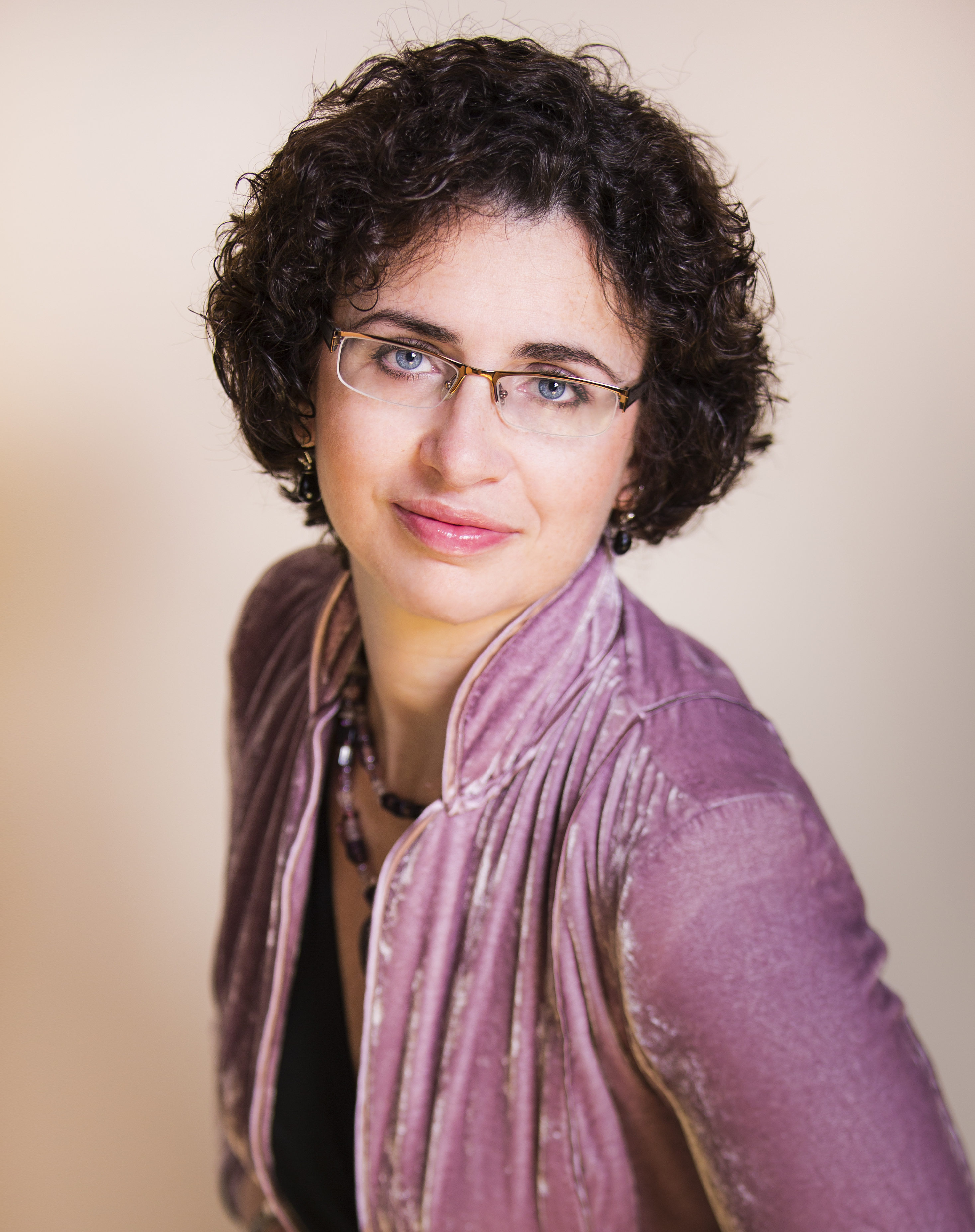
Radvilė Rimgailė-Voicik

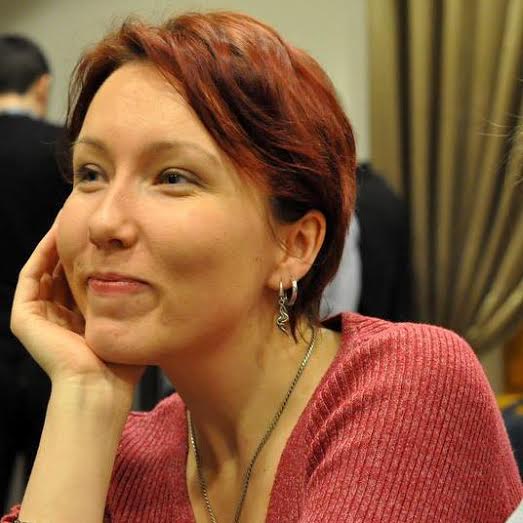
Radvilė Rimgailė-Voicik, who writes and compiles the quarterly Bagel Shop newsletter, has had an academic article published by the Israel Journal of Plant Sciences. The article, called “Plant Community Associations and Complexes of Associations in the Lithuanian Seashore: Retrospective on the Studies and Tragic Fate of the Botanist Dr Abromas Kisinas (1899–1945),” pursues the topic Radvilė wrote about in a previous issue of the Bagel Shop newsletter.

Abstract:

The life and scientific activities and discoveries of Dr Abromas Kisinas (1899–1945, also appearing in the literature as Avraham, Abraham, Kisin or Kissin) are presented here for the first time. He was a botanist, a Lithuanian, a graduate of Vytautas Magnus University in Kaunas, a polyglot and a social figure. In 1936, Kisinas’ major phytosociological work “Plant Associations and Complexes of Associations in Lithuanian Seaside (without Klaipėda Region)” was published in the Works of Vytautas Magnus University Faculty of Mathematics and Natural Sciences. The publication was written in Lithuanian with a summary in German and summarized Kisinas’ PhD dissertation, which was defended in 1934 under the supervision of Prof. Constantin Regel. In his research, Kisinas applied ideas proposed by the Uppsala School of Phytosociology. For plant communities evaluation he used linear transects with 1 m², 4 m² and 16 m² sampling squares. In a 15 km seashore range Kisinas determined 63 plant community associations and 26 sub-associations. The fate of this gifted scientist was tragic. In 1941 he and his family were deported to the Kaunas Ghetto. In 1945 Kisinas died at the Dachau concentration camp in Germany.

New Book on Litvak Art in Private Hands

TMP000_470

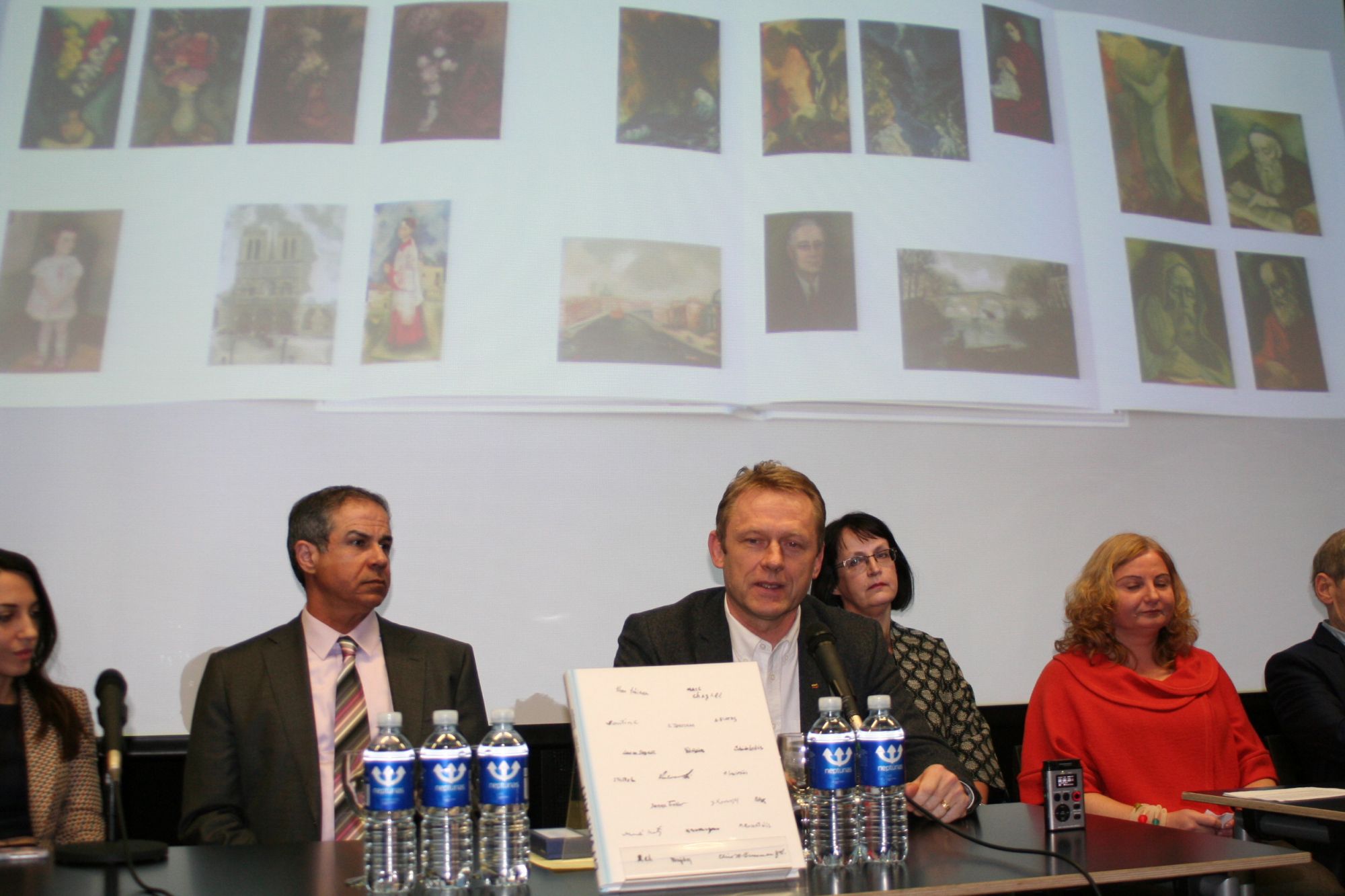
A new book/catalogue called “Litvakų dailė privačiose Lietuvos kolekcijose” [Litvak Art in Private Lithuanian Collections] was presented at the National Art Gallery on April 5. The book is bilingual in Lithuanian and English, and contains about 250 works by 44 Litvak artists, including paintings, water colors and sculpture, many of which have never been seen by the public before. The publication is the fruit of exhaustive research by Dr. Vilma Gradinskaitė, an historian at the Vilna Gaon State Jewish Museum’s History Department.

Lithuanian minister of culture Šarūnas Birutis spoke at the book launch and said: “This serious album spans more than 150 years from the mid-1800s to current artists working within the Litvak artistic tradition. I hope this publication will interest the broader public as well as professionals, hooking the reader and reminding us of the names and works of little-known and forgotten artists.” He said it was the only book in Lithuania which so broadly and comprehensively surveys Litvak ark, graphics and sculpture held in private collections.

litvak art

Rakija Klezmer Orkestar

Rakija klezmer1

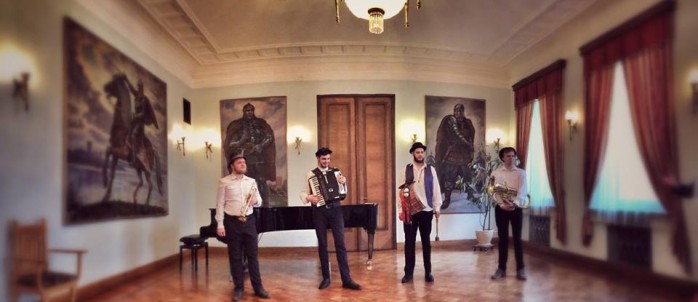
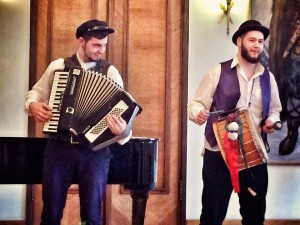
Rakija Klezmer Orkestar is a klezmer group which formed three years ago in Kaunas, Lithuania. They have performed Hanukkah concerts at the Lithuanian Jewish Community.

Rakija Klezmer2

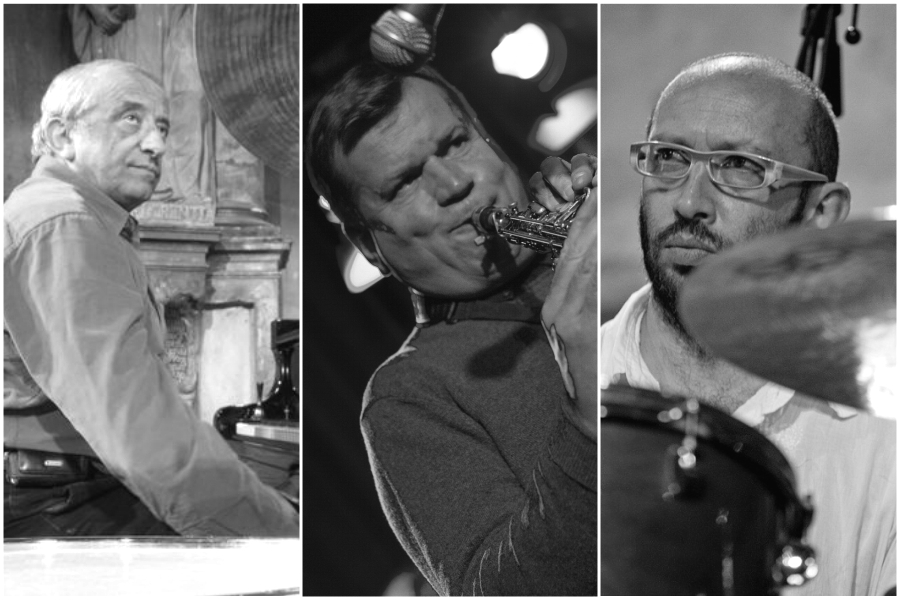
The group say they want to revive Litvak klezmer traditions. The four-set will soon become five with addition of Mantas Ostreika on saxophone. The other members are Darius Bagdonavičius, Mikas Kurtinaitis, Skirmantas Rumševičius and Povilas Jurkša.