Learning, History, Culture

Rothschild Foundation Holds International Conference on Jewish Cemetery Protection in Vilnius

The Rothschild Foundation (Hanadiv) Europe held a conference to discuss Jewish cemetery heritage protection issues in Vilnius from October 25 to 28.

The conference, “A Cross-Disciplinary Seminar on European Jewish Cemeteries: Theory, Policy, Management and Dissemination,” with professionals from different European counties working in the field of Jewish Cemeteries including, scholars, genealogists, Jewish communities and federations, religious leaders, NGOs and policy makers, was designed to bring together a group of experts with 3 core aims:

• To review achievements since the conference on Jewish Immovable Heritage in Krakow 2013. The conference will provide a chance to conduct an appraisal of what has been done in the field until now. Organizations shared their most important projects, including new trends such as the development of technological tools to assist in the discovery and research of cemeteries.

• To explore important issues through a series of roundtable and panel conversations on the central questions and topics affecting the field.

• To encourage future collaboration between participating organizations, exploring how they can work together, encourage cross-border opportunities and consider further strategic cooperation.

Victims of 1941 “Great Action” Remembered at Kaunas Ninth Fort

IMG_1771

Every year on the last Sunday in October members of the Kaunas Jewish Community and others gather to remember the victims of the so-called Great Action at the Ninth Fort in Kaunas. The largest mass murder operation to kill Jews in the Kaunas ghetto was carried out from October 28 into October 29 in 1941. Approximately ten thousand people were murdered during the single operation, including about 4,300 children.

Ninth Fort Museum director Jūratė Zakaitė spoke first at the ceremony, followed by Kaunas Jewish Community chairman Gercas Žakas. Žakas as well as Kaunas deputy mayor Vasiliy Popov, deputy Israeli ambassador to Lithuania Yehuda Gidron and Russian embassy attaché Svetlana Lepayeva spoke about how we must never forget the atrocities committed and must talk about the subject with young people, including humanity’s apparent inability to learn from its mistakes and parallels with racist crimes today. Kaunas Jewish Community member Julijana Zarchi, a Holocaust survivor and Soviet deportee, shared her experiences and insights.

Amit Belaitė: Jewishness Isn’t Always a Religious Thing

amit

“The busier you are, the more you get done,” Vilnius University medical student Amit Belaitė says. The young woman studying social medicine has earned the tolerance award for her work with the Bagel Shop campaign and she is an active promoter of Jewish culture. Belaitė currently heads the Lithuanian Jewish Student Union and was elected vice-president and executive board member of the European Jewish Student Union last summer.

The organization Belaitė leads operates at the Lithuanian Jewish Community. She says the student union’s spectrum of activities is broad and shouldn’t be construed as an exclusively religious or exclusively cultural institution.

“We celebrate Jewish holidays, attend cultural events and attempt to learn more about our history. We organized a Purim holiday party, for example…”

Full article in Lithuanian at the Vilnius University website.

Memorial Plaque Commemorating Bluma Katz Unveiled

OLYMPUS DIGITAL CAMERA

Moisejus Preisas and Fania Brancovskaja lay a wreath at the Menorah statue in Švenčionys

Every year at the beginning of October a small group of people gather at the Menorah statue in the Švenčionys City Park who remember what happened there from 1941 to 1943.

This year Švenčionys Jewish Community chairman Moisiejus Šapiro began the meeting and presented Nalšia Regional History Museum historian Nadežda Spiridonovienė, who spoke about historical events in Švenčionys and how Jewish settlement in Lithuania was a result of tragedies in Western and Central Europe in the 19th century.

“Lithuania was an agrarian country and belonged to the large non-industrial part of Russia. Most of the country people were Catholic Lithuanians, Belarusians and Poles. This was the main factor in the locals’ relationship with Jews. To Lithuanians, Belarusians and Poles, it seemed the Jew was clever and wise because of his many talents. Jews were small businessmen and craftsmen who traveled around and were much valued for spreading information as bearers of news. There were about 4,500 Jews living in Švenčionys then, they established an herbal medicine factory and had leather-working workshops in the city center. The hard work, initiative and expertise of Jewish business people expressed themselves in all areas of production.

Remembering the 74th Anniversary of the Large Action at the Kaunas Ghetto

The Kaunas Jewish Community plans to mark the 74th anniversary of the Great Action at the Ninth Fort in Kaunas at 12 noon on October 25, 2015.

Let’s remember and honor the memory of the victims.

The Large Action was the mass murder operation on October 28 and 29, 1941, during which about 10,000 people were murdered at the Ninth Fort in a single twenty-four hour period, including about 4,300 children.

Lithuanian President: Litvaks Played Special Role in Establishment of Lithuania and Israel

VILNIUS, October 21, BNS–Litvaks, or Jews originating from Lithuania, played a key role in establishing both Lithuania and Israel, Lithuanian president Dalia Grybauskaitė said at the opening of the World Litvak Forum in Israel.

She said Litvaks are among the most active Israeli public, business, cultural and political figures who have worked effectively in all the parliaments of democratic Lithuania, both in the interwar period and after the country regained independence in 1990.

“Litvaks have always been among the most active Israeli public, business, cultural and political figures, they still are and will continue to be so,” the Lithuanian president said in a press release published by the presidential press service.

She applauded the Litvak contribution to the Lithuanian economy, culture and science.

President Grybauskaitė said Lithuania and Israel cherish democracy, human rights and a culture of tolerance, and that world-wide challenges including terrorism and aggression are problems the two countries share.

According to a census in 201ą, 3,000 Jews lived in Lithuania. In Israel the Lithuanian Foreign Ministry calculates there are about 200,000 Litvaks and their descendants, the world’s largest Litvak community.

BNS

Arkadijus Gotesmanas Wins Vilnius Jazz Prize

ag

Percussionist and composer Arkadijus Gotesmanas won the 12th Annual Vilnius Jazz Festival Prize for contributions to Lithuanian jazz and was awarded Saturday at the Russian Drama Theater in Vilnius.

Gotesmanas has been performing jazz for more than three decades. He has long partnered with Vyacheslav Ganelin, Petras Vyšniauskas, Vladimir Tarasov, Liudas Mockūnas, Dainius Pulauskas and Tomas Kutavičius, and also performs with the Vilnius Jazz Orchestra, the ACCOsax Freeminded trio, with Juozas Kuraitis, with Eugenijus Kanevičius and many other jazz masters.

Gotesmanas’s newest project is a duet with Dmitri Golovanov on keyboard featuring spontaneous improvisation using acoustic percussion beats, keyboard melodies and live electronic sounds. The poet Rolandas Rastauskas often makes the duet a trio.

More in Lithuanian here

Taboo against Death

New book entitled Price of Concord/Memoirs;Portraits of Artists; Interactions of Cultures by prof. Markas Petuchauskas („Versus aureus“ Publishers, 2015; www.versus.lt; info@versus.lt) is available to the readers.

Please find the extracts about prominent Litvak artists from the book.


Samuel Bak, with whom I keep corresponding, told me that he had seen a mono-performance by Chaje Rozental’s daughter Naava Piatka dedicated to her mother. He liked the performance. I thought then that the transference of the performance to the stage in Vilnius might be a good idea. I started corresponding with Naava Piatka. We discussed the questions pertaining to her arrival to the land of her parents as well as those concerning the preparation of the performance. Both in the States and in London, Naava performed in English. It took me a long time to talk her into rehearsing the performance in Yiddish, a language posing difficulties for the actress. Eventually I managed to convince her that on the stage of the Vilnius Ghetto Theatre one must use Yiddish. On the 24th of September 2003, I organized the first night of the play dedicated to Chaje Rozental entitled Better Don’t Talk. By extending the Art Days dedicated to the commemoration of the 60th anniversary of the Vilnius Ghetto theatre, we also marked the 60th anniversary of this phenomenon of Lithuanian Jerusalem and the destruction of the Vilnius ghetto.

 The Precedent of the Binkis Family

New book entitled Price of Concord/Memoirs;Portraits of Artists; Interactions of Cultures by prof. Markas Petuchauskas („Versus aureus“ Publishers, 2015; www.versus.lt; info@versus.lt) is available to the readers.

Please find the extracts about prominent Litvak artists from the book.

I had already written a review about the play Dress Rehearsal by Kazys Binkis. It was stage director Henrikas Vancevičius who for the first time dared to save that play from complete forgetfulness by staging it. By publishing my article in the newspaper Tiesa, run by the Central Committee of the Communist Party, I wanted to support Binkis’ European level play, which was a new word in our dramaturgy. That was the play which, unused, had been lying in the drawer for a very long time, and which had given lots of doubts to our men in power.

When I proof-read the text, prepared by the publishing house, I felt sick. The main emphases of the review had been changed for another text, underlining the professional limitations of the play and of its production as well. The emphasis was laid on Binkis’ inability to differentiate between the right kind of wars and the wrong ones. All of that had been flavoured with usual Soviet phraseology. I was enraged, and I told them I was retrieving my article, because the present text was reversing my review and was putting it from head to foot.

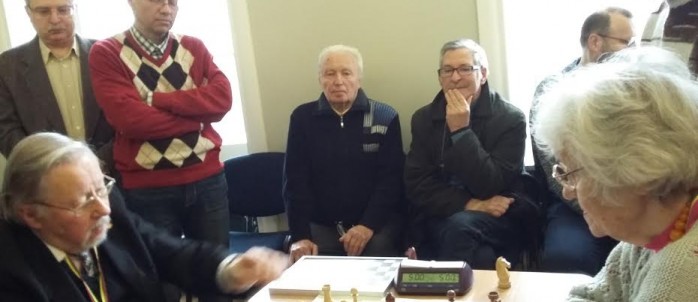
Alexander Macht Chess Tournament at Lithuanian Jewish Community Sunday

The Alexander Macht Chess Tournament will be held at the Lithuanian Jewish Community at Pylimo street No. 4 at 6:00 P.M. on Sunday, October 18. The tournament was organized by the LJC and the elite chess and checkers clubs Rositsan and Maccabi.

Boris Rositsan gave the LJC website a small interview in the run-up to the tournament where, he said, at least 30 people are planning to play. Special medals have been ordered for this competition.

What does the name Alexander Macht signify?

Boris Rositsan: Alexander Macht is an historical figure and a very important person in the history of Lithuanian chess as well as Jewish. We cannot forget this sort of person, so we are continuing the tradition of tournaments. In interwar Lithuania he was Lithuanian champion seven times over. Macht lived in Kaunas and was director of the Jewish People’s Bank. He went to Israel in 1935 and directed the famous Bank Leumi there. No one wrote, said or remembered anything at all about this great chess player during the Soviet period. We have prepared a program dedicated to Litvak chess players. After we presented our book “Žydai Lietuvos šachmatų istorijoje” [“Jews in Lithuanian Chess History”] at the beginning of this year, LJC chairwoman Faina Kukliansky asked us why weren’t continuing that history. I would like to say that we are preparing to do just that in cooperation with the community. We are holding two tournaments, this is for adults, but if strong young chess players come forward, we will include them. On October 31st there will be a tournament dedicated to the memory of Itzhak Vistinietzki [Isakas Vistaneckis] and children will play in that. We are inviting children aged five and over to come and learn to play chess. We have student groups at the community for the ages of 5, 6, 7… and 13 years old. Also, elderly and retired LJC members are coming to us. Fishman is helping me with the training. Serious work is taking place, non-commercial, I really love chess and I want to revive the LJC chess movement.

First Chairwoman of Švenčionys Jewish Community Remembered

A memorial plaque has gone up on the building at Vilniaus street No. 5 in Bluma Katz’s hometown of Švenčionys. Bluma Katz was the first chairwoman of the Švenčionys Region Jewish Community. City and regional administration leaders, Lithuanian Jewish Community chairwoman Faina Kukliansky, deputy Israeli ambassador to Lithuania Yehuda Gidron and local residents gathered to remember her at the ceremony to unveil the new plaque.

Katzs was born in Švenčionys in 1913, studied at a Jewish gymnasium and continued her education in Vilnius where she was an active participant in Jewish life. Her teachers included well-known Jewish scholars and writers such as Max Weinreich and Zalman Reyzen, among others. She moved to Russia with her future husband Sh. Yavich. They were both arrested there in 1937, with Bluma Katz sentenced to ten years at a Stalinist gulag in Kolyma. She returned, remarried to her second husband Segalovich, to her hometown, Švenčionys, in 1947. She completed nursing courses and worked for the next 42 years at the city hospital. After Lithuanian independence Katz formed and led the Švenčionys Jewish Community and was noted for her sincere and personal concern for every member of the community. Katz’s memoirs have been published in Lithuania and the West and she always consented cheerfully to meet students from around the world coming to Vilnius to study Yiddish. Katz also attended Yiddish workshops at Oxford University in Great Britain.

When Will Lithuania Improve Its Holocaust Reputation?

October 11, 2015. The Švenčionys Jewish Community commemorated Holocaust victims at the Menorah statue. Švenčionys city leaders, Lithuanian Jewish Community chairwoman Faina Kukliansky, Vilnius Religious Jewish Community chairman Simas Levinas, deputy Israeli ambassador Yehuda Gidron, Dr. Dovid Katz and local residents all attended the sad ceremony. Švenčionys Jewish Community chairman Moisiejus Šapiro thanked everyone for coming despite the cold weather to remember those who were murdered. Kaunas ghetto inmate Moisiejus Preisas and Vilnius ghetto prisoner Fania Brancovskaja laid flowers next to the statue. A representative from the local Nalšia regional history museum spoke about the history of the city of Švenčionys, contributions made by Jews to the growth of the city and the tragedy of the Holocaust.

The ceremony to commemorate the dead continued at a mass murder site where eight thousand Jews were murdered in the Švenčionys Forest. Deputy Israeli ambassador to Lithuania Gidron, after hearing eight thousand Jews were murdered at the site, and that six million in total were murdered over a few years, said it is difficult to comprehend those numbers. “I am glad the Švenčionys municipality is planning to erect a memorial plaque with the names of the Jews murdered next to the Menorah statue in the former ghetto territory. This is important not just for each of us, but also for everyone who lives in Švenčionys,” he said.

Lithuanian Jewish Community chairwoman Faina Kukliansky said: “We should remember not just the names of those who were murdered, but the names of those who murdered as well. This is necessary not just for condemnation or revenge, because those who are some still alive are very old, while others have passed on and stand in the court of the Almighty. I think it is necessary for all of us, their inheritors, so that our neighbors might know by whose hand the most horrific crime of the 20th century was committed. Because only when everyone whose hands were sullied with the blood of innocent victims is named and condemned, even if only in our thoughts, only then can we start to hope Lithuania might rid itself of its shameful title as a ‘nation of Jew-shooters’,” she said.

Vilnius Choral Synagogue cantor Shmuel Yatom said Kaddish for the dead.

Monument to Jews of Šeduva Unveiled

Monument to Jews of Šeduva Unveiled

Lithuanian prime minister Algirdas Butkevičius, representatives of the Lithuanian Ministry of Foreign Affairs, foreign ambassadors to Lithuania, Radviliškis regional administration representatives and Jews from all over the world as well as local residents attended a ceremony to commemorate the murdered Jews of Šeduva, Lithuania, and a ceremony to kick off the Lost Shtetl Šeduva Jewish memorial project.

More photos here

They visited the restored Jewish cemetery and three mass murder sites as well as attending the ceremony for the unveiling of a monument to the Jews of Šeduva in the town center. Under private initiatives architectural compositions by the sculptor Romuoldas Kvintas now greet visitors to two mass murder sites in the Liaudiškiai forest and one in the Pakuteniai forest.

Litvak Life before the Holocaust: An Exhibit of the Personal Collection of Michailas Duškesas

The Antanas Žmuidzinavičius Museum of Works and Collections in Kaunas (Vlado Putvinskio street No. 64) is hosting an exhibit of original documents from the personal collection of Michailas Duškesas on Jewish life in Lithuania before the Holocaust.

This unique exhibit is being shown for the first time in Kaunas. It is dedicated to the Jews of Lithuania who were murdered in the Holocaust. A wide range of archival material, photographs, original documents and postcards show Jewish life in Kaunas and throughout Lithuania at the end of the 19th and early 20th century. Jewish activity is presented under the principles of mutual aid, sponsorship and welfare. The exhibit features notable personalities, religious organizations, banks, agencies and credit unions.

Lithuanian Jewish Community Staff Pitch In to Clean Up Old Jewish Cemetery in Užupis Neighborhood

A group of volunteers from among the personnel of the Lithuanian Jewish Community gathered October 8 at the old Jewish cemetery in the Vilnius neighborhood of Užupis. Although not that many people turned out, those who did put their backs into it, hauling off brush and saplings. Volunteer director Juozas Labokas of the Regional Park’s Office of Inspector told volunteers of the history of the site and called for more volunteers and volunteer actions so the refurbishment of the cemetery could continue through the winter months. Strong individuals are sought especially, since many of the trees being removed require heavy lifting.

The site located along Olandų street next to the Soviet-era funeral home facility there was a Jewish cemetery where some 70,000 people were buried. The 11-hectare cemetery now falls under the care of the Pavilniai Regional Park. It has been completely overgrown by weeds, bushes and small trees. Now enough undergrowth has been cleared away to reveal some of the surviving Jewish headstones.

The cemetery was the main Jewish burial site in Vilnius from 1831 to 1946. The cemetery was destroyed beginning in 1965.

Currently the Municipal Works and Transportation Department of the Vilnius municipality is undertaking work to refurbish the graveyard. Trees are being removed to provide an aesthetic view of the grave monuments. Currently work is on-going in 4 hectares and volunteers are sorely needed.

The Pavilniai Regional Park webpage says:

The more people who step forward to contribute to putting the old Jewish cemetery in order, the more quickly the territory will be liberated from the brush. We hope for your reply and await your telephone call or email.

telephone: Vida at 8 614 92 522
email: parkas@botanika.lt

Lithuanian Foreign Minister Meets Reps of US and World Jewish Organizations in NY

link

Lithuanian foreign minister Linas Linkevičius met October 2 with directors and representatives of leading US and world Jewish organizations in New York City during the current session of the United Nations general Assembly.

They discussed important issues including UN effectiveness, battling anti-Semitism and other forms of hate, policy on Iran, the Mideast peace process and current issues in safeguarding the Lithuanian Jewish heritage at the Lithuanian general consulate in New York. The Lithuanian foreign minister said ever more Lithuanians are discovering the rich Litvak heritage, understand the need to protect that legacy and take pride in the remarkable contributions Litvaks have made to world culture.

Monument to Gandhi and His Friend from Lithuania Unveiled

VILNIUS, October 2, BNS–A statue portraying Indian independence hero Mohandas Gandhi and his friend Jewish architect Hermann Kallenbach was unveiled Friday in Kallenbach’s hometown, Rusnė, located in the Šilutė region of Lithuania.

Lithuanian prime minister Algirdas Butkevičius was at the ceremony and called the bronze statue a monument to Lithuanian-Indian friendship and a testimony to the achievements of Litvaks. “Today is unveiled a monument to friendship, between two people and two peoples,” he said, standing next to the almost two-meter-tall statue of the two men on the banks of the Atmata River on the border with Russia’s Kaliningrad Oblast. Gandhi and Kallenbach, who left Rusnė in his youth, became friends in South Africa at the beginning of the 20th century.

Gandhi’s great-grandson Tushar Gandhi attended the ceremony and said non-violent resistance unite India and Lithuania. He said Kallenbach was an important spiritual influence on his ancestor.

“Lithuania is still a little-known country in India,” Lithuanian ambassador to India Laimonas Talat-Kelpša told BNS. “This is a good opportunity to bring the attention of Indian society to Kallenbach and Lithuania.”

Lithuanian Holocaust Remembrance Day Marked in Batakiai

b

Lithuanian Holocaust Remembrance Day was observed in the village of Batakiai, Lithuania, on September 23, 2015. A new monument to Holocaust victims was unveiled there.

The event at the Batakiai House of Culture began with a literary musical composition dedicated to the memory of Jewish victims of the Holocaust. Batakiai High School students and teachers performed the composition which was a sensitive treatment of the Holocaust. Tauragė Regional Administration director Sigitas Mičiulis, deputy director Aušrinė Norkienė and Klaipėda Jewish Community chairman Feliksas Puzemskis spoke at the event.

Members of the audience at the event went to the mass murder site in Gryblaukis Forest. Regional administrator Sigitas Mičiulis and Klaipėda Jewish Community chairman Feliksas Puzemskis unveiled the monument to seven Jews of Batakiai murdered in 1941. A moment of silence was held, flowers were laid at the monument and candles lit. Another nearby mass murder site was visited after the ceremony where about 1,800 Jewish women and children were murdered. A moment of silence was held there, too, and flowers and candles were placed by the second monument.

Klaipėda Jewish Community News

On September 25 the Klaipėda Jewish Community visited Švėkšna for the “Let’s Save the Švėkšna Synagogue” event. A guide provided an excellent tour and told of Švėkšna, its history and important sites. Volunteers took members to the old Jewish cemetery and mass murder sites. The Klaipėda delegation met with the group from Kaunas and were treated to the songs of Vitalijus Neugasimovas.

Members of the Klaipėda Jewish Community along with the rest of the audience were much impressed with the visual presentation on the history of the Švėkšna Synagogue.

Even so, members on the return trip wondered if the money hadn’t been better spent repairing the synagogue roof.

Snapshots here:
https://www.facebook.com/klaipedajewish