Learning, History, Culture

Vampires in Medieval Jewish Texts: What Are They Doing There?

Vampires in Medieval Jewish Texts: What Are They Doing There?

Haaretz reports on an unexpected find in old Hebrew texts and commentaries from Europe.

Secure in their monotheism, Jews may scoff, but some of the earliest texts on vampires were written in Hebrew by their coreligionists.

by Elon Gilad

The vampires which abound in popular culture today are, for the most part, a literary embellishment of an old Slavic belief that under certain circumstances, the dead can rise from their graves at night and kill their neighbors, friends and family.

Modern Jews might scoff at vampire culture, secure their monotheism rules out belief in such nonsense. But they should hold their tongues. Some of the earliest texts on vampires were written in Hebrew by their coreligionists, albeit after learning about the plague of the undead from their neighbors.

Lithuanian Jews, Fostering Lithuanian Independence since 1918. An excerpt from Vilius Kavaliauskas’s book

sarasas2
Election poster. Vote for List Number 13–the Jewish List.

A translated excerpt from Vilius Kavaliauskas’s book “Pažadėtoji žemė – Lietuva,” or “Lithuania, the Promised Land”:

After independence was reestablished and the Lithuanian state was established on democratic principles on February 16, 1918, one of the most important events in Lithuanian Jewish history was the Jewish Affairs Institute established by the independent state in 1919, which in essence performed the functions of a government ministry. Dr. Maksas Soloveičikas became minister without portfolio.

From 1918 to 1926 Lithuania’s Jewish population successfully involved themselves in the country’s governance structures and actively ran for posts in elections to municipal bodies and the parliament of the Republic of Lithuania. There were a number of Jewish members of the ministerial cabinet of the Lithuanian government as well: minister without portfolio for Jewish affairs [sic] Jokūbas Vygodskis, Maksas Soloveičikas, Bernardas Fridmanas (from Panevėžys, judge at the Panevėžys District Court in 1925) and Simonas Rozenbaumas.

Doctor of philosophy Maksas Soloveičikas (1883-1957) was exceptional for his erudition and education. He studied in Petropol [Petrograd, Leningrad, Saint Petersburg. etc.], Germany and Switzerland. He was an active member of the Zionist movement and a Jewish press correspondent. He spoke Russian with his fellow ministers. In 1921 he was elected to the World Zionist executive committee in London.

The cabinet of ministers tolerated the Jewish community’s aspiration to turn the ministry into a political institution while the Vilnius question remained unsolved. When the Christian democrats came to power in 1924, the accreditation for the ministry was withdrawn and the ministry ceased to exist.

Chess Tournament to Celebrate Lithuanian Independence Day Held at LJC

332b6b05-17f9-4554-880a-50794b55861a

A chess tournament held by the Rositsan and Maccabi elite checkers and chess club dedicated to celebrating February 16, Lithuania’s pre-war independence day, began at the Lithuanian Jewish Community on schedule at 11:00 A.M. on February 14.

Tournament director and FIDE master Boris Rositsan welcomes contestants and gave the floor to Vytautas Landsbergis, the first chairman of the independent Lithuanian parliament, Lithuanian independence leader and avid chess player. Not only avid, but good: he won a match against Marytė (Marija) Kartanaitė, Lithuanian chess master many times over, at the LJC. “Playing chess, it’s important not to lose the initiative and not to give up,” Landsbergis said. “It’s important how much space you occupy. The opponent, it seems, is pressuring you to give up, but don’t lose the initiative. It’s nice chess players are honoring February 16, and that Boris Rositsan wants to demonstrate Lithuanian history through chess. Chess is the school of life and part of the culture of our country, and influenced our independence,” he commented.

Lithuanian Jewish Community chairwoman Faina Kukliansky spoke and characterized chess players as educated and honorable people. This year has been named the Year of Kazys Grinius, the interwar Lithuanian president and a Righteous Gentile who was also a fine chess player, and who rescued chess player Dima Gelpern from death during the Holocaust.

Lithuanian Jewish Community Proposes Publishing Information on Holocaust Perpetrators

February 12, BNS–Friday the Lithuanian Jewish Community proposed publishing “information of a general nature” on more than 2,000 people who, according to a study by historians, might have been complicit in the Holocaust during World War II. This proposal was presented Friday in a letter by LJC chairwoman Faina Kukliansky to the Office of Prosecutor General and the Center for the Study of the Genocide and Resistance of the Residents of Lithuania. The head of the community proposed announcing which group of people on their list participated directly in mass murder, how many participated indirectly, how many in total were convicted and whether there are people on the list who were honored in some way by the state, and under what agencies they worked. Kukliansky told BNS Friday she thinks it’s important to the public to receive explanations about the list. In her opinion, it is possible to publish the names of those whose cases have been tried.

“The Lithuanian Jewish Community believes refusal to release the List could have negative repercussions at the international as well as national level and could give rise to various theories which would damage the reputation of the Lithuanian state,” her letter said. She also called upon the prosecutor’s office to look into how many people on the list hadn’t been convicted but who are still alive, and if such exist, to begin criminal cases against the,

The Center for the Study of the Genocide and Resistance of the Residents of Lithuania has prepared a list of about 2,000 people who were complicit in Holocaust crimes. It has been turned over to the Government.

Keeping an Implicit Promise

by Geoff Vasil

It was interesting to watch the publicity machine surround Ruta Vanagaite’s new popular account of the Lithuanian Holocaust swing into gear to sell her new book. The publisher Alma Littera seemed to adopt an “artificial scarcity” marketing plan with an initial print run of only 2,000 copies, a plan which appears at this point to have been very successful. The next print-run is slated for 6,000, a humble figure given all the press and discussion of the book.

Initial confusion about the book–Jerusalem Post reported it as Efraim Zuroff’s new work–and some surprising comments by Vanagaite herself regarding Zuroff on national television softening his demonized image among the Lithuanian public gave way to a more general call for the Center for the Study of the Genocide and Resistance of Residents of Lithuania to stop dragging their feet and finally publish a “list of names” of Lithuanian Holocaust perpetrators.

LJC Letter to the Prosecutor and the Genocide Center

Lithuanian Jewish Community
No, 179, February 11, 2016

To:
The Honorable Evaldas Pašilis
Office of Lithuanian Prosecutor General

The Honorable Birutė Burauskaitė
Center for the Study of the Genocide and Resistance of the Residents of Lithuania

Re: Possible actions connected with the list comprised of 2,055 people who are alleged to have committed or contributed to the murder of Jews during World War II

February 11, 2016, Vilnius

The Lithuanian Jewish Community, seeking the restoration of historical justice and commemoration, and honoring the principles of the rule of law, equality before the law and the presumption of innocence, proposes:

Musicians of the Symphony of the Lie

Serg.Kanovic
by Sergejus Kanovičius

Rūta Vanagaitė’s book has raised several more unpleasant matters. Although it seems to talk about victims and perpetrators, neither side making comments about the book seem to care. What does interest the Genocide Center and the manipulators of history who stand behind it is the status quo of the center’s immunity, which has been seriously threatened recently, and the Jewish Community doesn’t seem to care either, because its chairwoman has voluntarily fallen into the same orchestra pit where, faking the notes, the Genocide Center symphony orchestra is performing, the shining white knights cavorting with television entertainment figures out for ratings, and someone in the background whining about Holocaust education. But the people who were pushed below the turf 75 years ago still lie there as they lay before. Usually nameless, very often surrounded by used hypodermic needles, condoms and plastic beer bottles. As nameless as their murderers. Trying to name the latter causes great controversy, and again all sorts of “I do this for you, you do that for me” deals begin to find voice, after which prosecutors are supposed to suddenly confirm a list already confirmed long ago by historical fact of those who did the shooting or helped shoot almost all Lithuanian Jews to the very last individual.

Opening of Exhibit “YIVO in Vilnius: The Legend Begins”

YIVO-d5281c3b6c78a6447dd232c1c135c8d3.jpg

You are invited to the opening of the exhibit “YIVO in Vilnius: The Legend Begins” at the Lithuanian National Museum at Arsenalo street no. 1 in Vilnius at 4:00 P.M., February 18. Exhibit curators: Dr. Lara Lempertienė and Dr. Giedrė Jankevičiūtė.

The exhibit was created to celebrate the 90th anniversary of the creation of YIVO in Vilnius. It includes previously unseen material from Lithuanian state collections on the history and work of YIVO. It demonstrates how YIVO’s work gave stimulus to the intellectual life of the Jews of Vilnius and the wider Central and Eastern European arena. It also presents the city and urban community as a source of inspiration and as the historical and cultural hearth and sustenance for the institute’s work. The exhibit was first shown at the Galicia Jewish museum in Cracow from September 30 to November 8, 2015. The exhibit to open in Vilnius contains additional material.

Come Meet Author and Art Historian Kristina Sabaliauskaitė

The Destinies series invites you to come meet Dr. Kristina Sabaliauskaitė at a presentation/seminar called

Jewish Motifs in the Art of Kristina Sabaliauskaitė

This will be the 24th seminar in our series and will be moderated by teacher and essayist Vytautas Toleikis.

Time: 6:00 P.M. on Wednesday, February 17
Place: Jascha Heifetz Hall, third floor, Lithuanian Jewish Community, Pylimo street no. 4, Vilnius

Series organizer and MC: Lithuanian Jewish Community deputy chairwoman Maša Grodnikienė

New Book about Jews of Ukmergė

kn w
by Daiva Zimblienė, lrytas.lt

A new book called “Ukmergės žydų bendruomenės istorija” [History of the Jewish Community of Ukmergė] is being passed around from hand to hand in Ukmergė. The almost 500-page book published in Lithuanian and English contains many important historical dates, interesting facts, documents and quotations about the Jews who lived in Ukmergė.

“I am not an artist, only a collector of historical facts. For about 15 years I carefully selected and accumulated different facts about the history of the city and district of Ukmergė. One computer folder began to grow quickly with material about the Ukmergė Jewish community. And that makes sense, because Jews were for several centuries the largest ethnic community in Ukmergė, you could say the dominant one,” author Julius Zareckas, deputy director of the Culture and Public Relations Department of the Ukmergė Ukmergė regional administration, said.

He said the new book is the second book of the same title which first appeared in 2008, with additional material and much more solid research.

Full story in Lithuanian here.

Israeli Scientists Discover Early Detection Method for Lung Cancer

40
by Michael Ordman

Scientists at Tel Aviv University and Rabin Medical Center have discovered they can detect lung cancer early in smokers by performing a CAT scan at the time they are admitted as pneumonia patients. Often the pneumonia is caused by young cancer cells blocking airways.

According to the American Journal of Medicine, lung cancer is the leading cause of cancer mortality in the US, associated with a 5-year survival of 17%.

The most important risk factor for lung cancer is smoking, which causes approximately 85% of all lung cancer cases. Only 15% of patients are diagnosed at an early stage.

Lithuanian Jewish Community Wants Rescuers Commemorated

Vilnius, February 7, BNS–The Lithuanian Jewish Community says commemoration of Righteous Gentiles is missing in Lithuania, and so far the Vilnius administration isn’t considering any specific ideas to do so.

LJC chairwoman Faina Kukliansky hailed an initiative by activists to erect a statue in Israel to rescuers of Jews, but thinks such commemoration needs to begin in Vilnius.

“But why does it need to be built in Israel instead of Lithuania? Is there no need to honor rescuers in Lithuania? I don’t know, maybe it wouldn’t be over the top if such a statue appeared in Israel. I think there are people who left Lithuania who survived, and if someone was left alive, it was thanks to the rescuers. I don’t think people would object to that. But perhaps first we should set things in order in Lithuania,” Kukliansky told BNS.

Lithuania to Publish Names of 1,000 Suspected Holocaust Perps

Following the publication in Lithuania of a groundbreaking book on local complicity during the Holocaust, a state museum on genocide said it would publish a list of 1,000 suspected perpetrators.

Terese Birute Burauskaite, who heads the Vilnius-based Genocide and Resistance Research Centre of Lithuania, said her institution would “this year try to publish a book” containing “over 1,000 Lithuanian residents who are connected to the Holocaust,” the news website Delfi.lt reported Tuesday.

Full story here.

New Bagel Shop Opens with Great Expectations

beigel8
Bagel shop, Vilnius, 1910, by Mstislav Dobuzhinsky.

A new kosher café in Vilnius, Lithuania, had its grand opening Thursday with an overflow crowd spilling into the street.

The Bagel Shop café is housed on the first floor of the Lithuanian Jewish Community, which some visitors still refer to as the Kahilla, in a mostly neglected and empty cafeteria hall.

Guests and LJC staff began filtering in well before the scheduled 3 P.M. start and four cheerful women behind the counter began placing bagel sandwiches cut into quarters on plates on the café’s six small tables.

LJC chairwoman Faina Kukliansky addressed the small packed room and said the Bagel Shop Café is an important part of the Bagel Shop tolerance program the LJC has been carrying out for the last year or so with funding from Norway and the EEA Grants program. She said the project was supposed to end earlier but had been continued into the next year.

Prosecutors Should Examine List of Holocaust Perpetrators

Vilnius, February 2, BNS–Lithuanian Jewish Community chairwoman Faina Kukliansky thinks a list of Holocaust perpetrators held by the Center for the Study of the Genocide and Resistance of the Residents of Lithuania should be handed over to prosecutors for possible action.

Center for the Study of the Genocide and Resistance of the Residents of Lithuania director Teresė Birutė Burauskaitė said she doubts such an investigation could take place and believes it is up to the Lithuanian Government and not the Center to address prosecutors.

“I would be satisfied” with the release of the list, Kukliansky said, “but would that affect the families of these people, would it violate their rights if guilt hasn’t been established? I would give the list to the prosecution, [these] crimes don’t have a statute of limitations, let them investigate. That needed to happen a long time ago. I think people need to know the names of the murderers as well as the rescuers. But the list may only be published when the guilt of these people has been proven. It should as provided for in law,” she added.

La Cumparsita

by Sergejus Kanovičius

“Šeduva? Oi, oi, oi. What’s your name? Sergejus? Oi, great, come, I’m waiting. When will you arrive? Tomorrow. Really? Šeduva? Come. Oi…”

That’s how I rang into her life last spring. Neither I nor she knew what to expect from our unexpected meeting. I have knocked at the chambers of people’s memories knowing for some the trip back into the past will be pleasant, while for others it will perhaps not be such a joyful return to memories stashed away in the most remote drawers,

I found Frida’s house easily enough, after all it wasn’t very long ago, just two decades ago, that I lived almost right there. She opened the door for me, so fragile, so small, always smiling. After listening to my short introduction about how some strange people were concerned with recording her life and those of her neighbors, their deaths and the disappearance of their home town, she sighed and looking somewhere far off in the distance, as if at the Milky Way of memory, said:

“How long have I waited for you. How very long. All my life.”

Panevėžys Jewish Community Member Oksana Navickienė Receives Yad Vashem Diploma

Oksana Navickienė, a member of the Panevėžys Jewish Community, has received a diploma from the Yad Vashem Memorial Authority and Museum in Jerusalem for completing a course at the International School for Holocaust Studies there. We hope she is able to apply her new knowledge to teaching the Holocaust to primary and secondary students throughout Aukštaitija. Congratulations, Oksana!

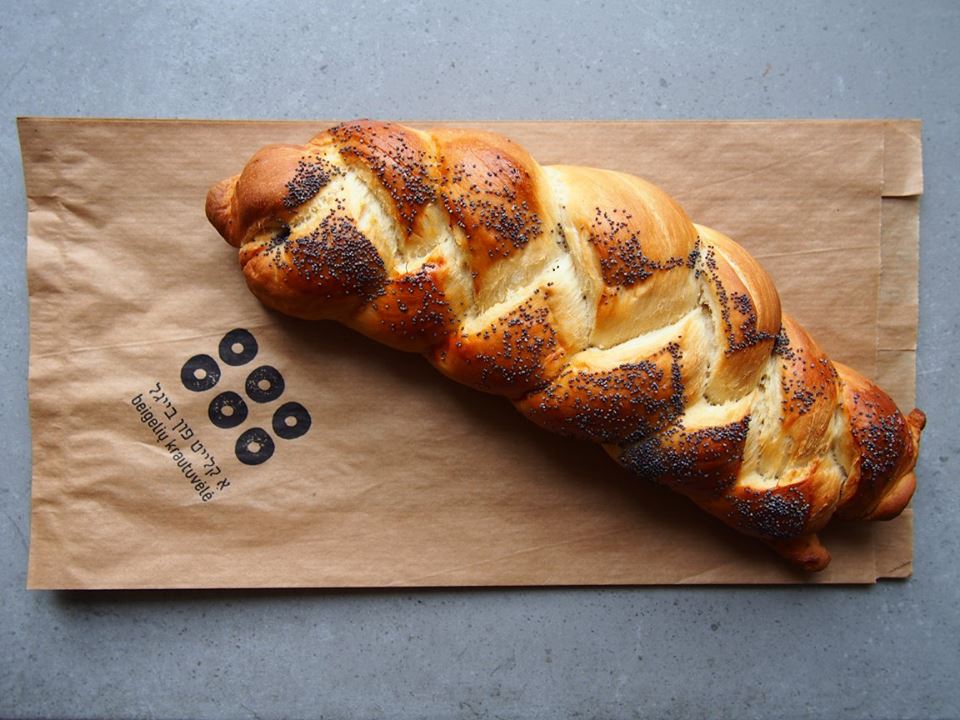
The Smell of Fresh Jewish Bagels Returns to Vilnius

Beigel1

The Bagel Shop, a new kosher food café, opens its doors February 4. The café will prepare kosher food and different traditional sweets according to the rules of Judaism. The Bagel Shop’s main draw will be freshly-baked bagels and bagel sandwiches. Adhering to the strictest rules, the bagels will be made under the supervision of a rabbi versed in kosher food rules.

Bagels are a traditional European Jewish food product often referred to as a “baronka” in Lithuania in the past, and when cooked may be cut in half and made into a sandwich. The book Joy of Yiddish furnishes one version of the origin of the bagel, according to which the recipe for bagels was created in Cracow at the beginning of the 17th century, and that bagels were given then as gifts to women giving birth. The bagel was supposed to symbolize the “wheel of life” because of its roundness. The bagel’s popularity quickly grew and spread to other countries where Jews speaking Yiddish lived, and was quickly adopted in America, where today about five million bagels are baked daily!

Lithuanian Jewish Community Chairwoman Faina Kukliansky on the Holocaust Discussions of Recent Days

C

Several days after commemorating International Holocaust Remembrance Day, discussions on the topic of the Holocaust have again come up in Lithuania. In my childhood I heard everything in my family–during conversation memories of the ghetto often came to the fore, being locked in the ghetto, taken to concentration camps, about the hole where people hid. But the experience of the Holocaust was as it were one of many things which separated Jews from non-Jews. They murdered us, while others at the same time went on with their lives, went to movie theaters, went to school and studied. Over just a few months almost the entire Lithuanian Jewish community, more than 200,000 people, were exterminated. For all of my life, for the entire Soviet period, many people treated us differently. We always knew our opportunities were limited and that we were different.

The Co-Authors of Rūta Vanagaitė’s Book

sk
by Sergejus Kanovičius

The noise generated as soon as an excerpt from Rūta Vanagaitė’s book “Mūsiškiai” was published was phenomenal in the true sense of the word. The passage released is almost certainly a transcription of an interview Saulius Beržinis conducted almost two and a half decades ago, one of many he did with Holocaust perpetrators. It says nothing about the book or its worth.

A bit later several interviews with the author and several responses to the facts recited in those interviews appeared. Writers, historians, publishers and known and unknown public figures began immediately discussing and judging the unread book, some even compared to a great work of literature and mused upon questions of metaphysical guilt and the effect of the Holocaust on society. For some of the non-readers it was enough that famous Holocaust historian and Nazi hunter Efraim Zuroff attended the presentation of the book and participated in its creation: right-wing non-readers immediately christened the unread book a provocation by the Kremlin intended to sow ethnic discord. One long-time Conservative Party member even fretted the book would ruin Lithuania and Israel’s wonderful relations, although she was unable to explain exactly the connection between Lithuania’s inability to come to terms with its past and foreign policy.