
Learning, History, Culture

Latkes: Traditional Hanukkah Food

Latkes: Traditional Hanukkah Food

Latkes are potato pancakes which Jews consider a national dish, as do Lithuanians, Russians, Belarusians, Ukrainians, Germans, Czechs and the Swiss. The first mention of the potato dish seems to come from 1830 and seems to have been German cuisine. although the word itself comes into Yiddish probably from Russian. Whatever the case, Jews made latkes global and it is a required part of the Hanukkah table now.

Some sources say latkes were originally made of buckwheat. Others put their origins in Italy where pancakes were served with ricotta cheese. Rabbi Kalonymus ben Kalonymus (1286-1328) seems to be the first person to associate pancakes with Hanukkah, in a poem about the holiday.

When Spain expelled the Jews of Sicily in 1492, they took their ricotta cheese pancakes with them and introduced them to the Jews in the northern Italian lands. These pancakes reportedly were called cassola in Rome.

Conference “Remarkable Women of the Panevėžys Region”

Conference “Remarkable Women of the Panevėžys Region”

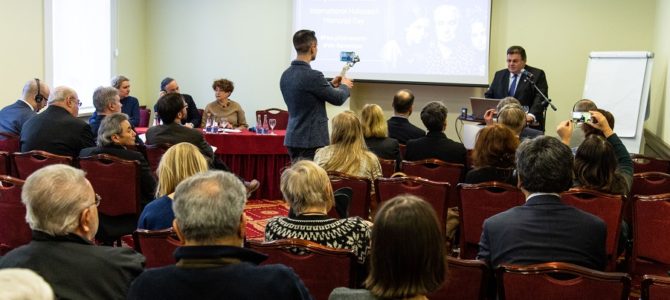
Acting Panevėžys mayor Petras Luomanas welcomed speakers and audience to the conference, saying: “It is very significant that we are now for the second time holding a conference in which we remember the remarkable women of our region whose contributions to culture, education, health-care, industry and other areas of endeavor in Panevėžys and throughout Lithuania have been gigantic.” Library director Loreta Breskienė spoke her library’s activities and “Lithuania’s Greats,” an exhibit of hand-sewn flags there. The author of the exhibit is Sofija Kanaverskytė, an artist and former resident of Panevėžys who did scenography at the J. Miltinis Drama Theater there.

The main topic of Panevėžys Jewish Community chairman Gennady Kofman’s presentation was historical information about the activities of notable Jewish women of Panevėžys till 1940. He said many of the Jewish women are little-known, including sculptress Marija Dilon, the businesswomen Ana Kisina and Lėja Chazanienė, social activist and doctor Ana Merienė, Panevėžys Jewish Hospital doctors Mirijam Todesaitė-Blatienė and Zinaida Kukliansky and the dentists Vera Dembienė, Golda Izraelienė, Liuba Gurevičienė and Chasjė Feigelienė. Much more widely known was the Jewish women’s Esperanto organization in the city of Panevėžys, whose members included Ana Grinberg, daughter of Rabbi Abraham Grinberg.

Kofman said the topic of notable Jewish women has been neglected in Panevėžys as it has throughout Lithuania. Many write about men and their contributions, while women remain on the margins. He said this conference was a very good idea and should serve to foster a more tolerant attitude towards life and history.

Conference participants included deputy director of the Panevėžys city administration for educational affairs Sandra Jakštienė, Panevėžys Regional History Museum director Arūnas Astramskis, principals and teachers of the gymnasia in Panevėžys and other professionals working in education in the city. Nine presentations were given, including by Panevėžys College library director Vilija Raubienė, Panevėžys District G. Petkevičaitė-Bitė Public Library librarian Albina Saladūnaitė, regional history expert from Šiauliai Irena Dambrauskaitė-Rudzinskienė, director of the Kalba Knyga Kūryba Communications Center Lionė Lapinskienė, museum specialist Donatas Juzėnas, Paįstrys resident and local history expert Stasė Mikeliūnienė and puppeteer Antanas Markuckis.

A Shadow over Europe: CNN Poll Reveals Depth of Anti-Semitism in Europe

A Shadow over Europe: CNN Poll Reveals Depth of Anti-Semitism in Europe

European Jewish Congress

Dear Presidents,
Dear Friends,

We would like to draw your attention on the findings of the CNN Poll on Antisemitism in Europe.

Please find below some of the most appalling results:

–According to the poll, more than a quarter of Europeans surveyed believe Jews have too much influence in business and finance. Nearly one in four said Jews have too much influence in conflict and wars across the world.

–One in five said they have too much influence in the media and the same number believe they have too much influence in politics.

–A third of Europeans polled said they knew just a little or nothing at all about the Holocaust.

Irene Pletka Donates Million Dollars for YIVO Bund Collection Digitization

Irene Pletka Donates Million Dollars for YIVO Bund Collection Digitization

YIVO in New York has had a separate collection for the Jewish Bund since 1992. Recently they announced a project to digitize that collection to make it accessible to scholars and the public around the world. Vice-chairwoman of the YIVO board Irene Pletka initiated the project and announced she is donating one million dollars to the effort.

More than 150 people came to the YIVO gallery in New York to honor Pletka for her exemplary donation, inspirational generosity and extraordinary sense of duty in preserving Jewish history and culture. After the Bund project receives donations totaling from 2.5 to 3 million dollars the first phase of digitization will begin.

The Bund Jewish political party began in Vilnius in 1897 with a socialist democrat platform and pledge to fight pogroms. YIVO describes the part as a Jewish political party adhering to a social democrat ideology in the context of Jewish culture and seeking Jewish political autonomy. Political science professor Jack Jacobs at Cambridge University in New York says the Bund was the first Jewish political party in Eastern Europe. Bund ideology was aimed at the Jewish working class.

Nun Who Helped Abba Kovner Dies at 110

Nun Who Helped Abba Kovner Dies at 110

Sister Cecylia Maria Roszak passed away at a convent in Cracow on November 16 at the age of 110, the archdiocese of Cracow reported. She was probably the oldest Catholic nun in the world at the time of her death. She was also a Righteous Gentile who harbored Jews in Nazi-occupied Vilnius, including writer and partisan leader Abba Kovner.

Maria Roszak was born March 25, 1908, in Kiełczewo and joined the Dominican order at the Gródek monastery (named after an old fortification and now neighborhood, adjacent to the Church of Our Lady of the Snows) in Cracow at the age of 21. In 1938 she and several fellow nuns were sent to Vilnius, then Wilno under Polish control, or more precisely to Naujoji Vilna outside the city, where the order had a wooden house and chapel on five hectares of land and intended to set up a monastery under Anna Borkowska, aka Mother Bertranda. World War II cut short these plans.

Vilnius came under Soviet occupation and then Nazi occupation. During the Nazi occupation Roszak and fellow nuns under Mother Bertranda hid 17 members of the Jewish resistance at their convent, including future ghetto underground leader, partisan and writer Abba Kovner.

Remembering Jewish Veterans in Kaunas

Remembering Jewish Veterans in Kaunas

Members of the Kaunas Jewish Community, residents of Kaunas and visitors honored Lithuanian Jewish veterans at the Jewish cemetery in the Gičiupis aldermanship in Kaunas November 23.

KJC chairman Gercas Žakas spoke about the historical relations between Jews and ethnic Lithuanians, Jewish service in the battles for Lithuanian freedom in 1919 and 1920 and later service in the military of independent Lithuania. Dr. Raimundas Kaminskas, president of the Kovo 11-osios Gatvė Association, spoke of the patriotism of Jewish soldiers between 1918 and 1940 and presented a medal to chairman Žakas. Lithuanian MP Gediminas Vasiliauskas, Gičiupis alderwoman Jolanta Žakevičienė and Kaunas Ukrainian Association chairman Nikolai Denisensko also spoke.

The old Jewish cemetery in Kaunas was established in 1861 and closed in 1952. The Lithuanian Cultural Heritage Department reports many notable public, cultural, political and religious figures are buried there, as well as 14 Lithuanian Jewish soldiers who served in the Lithuanian military or fought in the battles for Lithuanian freedom.

The Kovo 11-osios Gatvė Association and the 202nd division of the Union of Lithuanian Sharpshooters are implementing a project called “Strengthening Civic-Mindedness and Patriotism through Community Activity in the Gričiupis Aldermandship.”

Lithuanian Jews Send Congratulations on 100th Anniversary of Lithuanian Military

Lithuanian Jews Send Congratulations on 100th Anniversary of Lithuanian Military

Lithuanian Jews send their congratulations on the 100th anniversary of the restoration of the Lithuanian military. This is also a holiday for Jews. We remember and are proud of the Lithuanian Jewish volunteer soldiers, the participants in the battles for Lithuanian freedom in 1919 and 1920. We honor the civic-mindedness and patriotism of the Jewish soldiers and their devotion and service to Lithuania. Through their blood and at the cost of their lives they proved the Jewish community had decided resolutely with Lithuanians to established the democratic Republic of Lithuania and to defend bravely their country.

Happy 100th anniversary!

Kaunas Jewish Community Meets Students

Kaunas Jewish Community Meets Students

Kaunas as the cultural capital of Europe for 2022 is preparing an educational program for high school students aged 15 to 18 called “The Challenge of Kaunas.”

The Bureau of Memory program is striving to interest high school students in the multi-ethnic and multicultural history of Kaunas. The students have an assignment: to draft a project for the younger and older generation, including KJC senior citizens, to work together. The students are being encouraged to learn about the city’s history from living eye-witnesses and to come up with proposals for what they themselves have to offer the elder generation; what manner of cooperation might work is left up to them.

The students had the opportunity at the meeting at the KJC to communicate directly with members of the Community and to learn about their biographies. The young participants reported that they were very interested and moved by the warmth of Community members.

The KJC said this meeting was the start of a new and beautiful friendship.

Visit the Lost Shtetlakh, the Jewish Towns in Lithuania

Visit the Lost Shtetlakh, the Jewish Towns in Lithuania

The popular Lithuanian travel page www.lietuvon.lt has been updated and now includes a new group of sites, the shtetlakh, towns which had a large Jewish population before the Holocaust.

The Lithuanian-language internet site is promising to continuously update local and regional Jewish heritage tourist routes (at https://www.lietuvon.lt/stetlai) which are being developed and advertised by local municipalities. tourism information centers, museums, libraries and individual travel enthusiasts.

This project is the fruit of a joint-venture between the Lithuanian Jewish Community and www.lietuvon.lt author Karolis Žukauskas.

The project receives support from the Lithuanian Cultural Heritage Department and the Goodwill Foundation.

Wordless Shadow Theater

Wordless Shadow Theater

The Ilan Club invites members and interested parties to attend a workshop on shadow theater at 1:00 P.M. on November 25. Those interested should send an email to sofja@lzb.lt or call 867257540.

The goal of the workshop is to create a short play based on traditional Jewish tales. The play will be expressed in light and shadow and without words. The director believes the lack of verbal content will enhance perception of the environment and people around us, thus increasing empathy and fostering new kinds of creativity. Participants at the workshop will discuss the play and will make scenography and shadow puppets with help from artists. Together with the director and actors, participants will explore different ways for characters to express themselves without using words.

Simon Karczmar Exhibit at Vilna Gaon Museum

Simon Karczmar Exhibit at Vilna Gaon Museum

The Tolerance Center of the Vilna Gaon State Jewish Museum at Naugarduko street no. 10/2 in Vilnius will open an exhibit of paintings and prints by Simon Karczmar at 5:30 P.M. on November 22. The exhibit will run till January 21, 2019.

Karczmar was born in 1903 and died in 1982. His most productive period came later in life. He studied art in Paris as a young man but worked in the fur industry rather than as a professional artist. At the age of 57 he developed an allergy to fur and his wife encouraged him to return to making art. As a member of an artists’ colony in Safed, Israel, to which he moved in 1962, Karzcmar painted daily life in the Dieveniškės (Diveishok, Jevenishok) shtetl. His work has been exhibited in the USA, Canada, Israel and Mexico but never before in Lithuania. A month ago the School of Business and Technology in Dieveniškės hosted the exhibit. Karczmar’s son Natan came from Israel to attend and said the exhibit in Vilnius fulfills an old family dream.

Street Named in Honor of Frankel Family in Šiauliai

Street Named in Honor of Frankel Family in Šiauliai

The city of Šiauliai turned out November 19 to unveil the first street sign commemorating the Frankel family. These Jewish industrialists contributed significantly to the development and history of Šiauliai. The family name now graces what was Elnis [Deer] street. A large audience including members of the Jewish community, municipal representatives, staff at the Aušra Museum and guests from Kaunas and Klaipėda attended the ceremony at what is now Frenkelių street no. 23.

Israeli ambassador to Lithuania Amir Maimon was also there, presenting warm congratulations and speaking about the need to remember and honor shared Lithuanian and Jewish history. Lithuanian MP Stasys Tumėnas and Lithuanian Jewish Community executive director Renaldas Vaisbrodas, among others, also spoke about that. Historian Andrius Kvedaras led an excursion and provided details from the biographies of Chaim and Jakob Frenkel.

Deputy mayor Domas Griškevičius was a supporter of renaming the street and said “the municipality still has to seek cooperation from businesses here so they change their signs” to the new street name, according to the newspaper Šiaulų kraštas. Griškevičius said the regional Jewish community had paid for the manufacture of the new street signs and said he hoped the city budget would soon include funding for maps for tourists of the Chaim Frenkel leather factory in the past and present.

Jewish Veterans Commemoration

Jewish Veterans Commemoration

A ceremony to commemorate Lithuanian Jewish veterans is to be held at the Jewish Cemetery in Kaunas at 4:30 P.M. on November 23. Organizers include the Kaunas Jewish Community, the Sugihara Foundation/Diplomats for Life and the Kovo 11-osios Gatvė Association. For more information send an email to kaminskas.raimundas@gmail.com or call +370 680 53 495

Parliamentary Cultural Committee Considers Jewish Heritage Issues

Parliamentary Cultural Committee Considers Jewish Heritage Issues

A sitting of the Lithuanian parliament’s Cultural Committee November 14 addressed Litvak heritage. The meeting was held at the Tolerance Center of the Vilna Gaon State Jewish Musum in Vilnius with committee chairman Ramūnas Karbauskis attending.

Three main issues were discussed:

1. Further expansion and financing of the Vilna Gaon Museum
2. Jewish heritage issues
3. Restoration of the Great Synagogue in Vilnius

MP Emanuelis Zingeris proposed a resolution for the restoration of the Great Synagogue at the meeting. The Lithuanian Jewish Community expressed a different position. LJC chairwoman Faina Kukliansky said Lithuanian Jews are not asking and never had asked for the rebuilding of the Great Synagogue using state funds. She further noted that currently the LJC is engaged in studying other methods and problems in commemoration and preservation, having been tasked with drafting a study on Jewish heritage by the Lithuanian Government.

Special Focus on Ethnic Communities at Tolerance Day Celebration

Special Focus on Ethnic Communities at Tolerance Day Celebration

The celebration of Tolerance Day supported by the Lithuanian prime minister demonstrated sincere and exceptional attention to representatives of the ethnic communities in Lithuania.

International Tolerance Day was marked for the fifth time in Lithuanian November 16 with an event at the Lithuanian Academy of Sciences supported by the Lithuanian prime minister and organized by the Department of Ethnic Minorities under the Government of the Republic of Lithuania. During the event prime minister Saulius Skvernelis and department director Vida Montvydaitė honored and awarded those who had contributed most to the establishment of civil society, celebration of ethnic cultures and the fostering of intercultural dialogue in Lithuania.

From the Vilnius Ghetto: Sutzkever’s Memoirs in Lithuanian

From the Vilnius Ghetto: Sutzkever’s Memoirs in Lithuanian

by Danielė Ūselytė

Abraham Sutzkever (1913-2010) was one of the most remarkable Yiddish poets in the 20th century, a Holocaust survivor, one of the leaders of the cultural resistance and in his memoirs “From the Vilnius Ghetto” provides a testimony of his authentic experience.

These texts were written immediately following the tragic events of World War II and were published in Moscow in 1946. These memoirs contain the living memories in the author’s mind and thus are a testimony of history. Feelings and states of mind are presented, indirectly, through specific situations, sometimes with irony, feelings of hopelessness, fear, debasement, but always the infinite desire to survive, to fight to the last breath. Resistance is supported by intense creativity in an extreme situation, in the belief its power will fortify human existence, and the historical narrative is based on this, demonstrating the possibility to write poetry in the tragic moment.

Full text in Lithuanian here.

Kaunas Jewish Community News for October

Kaunas Jewish Community News for October

In October the Kaunas Jewish Community experienced moments of celebration and painful losses, and commemorated the past.

The most momentous event in October was the celebration of the Community’s 30th birthday with a concert. The Kaunas State Philharmonic hosted the Klaipėda Chamber Orchestra accompanied by harpist Gabrielė Ašmontaitė, baritone Stein Skjervold and VilhelmasČepinskis on violin. Orchestra art director Mindaugas Bačkus presented a rich program of well-known and lesser-known works by Jewish and Litvak composers of different times and in different genres. He both played cello and presented the event.

The historian Linas Venclauskas told the audience about the history of the Jewish community and current events. He spoke about the Litvak contribution to Lithuania and together with KJC chairman Gercas Žakas presented thank-you letters from the Kaunas mayor and municipal culture department to long-standing and outstanding members of the Community, including Fruma Kučinskienė, Judita Mackevičienė, Motelius Rozenbergas, Basia Šragiene, Julijana Zarchi, Simonas Dovidavičius and Gercas Žakas himself.

Reflections in a Broken Mirror Exhibit Opens

Reflections in a Broken Mirror Exhibit Opens

The exhibit Reflections in a Broken Mirror detailing Litvak life in the period between the two world wars opened at the Lithuanian National Martynas Mažvydas Library November 12. Judaica Research Center director Dr. Lara Lempert presented the exhibit, talking about Jewish social life, modern art, literature, books, reading culture, publishing and medicine in the interwar period. The rich collection of multimedia exhibits presents Lithuanian and Vilnius Jewish life including the social welfare and medical system, education, art, learning and literature. It also demonstrates the importance of the Lithuanian and Vilnius Jewish communities in the context of world Jewry.

Commission for Preservation of America’s Heritage Abroad Chairman Visits Lithuania

Commission for Preservation of America’s Heritage Abroad Chairman Visits Lithuania

United States Commission for the Preservation of America’s Heritage Abroad chairman Paul Packer has visited the Lithuanian Jewish Community during his trip to Lithuania from November 6 to 8 to discuss Jewish heritage issues in Lithuania and participated in a prayer service at the Choral Synagogue in Vilnius where he discussed the need for a mikvah with members of the Community. Chairman Packer also visited the Zavl shul on Gėlių street in Vilnius, currently undergoing renovation.

It was due to Packer’s initiative and concern that an information stand was erected to mark the old Jewish cemetery in the Šnipiškės neighborhood of Vilnius. He and members of the Vilnius municipality discussed future commemoration of the Jewish cemetery during his most recent trip to Lithuania. Packer visited the Jewish cemetery on Olandų street in Vilnius and said it, too, needs more information for visitors. He also visited the only working Jewish cemetery in Vilnius on Sudervės road.

In Kaunas Packer visited the Hassidic synagogue building which, if restored, could serve the needs of Lithuania’s second largest Jewish community and Israeli exchange students living in Kaunas. The chairman expressed unpleasant surprise at the state of the old Jewish cemetery in the Žaliakalnis neighborhood of Kaunas where a number of notable Jewish religious and cultural figures are buried. Many of the headstones are broken and overturned in the cemetery near the city’s center, and Packer said this didn’t serve to demonstrate the city’s pride in its rich Jewish history. LJC representatives also contacted the appropriate institutions regarding technical problems with video surveillance at the cemetery.