Litvaks

When Was Lithuanian Citizenship Rescinded for Jews and Never Reinstated?

According to the Lithuanian Migration Department, Jews with Lithuanian roots are making active use of the opportunity to restore Lithuanian citizenship following amendment to the law on citizenship adopted in July of 2016 to streamline the process. Following the changes, the number of Litvaks restoring citizenship has grown dramatically. The amendment was adopted by the Lithuanian parliament and signed into law by president Dalia Grybauskaitė, and Lithuanian Jewish Community chairwoman Faina Kukliansky contributed much to the initiative and lobbied heavily for it. The legislation now safeguards the right of Jews who left Lithuania during the period between the two world wars–and their descendants–to restore Lithuanian citizenship.

Many Litvaks died in the Holocaust and others are now spread around the world. Many of them identify themselves with Lithuania, but no longer have Lithuanian citizenship. The issue is not just one of morality, it’s also a legal issue. When we are speaking of Jews who survived the Holocaust and the war, they weren’t deprived of their citizenship in the concentration camps. They were deported, isolated and murdered not as citizens of Lithuania, but as Jews. People were exiled to Siberia because they owned property, or were lawyers, fire-fighters or volunteer soldiers. So the well-founded question arises: when exactly did they lose citizenship?

LJC chairwoman Faina Kukliansky says: “The doctrine of the Lithuanian law on citizenship remains unclear to this day. State leaders and politicians associate citizenship with restitution. There is a wide-spread but incorrect belief that after granting citizenship or making that process easier, under some sort of reverse discrimination making it easier for Jews, there will be a flood of applications from people of other ethnicities for restoration of citizenship. The fact is often ignored that Polish citizens, arrivals from Poland, were never Lithuanian citizens, because they lived in a territory which at that time belonged to Poland, after Poland occupied Lithuania. Likewise, Germans from the German lands were never Lithuanian citizens because they lived in territories which were occupied by Germany.

“Speaking of restitution, we are talking about a very small portion of Lithuanian Jews who survived the war, who were deported violently and lost all their rights in Lithuania following the occupation. If we base our thinking on legality, then they were deprived of citizenship under the occupational regime and never got it back, or got it back after the deadlines for submitting property claims. This is equally urgent for Jews who left after 1990, they were included the newly drafted law on citizenship presented in parliament. Are they somehow opposed to the Lithuanian state because they live in Israel, which is neither a NATO nor an EU member? Is Israel really considered an enemy of the Lithuanian state?

“So I again ask, when were Jews deprived of certain rights and property by the laws and bylaws of the local or occupational government, and when did they lose Lithuanian citizenship? If they didn’t lose it, because the occupational regimes and the actions they carried out were illegal, then when should these people be issued documents testifying to their citizenship in Lithuania, and when should their illegally seized property be returned? The Lithuanian law on citizenship doesn’t address these issues.

“Reviewing the history of the first independent Republic of Lithuania and its sad fate, we find a lack of legal judgment regarding the occupational Soviet government, the Lithuanian Provisional Government, that of Nazi Germany, the second Soviet occupation and finally of the current independent Republic of Lithuania. So it remains who deprived Jews of citizenship, property and other civil rights, and when they did this, and whether these have been restored. I don’t deny there are a number of studies on this issue, but how do they affect the legal verdicts being issued now or those which will be issued in the future? I’d like to remind everyone we are not talking those who perished in the war, but about the Jewish citizens of Lithuania who were persecuted and murdered in the territory of the state of Lithuania.

“So far the state hasn’t been able to solve issues surrounding Jewish history and culture as well as legal status. Perhaps these matters need to solved serially, one after another: the problem of education, of Jewish history and issues around restoring rights violated. These matters are not for NGOs such as the LJC to solve, but for the state. The issues enumerated were solved long ago throughout Western Europe. They remain unsolved only in the former Soviet Union. We cannot forget Lithuania is in the lead among all former republics in the Soviet Union–the issue of restitution for Jewish communal property has been solved–but the cynical view of the individual’s civic, political and social rights as being of secondary importance remains more what it was in the USSR than anything else.

“I have heard rebuttals that Russia has also failed to make restitution with Lithuania, but this point of view and social attitude can hardly be expected to lead to further progress not just in restitution, but in a host of economic, social and other issues.

“The Lithuanian Jewish Community is concerned with all issues surrounding citizenship and restitution. This is a problem and a great injustice of urgency for Litvaks living abroad. The European Commission recently adopted a declaration again emphasizing remembrance and justice, which is what we seek and invite all Lithuanians to pursue with us.”

Litvaks Abroad Using Opportunity to Restore Lithuanian Citizenship

Užsienyje gyvenantys litvakai aktyviai naudojasi galimybe atkurti pilietybę

Vilnius, July 20, BNS–Jews with Lithuanian origins are actively making use of the opportunity to restore Lithuanian citizenship following amendments which came into effect in July last year making the process easier, officials reported Thursday.

The Lithuanian Migration Department announced 1,131 people restored Lithuanian citizenship in the first half of this year. In the second half of last year the number was 912.

Director Evelina Gudzinskaitė said the majority were Litvaks.

“After the law on citizenship was changed last year, the numbers are really growing. Litvaks from Israel and the Republic of South Africa are the majority, and people who left for the United States are also making active use of the opportunity,” Gudzinskaitė told BNS.

In the first half of last year Lithuanian citizenship was restored to 481 people. In July of 2016 amendments came into effect allowing people who left the country in the interwar period and their descendants to receive Lithuanian citizenship.

The law was changed after Migration Department officials and courts began refusing to restore citizenship to certain Litvaks who failed to provide proof they were persecuted in independent Lithuania between the two world wars. Lithuanian officials calculate there are about 200,000 Jews living in Israel with Lithuanian roots, and more than 70,000 Jews with Litvak roots in South Africa.

People and Books of the Strashun Library Exhibit to Close July 28

Paroda „Strašuno bibliotekos žmonės ir knygos“ veiks iki liepos 28

For those who haven’t seen the exhibition at the Lithuanian National Martynas Mažvydas Library, People and Books of the Strashun Library will close July 28. Judaica Center director Dr. Lara Lempertienė is planning to lead a tour July 28 for those interesting in learning why the Strashun Library looms so large on the Litvak cultural horizon, to be followed by a discussion. She is inviting interested parties to gather in the exhibition hall on the third floor at the library at 3:00 P.M., July 28.

Sergejus Kanovičius: Let’s Put Our Whole Heart in It, There Won’t Be a Second Chance

by Donatas Puslys
bernardinai.lt

A unique project should open its doors in 2019: the Lost Shtetl Šeduva Litvak history, culture and commemoration museum. We spoke with the project director and founder of the Šeduva Jewish Memorial Fund Sergejus Kanovičius about his work, commemorating the memory of Litvaks and the challenges he faces.

Let’s begin our conversation with the context surrounding the entire Šeduva project. How are doing here in Lithuania in integrating Lithuanian Jewish history into the general historical narrative? Is it an integral part of the story now, or still just an interesting footnote adding color to the main story?

It’s hard to assess this because you can never have all the information. You can only try to take it all in. What’s important is that all of these kinds of projects, including Šeduva, serve a very noble goal, to preserve or create cultural treasures. I think all the efforts connect up and achieve their goal sooner or later, each project is doing something worthwhile, contributing to educating the public. It might be somewhat boring to keep repeating it, but I will say it again, that everything will change, and I believe it will change for the better, when the educational system gets serious about these matters and the content of textbooks will be much different so that the story of the Jews–of Vilnius, Šeduva, Jonava and Lithuania–doesn’t begin and end in the Holocaust mass graves. There is a normal cycle to life. A person’s life begins with being born, and the history of the Jews of Lithuania begins here with the movement and settlement of people. The history of this settlement is extremely varied and rich and needs to be told. I think this is a question of educational reform.

Full interview in Lithuanian here.

Netanyahu Warns EU Will Shrivel and Die from Immigration from Middle East and Africa

Israeli prime minister Binyamin Netanyahu attending a closed-door meeting of the leaders of the Visegrad group was overheard by Israeli reporters telling the leaders the European Union would “shrivel and die” unless it changes its open-door immigration policies allowing in a flood of refugees from North Africa and the Middle East, and again called upon the EU to change its policies towards the state of Israel which he described as a European Western country.

“I think Europe has to decide if it wants to live and thrive or if it wants to shrivel and disappear,” he said. “I am not very politically correct. I know that’s a shock to some of you. It’s a joke. But the truth is the truth – both about Europe’s security and Europe’s economic future. Both of these concerns mandate a different policy toward Israel,” Netanyahu reportedly said in front of a microphone accidentally left on.

“The European Union is the only association of countries in the world that conditions the relations with Israel, which produces technology in every area, on political conditions. The only ones! Nobody does it,” Netanyahu said before the feed was cut by embarrassed hosts in Budapest.

Happy Birthday to Gennady Kofman

Dear Gennady,

The Lithuanian Jewish Community wishes you a happy 65th birthday!

A person is only happy when he does his daily work well and solves problems to achieve the goals he sets for himself. In your case, Gennady, those goals involve the lives, needs and joys of the Panevėžys Jewish Community. May every day bring you joy and meaning in your work on behalf of the Community, researching Jewish history and caring for your family.

Our respect and good wishes to the chairman of the Panevėžys Jewish Community. May you remain always in good health. Mazl tov!

Vilnius Jewish Religious Community Chairman Visits Great Synagogue Archaeological Site

Vilnius Jewish Religious Community chairman Shmuel (Simas) Levinas visited the site of the Great Synagogue July 18 where an international team of archaeologists are now working for their second summer. Dr. Jon Seligman acquainted the chairman with current work, including the discovery of two well-preserved ritual baths with original tiles and a well-developed water system. The pieces discovered are washed by volunteers and excavated earth is sent through sieves to find smaller items. Some of the volunteers, mainly from the USA and Israel, and Dr. Seligman have Litvak roots.

On July 19 Dr. Seligman and fellow archaeological dig director professor Freund visited the Choral Synagogue in Vilnius and had a chance to see for themselves the revival of Jewish religious life taking place there.

The visitors saw the synagogue’s Torah scrolls and were especially interested in the scroll donated by Judah Passow which originates in the time of the Vilna Gaon. They were impressed by a matzo-making machine contrived after World War II at the synagogue and were most interested in fragments of the former Great Synagogue preserved at the Choral Synagogue, including plaques with prayers. The two visitors donated Vladimir Levin’s book History of the Synagogues of Vilnius to the library at the Choral Synagogue.

NOVA Documentary Holocaust Escape Tunnel Screened at Vilna Gaon Museum

The Tolerance Center of the Vilna Gaon State Jewish Museum screened the NOVA documentary about Jewish Vilna which aired earlier in the spring on the PBS network in the United States on July 18. The event space was filled with audience members and staff had to find additional chairs for the large crowd. Many sat in the upstairs balcony overlooking the space. Also in attendance were current and former staff from the Vilna Gaon museum and MP Emanuelis Zingeris. The audience was mainly interested members of the Lithuanian public including a large number of young Lithuanians.

Speaking before the film, museum director Markas Zingeris praised the documentary about archaeological digs at the site of the former Great Synagogue in Vilnius and at the Holocaust mass murder site Ponar just outside the Lithuanian capital.

Deputy chief of mission at the United States embassy to Lithuania Howard Solomon also called the film important and reiterated long-standing US support for the Lithuanian Jewish community.

Israeli ambassador to Lithuania Amir Maimon noted Israelis remember the heroes as well as the victims during Holocaust commemorations, and said his personal hero was Fania Brancovskaja, the FPO partisan present in the audience. He also expressed the hope the documentary would be shown throughout Lithuania.

Jews of Vilkomir on Lietuvos Rytas TV

The Lietuvos Rytas television program Travel with a Reporter features Ukmergė (Vilkomir) Jewish Community chairman Artūras Taicas and discusses the former Jewish community in the Lithuanian town.

Watch the program in Lithuanian here.

Archaeologists Return to Digs at Shulhoyf, Ponar

from Jewish Heritage Europe

The second season of archaeological excavations is under way at the site of the destroyed Great Synagogue in Vilnius and the surrounding Shulhoyf complex of Jewish buildings. A team of Israeli, Lithuanian and American volunteers began work on July 10 and will continue until July 21.

The objective is to continue last year’s work  researching the water system of the complex developed in the 18th century and two mikvaot, ritual baths. Plans are to open “an area … probably near the entrance staircase descending into the synagogue and around the area of the bimah.”

Screening of NOVA Documentary about Ponar

Dear all,

The Vilna Gaon State Jewish Museum and the embassy of the United States of America in Vilnius kindly invite you to a screening of the documentary film “Holocaust Escape Tunnel” at the museum’s Tolerance Center (Naugarduko St. 10/2, Vilnius) on Tuesday, July 18, at 5:30 P.M. The screening will be followed by a discussion with the archaeologists featured in the film.

On Issues Surrounding the Protection and Conservation of Anti-Semites


by Sergejus Kanovičius

bernardinai.lt
July 29, 2016

Recently members of the City of Vilnius’s Commission of Names, Monuments and Memorial Plaques (hereinafter the City Commission) visited these issues.

Members of the Commission apparently didn’t feel a lack of expertise in the matters at hand and didn’t seek the advice of the Lithuanian Language Commission on how to write Washington Square (there is no W in Lithuanian, but in any case it wasn’t Wrocław), didn’t ask for public input on Ukraine Square and felt confident enough to deliberate on issues related to commemorating Jonas Basanavičius.

But one question was the subject of much–how to say it precisely–profound avoidance of responsibility and competence. This was the issue connected with Vilnius City Council member Mark Harold’s statement in which he argued for renaming Kazys Škirpa Alley the Alley of the Righteous Gentiles. What did the Commission do? The Commission said they didn’t know what to do. They asked for help from another institution which, also not knowing what to do, issued historical reports on Škirpa full of evasions (he didn’t take part in mass murder because the Germans wouldn’t allow him to travel, he didn’t murder anyone personally, he was just the head of the anti-Semitic LAF and called for getting rid of the Jews in this manner: “Having examined the anti-Semitic statements encountered in texts prepared by the Berlin LAF organization, it can be stated its members proposed solving ‘the Jewish problem’ not through genocide, but by means of driving them out of Lithuania.” This is a quote [translated] from Center for the Study of the Genocide and Resistance of Lithuanian Residents director T. B. Burauskaitė’s history report sent to the head of the municipal administration of Kaunas).

There Is No Europe Without Jews

“There is no Europe without Jews,” Frans Timmermans, first vice-president of the European Commission, said during a meeting with Lithuanian Jewish leaders.

The first vice-president of the European Commission visited the Tolerance Center of the Vilna Gaon State Jewish Museum July 3 and met with museum director Markas Zingeris, Lithuanian Jewish Community chairwoman Faina Kukliansky and others there. Arnoldas Pranckevičius, European Commission representative in Lithuania, was also present. Timmermans asked about anti-Semitism in Lithuania. Chairwoman Kukliansky explained Lithuanian Jews, having lived in Lithuania for 700 years, don’t consider themselves an ethnic minority, see themselves as citizens of the country in common with ethnic Lithuanians and aren’t seeking any legal protection as a minority. She also expressed apprehension over solutions to Lithuanian Jewish problems offered by the Government, because governments change and the new Government won’t necessarily support the policies of the former one, leading to a lack of continuity in decision-making regarding matters of importance to Lithuanian Jews.

Based on his long political experience, Timmermans said the only antidote to anti-Semitism is learning Jewish history.

“There is no Europe without Jews,” he said, and stressed the importance of education which provides the opportunity to learn more about and understand Jewish history. Living history, or people who remember the actual events and the Holocaust, are dying, and historians now provide the facts and their interpretation, he noted. He said nostalgia is a kind of new opium. People operate on what they heard as children from adults, and knowing it to be wrong, nonetheless are prone to doubt new facts, Timmermans said. He also said he believed good history curricula are a must.

Vilnius Jewish Religious Community Statement on Conference to Commemorate Great Synagogue

Vilniaus žydų religinės bendruomenės pareiškimas dėl konferencijos, skirtos Vilniaus Didžiosios sinagogos įpaminklinimui

The Vilnius Jewish Religious Community in great concern categorically stands against any plans to build new buildings on the remains of the foundations of the Great Synagogue of Vilnius.

The Great Synagogue of Vilnius was and is the holiest site for Lithuanian Jews. We consider any plans calling for new buildings to commemorate the supposedly non-extant temple blasphemy and the appearance of new buildings a desecration rather than a commemoration.

We consider it an expression of total disrespect that, without asking the Vilnius Jewish Religious Community and without regard to earlier public statements against this by the Lithuanian Jewish Community, certain organizations are undertaking initiatives whose implementation would, without doubt, offend Jewish religious sentiments and bring on criticism by the followers of the Vilna Gaon around the world. We hope organizations which are attempting to initiate construction projects at the Great Synagogue site will take into account the request made by the Vilnius Jewish Religious Community and give up the plans they have announced.

The Great Synagogue of Vilnius, destroyed by the Nazis and the Soviets, or more accurately its remains which are still being investigated by archaeologists, should be left in peace. At the same time, we note there is an abundance of heritage sites in Vilnius and throughout Lithuania which truly need greater attention.

The Vilnius Choral Synagogue, for example, needs greater attention. It still has no ritual bath or mikveh, and needs authentic restoration of its interior.

If something must be changed at the Great Synagogue site, we suggest the sign with incorrect information be replaced, and that the statue to the Vilna Gaon which looks like some sort of caricature be removed and given to some museum in the city. With all respect to the sculptor, it was made without any understanding of Judaic tradition.

We invite those organizations which want to undertake construction at the Great Synagogue site to take into account the real and urgent actual needs of religious Jews.

The Great Synagogue of Vilnius is important as a symbol of annihilated Jewish civilization. There are less ostentation, cultured and respectful ways to mark the site where it once stood, without earth-moving equipment and construction cranes.

Shmuel (Simas) Levinas, chairman
Vilnius Jewish Religious Community

July 3, 2017
Vilnius

Citizens. Fellow Citizens. People


by Sergejus Kanovičius

The weird memory wars continue. Thank God they are being waged only in the virtual arena and, it seems to me, the atmosphere surrounding these memory gun-battles is becoming calmer and more on-topic.

Just last year after one large public event, the term “fellow citizens” began to be used very widely to refer to Jewish Holocaust victims. In one discussion where I objected that it wasn’t useful to underline the fact that “our fellow citizens” were murdered, because beyond the limits of this invitation to repentance remain many non-citizens of Lithuania who were victims of mass murder in Ponar and the Ninth Fort in Kaunas, I was presented with a rather unique argument, which goes something like this: by saying “our” fellow citizens were murdered, we make the victims “our own people,” meaning they become closer or dearer to us. Perhaps. I have noticed that even refined and let’s say modern nationalists who before now have not wanted even to mention the Holocaust, much less the victims, have begun gradually to get used to the idea, which becomes for them a kind of indulgence of forgiveness for saying anything at all on the topic. From among those modern and rather square nationalists you might overhear the following: “Well, since it was our ‘fellow citizens’ who were murdered, that’s a bad thing; killing Jewish ‘fellow citizens’ is unpatriotic.” This is the deconstruction of the nationalist’s reasoning having undergone, excuse the phrase, some degree of liberalization. But what about murdering non-citizens?

I’m not a lawyer, but it seems to me this constant emphasis–sincere or not–on Holocaust victims being Lithuanian citizens tends to undermine any sort of human compassion expressed, whether it be Christian, Jewish or Buddhist, undermining the moral dimension of regret, the feeling when you want to say simply and sincerely: I am sad for them, that shouldn’t have happened. And it doesn’t matter in which country those people held citizenship.

And for those whom the legal aspect is important: let them determine and count how many holders of Polish passports from occupied Vilnius, how many French nationals, how many citizens of independent or Soviet-occupied Lithuania lie buried in those pits. If someone is truly sorrowed for these people, it’s surely not because they were citizens of a certain country.

I was moved to write this by a photograph posted recently on social media; it seems there are people who still remember and remind others of the Lietūkis Garage massacre carried out on June 27, 1941. The photograph has in common with the massacres that it is from another future site of tragedy, the Kaunas ghetto. The photograph secretly taken by Kaunas ghetto inmate Zvi Kadushin (Hirsh (George) Kadish) is of two children. They will be murdered. As will be so many children, so many it seems pointless to write the number.

When we think about regret and repentance (if we are really thinking about it), do we need to note or be interested in the citizenship of these two souls?

Full article in Lithuanian here.

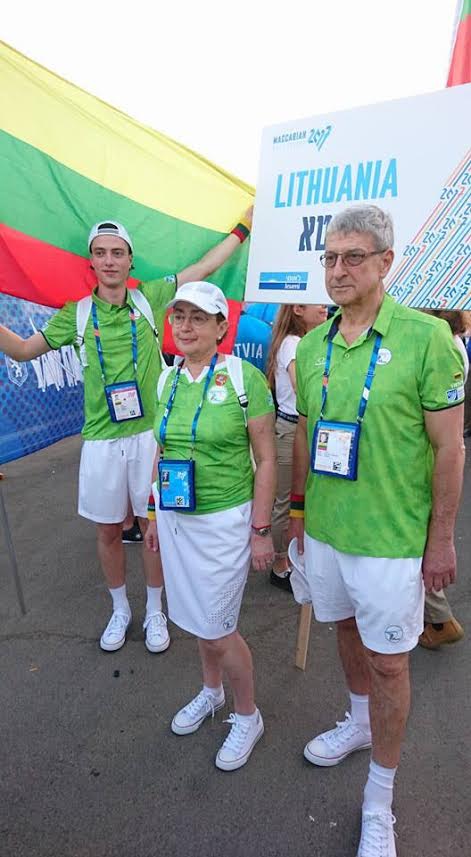
Lithuanian Makabi Athletics Club Leaves for 20th Maccabiah Games in Israel


Lithuanian Makabi team at 13th Maccabiah Games opening ceremony, Israel, 1989

The Lithuanian Makabi Athletics Club delegation is leaving for the 20th Maccabiah Games, held once every four years, in Israel, where more than 10,000 athletes from 80 countries will compete.

This will be the 8th Maccabiah Games attended by the Lithuanian team. In 1989 the team was the first to carry the Lithuanian national flag at the opening ceremonies as the country sought independence from the Soviet Union. Club president Semionas Finkelšteinas and club athletes remember well the event.

Semionas Finkelšteinas:

“The Lithuanian Makabi delegation will have 28 athletes in 8 sports: badminton, swimming, mini-soccer, judo, table tennis, tennis, chess and riding. A Canadian rider who has Litvak roots was accepted on the Lithuanian team since Canada didn’t send a team of riders this year. The Lithuanian team includes three former Maccabiah medal-winners: chess player Eduardas Rozentalis who took bronze in 1989, badminton player Alanas Plavinas who won silver in 2013 and Aleksas Molodeckis who took bronze in judo in 2013.

“It’s important to us to participate in the Maccabiah and we never miss a single Jewish Olympics. Whether our team is stronger or weaker, we have always participated and won medals. This time we have five young people, three of whom expect to win medals. We have three badminton players, and the swimmer and strong table tennis player Neta Alon who could be a medal winner. Markas Šamesas and Vitalija Movšovič are our badminton players who could come home with medals. Among the adult athletes the chess player E. Rozentalis, badminton player A. Plavinas, and judo martial artist A. Molodeckij have a good chance of winning medals. Salomėja Zaksaitė, an accomplished chess player, will be competing at the Maccabiah for the first time. Our soccer team is traveling there with their new trainer Arūnas Šteinas. Three of our strong soccer players are unable to attend for various reasons. Artūras Sobolis couldn’t take time off work, Danielius Gunevičius’s trainer won’t allow him to go and Romanas Buršteinas has to attend to family matters.

“All the young people will stay at the best hotel in Haifa. They will compete in the games after which they have a separate program of activities. The swimmers will compete at the Wingate sports complex. Athletes from 80 countries will attend Maccabiah opening ceremonies July 6 and global media always give large coverage to the event, the opening ceremony is covered outside Israel by CNN, BBC and other global televisions channels. The Jewish Olympics takes place once every four years and there is a broad cultural program arranged for all participants. This event is about more than just about sports.

Joniškis White Synagogue Re-Opens

Re-Opening of White Synagogue in Joniškis

Joniškio Baltosios sinagogos atidarymas

During celebrations of Joniškis’s own city day next week the restored White Synagogue there is to host a re-opening ceremony. The synagogue was built in 1823 and its external face combines features of the late classicism and romantic styles.

Restoration of the synagogue was financed by European Economic Area grants allocated by the Republic of Lithuania, the state budget and the Joniškis regional administration for a total of 389,358.35 euros.

Larger Lithuanian cities but even smaller towns often featured two synagogues, built at different periods. Few double-synagogue complexes are still standing in Lithuania, only in Joniškis, Kalvarija and Kėdainiai.

The Joniškis synagogue complex is located on the eastern side of the town square. Two adjacent brick buildings, the White and the Red Synagogues, form the complex. They were built at different periods and have different architecture and interiors. Their location by the central town square but set back among other buildings is fairly typical. They are very visible from side streets but looking from the main street they are blocked by other buildings. Both synagogues have smaller one-storey and two-storey buildings surrounding them.

Jews settled in Joniškis around the middle of the 18th century when charter rights were granted the cities of Joniškis and Šiauliai. Jewish communal life was intimately connected with religion and the synagogues. In 1797 the Jews of Joniškis received permission to build a synagogue and acquire a piece of land for a Jewish cemetery. A synagogue is first mentioned in 1823. According to the inventory of the Šiauliai economy conducted in 1825 and 1826, there were 49 Jewish families in Joniškis. In the mid-1800s there were 1,042 Jews living there. A second synagogue is first mentioned in 1865, and in 1866 there are records of a third synagogue and a Jewish inn. By 1897 the Jewish population had grown to 2,277. The third synagogue located at Vilniaus street no. 8 was turned into a store and residential building in 1965 and 1966.

Jewish Community Proposes Cultural Museum in Vilnius Ghetto

Vilnius, June 27, BNS—The Lithuanian Jewish Community is proposing the creation of a cultural museum in the former Vilnius ghetto. There are considerations to include an open-air section beyond a single building housing the museum using modern technology. The LJC presented these ideas to Vilnius mayor Remigijus Šimašius Thursday.

Creative analyst Albinas Šimanauskas, one of the authors of the idea, said they hadn’t decided on a specific location for the museum yet, but there was a proposal to establish it near Rūdininkų square.

“Rūdininkų square, for example, where there is a statue commemorating Tsemakh Shabad, could be the site for a memorial to Righteous Gentiles. It’s a fine square which could host international events, concerts, thematic festivals… this would be a Vilnius Jewish cultural museum exhibiting historical events and cultural phenomena through living story-telling,” he told BNS.

Lithuanian Jewish Community chairwoman Faina Kukliansky said they are waiting for basic confirmation of the idea from the municipality and will decide on a location for the museum after that.