Litvaks

International Conference Remembrance, Responsibility, Future Held in Vilnius

Vilniuje vyko svarbi tarptautinė konferencija #AtmintisAtsakomybeAteitis

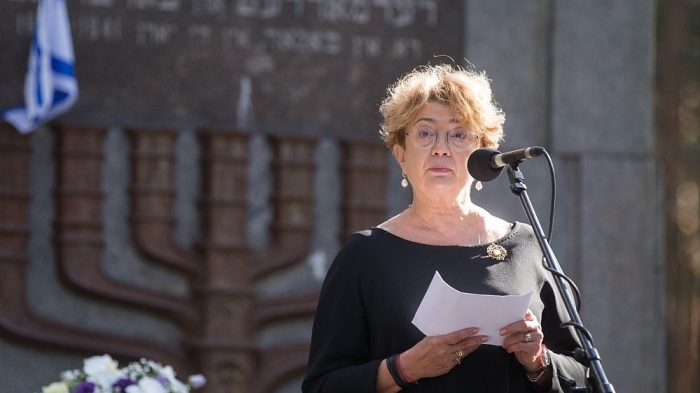
To mark the international day against fascism and anti-Semitism, the Lithuanian Jewish Community held a large international conference November 9 called “Remembrance, Responsibility, Future” which attracted well-known scholars and media attention. Speakers discussed whether commemoration of painful historical events can serve as a bridge to understanding contemporary politics and prevent such events in the future.

LJC chairwoman Faina Kukliansky, US ambassador Anne Hall, German ambassador Angelika Viets and deputy chief of mission for the Israeli embassy Efrat Hochtetler welcomed conference participants.

Unique Jewish Archive Emerges in Vilnius

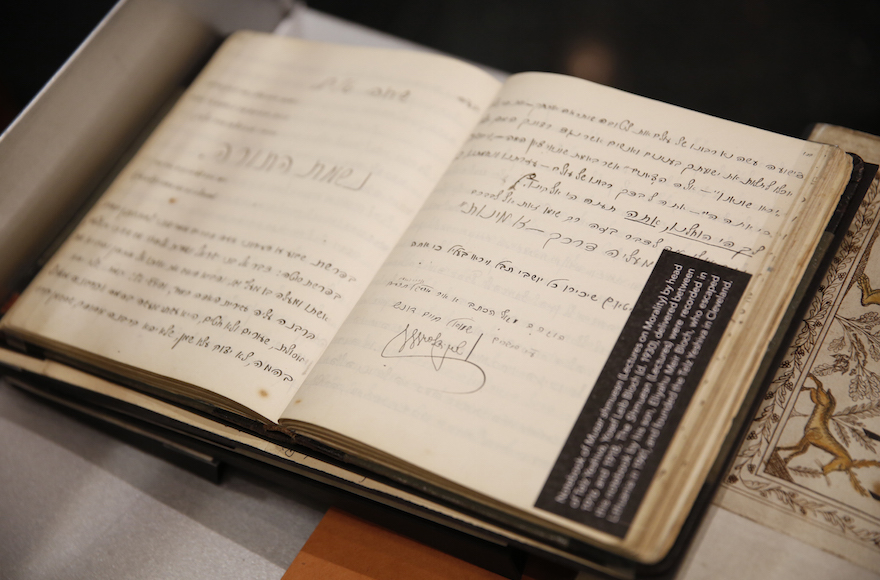
Vilnius, November 3, BNS–As Judaica studies intensify in Vilnius, scholars have identified thousands of important Jewish manuscripts this year which had laid forgotten in a church basement during the Soviet years and were scattered to separate archives for two decades following Lithuanian independence.

Some of the newly identified documents are currently on display in New York City and there are plans to exhibit some of the collection in Lithuania in the near future as well.

Lithuanian National Martynas Mažvydas Library director Renaldas Gudauskas said the identification of ever more documents makes him confident the library currently conserves one of the most significant collections of Judaica in the world.

Hidden at a Church

Vilnius had hundreds of Jewish communal, religious, cultural and education organizations before World War II. YIVO, the Jewish research institute founded in 1925, was an important member of that group. YIVO did work on Jewish life throughout Eastern Europe, from Germany to Russia and from the Baltic to the Balkans, collecting Jewish folklore, memoirs, books, publications and local Jewish community documents, and published dictionaries, brochures and monographs.

New Calls for Jewish Restitution


by Vytautas Bruveris, www.lrytas.lt

After adopting a law on compensating Jewish religious communities, Lithuania should go further and compensate Holocaust survivors for their private property. Both US officials and the Lithuanian Jewish Community are calling for this.

The Lithuanian prime minister’s advisor on foreign policy Deividas Matulionis said: “The issue of returning Jewish private property was raised earlier, but it’s being discussed more frequently now. I wouldn’t say there’s pressure, but the Americans have let us know return of Jewish property remains on the agenda.”

Matulionis was government chancellor in the earlier Government led by Andrius Kubilius when the law creating the Goodwill Foundation was adopted. Under that law the state pays out compensation for Jewish religious community property lost during the war, financing Jewish cultural, religious, educational and other socially useful activities.

The Lithuanian Government is obligated to pay 37 million euros in total to the foundation.

US Diplomat Visits

Matulionis recently spoke with Thomas Yazdgerdi, the US State Department’s special envoy for Holocaust issues, in Vilnius.

The American diplomat also met MPs and leaders of the Lithuanian Jewish Community.

One of the Yazdgerdi’s main topics of discussion was the continuing return of Jewish property.

He said Lithuania following the examples of other Central and Eastern European countries should keep moving forward by returning private property to Holocaust survivors and their descendants or by paying out compensation.

US Officials Urge Lithuania to Return Jewish Property

Vilnius, November 8, BNS–US officials and the Lithuanian Jewish Community are calling upon the Lithuanian Government to return private property to Holocaust survivors and their descendants, the daily Lietuvos Rytas reported Wednesday.

“The issue of restitution of private Jewish property has been raised in the past, but it is being increasingly discussed lately,” Deividas Matulionis, foreign policy adviser to prime minister Saulius Skvernelis, told the paper.

Matulionis recently discussed the issue with US State Department special envoy for Holocaust issues Thomas Yazdgerdi in Vilnius. The Lithuanian prime minister’s advisor told Lietuvos Rytas they hadn’t discussed any specific measures for restitution or numbers.

Matulionis said they talked about possibly compensating Jews for a portion of the value of their property and said that would be more of a symbolic gesture.

Six years ago Lithuania committed to paying 37 million euros compensation for Jewish religious communal property by 2023.

Public Relations Horoscope


by Sergejus Kanovičius

The weighing ritual from the Soviet era has impressed itself deeply in memory: a plump woman standing behind the counter in a store with a white apron, the apron is somewhat wrinkled and with grease stains, the scales have larger and smaller weights, and she stands and watches, if she has something to way. One weight, and another, then another is needed to reach complete balance, placed on the right-hand plate of the scales, always a deficit, whose weight is measured by this very important woman. The woman is all-powerful. Usually she set some fifty or more grams aside, she also had to supplement her salary. Why do I remember this? I see how today the PR masters and the politicians who have taken up their ideas are joyfully weighing and trying to place a weight or two on a much emptier plate of the scales of historical truth. But one gets the impression that they, just as the woman in the Soviet store did, are setting a bit aside. Sometimes more, sometimes less. Usually more, unfortunately.

You leave their store and unwrap the purchase and hey, either it’s just paper, or else they’ve taken a bit for themselves again. And then you wait again until they decide the time has come to mete out some sort of historical deficit.

As I understand it, the quota for naming the year of the coming 100th anniversary of the state has been used up. Other years are being suggested, maybe the year of the bear on the Chinese calendar, or perhaps the year of the dragon or the cat on the Japanese, one year under the Jewish calendar and a different one according to Christ. Well anyway, we like to baptize, to be baptized and to attend baptisms, it’s fun. Even if there is no baby, we’ll make one up.

Rūta Vanagaitė’s Stories Cause Ears to Perk Up Abroad


Photo: BNS

by Joana Lapėnienė, LRT teleivison program Savaitė, www.LRT.lt

Rūta Vanagaitė accuses Adolfas Ramanauskas while her defenders accuse Lithuania.

The voice of the European Jewish Congress resounds the loudest in this matter, whose leader is an oligarch sympathetic to the Kremlin, the Russian businessman who likes to show off photos of himself with Vladimir Putin and who often praises the latter, but the fact remains the case has resonated beyond Lithuania’s borders. And deliberations on whether the rights of people who hold an alternative view are abused in Lithuania, whether books are burned in Lithuania because of the point of view they express, books about the Holocaust among them, and whether we are trying again to avoid responsibility in the mass murder of Jews, are not beneficial to Lithuania.

Was this scenario planned? It turns out the chairwoman of the Lithuanian Jewish Community attempted to talk the head of the European Jewish Congress, Putin’s beloved oligarch, out of making these accusations against Lithuania. When we tried to find out what the Lithuanian Foreign Ministry and its special ambassador for contacts with Jewish organizations had done, we only received a general sort of letter saying they are constantly working. People we interviewed, however, said the opposite. But replies must have been drafted, because Vanagaitė’s letter purely for local consumption was a public one. She has not taken back any of what she said outside of Lithuania and has not recognized any wrong-doing. She did, however, thank an embassy for supporting her in telling her truth, meaning the Lithuanian Foreign Ministry.

Lithuanian Jewish Community Position on Public Discussion of Writer Rūta Vanagaitė’s Statements Regarding Lithuanian Partisan Leader Ramanauskas “Vanagas”

The Lithuanian Jewish Community, or LJC, expresses concern over public discussion of writer Rūta Vanagaitė’s statements regarding the actions of Lithuanian partisan movement leader Adolfas Ramanauskas “Vanagas.” At this time the LJC knows of no reliable information based on extant historical documents confirming the accusations made against Ramanauskas implicating him in the Holocaust or the murder of Jews of Lithuania.

We call upon all sides to refrain from making rash statements leading to public discord and emphasize that discussion of complex questions of Lithuanian-Jewish history should be based on the principles of mutual respect, openness and honesty.

The LJC respects the right of the private publisher Alma Littera to carry out its own business plan as it sees fit. Nonetheless, the LJC considers the publishing house’s decision on how to utilize the works of Vanagaitė, recalling from stores all of her works, inappropriate, and that it could lead to conflict within society.

Adhering to the belief that historical justice and its restoration should be based on reasoned studies by professional historians using authentic documents, the LJC invites the public, professional historians and national leaders to take measures to halt the further division of society and the spread of hate.

Lithuanian Foreign Ministry Says Not to Set Jewish Genocide against Anti-Soviet Resistance

Vilnius, November 1, BNS–Lithuanian diplomats say the genocide of Jews and the Lithuanian armed struggle against the Soviet occupation shouldn’t be set against each other.

The Lithuanian Foreign Ministry Wednesday expressed regret over a statement from the European Jewish Congress condemning the Lithuanian publisher Alma Littera’s decision to halt sales of books by Rūta Vanagaitė and criticism of the Lithuanian public relations specialist and author for allegedly libeling partisan leader Adolfas Ramanauskas “Vanagas.”

“For many years now Lithuania has been working in Holocaust research and education in consultation with international Jewish organizations including the World Jewish Congress and the European Jewish Congress. Counterposing the Jewish genocide against the Lithuanian anti-Soviet resistance in this context is completely unacceptable,” a press release from the Foreign Ministry stated.

Jeffrey Yoskowitz Visits Bagel Shop Café, Investigates Litvak Recipes

Jeffrey Yoskowitz, viešėdamas Vilniuje, apsilankė “Beigelių krautuvėlėje” ir domėjosi litvakų virtuvės receptais

The Bagel Shop Café received an extraordinary guest today, Jeffrey Yoskowitz, an expert on Ashkenazi cuisine, author of the Gifilteria , author of the gefilte fish pop-up concept and the force behind #gefiltemanifesto. He is visiting Vilnius with a friend and is searching for the secrets of Litvak cooking. Both visitors spent a good hour writing down Faina Kukliansky’s family recipes in Yiddish and tasted Riva Portnaja’s Litvak carp.

LJC Challa-Making Event Big Success

The challa-making event at the Lithuanian Jewish Community on October 26 was a fun-filled evening with klezmer music and treats from the Bagel Shop Café. Four generations of women participated, some with their children and grand-children, others with friends, kneading and braiding the dough which was then baked and taken home.

The event was in solidarity with the annual Shabbos Project, now in its fourth year.

More photos here.

Leon Livshin Piano Concert

World-famous pianist Leon Livshin from the USA will perform selections from Brahms, Schnittke and Renaud Déjardin at the Stasys Vainiūnas House of the Lithuanian Musicians Support Fund, located at Goštauto street no. 2-41 in Vilnius, at 5:30 on Tuesday, October 31, 2017. For more information call 8 699 90035.

Livshin was born in Vilnius. He was graduated from the Lithuanian Academy of Music and Theater. He has performed at Carnegie Hall, the Kennedy Center for the Performing Arts, the Merkin and Steinway halls, the Cologne Philharmonic, Zurich town square, Moscow and Harvard College in the USA, among others.

First Plaque Commemorating Rescuers in Lithuania

Panevėžys Is the First to Thank Jewish Rescuers
www.sekundė.lt

The first plaque commemorating those who rescued Jews during the Holocaust has been unveiled in Panevėžys, Lithuania. It honors nun, activist, nurse and teacher Marija Rusteikaitė of the Congregation of the Sisters of the Love of God and her fellow nuns. The stone plaque was unveiled at a ceremony at the intersection of J. Tilvyčio and Krekenavos streets in the Lithuanian city, close to where the Sisters of the Love of God monastery and hospital were located, according to historical documents.

“It was namely this spot, a few dozen meters away, which is the most important historical site of the monastery for us, because this is where Marija Rusteikaitė brought together the nuns, the first sisters of the Love of God, between 1925 and 1936. As soon as she completed the university of medicine in St. Petersburg, the mother superior from Žemaitija joined the St. Vincent de Paul society in order to help the poor people of the city of Panevėžys and surrounding areas. Before that she taught mathematics and geography at the Kražiai pre-gymnasium and Polish at another location,” sister Leonora Kasiulytė, who has long taken an interest in the historical figure, said of the founder of her monastery.

LJC Calendar for 5777 Wins Prize at Unusual Ceremony

A Jewish calendar published by the Lithuanian Jewish Community last year took first place in an annual Lithuanian calendar contest October 20.

The 28th annual Laurynas Ivinskis Prize ceremony was held in Kuršėnai, Lithuania with live Lithuanian folk music and a performance by the Fayerlakh ensemble.

The theme of the LJC calendar for 5777 was Lithuanian rescuers of Jews. It featured interwar president Kazys Grinius and wife Kristina on the cover, both Righteous Gentiles. Each month featured more than one story of rescue.

Laurynas Ivinskis (1810-1881) was a 19th century calendar maker whose agricultural calendars were also more text than calendar, and were for a period of time forbidden by Russian authorities because they were written in Lithuanian using the Latin rather than Cyrillic alphabet. His almanachs included stories and parables in pre-standard Lithuanian.

Khasia Shpanerflig Has Died

Khasia Shpanerflig (Chasia Španerflig) has died at the age of 97. She was a long-standing member of the Community and formerly a student at the Tarbut Gymnasium as well as a Jewish partisan under the Vytautas the Great Trakai brigade. As long as health permitted she devoted herself to the activities of the Union of Ghetto and Concentration Camp Prisoners, the Lithuanian Jewish Community and Holocaust education.

Our condolences to her son Volodia and daughter Sofiya and all her family and friends.

Will We Tell Students the Whole Truth, or Only What’s Useful to Us?


by Mečys Laurinkus, www.lrytas.lt

Toppling (taking down temporarily for restoration) the “idols” on the Green Bridge [in Vilnius] under natural field conditions with no special measures taken, I overheard the complaint: the topplers themselves name streets and hang memorial plaques to the “heroes” who took part in the shooting of Jews. The public is interested in history, reads, listens to discussions and judges the actions of the government. You cannot forbid this.

Virginijus Savukynas in his television show “Istorijos detektyvai” [History’s Detective Stories] returned to this often emotionally explosive topic. Kazys Škirpa, in whose honor a street is named in Vilnius, a noteworthy founder of the Lithuanian state and the organizer of the June, 1941, uprising against the Russians, while under house arrest in Berlin issued a statement about Jews which was totally contrary to his biography and likely his own views, one which was comparable to the spirit of the Gestapo. I will restate my thoughts again a bit later. Jonas Noreika, aka Generolas Vėtra, who had fought against the Nazis and the Bolsheviks and was shot by the latter, appointed head of the Šiauliai district administration by the Provisional Government of Lithuania in 1941, blessed with his signature the establishment of a ghetto for Jews in Žagarė, Lithuania.

General Vėtra (actually just a captain) has been honored with a commemorative plaque. Not somewhere marginal. On the building of the library of the Lithuanian Academy of Sciences. In an even more visible location there still stands the statue to Petras Cvirka, who brought back the sun of Stalin not at all because of any political manoeuvering to help Lithuania in the grindstones of time, but out of conviction that “Mother Russia” would take us in and protect us. Of course she did take us in, but only to a very cold place, where poets such as Kazys Jakubėnas, upon whom Cvirka informed to Soviet security, were sent.

Makabi Athletics Club Teaches Jews How to Shoot

The Lithuanian Makabi Athletics Club held a target-shooting contest at the GSKA gun club in Vilnius October 8 in three participation categories: men, women and young people. Contestants shot a pistol 25 times (including five practice shots) at concentric targets 20 meters away.

The Fish family won in all categories. The brothers Fish, Adomas and Nojus, took first and second place in the youth competition with 139 and 116 points, respectively. Their mother Kristina with 109 points beat out Laimina Gurvičienė with 55 points and Marina Balderman with 40 to take the women’s. Julius Fish won men’s with 132, followed closely by Algirdas Malcas with 122 and Boris Kirzner with 116 points.

All contestants won participation medals and the actual winners got handsome trophies. The event was organized by Artiomas Perepelica and refereed and supervised by Anatoly Kapustin and Aleksej Slyčkov.

Congratulations to all the contestants and organizers for a fine showing!

Jewish Gravestone Fragments to be Used in Memorial


by Monika Petrulienė, LRT TV News Service, LRT.lt

Jewish headstones used during the Soviet era for construction in Vilnius are being returned to the Jewish cemetery on Olandų street. Fragments of grave markers were removed from buildings and stairwells in the capital. A memorial will be made from the remains of headstones at the cemetery.

More than 1,000 metric tons of grave stones are being transported to the old Jewish cemetery on Olandų street. Less than half have been brought there so far. They are to be examined by experts to determine to which cemetery they will be returned ultimately. The Jewish cemetery on Olandų street covers almost 12 hectares and is roughly equal to the Rasos cemetery in Vilnius in size and number of burials.

“The first decision made was that the stones should be arrayed somewhere in what we might call an open working area, so that project authors, architects and landscape artists can learn about and get a feel for them, and so that they can be used directly from that area for certain compositions,” Martynas Užpelkis, heritage protection specialist for the Lithuanian Jewish Community, said.

Heritage protection experts say the majority of the Jewish grave markers were used in building stairs on Tauro hill in Vilnius. Many were also used in constructing electrical transformer substations and support walls in the city. Historians have examined about 2,500 pieces so far. The majority of inscriptions have been in Hebrew, but there are also inscriptions in Yiddish, Polish and Russian. The plan is for most of the stone fragments to stay at Olandų street, with the remainder going to the old Jewish cemetery in the Šnipiškės neighborhood.

Much Applause

“The project was conceived in 2014 when Zubin Mehta conducted the Israeli Philharmonic Orchestra in Vilnius. The person who runs the orchestra, Gintautas Kevisas, informed ambassador Laimonas that he was planning a visit to South East Asia with the Lithuanian Symphony Orchestra, and was wondering whether they could give a couple of concerts in Mumbai. The ambassador approached Khushroo Suntook and the two days, the 10th and 11th, were finalized,” says a spokesperson about the Lithuanian National Symphony Orchestra, wich performed to great acclaim at the NCPA this week, and which we had the pleasure of attending on Wednesday evening.

“Dr. Yusuf K. Hamied, chairman of CIPLA, whose mother was Lithuanian and who was born in Lithuania, came forward to make it happen.”

As was to be expected, the presence of this international group of acclaimed musicians was highly applauded, and the packed auditorium was witness to many shouts of “Encore” and “bravo,” especially when the dapper resident conductor and violinist of the Symphony Orchestra of India, Marat Bisengaliev, participated as a solo violinist. What’s more, we noted: it wasn’t just the usual suspects of well-heeled Parsis savoring the fare.

Lithuania’s ambassador to India Laimonas Talat-Kelpsa with Linas Antanas Linkevicius, minister of foreign affairs in Lithuania, along with the consul generals of Spain, Hungary, Argentina and Holland and minister of external affairs M. J. Akbar were in the audience.

(From the Friday, October 13, 2017, print edition of Mid-Day newspaper, Mumbai, India)