Litvaks

Lithuanian Media Report US, Israeli, Danish Ambassadors Attend Road of Memory March in Šiauliai

Lithuanian Media Report US, Israeli, Danish Ambassadors Attend Road of Memory March in Šiauliai


Lrytas.lt

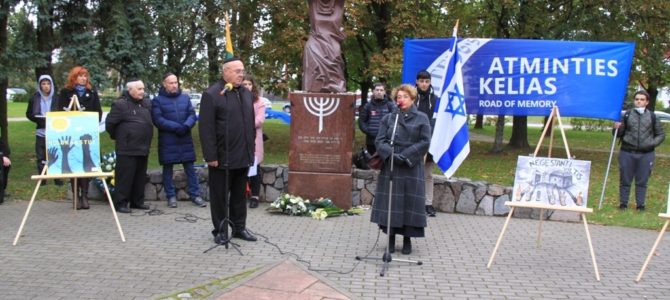
The Lithuanian daily newspaper and news website Lietuvos rytas reports the Road of Memory march on Sunday to mark the 80th anniversary of the beginning of the Holocaust in Šiauliai was attended by the US, Danish and Israeli ambassadors as well as Lithuanian members of parliament.

Besides members of the Šiauliai Regional Jewish Community, MPs Emanuelis Zingeris and Rima Baškienė, US ambassador Robert Gilchrist, Israeli ambassador Yosef Avny-Levi, Danish chargé d’affaires Jakob Greve Kromann, Lithuanian Jewish Community executive director Michailas Segalis, Vilnius Religious Jewish Community chairman Simas Levinas, Kaunas Religious Jewish Community chairman Mauša Bairakas, a representative of the Vilnius Jewish Community and others.

The event was staged by Lithuania’s International Commission to Assess the Crimes of the Nazi and Soviet Occupations Regimes in Lithuania as part of their “Road of Memory 1941-2021” project.

Šiauliai Regional and Klaipėda Jewish Communities Commemorate Holocaust Victims in Ylakiai

Šiauliai Regional and Klaipėda Jewish Communities Commemorate Holocaust Victims in Ylakiai

Members of the Šiauliai Regional and Klaipėda Jewish Communities attended an event to commemorate the 80th anniversary of the Holocaust in Ylakiai, Lithuania, on July 6. The town center hosted an exhibit called “The Homes They Lived In” about Jewish families, businesses and activities. During the commemoration opera soloist Olga Šardt-Žarova sang “Our Father” and other works in Hebrew. After a minute of silence, a procession set off for the mass murder site and the old Jewish cemetery. Candles were lit and flowers placed at the site of the former synagogue, as were stones as well at the mass murder site, where kaddish was also performed.

According to the census at the end of the 19th century, 57% of the town’s population were Jews. Before World War I there were 150 Jewish families there. The town was heavily damaged during that war and many buildings include the synagogue burned to the ground. The town was rebuilt with large contributions made by Jews and in 1923 Jews constituted 41% of the population then. Many Jewish residents engaged in trade, light production and even agriculture before World War I. There were two mills with Jewish owners. Commerce took place at the weekly market and the large fair held once every five years. According to a government survey in 1931, there were 20 shops there, of which 17 belonged to Jews.

Forgotten Names: The Symbol of Lithuania in Works by Musicians Scattered around the World

Forgotten Names: The Symbol of Lithuania in Works by Musicians Scattered around the World

The spiritual formation of an artist is impossible without a creative environment. This is indivisible from the specific people who set a great example, who direct the artist, enrich the artist spiritually, and support and encourage the artist. That sort of environment is exactly what existed in Vilnius in the early 20th century, giving rise to wonderful musicians including Jascha Heifetz, the Schneider brothers, the Reizenberg sisters, the great Hofmekler family and others.

Some left Lithuania and made incredible careers, others remained and became known in their homeland. Their lives were different, but their legacy is very clear. Let’s remember them, let’s enjoy their works. We will discover a world we didn’t know which was hidden from us for almost a century.

During the event we will learn about the lives of these renowned musicians and their works will be presented.

Jewish Sacred Cultural Heritage: The Telz Rabbis Seminary Yeshiva and Synagogues

Jewish Sacred Cultural Heritage: The Telz Rabbis Seminary Yeshiva and Synagogues

Bernardinai.lt

Telšiai became an important economic and cultural center in the late 19th century. The large Jewish community which had lived there since ancient times had great influence on the growth and success of the city. Its members harmoniously merged with the city’s cultural, economic and political activity and were active participants in it.

In Telšiai as in other Lithuanian towns and cities Jews mainly engaged in mercantilism and traditional trades; there were also many Jewish doctors and dentists as well as Jews offering other services. Services and light industry were an important source of income for the Jews of Telšiai. For many others, however, the Jewish spiritual seminary–the yeshiva and its synagogues where hundreds of students from all over the world studied–became the way of making a living.

It wasn’t just the residents but the entire atmosphere of the community which demonstrated the spirit of the Jews of Telšiai. Here the ancient past the present lived alongside one another, proponents of tradition and of the Enlightenment, the orthodox and the secular and social activists. There were Torah sages and highly-educated people among the Jews of Telšiai. The city was filled with creative energy and spirituality and materiality merged into a perfect whole there. The crooked narrow streets and the old buildings were miraculous, a world filled with enchantment where thousands of Jewish families lived.

Condolences

Dora Kerbelienė has died. We mourn her passing as do her daughters Sara and Simona, grandchildren Vanesa and Denas and all her loved ones.

Utyan Jews Speak about Holocaust and Post-War Years in Lithuanian Translation of Zakhor Book

Utyan Jews Speak about Holocaust and Post-War Years in Lithuanian Translation of Zakhor Book

The A. and M. Miškiniai Public Library in Utena (Utyan in Yiddish), Lithuania, hosted a presentation of the only Lithuanian translation of a zakhor or memorial book in Yiddish about the city and region of Utena (the region includes Molėtai, Anykščiai, Vyžuonos and other locations. Incredibly, it took the book 42 years to reach the Lithuanian reading public: it was published in Tel Aviv by Nay Leben in 1979 under the title “Yishker-bukh Utyan un umgegnt.”

The translation and publication was the initiative of cultural historian Sandra Dastikienė as part of her project “Old Neighbors” to educate the public about the Jewish community, Jewish culture and the Litvak legacy in the Utena region.

“The old neighbors return to their towns in different ways–as works of art on the streets, through live appearances–but we are really missing the authentic history. This book fills that gap. It’s not an academic work, not an historical study, but the real memories of Jews who survived the Holocaust or left Lithuania before it. It raises more questions and presents a lot of answers,” Sandra Dastikienė said.

The recollections were collected into a single zakhor book from 1945 to 1979 in Israel. Roma Jančauskienė has long been interested in the history of the Utyan Jews and when she learned of the existence of this book tried over an extended period to buy a copy on the internet, unsuccessfully. About four years ago she finally did buy a copy on eBay, in Yiddish of course.

Faina Kukliansky Re-Elected Head of Lithuanian Jewish Community

Faina Kukliansky Re-Elected Head of Lithuanian Jewish Community

ELTA, July 8, 2021

A general meeting of the members of the Lithuanian Jewish Community held Wednesday voted for a third time to elect Faina Kukliansky the chairwoman of the organization. Twenty-six members of the LJC’s executive board were elected at the same time.

The chairperson of the Community is elected for a four-year term by a majority of the regional Jewish communities and associate members constituting the LJC. Of the 32 organizations under the LJC umbrella, 31 representatives took part in Wednesday’s ballot. Kukliansky received 30 votes out of the possible 31, according to a press release from the LJC.

Kukliansky said her most important task as chairwoman is to inspire unity among the different Jewish communities in Lithuania. She said the LJC’s other priorities haven’t changed, but life is changing: the generation which experienced the horrors of World War II is growing old and dying, and so caring for them is becoming even more crucial.

“We are continuing to strengthen the activity of our social center, taking care of those requiring support, employing people with disabilities and engaging them in Community activities. Another important priority is preservation and putting to use the surviving Jewish cultural heritage: we have wonderful examples of restored synagogues being used as cultural activity centers,” Faina Kukliansky said.

Association of Lithuanian Jews in Israel Letter on 80th Anniversary of the Beginning of the Extermination of Lithuanian Jewry

Association of Lithuanian Jews in Israel Letter on 80th Anniversary of the Beginning of the Extermination of Lithuanian Jewry

Association of Lithuanian Jews in Israel


Letter to friends on the 80th anniversary of the beginning of the extermination of Lithuanian Jewry

Eighty years ago, on June 22, 1941, the Germans invaded Lithuania. The Lithuanians immediately declared independence and formed a “temporary government” consisting of members of the “Lithuanian Activists Front”–an underground group headquartered in Germany and composed of nationalist elements who prepared plans for the extermination of Jews and waited for an opportunity to act. The opportunity came on June 22, 1941, with the start of Operation Barbarossa. Before the Nazi army entered the cities and towns of Lithuania, the extermination of Lithuanian Jews began–a 600 year history of coexistence ended in the great tragedy that has no precedent in human history.

Within the first 10 days of the invasion thousands of Lithuanian Jews were murdered. During the Nazi occupation 95% of Lithuanian Jewry were brutally murdered.

Israeli Street Food Booth Open for Business

Israeli Street Food Booth Open for Business

An Israeli street food kiosk called “Tzvi in the Park” opened on July 2 in the Petras Cvirka Square park across the street from the Lithuanian Jewish Community in Vilnius. The food booth is offering humous, carrots with anise, chicken shwarma and other traditional foods with pita bread, with ingredients to order by the customer. The menu is planned to expand over time. While the food kiosk is the initiative of the culinary masterminds at the Bagel Shop Café across Pylimo street, the food booth will offer different dishes and hopes to inspire people to linger and talk.

“When we set up the Bagel Shop, we wanted to offer people delicious food, but also to offer them a way to have a good time, to hang around and talk about different things, even such sensitive and important topics as tolerance, human equality and so on. So this summer we want to create a space for city residents and visitors where they can spend some time in the green space of the park and learn about Israeli culinary culture,” LJC chairwoman Faina Kukliansky commented.

While the Bagel Shop offers more traditional Litvak fare, the food kiosk will present characteristically Mediterranean food, the new director of the Bagel Shop and of the Israeli food kiosk Aistė Košienė said. She said Israeli street food has distinct characteristics, but the main features are that it’s healthy and of good quality.

Jewish Scouting Camp This Summer

Jewish Scouting Camp This Summer

The camp is for children and young adults aged 13 and above. In order to participate, applicants need permission from their parent, parents or legal guardian(s) and proof of payment by electronic transfer of funds. Please note that payments for the camp will not be refunded (although for unavoidable reasons beyond the power of the parents or applicant to stop, LJC will consider reasonable requests).

Payment information:

Recipient: Lithuanian Jewish Community
Corporation code: 190722117
Bank: SEB Bank
Account: LT097044060000907953
For: Scouting Camp 2021, child’s name and surname and which specific fee is being paid

For more information contact Viljamas at viljamas@lzb.lt or by telephone at+370 67250699

Registration form: https://forms.gle/66KHQmVpUXJJV9WbA

Warsaw Summons Israeli Ambassador Following Statement on Restitution

Warsaw Summons Israeli Ambassador Following Statement on Restitution

Warsaw Sunday reported they had summoned the Israeli ambassador for discussion following Tel Aviv’s statement a law adopted by the Polish parliament on restitution to Holocaust victims was “immoral.” Experts say the new law would basically halt the restitution of property to Jews and others.

Polish foreign minister Pawel Jablonski said Warsaw sought to clarify the situation regarding the new law. Israeli embassy chargé d’affaires Tal Ben-Ari Yaalon “was summoned and we explained to her clearly and based on facts about all of this,” Jablonski told Polish broadcaster TV Polonia about the meeting on Monday. “We believe, unfortunately, they we have come upon a situation where some Israeli politicians seek to exploit this for domestic political gain,” he said.

They Can’t Come Back…

They Can’t Come Back…

We all need to remember all of our innocent people who were murdered and will never return.

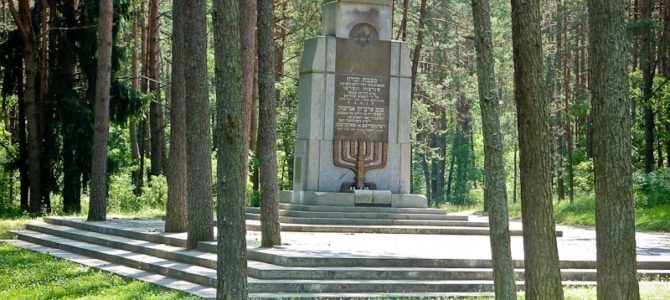
The Panevėžys Jewish Community has asked the Panevėžys regional administration to renew inscriptions on monuments and memorial plaques commemorating Jewish victims murdered in World War II. The inscription on the Ghetto Gates monument has already been renewed.

The Panevėžys Jewish Community is carrying out a project called “Let’s Maintain the Mass Murder Sites” to commemorate the 80th anniversary of the beginning of the Holocaust in Lithuania. We plan to visit all the mass murder sites in the Panevėžys district.

Through our work and contribution not only do we seek to remember the tragedy which began 80 years ago, but also to set an example for regional administration employees charged with maintaining Jewish mass murder sites and Jewish cemeteries under Lithuanian law. The area around the Kurganava mass murder site has been put in order this year, but saplings still need to be cut and the fence repaired.

The Panevėžys Jewish Community is grateful to our volunteers and staff, including Albertas and Virginija Savinčiai, Jurijus Grafmanas, Timūras Jerovickis, Borisas Marijampolskis, Ona Juospaitienė and others, for taking part in this project.

We are planning repair and upkeep next month as well, with Panevėžys Jewish Community members travelling to Žalioji forest, Ramygala, Raguva and other mass murder sites.

An Assessment of the Holocaust and Our Moral State: A Virtual Discussion

An Assessment of the Holocaust and Our Moral State: A Virtual Discussion

One of the most painful periods in Lithuania’s history began 80 years ago in the summer of 1941, the beginning of the Holocaust in this country. We lost hundreds of thousands of our fellow citizens constituting a significant portion of the population of Lithuania’s cities and towns. The Lithuanian Jewish Community is holding a virtual discussion in Lithuanian on June 28 to mark this painful anniversary.

Participants:

• LJC chairwoman Faina Kukliansky, attorney;
• Arūnas Bubnys, director of Lithuania’s Genocide Center;
• Saulius Sužiedėlis, professor emeritus, Millersville University;
• Justinas Žilinskas, writer, publicist and professor of the European Union Law Institute at Mykolas Romeris University;
• Vytautas Bruveris, writer and analyst, Lietuvos rytas newspaper;
• Paulius Gritėnas, philosopher, observer and member of the executive board of the Human Rights Monitoring Institute;
• Donatas Puslys, director of the media and democracy program, Vilnius Policy Analysis Institute.

Writer and director of the Šeduva Jewish Memorial Foundation Sergejus Kanovičius will moderate.

The discussion is scheduled for 7:00 P.M. on Monday, June 28. You can watch it live on the LJC facebook page:
https://www.facebook.com/events/777981389558688/

Lietūkis Garage Commemoration

Lietūkis Garage Commemoration

Around 50 Jewish men were tortured and murdered at the Lietūkis autoservice lot in Kaunas on June 27, 1941. Randomly grabbed off the streets, they were beaten with crowbars and water hoses were used to burst their stomachs. The victims included day workers, students, merchants, a musician, former director of the Industry and Trade Department of the Lithuanian Finance Ministry Jurgis Štromas and others. Many of the victims and perpetrators remain nameless to this day.

We will commemorate the victims of the Lietūkis Garage massacre and the 80th anniversary of the beginning of the Holocaust in Lithuania at 5:00 P.M. on June 28, 2021, at the monument to the victims located at Miško street no. 3 in Kaunas.

At 6:30 P.M. the same day we will unveil a new sign in remembrance of the victims at the Žaliakalnis Jewish cemetery, where it is believed they were buried.

The Kaunas Jewish Community and the city of Kaunas invite you to join us in remembering the innocent Jewish citizens of Lithuania who were murdered.

We would be grateful if you could announce your intention to attend by sending an email to ieva0102@yahoo.com

Gercas Žakas, chairman
Kaunas Jewish Community

Choral Synagogue Prayer Service for Holocaust Victims

Choral Synagogue Prayer Service for Holocaust Victims

June 22, 1941, was the date the Nazis invaded Lithuania, Belarus and neighboring countries and the Holocaust began. Today the Choral Synagogue in Vilnius will hold a prayer service to remember the beginning of the Holocaust in Lithuania. Unlike in the West, Jewish victims in the East were mainly executed near their homes. Over just a few months in the summer and fall of 1941 the vast majority of the once-populous Jewish community of Lithuania were exterminated.

Commemorating the 80th Anniversary of the Holocaust in Panevėžys

Commemorating the 80th Anniversary of the Holocaust in Panevėžys

The Holocaust began in Panevėžys and Lithuania on June 22, 1941. We must not forget how Litvaks lived before the tragedy and how their history ended in 1941.

There are still eye-witnesses to the mass murder of the Jews who lived in the Panevėžys district before World War II. The first mass shootings began in July in the Panevėžys district when ghettos were set up in every town and city, in Panevėžys, Biržai, Kupiškis, Pasvalys, Rokiškis and elsewhere.

The Panevėžys Jewish Community and the scouts of Panevėžys have undertaken a project conceived by Michailas Adomas and Elena Adelina to maintain the mass murder sites in the district.

This time the clean-up began June 9 in the Kurganova Forest in the Panevėžys region. Volunteers including Panevėžys scouts and the chairman of the Panevėžys Jewish Community participated. The scouts learned about the Holocaust in Panevėžys, the Panevėžys district and Lithuania.

In total around 200,000 Jews were murdered in Lithuania with about 13,500 Jews murdered almost immediately in the Panevėžys region.

Lithuanian Parliament Adopts Resolution on Great Losses and Resistance to Totalitarian Occupational Regimes

Lithuanian Parliament Adopts Resolution on Great Losses and Resistance to Totalitarian Occupational Regimes

Photo: Children in Kaunas ghetto, courtesy Yad Vashem.

Today [June 15] the Lithuanian parliament adopted a resolution on commemorating the 80th anniversary of great losses and resistance to the occupations of Lithuanian by totalitarian regimes which says “After Nazi Germany occupied Lithuania, the Nazis began to carry out the genocide of the Jews of Lithuania, opening the way to mass murders and violence, leading to the loss of the larger part of the Jewish community.”

The language of the resolution is missing an essential element, a reminder that the mass murders were carried out with the aid of local collaborators. Would you like to put it more simply and clearly? There were people in the Lithuanian cities and towns who murdered their Jewish neighbors. Should we put it yet another way? There weren’t Nazi tanks and units standing by the side of the gravel pits on the forest margin, there were armed local men who fatally shot Jews lined up there, men, women and children [in Lithuania Jewish children were often murdered by smashing their heads against trees and rocks or with rifle butts in order to save ammunition–translator]. Another formulation which frightens us so much is also missing: there were Lithuanians among those who organized and physically carried out the genocide.

Does that sound horrible? But it’s the truth. The truth which is so hard to admit yet again. Perhaps the Lithuanian parliament is following the Lithuanian saying, “one teaspoon of tar ruins the barrel of honey?”

If so, it’s being misapplied, because the Lithuanian people aren’t a barrel of honey, and the Lithuanians who murdered Jews aren’t a teaspoon of tar. They are criminals who have committed crimes against humanity. A nation who can admit such people existed in its ranks is a brave and honorable nation. It’s not that their sins pass down to us, just that today’s generation is still afraid of the truth.

The Lithuanian Jewish Community had hoped the voice of the only Jewish member of the Lithuanian parliament, Emanuelis Zingeris, would be heard. He proposed amending the text of the resolution to read “the Nazis and their local collaborators.” He was not heard. Neither were the Lithuanian Jewish Community and the thousands of victims who stood before their armed neighbors, and millions of Jews and other people of goodwill around the world who are only asking for one thing, to face the truth.

Before writing this commentary, many people said: “It’s not worth raising the issue, it’s better to keep quiet, remain silent, not irritate, not sow discord.” But as Tomas Venclova said, “We should avoid descending into these scandals, but they will be inevitable as long as there are defenders of the Nazi collaborators.”

Faina Kukliansky, chairwoman
Lithuanian Jewish Community

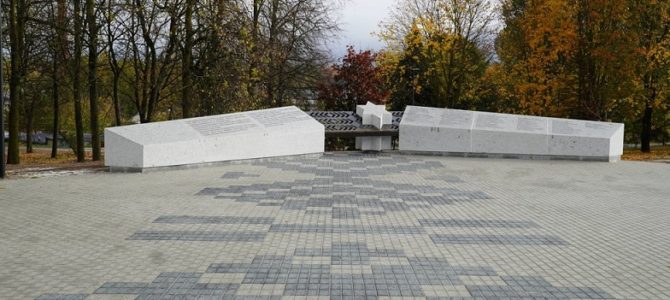
Monument to Vilnius Jews

Monument to Vilnius Jews

by Victoria Sideraitė-Alon

The old Jewish cemetery in the Šnipiškės (Shnipishok) neighborhood in Vilnius wasn’t destroyed in a single day. Back at the turn of the 19th to 20th century, the remains of 700 Vilnius Jews buried there were exhumed and reburied in a different part of the same cemetery during construction in the surrounding area.

Later during the Soviet era during the mid-20th century when work went on to extend what is now Šeimyniškių street, encroaching again on the old Jewish cemetery, these 700 burials were again exhumed and sent to a different grave. They were rediscovered in 2003 during construction of apartment houses next to Vilnius’s King Mindaugas Bridge. At the time, Lithuanian Jewish Community chairman Simonas Alperavičius resolved to have these 700 reinterred at the still-operational Jewish cemetery on Sudervės road in Vilnius. The reburial ceremony was attended by LJC officials and rabbis. The new grave there was marked with four posts.