Litvaks

Cyclopedia on Holocaust in Žemaitija Published

holokaustas-zemaitijoje

Aleksandras Vitkus, Chaim Bargman. Holokaustas Žemaitijoje. – Vilnius: Mokslo ir enciklopedijos institutas, 2016. – 488 p.

The book’s authors go into fine detail in their descriptions of the mass murders in Žemaitija (the historical Samogitia, western Lithuania), having collected testimonies from witnesses several years ago. Žemaitija is composed of 6 districts plus the Klaipėda region (historical Memel). They collected information about Kretinga (12 rural districts), Mažeikiai (8 rural districts), Raseiniai (12 rural districts), Tauragė (13 rural districts), Telšiai (9 rural districts) apskritis, the western section of the Šiauliai district (10 rural districts) and the Klaipėda region. The cyclopedia includes about 70 locations where mass murders took place and monuments now stand.

bernardinai.lt

Full story here.
Bernardinai logo

Sixth Annual Litvak Days Focus on Jewish Languages

On December 1 the Lithuanian Embassy in the UK in cooperation with University College London invited the public to the annual Litvak Days in London.

The program of the sixth annual Litvak Days included an evening of Yiddish song performed by Polina Shepherd at University College London and a conference on Jewish languages (Yiddish and Hebrew) in Lithuania held at the Lithuanian embassy.

“Lithuania puts a lot effort into promoting and preserving the rich heritage of Lithuanian Jews. We regard the Litvak Days events in London as a platform which facilitates cultural links between the UK’s British, Lithuanian and Jewish communities”, Lithuanian ambassador Asta Skaisgirytė said.

Litvak Days in London were attended by Jonathan Arkush, president of the Board of Deputies of British Jews; Faina Kukliansky, chairwoman of the Lithuanian Jewish (Litvak) Community and Arkady Rzegocki, ambassador of Poland. Dainius Junevičius, ambassador-at-large, conveyed a message from the Lithuanian foreign minister Linas Linkevičius.

Full story here.

Barbed Wire at Synagogue

We’ve received some angry emails about the barbed wire which has appeared on the synagogue fence. The main point seems to be that it’s not aesthetic. Of course it’s not. And it doesn’t fit in with our unique synagogue built in 1903 with its architectural authenticity.

Many students and teachers from Vilnius and Lithuania visit our synagogue. Tourists also visit. This year more than 5,000 guests visited the synagogue.

The Lithuanian Jewish Community celebrates all the traditional Jewish holidays at the synagogue. Our guests also celebrate with us, including foreign ambassadors and members of the Lithuanian Government and members of parliament. We are working actively with public organizations in the European Union which are involved in insuring the security of Jewish communities around the world. The security system at the Vilnius Choral Synagogue was set up based on their recommendations and continues to be improved. In Europe armed professional security service personnel guard synagogues.

Because of security concerns, we are asking everyone to adhere to rules for visitors at the Choral Synagogue, which are posted in three languages on the LJC website, lzb.lt, and will be posted at the synagogue in a visible location.

Concerning the barbed wire, we thought about it deeply, and of course we don’t like it, but we decided the most important consideration is safety. For that reason this quick and inexpensive temporary solution was adopted. At the same time, plans for a new fence are being drafted, one that doesn’t clash with integrity of the architectural style but does meet security requirements. The project will be a prolonged process, because we must ask permission from and harmonize the project with the Cultural Heritage Department to remove the old fence and build a new one. We hope to complete it next summer. We are in charge of the synagogue and we are concerned for the safety of worshipers and guests, and we don’t want events to repeat here in Vilnius which have occurred elsewhere. Here are some examples.

In Copenhagen a killer attempted to gain access to a Jewish event with about 80 participants, mainly children. No one knows what would have happened if not for the man who sacrificed his own life to stop the killer.

Over one week last July there were eight attacks on synagogues in Paris. In the Paris suburb of Sarcelles, a crowd of 400 watched as one synagogue was fire-bombed.

During the attacks in Paris a kosher food market was heavily damaged and looted, as was a pharmacy. There were signs with the inscriptions “Death to Jews” and “Cut the throats of the Jews.”

A synagogue in Wuppertal, Germany, which had been rebuilt after being destroyed in Nazi Germany’s Kristallnacht in 1938, was attacked with Molotov cocktails.

In Mumbai (Bombay) in 2008 a group of terrorists walked through the city shooting people in cafés and hotels as they made their way to the Chabad Lubavich Center, where they killed the young rabbi and his pregnant wife.

Once I was flying back from Israel to Vilnius, and my fellow passenger complained the entire trip about how security checks at Ben-Gurion International Airport were an affront to his human dignity. No argument could convince him that it was for his own safety. So we apologize to those who are offended by the barbed-wire fence. I know no arguments will convince them that this is for your own security, just as my fellow passenger on the airplane could not be convinced.

Simas Levinas, chairman
Vilnius Jewish Religious Community

More Work To Do on Holocaust in Lithuania

by Efraim Zuroff

Lithuania is a country known for the great reverence and care with which family graves are treated. Earlier this month, on All Saints’ Day, all the cemeteries in the country were full of visitors bringing flowers and lighting memorial candles, and there were huge traffic jams near the larger ones in the major cities. Yet, unfortunately, this praiseworthy sensitivity does not extend to all the graves in Lithuania, and certainly not to many of the more than 200 mass murders sites of Holocaust victims scattered along the length and breadth of the country.

One such neglected mass murder site is that of Vėliučionys on the outskirts of Vilna (Vilnius). I had visited the grave together with Lithuanian writer Rūta Vanagaitė in the summer of 2015 as part of our research on Lithuanian complicity in Holocaust crimes and the sad state of some of the murder sites, for our book, Mūsiškiai, which was published earlier this year.

Although a marker on the road pointed to a mass grave, it was misplaced, there was a large garbage dump right nearby and we never would have found the location without the help of a local resident who often picked mushrooms in the forest and knew where the murder had taken place.

Exercise in Democracy, or Futility?

panel
by Geoff Vasil

The “discussion” organized by the Vilnius city council on November 29 on whether to change an earlier decision to name a street after a Lithuanian Nazi leader in the center of Vilnius was an unmitigated disaster.

In fact, there was no evidence the Vilnius municipality organized anything at all. The main force and the only real announcer of the event was Vilnius City Council member Mark Adam Harold, aka Mark Splinter, a British expatriate who has been trying to get the street renamed to no effect for some time. Harold himself denied he was the organizer, but he was the main speaker and spoke bravely and forthrightly in favor of changing the street name.

The whole point seemed to me to be to shame Vilnius mayor Remigijus Šimašius with media attention into relinquishing his blocking the proposed change. Unfortunately only scant and local media attention was shed, the event having been all but suppressed until one day before it happened, leaving interested parties believing they had been excluded from the supposedly public forum.

Readers will recall mayor Remigijus Šimašius promised in writing to specify a location in Vilnius by October 20, 2016, for erecting a monument to Holocaust rescuers. No such site has been named to date. Instead the Vilnius municipal body claims work is going forward behind the scenes on creating the actual monument. One assumes they will place it in a dark forest far from public sight, as things stand now, sometime in the summer of 2047.

Chairwoman Faina Kukliansky’s Statement on Renaming Kazys Škirpa Alley in Vilnius

Because of the short notice given, the Lithuanian Jewish Community was unable to send a speaker to the Vilnius municipality’s discussion renaming Kazys Škirpa Alley held in Vilnius on November 29. Chairwoman Faina Kukliansky sent a statement which was read out loud at the discussion which follows.

The discussion initiated by the municipality of Vilnius being held today, “Should We Change the Name of Kazys Škirpa Alley?,” might have been called something else. Why not ask the citizens of Lithuania if they want to have public spaces in Vilnius named after suspected Holocaust perpetrators instead?

On the one hand, the very concept of the discussion appears strange. Does Lithuania have no one of whom to be proud, so that we can only lionize a person famous for his anti-Semitic statements, his vision of a Lithuania free of Jews and his idealization of Hitler’s Germany?

On the other hand, for most of society Kazys Škirpa doesn’t signify much, and the forum being held should theoretically at least shed some light on different aspects of his personality. Hopefully historians unafraid to express their positions and not subservient to the right-wing have been invited to participate. Were state institutions which use the word “Jew” in their titles invited to participate? Probably not.

When we marked the 75th anniversary of the Holocaust in Lithuania, there was a conference at the parliament where the historian A. Kasparavičius said all of the “power” in the Provisional Government of Lithuania and the Lithuanian Activist Front was in Škirpa’s hands. The historian noted Škirpa made no attempt to hide his enchantment with Germany and spent more than 10 years there, working as consul and later as military attaché. It was during this period, between 1933 and 1934, when Škirpa’s documents sent from Berlin to Kaunas show how enthralled he was with the policies being carried out by Germany. “He had many problems because of this. President Antanas Smetona even raised the question of relieving K. Škirpa from diplomatic service at the end of the winter in 1939,” Kasparavičius said. But Škirpa wasn’t fired. He created the Activist Front in Berlin. Members of the Front sought to liberate Lithuania from Soviet occupation and organized the uprising in 1941. They foresaw a free Lithuania without Jews. It was Škirpa’s idea to create the Tautinio darbo apsaugos batalionas [TDA, National Labor Security Battalion] who shot thousands of Jews without trial at the Seventh Fort in Kaunas.

After the Soviets occupied Vilnius in 1940, Kazys Škirpa organized the nucleus of the Lithuanian Activist Front in Berlin. LAF propaganda followed official fascist propaganda, which led to Lithuanians’ active involvement in perpetrating the Holocaust. He was named [Lithuanian] prime minister in the uprising of June 23, 1941. In accepting the post of prime minister, Škirpa included in his government Rapolas Skipitis and Vytautas Landsbergis-Žemkalnis. His government included 11 ministers: 4 from Vilnius (Vytautas Bulvičius, Vladas Nasevičius, Vytautas Statkus, Jonas Masiliūnas), 6 from Kaunas (Juozas Ambrazevičius, Jonas Matulionis, Adolfas Damušis, Balys Vitkus, Juozas Pajaujis, Vytautas Landsbergis-Žemkalnis), resident of Berlin Rapolas Skipitis, plus comptroller Pranas Vainauskas. [Prevented from leaving Berlin, his minister Juozas Ambrazevičius was appointed acting prime minister in Kaunas.]

The position of the Lithuanian Jewish Community regarding the question posed by the discussion is clear: the name of Kazys Škirpa Alley must be changed. If only to honor all Lithuanian citizens.

As this discussion takes place, the Lithuanian Jewish Community yet again reminds readers there is still no monument to rescuers of Jews, to Righteous Gentiles, in Vilnius. Neither are there public places in the city named after famous Litvaks who contributed to establishing Lithuanian statehood and strengthening democratic institutions. Lithuanian history textbooks still make no mention of 600 years of shared Lithuanian and Litvak history. What sort of priorities is the Lithuanian state setting for itself?

Faina Kukliansky, chairwoman

For Your Freedom and Ours?

by Sergejus Kanovičius

For our freedom and yours, we heard this motto during the independence movement in 1990 inviting everyone–Lithuanians, us Jews, and others–to rally to fight for independence. And we rallied, believing that in that Lithuania–the Lithuania of today–we would all be equal, and not just before God. We thought we’d be equal before memory, and before our history. As brothers and sisters. Are we equal in memory? Are we equal before history?

What about today, when discussion has come up whether it is worth honoring with a street name a volunteer soldier who fought for Lithuanian independence, the first to raise the tricolor on the castle tower almost a century ago, a man who commanded a different sort of movement, one which systematically and openly called for freedom only for some, before and after the June Uprising.

His ideology and that of his organization, the Lithuanian Activist Front, was inseparable from that of the battle for independence. For independence without Jews–without me, without my father, my grandparents and of those for whom there are annual bureaucratic gatherings to feel ashamed beside the larger pits, or beside those for whom the television cameras await.

An Unusual Story of Jewish Rescue

berniukas-su-smuiku_large

The Vilnius-based publishing house Kitos Knygos has published in Lithuanian a book by Yochanan Fein called Berniukas su smuiku [Boy with a Violin].

Yochanan Fein: Boy with a Violin

History, memoirs; 2017; ISBN 978-609-427-253-0 (printed edition), ISBN 978-609-427-296-7 (e-book); 304 pages; hardcover

translated by Ina Preiskel (Finkelšteinaitė) and Arvydas Sabonis, edited by Asta Bučienė

In the distant Kaunas neighborhood of Panemunė on the high banks of the Nemunas there once there stood a large wooden house with a stairwell inside. It was built by Lithuanian military volunteer and Šančiai railroad carpenter Jonas Paulavičius, who was called behind his back “father of the Jews” during World War II, having rescued 16 people from the clutches of death. He and his wife Antanina were recognized as Righteous Gentiles because of their heroic acts.

Among the fortunate was 14-year-old Yochanan Fein, who knew how to play violin, hiding in a pit dug in the garden together with a Russian POW and an Orthodox Jew. In his dotage he wrote a book of memoirs called “Boy with Violin” in which he explained the tragic stories of the lives of those rescued and presented an authentic painting of wartime and post-war Kaunas in many colorful details. The book was first published in Amsterdam in 2006 and two years later in Tel Aviv.

The Residents of Darbėniai Who Saved Their Doctor Jochveda

After the army of Nazi Germany invaded Soviet-occupied Lithuania on June 22, 1941, they soon began to carry out macabre repression turning into genocide against Jewish Lithuanian citizens.

1100-07
J. Marijampolskaitė (right) with her friends from
Darbėniai and children in Palanga, ca. 1935

Although a small portion of local residents became staunch Nazi supporters and contributed to the repressions, the majority felt sorry for their Jewish neighbors and tried to help them. Even now old-time Darbėniai residents remember the almost legendary story of the ultimately tragic rescue of the doctor of Darbėniai, Jochvedas Marijampolskaitė, discovered by this author [Romualdas Beniušis] as he browsed through the case of the deportation to Siberia of Būtingė village residents Katerina and Benediktas Bagdanavičius.

Jochveda Marijampolskaitė was born to a Jewish family in Vilkaviškis on April 23, 1898. It wasn’t possible to learn more about her family and childhood. The Lithuanian Central State Archive conserves documents concerning Jochveda Marijampolskaitė’s studies from the Medicine Faculty of the Lithuanian University, which they have shared with US-resident professor of history E. Goldstein, revealing some new information about her life. This includes a certificate showing she was graduated with a silver medal from the Tambov Women’s Gymnasium in 1917. It appears she was evacuated to Russia during World War I together with the students and staff of the Marijampolė [Staropol] Girls’ Pre-Gymnasium who moved to Trakai in February of 1915 when the Germans occupied Marijampolė, and then as the front drew near withdrew eastward to the town of Tambov in western Russia. She soon matriculated at one of the oldest schools of medicine in the Russian Empire, the medical faculty of Kharkov University, established in 1804. Female Jews were allowed to study medicine in Russia beginning in the late 19th century and many girls dreamed of pursuing this prestigious career with a steady salary and insuring social status. Students from Lithuania had studied at Kharkov University for a long time, and a Lithuanian Students Association was established there in 1894.

Full story in Lithuanian here.

Attend Unveiling of Plaque Commemorating 1927 Lithuanian Table Tennis Champions in Kaunas

makabi-tenisininkai1927

Photo of 1927 Lithuanian table tennis champions. Sitting: O.Gurvičaitė, champion in women’s group. Standing from right: I. Šimensas (first place), I. Keperis (second place), B. Podzelneris (director of the table tennis section of Makabi), I. Godas (third place), Ch. Šimensas (fifth place).

A plaque will be unveiled at 2:00 P.M. on Tuesday, November 29, on the western façade of the A. Martinaitis Art School in Kaunas located at Šv. Gertrūdos street no. 33 with the inscription:

“In this building on March 12 and 13, 1927, the first LITHUANIAN TABLE TENNIS CHAMPIONSHIP took place, organized by the Makabi athletics club.”

Makabi Athletics Club
Lithuanian Table Tennis Association
Kaunas Jewish Community

Children’s Chess Tournament

The Lithuanian Jewish Community and the Rositsan Elite Chess and Checkers Club invite you to a children’s chess tournament at 11:00 A.M. on November 26, 2016.

The tournament is dedicated to the memory of former world champion Michailis Talis.

The tournament will take place at the Lithuanian Jewish Community, Pylimo street no. 4, Vilnius.

Tournament director: Ričardas Fichmanas

For further information and to register, please contact:

info@metbor.lt
+3706 5543556

Professor Sofya Gulyak Discovers Documents about Her Family in Lithuanian Central Archive

Professor Sofya Gulyak of London visited the Panevėžys Jewish Community during her trip to Lithuania to find out more about her family’s roots. Many Jews from around the world are currently looking for their roots in the Lithuanian archives. The documents they are finding reveal interesting family histories.

Sofya learned from the Central Archive her ancestors lived in Panevėžys. She received copies of the passports of her great-grandfather Meier Gelvan, great-grandmother Keila Ringaitė-Gelvan and grandmother Rocha Gelvan from the archives in 2013.

Litvak Bob Dylan Hedges on Nobel Again

In a seeming about-face, US folk musician Bob Dylan, born Robert Zimmerman to a Litvak mother in Duluth, Minnesota, has now announced he will not attend a ceremony to confer the Nobel prize for literature to him scheduled for December 10 in Stockholm, Sweden.

Britain’s Guardian newspaper reported he had contacted the Nobel committee to say he wasn’t coming.

Initially the committee had been unable to contact him, and dedicated fans had hoped he would decline the prize as inappropriate and an attempt by the increasingly irrelevant Nobel prize group to remain relevant following earlier follies, including awarding US president-elect Barak Obama the peace prize for no reason. Nobel committee members attacked Dylan as rude and even arrogant for not answering their telephone calls.

Now it appears Dylan will accept the prize, just not in person.

The Guardian quoted the late Leonard Cohen, a fellow North-American-born Litvak, who advised Dylan the prize was superfluous: “…Before he died, Dylan’s songwriting peer and friend Leonard Cohen said that no prizes were necessary to recognize the indelible mark records like Highway 61 Revisited had made on popular music. ‘To me,’ he said, ‘[the Nobel] is like pinning a medal on Mount Everest for being the highest mountain.'”

Full story here.

Leonard Cohen, Litvak, Dead at 82

Canadians, Israelis and fans around the world continue to mourn the loss of one of the world’s great songwriters and singers, novelist and poet Leonard Cohen, born in Montreal in 1934 to Litvak mother Masha Klonitsky, daughter of Talmudic writer Rabbi Solomon Klonitsky-Kline, and father Nathan Cohen, whose father came from Lithuania.

Cohen passed away at his home in Los Angeles on the night of November 7, 2016. He was buried in the family plot before his death was announced publicly.

Cohen’s fourteenth and final album, You Want It Darker, was released just two weeks before his death, on October 21, 2016.

The Lithuanian Jewish Community extends our deepest condolences to his family during this time of grief.

International Tolerance Day in Panevėžys

gennprin

In 1996 the General Assembly of the United Nations passed resolution 51/95 inviting member-states to observe November 16 as the International Day for Tolerance. The day has been observed in Lithuania for over a decade now. Each year’s commemoration has featured a different symbol. This year it was a bird. More than 700 cultural and educational institutions marked the day. Tolerance birds decorated schools, kindergartens, private educational agencies and daycare centers.

The Šviesa special education center organized Tolerance Day events for November 14 through 16 in Panevėžys, in which the Panevėžys Jewish Community participated. Also participating were representatives from the Panevėžys primary school for the deaf and hearing-disabled and students and teachers from other primary and secondary schools. Sign-language interpreters conveyed speech to deaf members of the audience.

Vilnius: In Search of the Jerusalem of Lithuania

The Lithuanian Jewish Community this week hosted the launch of the second corrected and expanded edition of Irina Guzenberg and Genrikh Agranovsky’s book in Russian about Jewish Vilna.

The new edition has been reorganized with a new structure and better indices of names and sites.

Author Irina Guzenberg has done exhaustive research to provide authentic street names from the period and the book is graced with attractive period photographs. Much of the history is unknown to modern residents of the Lithuanian capital, which was not very Lithuanian before the 1950s. Before the war one heard Yiddish, Polish and Russian spoken on the street.

World Union of Jewish Students Nominates LJC Student Union for Awards

The World Union of Jewish Students has nominated the Lithuanian Union of Jewish Students of the Lithuanian Jewish Community for awards in two categories.

Lithuanian Union of Jewish Students director Amit Belaitė is up for one of the awards, and says her friends and colleagues in the Union need to learn more about Jewish life and Jewish traditions. She said Jewish students in Lithuania have been cut off from many Jewish things, including how to celebrate Sabbath, largely because Jewishness was forced into hiding in Lithuania after the Holocaust. She added there is a revival underway in Lithuania, including of Jewish holidays our great-grandparents celebrated, and said now there is a great deal of communication with Litvaks of the same age as Union members living around the world who have not lost their traditions.

amit

Challa Event at the Kaunas Jewish Community

The Lithuanian Cultural Service supports the Lithuanian Jewish Community’s campaign to revive the baking of challa in the different regions of Lithuania.

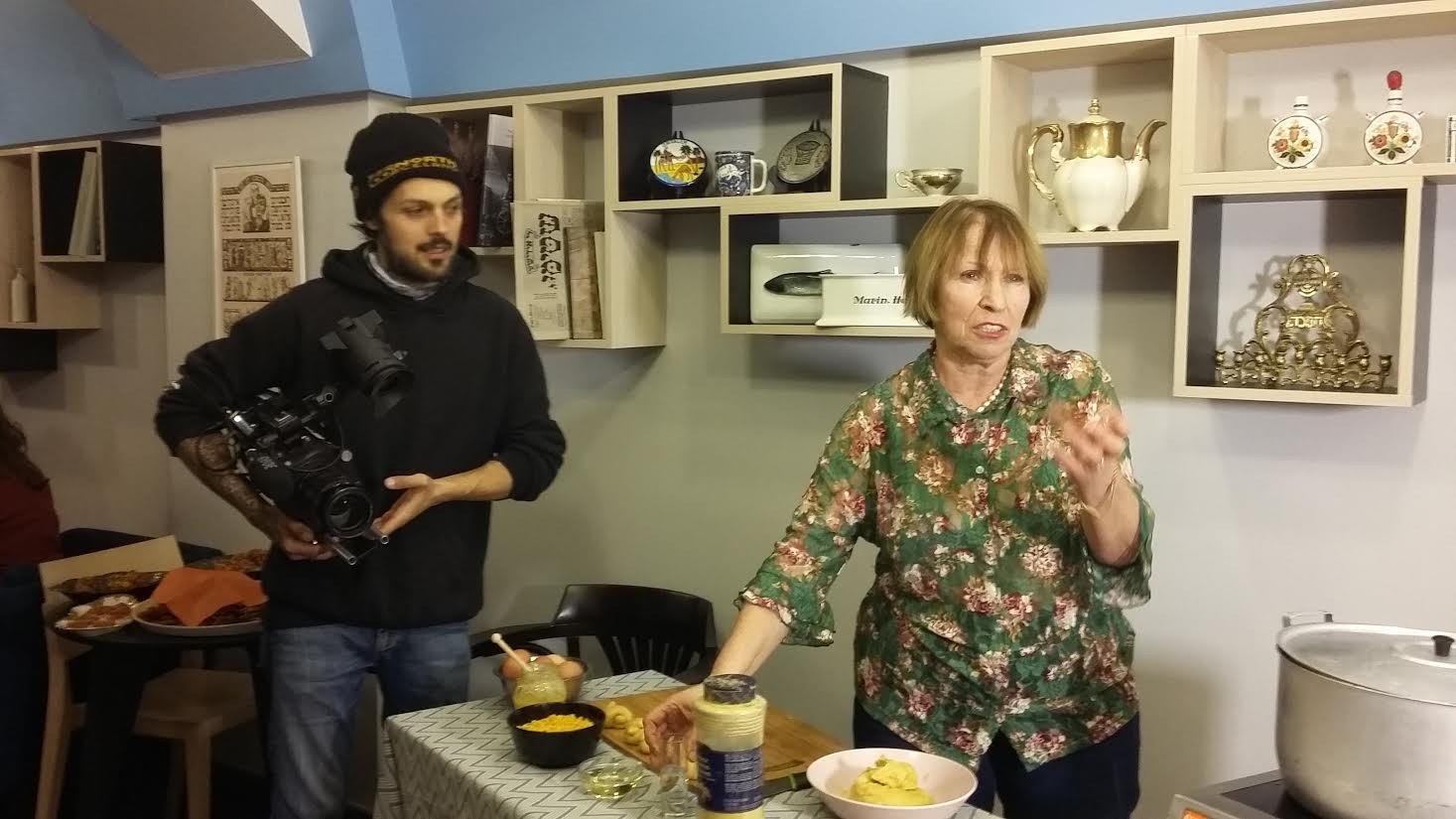
On November 11 members of the Kaunas Jewish Community met together and separately to bake challa, and there was a strong sense of concentration and responsibility but also a lot of positive emotions. The fresh-baked challa adorned the Sabbath table within hours. Iser Shreiberg, the chairman of the Kaunas Hassidic religious community, gave an interesting presentation o the symbolism and traditions of making challa. Guests included former Kaunas ghetto prisoner Asia who came all the way from New York with her husband and son these many years later to her hometown to see her memories of early childhood again and to look for traces of the stories her mother told her.

kchala2

Sabbath Challa in Panevėžys

The Panevėžys Jewish Community joined the Shabbos Project November 11 to bake challa bread. Participants included staff from the educatio department, teachers and Community members.

Preparations for the baking event got underway in the morning and all the necessary ingredients were purchased: eggs, yeast, oil, salt and poppy seeds. The main ingredient was of course highest-quality flour. Kosher flour left over from last year worked perfectly for making the dough. Different recipes were suggested, but in the end the traditional recipe was used, because the Panevėžys Jewish Community’s oven is not large and can’t be used for large-scale production. Housewife Virginija prepared the dough.

Administrator Lina gave a brief talk about challah-baking traditions in Jewish families. Although every housewife has her own recipe for challah bread baked for the Sabbath, the result is always the same: a blessed and delicious loaf of challa.