The Sugihara Foundation awarded Holocaust and Righteous Gentile historian Danutė Selčinskaja the Person of Tolerance for the foregoing year 2025 and awarded writer Sergey Kanovich the recipient of the Leonidas Donskis prize in Kaunas Sunday.
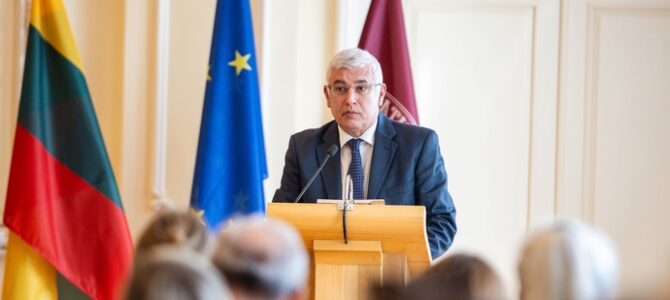


The Sugihara Foundation awarded Holocaust and Righteous Gentile historian Danutė Selčinskaja the Person of Tolerance for the foregoing year 2025 and awarded writer Sergey Kanovich the recipient of the Leonidas Donskis prize in Kaunas Sunday.
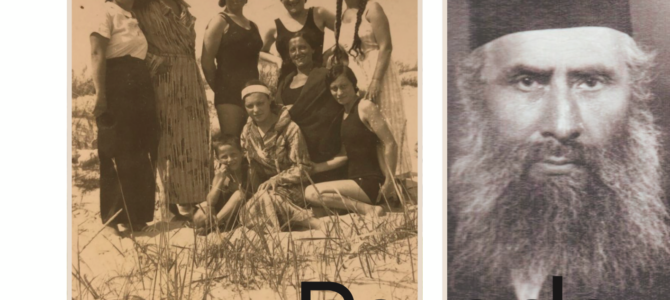
The Palanga Jewish Community invites you to visit an exhibit of photographs called “Jews of Palanga: An History in Photographs” at the Palanga Youth and Volunteer Center, Vytauto street no. 110, Palanga, opening March 3 and running till March 31.
With more than 20 authentic period portraits of interbellum Palanga, the exhibit tells the story of the Palanga Jewish community’s daily life, urban spaces and communal and cultural sites integrated in the landscape of the Lithuanian seaside resort town.
The exhibit is a joint project of the Palanga Jewish Community and the Palanga Youth and Volunteer Center. Mindaugas Surblys is the curator.

Dear Community members,
A happy and colorful Purim!
Our ancestors taught us a very important thing: to make use of every opportunity to enjoy life. Even as history has been full of challenges, we chose light, unity and joy. Therefore laughter, music and song ring out in our homes and community today.
May your tables be laden with fruit, your friendships be sincere and your hearts open. May there be no lack of homentashn, symbolizing the ear of the vizier Haman who sought to harm the Jews as a reminder to us that evil and falseness never win, but courage, hope and unity do.
I hope the joy of Purim inspires in us strength, a sense of belonging and togetherness and faith in the future.
Hag Purim sameakh!
Faina Kukliansky, chairwoman
Lithuanian Jewish Community
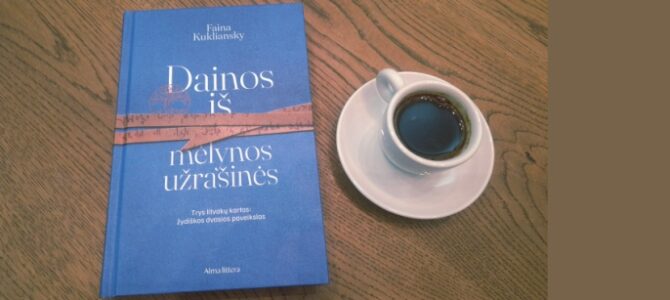
Publisher Alma Littera will present “Dainos iš mėlynos užrašinės” [Songs from a Blue Notebook] at the Vilnius Book Fair Friday.
The book tells the story of the family of the author, Lithuanian Jewish Community chairwoman Faina Kukliansky.
Covering three generations of Litvaks, the recorded memories move from her grandparents who miraculously survived the Holocaust, her parents in the concentration camps to the youngest generation, Faina and her sister Sulamita, the generation of Jews who came out of survivors of the Holocaust.
Readers say the book reads like a film with one frame following another painting a moving picture of the Jewish spirit: culture, heritage, traditions, holidays, cooking, children’s games and communal life. It’s also about a people who were condemned to death who, despite the great love of their families, carry grief from generation to generation, but also boundless courage, resolution, energy and an unstoppable ability to take joy in those things which make up daily life.
“Sometimes people ask me why I spend so much energy on the status of Jews in the world and history, especially since the majority of my people are gone. My only answer is, to safeguard their memory. We no longer have our parents’ candelabra which held the Sabbath candles in every Jewish home. All we have left is memory and respect,” Faina Kukliansky said.
The public is invited to the presentation with Faina Kukliansky who will sign books from 1:30 to 3:30 P.M. on Friday and from 6:30 to 8:30 P.M. on Saturday in Hall 5 at the Alma Littera Stand at the Litexpo pavilion in Vilnius. The Vilnius Book Fair starts Thursday.
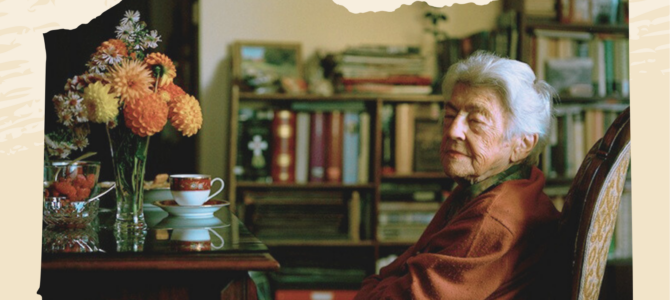
Author Małgorzata Quinkenstein will speak at a presentation of her book “Stronger than Fear” at the Lithuanian Jewish Community. The book features 36 portraits of Righteous Gentiles from France, Hungary, Lithuania, Poland, Romania and other countries and testimonies from rescued Jews. The interview with Quinkenstein is to take place in Polish with simultaneous translation to Lithuanian. Registration is required, click here.
Time: 1:00 P.M., Friday, March 6
Place: Lithuanian Jewish Community, Vilnius
Josifas Useris has died. He was born in 1937. He was a client of the Saul Kagan Welfare Center. Our deepest condolences to his family and friends.
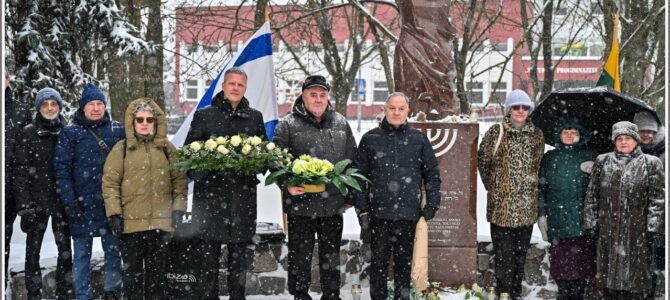
The Panevėžys Jewish Community, deputy mayor Deividas Labanavičius, continuing-education students and visitors from Kupiškis as well as local residents marked the International Day of Commemoration in Memory of the Victims of the Holocaust on January 27.
“The Holocaust reminds us to the depths to which hate, apathy and ignoring human dignity can lead. As we remember the victims, we take responsibility for preserving human respect, for strengthening tolerance and for passing on historical memory to the future generations. This is a duty, leading to a mature and responsible society,” deputy mayor Deividas Labanavičius said.
Panevėžys Jewish Community chairman Gennady Kofman spoke about the incredible mass murder of almost all Lithuanian Jews and noted more than 600,000 Jews had fought against Nazi Germany, many of them falling on the battle field or returning home disabled. “We also remember those who at risk to themselves and the lives of their families rescued Jews from certain death,” he said.
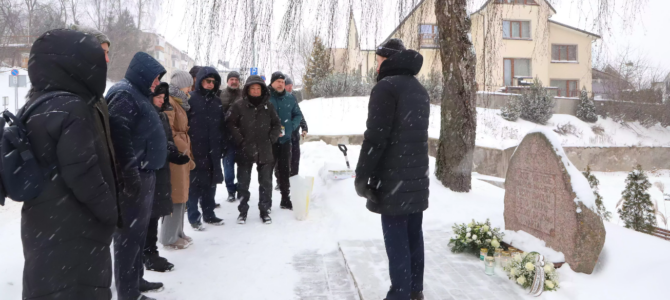
International Day of Commemoration in Memory of the Victims of the Holocaust was marked in Šiauliai January 27. People gathered at the location of the ghetto gates at the intersection of Ežero and Trakų streets. Members of the Šiauliai Jewish Community, local officials and local residents attended. Candles were lit at the monument marking the former ghetto gates. The attendees then moved on to Righteous Gentile Square.

Lithuanian Tolerance Center representatives held a national art conference called “The History of the Lithuanian Jewish Community Lost and Discovered” for the 11th time in Ariogala, Lithuania, on January 27, the International Day of Commemoration in Memory of the Victims of the Holocaust declared by the United Nations Education, Science and Culture Organization in 2005. January 27 is the anniversary of the liberation of Auschwitz.
Vocalists from the Ariogala high school performed. Israeli embassy hargé d’affaires Shimon Pesach, Raseiniai regional municipality mayor Arvydas Nekrošius, Department of Ethnic Minorities director Dainius Babilas and Kaunas Jewish Community chairman Gercas Žakas were among those attending.
Photos from the International Commission to Asses the Crimes of the Nazi and Soviet Occupational Regimes in Lithuania.
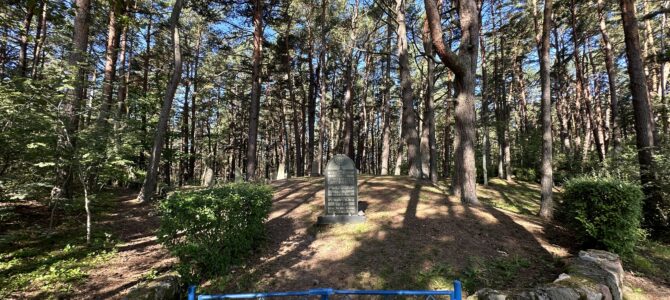
Information from Mindaugas Surblys, Palanga Jewish Community
When fire ran rampant in Palanga in 1830, old burial pinkhas were destroyed, dating back to 1487. Beginning in 1831 burial records were kept for the new Jewish cemetery at the edge of town. For a time two Jewish cemeteries operated in tandem in Palanga, the old one since 1487 till 1892, located inside Birutė Park. The new cemetery was instituted near Naglys Hill.
There are ten remaining headstones (matsevot) of different sizes made from granite and cement with inscriptions in Hebrew letters. Three headstones are broken in their upper sections. One is splintered with fragments lying on the ground. Many of the surviving monuments are difficult to read.
Several inscriptions are legible and correspond to the burial records of the Palanga Jewish community. The inscriptions match the information in the pinkhas, for example, “Here lies our dear and honored father who was famous for his charity work and high moral character, Natan Frank, son of Hirsh (Tzvi), deceased on Rosh Hashanah, 1935” (partial translation).
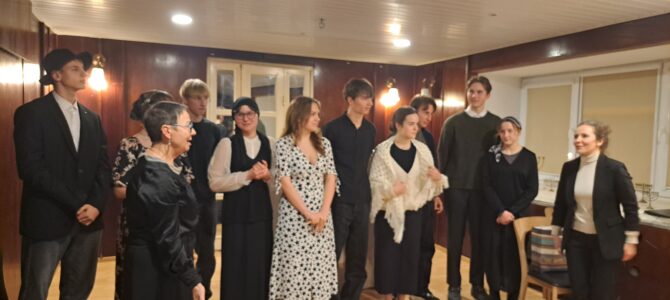
The Šiauliai District Jewish Community marked the International Day of Commemoration in Memory of the Victims of the Holocaust on January 27, the anniversary of the liberation of Auschwitz, with an evening of tea celebrating Vulf Visotiski, a tea expert whose family began dealing in tea in Žagarė back in 1849.
The Šiauliai District Jewish Community invited experts and cultural anthropologists from Žagarė and around Lithuania as well as the general public and served Visotski tea imported from Israel. The fifth generation of the family is still blending tea in Israel now. High school student singers from the area and from Klaipėda provided the highlight of the evening. Speakers also provided historical insights into the Volpert family and the history and current state of Žagarė.
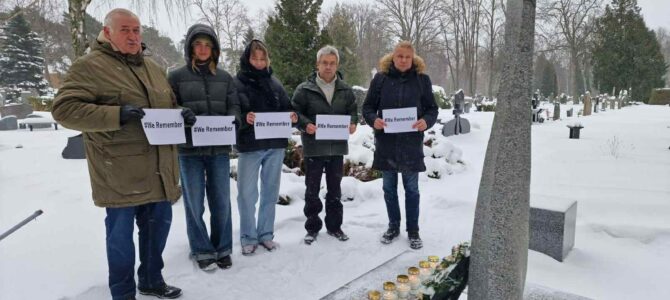
Members of the Palanga Jewish Community, representatives of the municipality and local high school students marked the International Day of Commemoration in Memory of the Victims of the Holocaust Tuesday by visiting a marker commemorating victims at a cemetery there.
“The Holocaust isn’t a past tragedy, it’s a warning of what happens when apathy becomes the norm and hate becomes acceptable. Our duty is not just to remember the victims, but also to protect the truth, which is uncomfortable to some. Remembering isn’t a ceremony, it’s a daily choice,” Palanga Jewish Community chairman Vilius Gutmanas remarked on the occasion.
The seaside resort town has several Holocaust memorial sites with commemorative markers and plaques. The local cemetery has a stele marking where 106 Jews and 5 Lithuanians murdered in 1941 were reburied. Jewish sites including the Great and Lesser Synagogues and a site connected with Dr. Lazar Gutman are also marked now, as are two pre-Holocaust Jewish cemeteries.
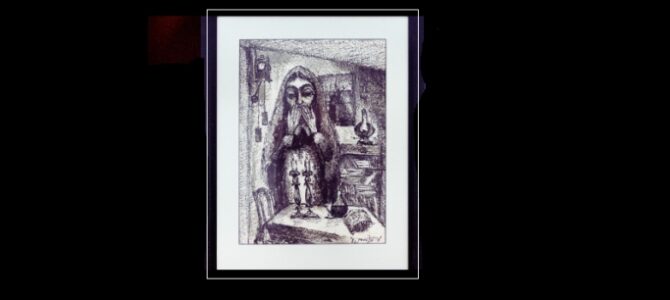
The Šiauliai District Jewish Community invites you to mark International Day of Commemoration in Memory of the Victims of the Holocaust together with the community on January 27. At 12 noon there will be a candle-lighting ceremony at the Shavl ghetto gate located at the corner of Ežero and Trakų streets. At 6:00 P.M. the Community will hold an evening to celebrate Vulf Visotski and tea called “Memory, Faith, Hope” at the Community at Višinskio street no. 24 in Šiauliai. Participants are to include the student theater from the Ąžuolynas Gymnasium in Klaipėda, vocalists from the Juventa Pre-gymnasium in Šiauliai District and guests from Pakruojis and Žagarė.
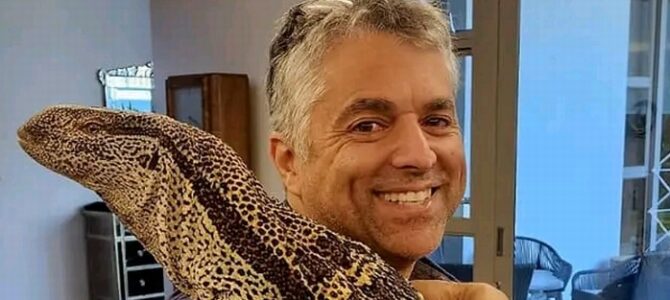
by Grant Gochin, January 5, 2026
History is not preserved by monuments or institutions. It is preserved by accuracy, accountability, and the willingness to confront what is difficult. Nowhere is that obligation more binding than in nations whose soil carries the memory of mass murder. When a state chooses to defend dishonest institutional narratives instead of historical truth, the cost becomes permanent: the leadership that made those choices becomes inseparable from the legacy of distortion.
Lithuania refuses to confront that legacy.
The Genocide and Resistance Research Centre of Lithuania
The Genocide and Resistance Research Centre of Lithuania (LGGRTC) is a state institution charged with researching and memorializing the crimes of totalitarian regimes. Over the past decades, its conduct has drawn sustained criticism for minimizing Lithuanian participation in the Holocaust while promoting dishonest national narratives.
International Jewish organizations and independent observers have warned that the Centre’s activities approach Holocaust distortion and contradict established historical scholarship. https://www.timesofisrael.com/lithuanias-genocide-studies-center-accused-of-holocaust-denial/
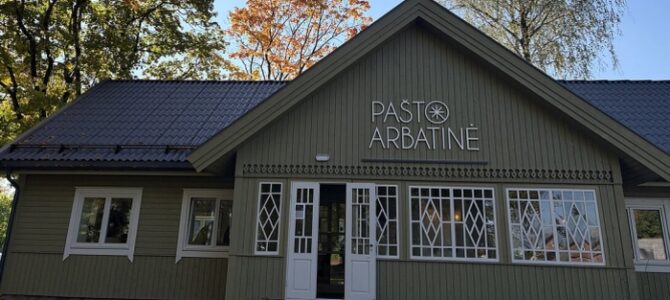
Rūdiškės is a small town in the Trakai district which most people pass on the road without a thought about its complicated and painful history. The railroad came through in the 20th century and brought business and a Jewish population, almost completely exterminated in the Holocaust. Now local residents, teachers and descendants of people from the town are trying to revive memories of the past there, through testimonies, initiatives and manual labor.
For people travelling between Vilnius and Alytus, Rūdiškės is mainly just a name on a road sign. It has a railroad stop, a main square. a school and stores. The tranquil façade hides a complex story. Lithuanian language teacher Loreta Masienė says Rūdiškės is different from most towns because it was established around the railroad station.
“This was the first railroad in Lithuania, the St. Petersburg to Warsaw line. Rūdiškės began to grow around the railway and the Geležinė River,” she said.
Full story in Lithuanian here.
Alė Šimulynienė has died. She was born in 1936. She was a member of the Lithuanian Jewish Community and a client of the Saul Kagan Welfare Center, We extend our deepest condolences on her loss to her surviving family and friends.
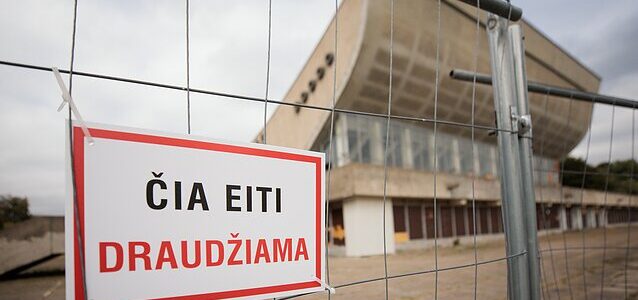
The Lithuanian Ministry of Economics and Innovation has issued a press release on the Baltic News Service webpage expressing approval for the idea of setting up a Holocaust museum at the former Palace of Sports built on top of the Vilna Jewish cemetery by the Soviets in the Shnipishok neighborhood on the northern side of the Neris (viliya( River.. The building has been in serious disrepair for over a decade.
“Taking into account the position held regarding the possibility of adapting the former Palace of Sports, since this site is not suitable for modern and competitive conference tourism… it would be more appropriate to renovate the Palace of Sports and equip it for use as a new memorial and museum,” the Economics and Innovation Ministry posted on the BNS press release webpage.
Vilnius mayor Valdas Benkunskas after meeting with economics minister Edvinas Grikšas last week told BNS the Vilnius municipality and the Economics Ministry have a common position regarding the aging concert and sports complex.
Mayor Benkunskas said: “We perceive in the same way that the Palace of Sports has to be renovated and adapted as a memorial and museum space, and that it wouldn’t be competitive for conference tourism, and would pose a risk to our public image as such.”
The Economics and Innovation Ministry earlier posted the building was not fit to use as a conference venue following a study ordered by the Government.
“According to the current studies, this site could only host some of the requirements as a venue, there would be a lack of parking places, and the costs of reconstruction are difficult to predict,” the Ministry said.
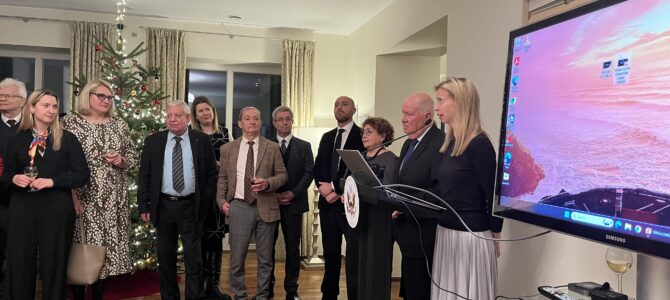
Goodwill Foundation co-presidents Rabbi Andrew Baker and Faina Kukliansky presented plans for a new Lithuanian Jewish Community Center at the US embassy in Vilnius last week.
World-renowned Litvak architect Massimiliano Fuksas’s team are drafting plans for the new building to be built at the site of the Great Synagogue complex in Vilnius Old Town.
Baker and Kukliansky provided details at the presentation on a planned YIVO exhibit at the new center telling the history of Litvaks, Litvak life, traditions, the people and their mass murder during the Holocaust.
The attack perpetrated on Bondi Beach in Australia where the attackers shot Jews gathered to celebrate Hanukkah has caused deep concern and upset to the Lithuanian Jewish Community. The victims included children, rabbis, Holocaust survivors and non-Jews as well.
We extend our sincerest condolences to the Australian Jewish community and call on everyone to realize that this mass murder targeted Jews around the world, not just in Australia. This is an alarm bell warning us no Jewish community is safe anywhere in the world. Our members including women and children are vulnerable to attack at any time.
Large metropolises throughout the world including Berlin, London and New York have responded to attacks on Jews by increasing security. Sadly in recent times amid a rising tide of anti-Semitism in the world and in Lithuania, we daily encounter hostile actions, vandalism and violence. We are citizens of a member-state of the European Union who are being targeted by followers of recognized terrorist organizations.
We call upon our members to remain vigilant, and we call upon the Lithuanian Government and the citizens of Lithuania to take measures to protect Lithuania’s Jewish organizations, including the communities, the kindergarten, the Choral Synagogue and other sites.
Events in Washington, D.C., Berlin and Sydney demonstrate the danger is real and that in order to avoid further tragedy, we must act now. Tomorrow could be too late.
Liucija Lavrenova has passed away. She was born in 1937. She was a member of the Kaunas Jewish Community and a client of the Saul Kagan Welfare Center. Our sincere condolences to her daughter, other family members and friends.