Holocaust

On Jewish Motifs, Historical Facts and Lithuanian Identity in Kristina Sabaliauskaitė’s Work

Kristina Sabaliauskaitė

The 24th meeting in the Destinies series of seminars and lectures took place at the Lithuanian Jewish Community on February 17, called “Jewish Motifs in the Works of Writer and Art Historian Dr. Kristina Sabaliauskaitė. Teacher and essayist Vytautas Toleikis moderated the meeting and LJC deputy chairwoman Maša Grodnikienė, the organizer, served as MC and introduced Sabaliauskaitė in person to the audience, noting she was very popular outside of Lithuania as well in Poland and Latvia.

Moderator Toleikis addressed the full hall saying “Kristina has returned Lithuania’s historical memory. She brought back 200 years of history which, due to [historian] Šapoka’s paradigm were lost to Lithuanian consciousness. ‘Silva Rerum’ [‘Forest of Things’ trilogy by Kristina Sabaliauskaitė, 2008, 2011 and 2014] is for us an unexpected historical good fortune, as if the nation had won the lottery. We are lucky Kristina has brought back centuries of history. The author’s memory is not selective, she writes about everything in the past, about Poles and Jews as if they were her own people. This is the attitude of a 21st-century person, it could not be otherwise.”

The conversation during the Destinies meeting revolved around Jewish characters and how the figure of the Jew came to be included in Kristina Sabaliauskaitė’s works in a way very different from the more common portrayal found in Lithuanian literature. Sabaliauskaitė chose the elite person of the doctor Aaron Gordon.

Vilnius Mayor Calls Crematorium in Jewish Cemetery Inappropriate

Šimašius

Vilnius, February 20, BNS–A plot of land next to the old Jewish cemetery on Olandų street is inappropriate for a crematorium and Vilnius residents will be asked their opinion on the need and location for such an operation, Vilnius mayor Remigijus Šimašius said.

“It has to be acknowledged that this is the territory of a Jewish cemetery and it’s obvious that in Vilnius, where 40,000 Jews lived before World War II, because of the association, a crematorium in the Jewish cemetery is simply inappropriate. For that reason alone there should be no crematorium at that location,” the mayor told BNS. He confirmed the council would be presented with the decision not to approve a crematorium on Olandų street in the Lithuanian capital. The mayor also said results of a poll of public opinion on the issue of the need for and location of a crematorium in Vilnius would be presented soon. “I think there is a need among some residents of Vilnius. We ordered a poll of residents of Vilnius to identify what sort of locations are most likely, where residents would like to see a crematorium,” mayor Šimašius said. He said a final decision would be made following the public opinion poll on “where to encourage investments” in the city.

February 16 Greetings from Japan

Dear Mrs. Faina Kukliansky,

Dear friends from the Lithuanian Jewish Community,

The Lithuanian embassy in Japan greets you on February 16, the day of the restoration of the state of Lithuania! We send for your information an article by Lithuanian ambassador to Japan Egidijus Meilūnas published today in the Japan Times. The article discusses Righteous Gentiles, the former Japanese consulate in Kaunas, Lithuania and their efforts to save Jews:

http://classified.japantimes.com/nationalday/pdfs/20160216-Lithuania_National_Day.pdf

We wish you a wonderful holiday!

Violeta Gaižauskaitė
Lithuanian embassy to Japan

Lithuania Must Confront Its Past

by Dr. Efraim Zuroff

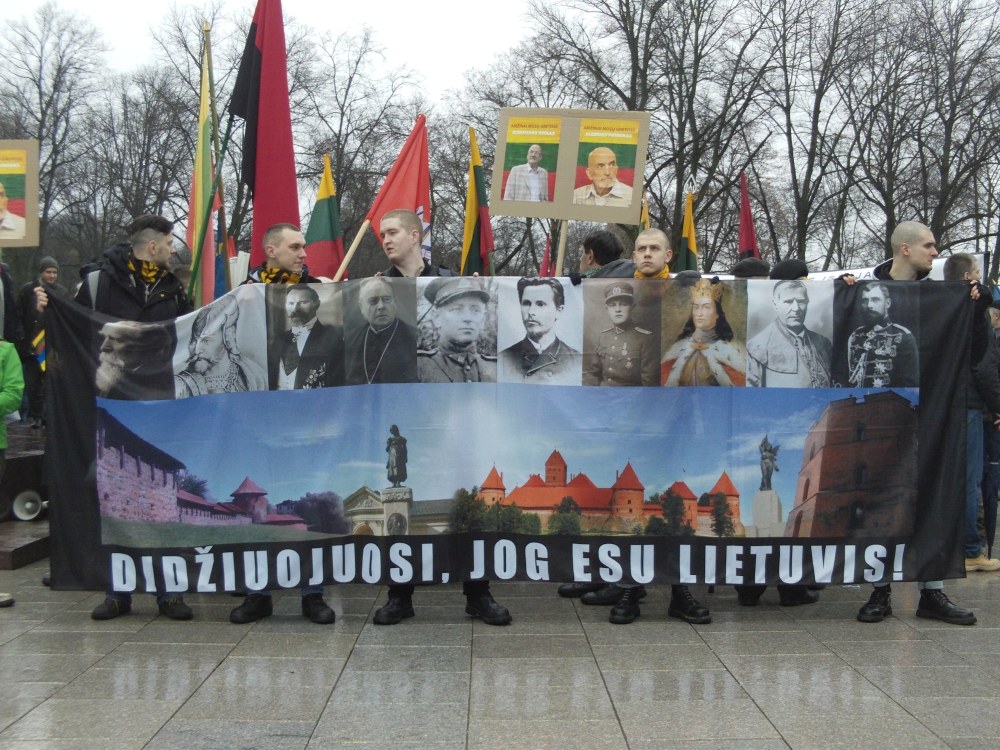
Until now, the glorification of the Lithuanian heroes who had played a role in Holocaust crimes was only one of several themes featured at the marches.

Baltic neo-Nazi/ultranationalist/fascist march-month is upon us once again. This Tuesday, February 16, the first of the marches will take place along the central avenues of Lithuania’s prewar capital of Kaunas, (Kovno) on one of the country’s two Independence Days, this one to mark the liberation from Czarist Russia in 1918. The second on March 11 marks independence from the Soviets, and will be the date of a similar march in the current capital of Vilnius (Vilna). Both marches are sponsored by the Union of Lithuanian Nationalist Youth. The two additional marches will be taking place in Tallinn, the capital of Estonia, on February 24, Estonian Independence Day, and the last march will be held in the Latvian capital of Riga on March 16, the date of an important battle fought by the Latvian SS Legion. It is the only one of the marches which is not held to mark the achievement of independence.

In Estonia, the march is being organized by Blue Awakening, the youth wing of the Estonian People’s Party, whereas the march in Riga is sponsored by SS veterans and their political supporters.

Chess Tournament to Celebrate Lithuanian Independence Day Held at LJC

332b6b05-17f9-4554-880a-50794b55861a

A chess tournament held by the Rositsan and Maccabi elite checkers and chess club dedicated to celebrating February 16, Lithuania’s pre-war independence day, began at the Lithuanian Jewish Community on schedule at 11:00 A.M. on February 14.

Tournament director and FIDE master Boris Rositsan welcomes contestants and gave the floor to Vytautas Landsbergis, the first chairman of the independent Lithuanian parliament, Lithuanian independence leader and avid chess player. Not only avid, but good: he won a match against Marytė (Marija) Kartanaitė, Lithuanian chess master many times over, at the LJC. “Playing chess, it’s important not to lose the initiative and not to give up,” Landsbergis said. “It’s important how much space you occupy. The opponent, it seems, is pressuring you to give up, but don’t lose the initiative. It’s nice chess players are honoring February 16, and that Boris Rositsan wants to demonstrate Lithuanian history through chess. Chess is the school of life and part of the culture of our country, and influenced our independence,” he commented.

Lithuanian Jewish Community chairwoman Faina Kukliansky spoke and characterized chess players as educated and honorable people. This year has been named the Year of Kazys Grinius, the interwar Lithuanian president and a Righteous Gentile who was also a fine chess player, and who rescued chess player Dima Gelpern from death during the Holocaust.

Lithuanian Jewish Community Proposes Publishing Information on Holocaust Perpetrators

February 12, BNS–Friday the Lithuanian Jewish Community proposed publishing “information of a general nature” on more than 2,000 people who, according to a study by historians, might have been complicit in the Holocaust during World War II. This proposal was presented Friday in a letter by LJC chairwoman Faina Kukliansky to the Office of Prosecutor General and the Center for the Study of the Genocide and Resistance of the Residents of Lithuania. The head of the community proposed announcing which group of people on their list participated directly in mass murder, how many participated indirectly, how many in total were convicted and whether there are people on the list who were honored in some way by the state, and under what agencies they worked. Kukliansky told BNS Friday she thinks it’s important to the public to receive explanations about the list. In her opinion, it is possible to publish the names of those whose cases have been tried.

“The Lithuanian Jewish Community believes refusal to release the List could have negative repercussions at the international as well as national level and could give rise to various theories which would damage the reputation of the Lithuanian state,” her letter said. She also called upon the prosecutor’s office to look into how many people on the list hadn’t been convicted but who are still alive, and if such exist, to begin criminal cases against the,

The Center for the Study of the Genocide and Resistance of the Residents of Lithuania has prepared a list of about 2,000 people who were complicit in Holocaust crimes. It has been turned over to the Government.

Keeping an Implicit Promise

by Geoff Vasil

It was interesting to watch the publicity machine surround Ruta Vanagaite’s new popular account of the Lithuanian Holocaust swing into gear to sell her new book. The publisher Alma Littera seemed to adopt an “artificial scarcity” marketing plan with an initial print run of only 2,000 copies, a plan which appears at this point to have been very successful. The next print-run is slated for 6,000, a humble figure given all the press and discussion of the book.

Initial confusion about the book–Jerusalem Post reported it as Efraim Zuroff’s new work–and some surprising comments by Vanagaite herself regarding Zuroff on national television softening his demonized image among the Lithuanian public gave way to a more general call for the Center for the Study of the Genocide and Resistance of Residents of Lithuania to stop dragging their feet and finally publish a “list of names” of Lithuanian Holocaust perpetrators.

LJC Letter to the Prosecutor and the Genocide Center

Lithuanian Jewish Community
No, 179, February 11, 2016

To:
The Honorable Evaldas Pašilis
Office of Lithuanian Prosecutor General

The Honorable Birutė Burauskaitė
Center for the Study of the Genocide and Resistance of the Residents of Lithuania

Re: Possible actions connected with the list comprised of 2,055 people who are alleged to have committed or contributed to the murder of Jews during World War II

February 11, 2016, Vilnius

The Lithuanian Jewish Community, seeking the restoration of historical justice and commemoration, and honoring the principles of the rule of law, equality before the law and the presumption of innocence, proposes:

Musicians of the Symphony of the Lie

Serg.Kanovic
by Sergejus Kanovičius

Rūta Vanagaitė’s book has raised several more unpleasant matters. Although it seems to talk about victims and perpetrators, neither side making comments about the book seem to care. What does interest the Genocide Center and the manipulators of history who stand behind it is the status quo of the center’s immunity, which has been seriously threatened recently, and the Jewish Community doesn’t seem to care either, because its chairwoman has voluntarily fallen into the same orchestra pit where, faking the notes, the Genocide Center symphony orchestra is performing, the shining white knights cavorting with television entertainment figures out for ratings, and someone in the background whining about Holocaust education. But the people who were pushed below the turf 75 years ago still lie there as they lay before. Usually nameless, very often surrounded by used hypodermic needles, condoms and plastic beer bottles. As nameless as their murderers. Trying to name the latter causes great controversy, and again all sorts of “I do this for you, you do that for me” deals begin to find voice, after which prosecutors are supposed to suddenly confirm a list already confirmed long ago by historical fact of those who did the shooting or helped shoot almost all Lithuanian Jews to the very last individual.

Lithuanian Jewish Community Wants Rescuers Commemorated

Vilnius, February 7, BNS–The Lithuanian Jewish Community says commemoration of Righteous Gentiles is missing in Lithuania, and so far the Vilnius administration isn’t considering any specific ideas to do so.

LJC chairwoman Faina Kukliansky hailed an initiative by activists to erect a statue in Israel to rescuers of Jews, but thinks such commemoration needs to begin in Vilnius.

“But why does it need to be built in Israel instead of Lithuania? Is there no need to honor rescuers in Lithuania? I don’t know, maybe it wouldn’t be over the top if such a statue appeared in Israel. I think there are people who left Lithuania who survived, and if someone was left alive, it was thanks to the rescuers. I don’t think people would object to that. But perhaps first we should set things in order in Lithuania,” Kukliansky told BNS.

Lithuania to Publish Names of 1,000 Suspected Holocaust Perps

Following the publication in Lithuania of a groundbreaking book on local complicity during the Holocaust, a state museum on genocide said it would publish a list of 1,000 suspected perpetrators.

Terese Birute Burauskaite, who heads the Vilnius-based Genocide and Resistance Research Centre of Lithuania, said her institution would “this year try to publish a book” containing “over 1,000 Lithuanian residents who are connected to the Holocaust,” the news website Delfi.lt reported Tuesday.

Full story here.

Prosecutors Should Examine List of Holocaust Perpetrators

Vilnius, February 2, BNS–Lithuanian Jewish Community chairwoman Faina Kukliansky thinks a list of Holocaust perpetrators held by the Center for the Study of the Genocide and Resistance of the Residents of Lithuania should be handed over to prosecutors for possible action.

Center for the Study of the Genocide and Resistance of the Residents of Lithuania director Teresė Birutė Burauskaitė said she doubts such an investigation could take place and believes it is up to the Lithuanian Government and not the Center to address prosecutors.

“I would be satisfied” with the release of the list, Kukliansky said, “but would that affect the families of these people, would it violate their rights if guilt hasn’t been established? I would give the list to the prosecution, [these] crimes don’t have a statute of limitations, let them investigate. That needed to happen a long time ago. I think people need to know the names of the murderers as well as the rescuers. But the list may only be published when the guilt of these people has been proven. It should as provided for in law,” she added.

La Cumparsita

by Sergejus Kanovičius

“Šeduva? Oi, oi, oi. What’s your name? Sergejus? Oi, great, come, I’m waiting. When will you arrive? Tomorrow. Really? Šeduva? Come. Oi…”

That’s how I rang into her life last spring. Neither I nor she knew what to expect from our unexpected meeting. I have knocked at the chambers of people’s memories knowing for some the trip back into the past will be pleasant, while for others it will perhaps not be such a joyful return to memories stashed away in the most remote drawers,

I found Frida’s house easily enough, after all it wasn’t very long ago, just two decades ago, that I lived almost right there. She opened the door for me, so fragile, so small, always smiling. After listening to my short introduction about how some strange people were concerned with recording her life and those of her neighbors, their deaths and the disappearance of their home town, she sighed and looking somewhere far off in the distance, as if at the Milky Way of memory, said:

“How long have I waited for you. How very long. All my life.”

Panevėžys Jewish Community Member Oksana Navickienė Receives Yad Vashem Diploma

Oksana Navickienė, a member of the Panevėžys Jewish Community, has received a diploma from the Yad Vashem Memorial Authority and Museum in Jerusalem for completing a course at the International School for Holocaust Studies there. We hope she is able to apply her new knowledge to teaching the Holocaust to primary and secondary students throughout Aukštaitija. Congratulations, Oksana!

Lithuanian Jewish Community Chairwoman Faina Kukliansky on the Holocaust Discussions of Recent Days

C

Several days after commemorating International Holocaust Remembrance Day, discussions on the topic of the Holocaust have again come up in Lithuania. In my childhood I heard everything in my family–during conversation memories of the ghetto often came to the fore, being locked in the ghetto, taken to concentration camps, about the hole where people hid. But the experience of the Holocaust was as it were one of many things which separated Jews from non-Jews. They murdered us, while others at the same time went on with their lives, went to movie theaters, went to school and studied. Over just a few months almost the entire Lithuanian Jewish community, more than 200,000 people, were exterminated. For all of my life, for the entire Soviet period, many people treated us differently. We always knew our opportunities were limited and that we were different.

The Co-Authors of Rūta Vanagaitė’s Book

sk
by Sergejus Kanovičius

The noise generated as soon as an excerpt from Rūta Vanagaitė’s book “Mūsiškiai” was published was phenomenal in the true sense of the word. The passage released is almost certainly a transcription of an interview Saulius Beržinis conducted almost two and a half decades ago, one of many he did with Holocaust perpetrators. It says nothing about the book or its worth.

A bit later several interviews with the author and several responses to the facts recited in those interviews appeared. Writers, historians, publishers and known and unknown public figures began immediately discussing and judging the unread book, some even compared to a great work of literature and mused upon questions of metaphysical guilt and the effect of the Holocaust on society. For some of the non-readers it was enough that famous Holocaust historian and Nazi hunter Efraim Zuroff attended the presentation of the book and participated in its creation: right-wing non-readers immediately christened the unread book a provocation by the Kremlin intended to sow ethnic discord. One long-time Conservative Party member even fretted the book would ruin Lithuania and Israel’s wonderful relations, although she was unable to explain exactly the connection between Lithuania’s inability to come to terms with its past and foreign policy.

Jerusalem Post Reports on New Holocaust Book by Efraim Zuroff

cdb_Musiskiai_z1

In an addendum to a piece on International Holocaust Remembrance Day commemorations around the world, the Jerusalem Post reported the publication of a new book by Efraim Zuroff, “co-authored” by Lithuanian Rūta Vanagaitė:

“Also on Tuesday, Zuroff launched his new book ‘Our People: Journey with an Enemy’ in Lithuania. Co-authored with Ruta Vanagaite, the writers accuse the current Lithuanian government of trying to ‘hide or minimize the role of Lithuanian collaborators during the Holocaust.'”

Full text here.

Students and Teachers Converge on Ariogala to Remember the Holocaust

Renginio organizatoriai ir sveciai

Ingrida Vilkienė, education program coördinator of the International Commission to Assess the Crimes of the Nazi and Soviet Occupational Regimes in Lithuania reports on the commemoration of International Holocaust Remembrance Day at a conference held at the high school in Ariogala, Lithuania. Teachers and students from schools with tolerance education centers throughout Lithuania as well as many others came to the Lithuanian town January 27 to remember the dead and present student works about the Holocaust. Others at the conference included Israeli ambassador Amir Maimon, Lithuanian ambassador for special assignments Dainius Junevičius, Kaunas Jewish Community chairman Žakas Gercas with community members, Panevėžys Jewish Community chairman Gennady Kofman, Raseiniai district administrative head Algirdas Gricius and a large number of people from the education department and other institutions in the Raseiniai district administration.

International Holocaust Remembrance Day

Auku minejimas (40)

International Holocaust Remembrance Day was marked at the Choral Synagogue in Vilnius with a minute of silence and a reading of the names of Holocaust victims. Cantor Shmuel Yaatov offered song and prayer for those who perished. Students from the Vilnius ORT Sholem Aleichem Gymnasium, Israeli ambassador Amir Maimon, deputy Lithuanian foreign minister M. Bekešius and may others took turns reading the names. Lithuanian Jewish Community chairwoman Faina Kukliansky addressed the audience, calling on them to pray for the Jews of Lithuania brutally murdered, and said there was a noticeable lack of an official reaction or even a minute of silence to remember the circumstances of the brutal mass murder of Jewish Lithuanian citizens by the leaders of the country.

Eye-witness Edmundas Zeligmanas, whose father was murdered as he watched by white armbanders, recalled the horrific mass murders in Šilalė during the first days of war in 1941. After his father’s murder, they murdered many members of the Jewish community the next day. The mass murders were so bloody and so swift there wasn’t time for the earth to absorb all the blood, and it flowed into a small stream which turned red.

A Story of the Holocaust and the AIDS Epidemic: The Romance of an Indian Muslim Freedom Fighter and a Lithuanian Jewish Woman

headerphoto

by Kenneth X. Robbins and John Mcleod

In 1992 the editor of the Times of India telephoned one of Mumbai’s most prominent businessmen, Dr. Yusuf K. Hamied. The editor asked Hamied “as a Muslim leader” his opinion on the communal riots then taking place in the city. Hamied replied: “Why aren’t you asking me as an Indian Jew? Because my name is Hamied? My mother was Jewish!” His maternal grandparents perished in the Holocaust.