
Holocaust

Guests from Belarus Visit Panevėžys Jewish Community

THAI

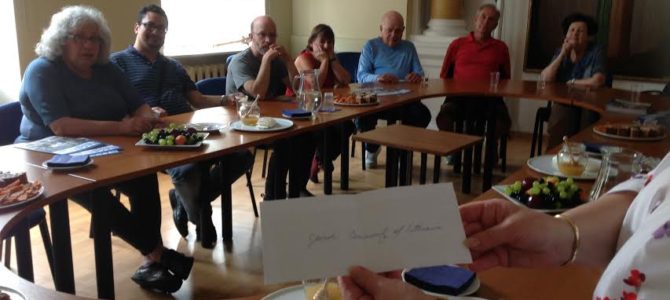
A jazz group from the city of Bobruisk (Babruysk), Belarus visited the Panevėžys Jewish Community. The members of the band are Jews and Belarusians who teach at the Children’s Music School in Bobruisk. They formed their own group called Thia. Over tea Panevėžys Jewish Community chairman Gennady Kofman told them about the city of Panevėžys and the history of the Jews living there. The guests were very interested in city industry, what enterprises operate there and the economic situation. They spoke about the economic conditions in Belarus and discussed migration problems. Bobruisk is famous for its marshmallow-like candies which the guests said have a special flavor. They were impressed by Panevėžys, how clean and orderly it was and with such a nice natural environment. They were interested in local Jewish affairs. Their first stop upon arriving in the city was the Jewish Community. Jewish Community members Yefim Grafman and Mikhail Grafman also shared their memories of the former Jewish population with the guests. The guests spoke about the Jewish communities operating in their city and about the close cooperation and friendship between them.

Plans to Commemorate Zwartendijk in Kaunas

Jan Zwartendijk

BNS reports on plans to commemorate Holocaust-era Dutch consul in Kaunas Jan Zwartendijk, who issued end-visas to complement the “visas for life” transit visas Japanese diplomat Chiune Sugihara issued to Jews, saving thousands of lives.

Speaking to BNS, Dutch ambassador to Lithuania Bert van der Lingen said Sugihara was well known in Lithuania, while Zwartendijk was not.

In truth, both men worked together to save Jews trying to flee the Nazis in Soviet Lithuania. Sugihara issued visas for transiting Japan, thus allowing many to cross the USSR, but without a final destination visa, many weren’t allowed to even begin their journeys. Zwartendijk issued end-point visas for Curaçao, a Dutch territory in the Caribbean, but one which required no entry visa in any event. While there is no evidence Zwartendijk met with Sugihara–although van der Lingen says they did speak by telephone–both diplomats were aware of one another and knew exactly what they were doing.

Greetings to Our Veterans on Victory Day!

A group of women wearing dresses representing flags of the Allied powers (left to right: the USA, France, Britain and the Soviet Union) outside the Eglise de la Madeleine on VE Day in Paris, 8th May 1945. (Photo by Keystone/Hulton Archive/Getty Images)

Lithuanian Jewish Community chairwoman sends her greetings to members of the community on Victory Day, celebrated as Victory in Europe or VE Day in America and Europe on May 8.

I am grateful for the opportunity to honor our veterans and bow my head before them on this day. I wish you, dear friends, good health. You will not forget your heroism, the spiritual and physical suffering, the wounds and losses you experienced. The Community will take care of you to the utmost of its ability. We appreciate and are proud of you, and for living Jews, Victory Day, the victory against the Nazis, means they were rescued from concentration camps, Naziism was defeated, they survived and the shadow of death withdrew. Happy Victory Day, dear veterans, I congratulate you all!

Come Celebrate Victory Day!

The Lithuanian Jewish Community, the Social Center and the Abi Men Zet Zich Club wish you a happy Victory Day, also known as VE Day in the West, and invite you to come out and honor our veterans of World War II at a ceremony to be held at 3:00 P.M. on Tuesday, May 10, 2016 at the Lithuanian Jewish Community in Vilnius.

For further information please contact Žana Skudovičienė at 8 678 81514

Righteous Gentile Awards Ceremony Held at Lithuanian Government

Vyriausybeje apdovanoj

A ceremony to award the title of Righteous Gentile was held in Lithuania’s Government House May 5. The award recognizes those who saved Jews from the Nazis during the Holocaust.

Prime minister Algirdas Butkevičius said at the event the tragedy of the Holocaust 75 years ago took the lives of hundreds of thousands of Lithuanian citizens, our friends, neighbors and loved ones. The numbers would have been even higher if not for those who found the courage at the darkest moments to remain human, Butkevičius said.

“Righteous Gentiles are the real heroes. They risked their own lives and those of their families to provide shelter to people who would been murdered. They disregarded their own situation and paid no heed to reputation, they were led by the voice of the heart. They helped the victims hide, fed them, gave them a roof and embraced them,” he continued.

Holocaust Commemoration Features Criticism of Lithuanian Government for Denying Litvaks Citizenship

yhs1

Ponar, May 5, BNS–During the annual commemoration of Holocaust victims Lithuanian Jewish Community chairwoman Faina Kukliansky Thursday blasted decisions by migration officials not to grant Lithuanian citizenship to Litvaks–Lithuanian Jews–and their offspring who left the country between the two world wars.

During the official ceremony on Holocaust Remembrance Day at Ponar, Kukliansky said Lithuanian officials needed “history lessons.”

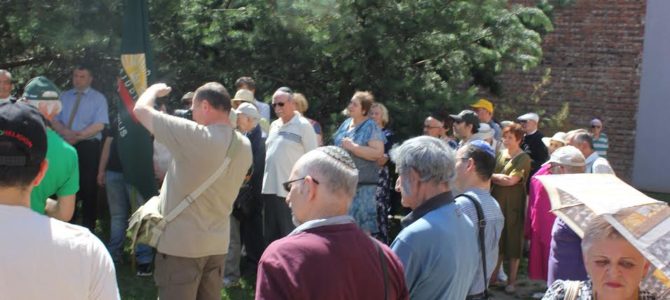
The event consisted of a march lasting under 20 minutes with marchers carrying Lithuanian and Israeli flags from the Ponar railroad station to the Paneriai (Ponar) Memorial Complex, where the commemorative ceremony too place. This is the route Jews of the Vilnius ghetto marched before they were murdered in the Ponar forest.

The Jewish Disease

logo_sm2

Miami, May 3, 2016–Yom HaShoah, Holocaust Remembrance Day, is May 4–5. Targum Shlishi’s support of projects related to Holocaust awareness and education is one of its core areas of giving. For many years, this category was primarily focused on pursuing justice for Nazi war crimes—Targum Shlishi worked with Efraim Zuroff, director of the Simon Wiesenthal Center’s Israel office, on many initiatives, including partnering on Operation Last Chance. As time has passed, the focus has shifted to the critical importance of issues around awareness, education, and combatting denial.

“The Jewish Disease is not that in every generation there arises an enemy that seeks to destroy us, as we read just two weeks ago in the Passover Haggadah; that has been our destiny. Instead, the Jewish Disease is that in every generation, Jews, wherever their locale, believe that this time is different,” says Aryeh Rubin, director of Targum Shlishi. “Whether it is thirteenth-century England; fifteenth-century Spain; nineteenth-century Ukraine; twentieth-century Germany; or twenty-first century France, England, or elsewhere, anywhere that Jews have achieved an exalted status in society, a confidence sets in that blocks their sense of historical reality. The details vary—perhaps there are Jews who are advisors to their country’s rulers, or on the highest corporate levels of large multinational companies, or one serves as the finance minister in a democratic state—regardless of circumstance, the refrain is always the same. Over and over, the Jews have stated: ‘It can’t happen here.’ Holocaust Remembrance Day serves to remind us that anti-Semitism has a long history and that it can happen anywhere. And this extreme anti-Semitism of yesterday extends to Israel today.”

Expanding on this, Rubin continues: “Israel is increasingly pilloried in ways that are the current face of anti-Semitism. It is critical that on Holocaust Remembrance Day we do much more than see the Holocaust as an historic event. The terrible truth is that we are in no position to call the Holocaust history. With anti-Semitism steadily rising throughout Europe, we are all obligated to do our job in increasing awareness and knowledge of the Holocaust as well as disseminating truth and countering lies about Israel and the Jewish people. Every year we help support a series of initiatives that are dedicated to expanding awareness of the Holocaust. We are very proud of the important work being accomplished by these programs.”

Campaign for Justice for Holocaust Survivors

Today, the World Jewish Restitution Organization is launching a grass-roots campaign to unite Jewish Holocaust survivors and younger generations in the ongoing effort for restitution of property stolen from Holocaust victims.

Please support this Call to Action and this international call for justice by signing this petition:
http://wjro.us3.list-manage.com/track/click?u=c6386fad48760c74d93ecc4fb&id=7f2893a939&e=700ea8e007

In the Call to Action, Jehuda Evron, an 84-year-old Holocaust survivor and a longtime advocate for survivors and their families, asks younger generations to join the struggle for justice for survivors and their families and to ensure that their efforts continue after the last survivor has perished.

Spirit of Jewish Girl Leads New Tour of Kaunas

vejune

The story of one Lithuanian who lived in Kaunas in the early 20th century deserves to be made into a film. Instead, a group of Kaunas residents are using it in their intriguing new tour of the Kaunas Old Town. This is the first project of its kind in Lithuania.

Beginning this week locals and visitors will be able to follow this exceptional itinerary through Kaunas called “Spirit Guide through Old Kaunas” with a narration about the story of Kaunas and people living in Kaunas.

An audiovisual tourist guide file at www.atmintiesvietos.lt is available for free download before embarking on this 70 minute tour starting May 5.

Daiva Citvarienė, a teacher from the Arts Faculty at Vytautas Magnus University and the director of the university’s 101 Art Gallery, and a team of professionals created the project.

Attend the March of the Living

dhs

The Lithuanian Jewish Community invites you to attend the annual March of the Living procession from the Ponar railroad station to the Ponar Holocaust Memorial and the commemorative ceremony following this on Holocaust Day (Yom ha Shoah) on Thursday, May 5.

The march will begin at 12:30 P.M. from the parking lot next to the railroad tracks in Ponar. A bus will take those wishing to attend but this year you will have to register beforehand (see more below). The bus will wait at the base of Kalinausko street in Vilnius near the Lithuanian Jewish Community, next to the Frank Zappa statue and the Central Clinic. Be ready to board by 11:15 A.M. because the bus will depart at 11:30 A.M. sharp.

The Embassy of Israel in Lithuania, the Vilna Gaon State Jewish Museum and the Lithuanian Jewish Community also invite you to attend events following the March of the Living at the Government House of the Republic of Lithuania including a ceremony to honor Lithuanian Righteous Gentiles at 3:30 P.M. the same day. Government House is located at Gedimino prospect No. 11, Vilnius. Please come early for this event, arriving by 2:30 P.M., with personal identification.

To register for the bus, the Government event or both, please send your intention to attend with your full name to info@lzb.lt or call (8 5) 2613 003 by April 29.

An Unforgettable Concert

foto (48)

Dutch pianist Marcel Worms performed melodies by interwar Jewish composers at the Lithuanian Jewish Community on April 29, in the same hall where he played 11 years ago. Most of the composers were murdered in the Holocaust, and Worms said if their music was forgotten, they would die a second death.

Works by Rosy Wertheim, Erwin Schulhoff, Gideon Klein, Alexander Tansman, Szymon Laks, Anatolijus Šenderovas, Leo Smit, Dick Kattenburg and George Gershwin were performed. Anatolijus Šenderovas’s “Sonatina” lent a local flavor to the concert.

Concert-goers were got more than just wonderful music: the children of Dutch diplomat Jan Zwartendijk attended. Robert Zwartendijk and Edith Jes spoke about their father who helped rescue at least 2,000 Jews in Lithuania by issuing visas for the Dutch possession of Curaçao, a somewhat fictitious “end-visa” the Soviets demanded of holders of Sugihara’s transit visas through Japan. He and his sister Edith were glad their father was being commemorated and also happy to have a chance to visit Kaunas again, where the Zwartendijk family lived and which Edith, then 13, remembers well.

Letter from Director of the Regional Administration of Molėtai

Director of the Regional Administration of Molėtai

March 3, 2016 No. B22-399
re: February 29, 2016 No. 190

To Faina Kukliansky, chairwoman
Lithuanian Jewish Community

On Measures to Commemorate Father Jonas Žvinys and Bronius Žvinys

We thank you for the position expressed regarding activities to commemorate Father Jonas Žvinys and Bronius Žvinys. We understand your people’s pain and desire to expose the truth.

We inform you that there has been no discussion in the board of administrators of the Regional Administration of Molėtai on any sort of merits of Bronius Žvinys which might be deserving of commemoration. Regarding the commemoration of the activities of the priest Jonas Žvinys meritorious to Lithuania, his relatives represented by Antanas Žvinys have petitioned multiple times the Molėtai regional administration director and board of administrators and finally the President’s Office regarding the inadequate actions by the director and board of administrators in solving this issue.

The board of administrators of the Molėtai regional administration in considering the commemoration of Jonas Žvinys’s contributions to Lithuania do so based on the fact the President’s Office of the Republic of Lithuania, having investigated the circumstances, awarded him the Order of the Cross of Vytis, 4th degree, in 1999. We don’t have the right to question the decision of the President’s Office, and so long as it hasn’t been proved that he did participate in committing crimes against the Jewish people, the contributions of this person to Lithuania cannot be struck from the record. In view of the doubts concerning this person’s actions, causing great public discussion, however, we will propose to the board of administrators of the Molėtai regional administration not to consider the question of commemorating this person until an investigation is completed.

Respectfully,

Stasys Žvinys, director
Regional Administration of Molėtai

LJC Chairwoman Faina Kukliansky with Passover Greetings and a Message about Anti-Semitism

fff

Recently US State Department special envoy for Holocaust affairs Nicholas Dean visited the Lithuanian Jewish Community. This was not just a coincidence. The rise of Holocaust denial in Lithuania was the reason for his visit. Jews from Lithuania and their offspring living in Israel and South Africa have been receiving negative answers regarding their applications for Lithuanian citizenship for some time.

As the questions mount over why one set of people have received Lithuanian passports while others haven’t, despite similar circumstances, the Lithuanian Foreign Ministry, the Interior Affairs Ministry, Migration Department officials and members of parliament have begun to investigate. While the law on citizenship says one thing, officials are saying other things, and one wonders why it is left to each individual bureaucrat to interpret history. Yet another revision of history is being carried out in Lithuania, which is an essential element in denials of the Holocaust. The vitality of anti-Semitism in Lithuania is shown by the way citizenship is restored, attempting to foist upon Jews who fled persecution that they left Lithuania for other reasons, not for political reasons, not for opposing the occupational regime, not because of persecution by that regime. Another example of the upturn in anti-Semitism is provided by Laisvas Laikraštis, a newspaper which prints openly anti-Semitic articles without commentary. The Community has lodged a complaint against the newspaper with the prosecutor, but no action has been taken.

Lithuanian Request to Germany: Return or Help Us Find Property Nazis Stole from Jews

mm

Almost 75 years have passed since Hitler began Operation Barbarossa. These were long and exhausting years for Lithuania and the world. But now, when the consciousness of the peoples has cleared, there are ever greater efforts to repair the losses and persecutions experienced under the Nazis.

…Emanuelis Zingeris says he’s resolved to achieve the discovery and return of Jewish property looted by the Nazis to heirs and communities. The politician says he has already grabbed the end of the thread which should lead to a location for discovering that property.

Katerina and Benediktas Bagdanavičius: Last Hope of the Jews of Darbėnai

Bagdonavciai
by Romualdas Beniušis

I recently discovered the case-file of the deportation of the Bagdanavičius family in the archives. It is a unique document from the Soviet period testifying to the will and sacrifice of the family during the Nazi occupation of 1941 to 1944 in rescuing completely innocent people of the small town of Darbėnai from genocide, and to the bitter lot of the deportees later.

Who were they, Katerina and Benediktas Bagdanavičius, the quiet heroes of the village of Būtingė who without regard to danger to them and their family reached out a helping hand to people condemned to death simply for having been born Jews?

Full story in Lithuanian here.

Condolences

The Lithuanian Jewish Community notes with deepest sadness the death of Judelis Ronderis, an active member of the Kaunas Jewish Community, a World War II veteran, an enthusiastic supporter of Jewish culture and the man who began the search for Lithuanian citizens who rescued Jews from the Holocaust, who concerned himself with their welfare and with their commemoration. Our deepest condolences to his daughter Lėja, his family, his grandchildren, his long-time caregiver Stefanija Ancevičienė and to the many who knew and loved him.

Litvaks Didn’t Suffer Enough to Deserve Lithuanian Citizenship?

Grant profile pic

by Grant Gochin

Lithuanian officials state that Jews were not oppressed in Lithuania:

In an astonishing display regarding the ignorance of rampant anti-Semitism in inter-war Lithuania, Lithuanian Foreign Minister Linas Linkevicius stated that there was “no violence, repressions or anything like that at the time”, against Jews in Lithuania during the period 1918 – 1939. Based on this assumption, Lithuania intends to deny citizenship applications for descendants of Lithuanian Jews. The belief that Jews did not suffer enough, in Interwar Lithuania, to warrant citizenship is simply preposterous.

http://www.baltictimes.com/litvaks_continually_rejected_restoration_of_lithuanian_citizenship/

At the beginning of the 20th Century, Jews represented about 14% of Lithuania’s population. In May 1915, the Czarist regime deported and exiled approximately 100,000 Lithuanian Jews to the Russian interior. After the war ended, Lithuanian Jews, who had lived in Lithuania for centuries and often constituted half of the population of many towns, were promised that the new independent Lithuanian state would be tolerant to minorities. Jews provided considerable political support for Lithuania in international forums and enlisted into the Lithuanian army to defend their country’s independence. A great many war medals were awarded to these soldiers for their extraordinary bravery and many lost their lives fighting for Lithuanian independence. In return for their contributions, the government granted full autonomy to the Jewish community and created a Cabinet-level Ministry for Jewish Affairs. Unfortunately, these promises were not kept; in 1923 funding for this Ministry was withdrawn, and in 1924 the Ministry was abolished. Sadly, the Ministry had served little purpose, because in 1923 the Lithuanian Government reportedly rounded up and expelled Jews whom they considered to be “alien”.

About Taverns, the Vilna Gaon and the Shared History of Lithuanians and Jews

by Nijolė Bulotaitė

American academic Glenn Dynner is teaching a module at the History Faculty of Vilnius University called “Socio-cultural History of Ethnic Minorities in the Central and Eastern European Context.” The professor specializes in the history of Eastern European Jews and has written several books, including “Men of Silk: The Hasidic Conquest of Polish Jewish Society” (Oxford University Press, 2008) and “Yankel’s Tavern: Jews, Liquor and Life in the Kingdom of Poland” (Oxford University Press, 2014). What prompted the professor to take an interest in taverns and Lithuanian and Polish Jews, and what has he discovered? We asked him those questions in Vilnius recently.

Q. Why Poland and Lithuania exactly? Was Jewish life here somehow special?

A. When I was a naïve American student, as soon as I started professor Antony Polonsky’s class at Brandeis University I learned the majority of the world’s Jews lived in Poland and Lithuania before the Holocaust. The professor was my doctoral dissertation supervisor later. I learned three quarters of the world’s Jews in the 19th century lived in Eastern and Central Europe. My problem was I didn’t know any languages. At first I had to learn Hebrew, then Polish, Yiddish and several more. Only then did all the rich sources become available to me. Not many Americans are able to do research in this area because the languages are rather difficult, and it’s difficult for us Americans to learn languages.

Full interview in Lithuanian here.

Litvaks Told No on Lithuanian Citizenship

VILNIUS, Apr 11, BNS–Jews and their descendants living in Israel and South Africa who left Lithuania in the interwar period have been receiving negative answers about restoration of Lithuanian citizenship for some time now.

Since November of 2015 the Lithuanian Migration Department has rejected the majority of applications for restoration of citizenship for people who left Lithuania in the 1920-1939 period and their descendants.

Under Lithuanian citizenship law, people who left Lithuania before March 11 of 1990 and acquired citizenship in a different country can be citizens of Lithuania, as can their descendants. About 1,000 Jews living in South Africa have taken advantage of the legal provision, but the process of citizenship restoration was suspended for some people in mid-2015.