Holocaust

Writer and Thinker Tomas Venclova Condemns Street Named after Lithuanian Nazi in Vilnius

Tomas Venclova: „Škirpa nusipelnė gatvės ne daugiau negu Paleckis“

“Škirpa doesn’t deserve a street named after him any more than Paleckis does.”

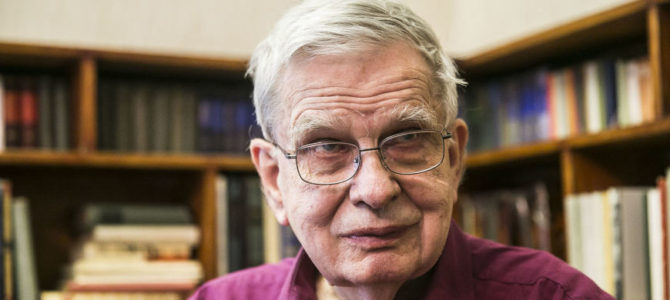
Poet, writer, translator and intellectual professor Tomas Venclova, currently living in the U.S., is highly critical of a street in Vilnius still named after interwar Lithuanian diplomat and colonel Kazys Škirpa.

“I think Kazys Škirpa, who obsequiously served Hitler and worked with the Gestapo, has no more earned having a street named after him than has Justas Paleckis, who kowtowed to Stalin and worked with the NKVD,” Venclova said in a statement which was read at a discussion at the Old Town Hall in Vilnius.

“The argument that Škirpa was in favor of independence while Paleckis was against is demagogic and full of error. THey both attempted to preserve independence formally but not actually under the protection of totalitarian regimes, and both of them killed independence,” the professor of literature and one of the five founders of Lithuania’s Helsinki Group said.

Full story here.

A Story of Moral Courage

screen-shot-2014-11-04-at-9-19-16-pm

SKOVAGALIU, LITHUANIA… NOVEMBER 1943 Lea Port and Samuel Ingel were members of a resistance group in the Kovno ghetto. They escaped the ghetto and walked more then 100 kilometers towards the village of Simnas. There they met Semonas Tamulinas, a communist who had been hiding from the Germans for three years. He said that since Lea did not look Jewish she could pass as a Christian and his sister, Elena Ivanauskai, would take her into her home. Lea lived with Elena and Petras Ivanauskai and their two children, Giedrute and Gintautas. At first Elena did not know that Lea was Jewish, but once she found out she agreed to keep hidding her. As the weather became colder Lea asked Elena if Samuel could hid in their barn. Elena agreed to help Samuel too. Lea and Samuel stayed with the Ivanauskai family until the area was liberated by the Soviet army in August 1944. In 2006 the JFR reunited Lea with Giedrute.

To read more about Giedrute and Gintautas Ivanauskai click here.

Read more at: https://jfr.org/video-library/reunion-2006/

Hanukkah Greetings from Jewish Telegraphic Agency

jta

Friends,

JTA was founded in 1917 to inform the world about the plight of Jewish refugees after World War I.

As we get set to turn 100, more than 1 million Jews still live in Europe. They aren’t refugees, but they face alarming developments — including anti-Jewish violence from jihadist terrorists and spikes in anti-Semitism, anti-Israel activism and political extremism. The post-Holocaust framework that has kept the peace in Europe for 70 years is teetering.

One thing that hasn’t changed and won’t change: JTA is paying attention — and keeping you informed about the lives of our brothers and sisters in Europe.

We are on the ground with a full-time reporter and a network of correspondents.

To continue and even expand our reporting efforts, we need your help.

Your financial support is critical to our efforts. Please make a tax-deductible gift today. Join our community of supporters who believes that keeping everyone informed and connected helps Jewish communities throughout the world remain safe and strong.

May the Hanukkah lights bring much warmth and joy to your home.

Sincerely,

Ami Eden,
CEO and executive editor
newsdesk@jta.org

P.S. A generous donor will match all new and increased gifts to JTA. Thank you in advance for your support. Should you wish, mail your check to JTA, 24 W. 30th St., 4th Floor, New York, NY 10001.

If you have already made you year-end gift, you have my heartfelt thanks.

Radio Documentary: Jews of Zarasai Region United by Love of Nature and Tragic Fate

lrtradijas

At 11:05 A.M. on Sunday Lithuanian National Radio, to be rebroadcast Tuesday at 9:00 A.M.

Lithuanian National Radio and Television looks back at the forgotten past of the Jews of Lithuania.


“Zarasai occupies a very warm place in my heart. There I spent what were probably the most important years of my childhood,” famous US cartoonist Al Jaffee (Mad Magazine and others) says. One might say his mother was killed by her love of her native land, according to a biography of the famous caricaturist from Zarasai. Those who left the region and the children of Holocaust survivors have a palpable nostalgia for the land with its lakes, forests and easy-going and care-free life. This sense is shared by all the residents of the different towns and villages interviewed, and who are creating their own initiatives to remember this forgotten part of their history.

Zarasai, Dusetos, Salakas, Antalieptė–the life of all the Jews who lived in these towns was snuffed out in Krakynė forest. Radio Documentary will take a look at the past of all these interconnected towns and how the Jewish community there is remembered today.

Hostess Vita Ličytė

Litvak Holocaust Historian Dov Levin is Dead

dov-levin

Dov Levin, scholar and Jewish historian, passed away December 3. The Lithuanian Jewish Community mourns the loss of the great Litvak scholar and extends our condolences to his loved ones. May his memory shine on.

Professor Levin was one of the most accomplished researchers working in Eastern European Jewish community history. Born in Kaunas in 1925, he attended a Zionist school with instruction in Hebrew and was a member of the Youth Zionist movement. He and his family were imprisoned in the Kaunas ghetto. His father Tzvi Hirsh, his mother Bluma Wigoder and his nine sisters all perished and Dov was the only survivor. In 1943 he fled the ghetto and joined the partisans. After Soviet liberation his partisan group, Death to the Occupiers, was moved to Vilnius, and Levin resolved to go to Palestine. He left Vilnius on foot for Israel in 1945. He was part of the founding of the State of Israel and fought in battles for independence. He completed his education and Hebrew University in Jerusalem and received a doctorate in history. He was a Fulbright scholar at the University of Chicago and became director of the Oral History Division of the Harman Institute of Contemporary Jewry at Hebrew University. Over 50 years he recorded more than 610 interviews with Holocaust survivors from the Baltic states. In 1960 he spearheaded efforts to record the testimonies of survivors in Israel and elsewhere. He is the author of over 520 academic articles and 16 books in Hebrew and English, including Lithuanian Jewry’s Armed Resistance to the Nazis 1941-1945 (1985); Baltic Jews under the Soviets (1994); Lesser of Two Evils: 1939-1941 (1995) and Litvaks: A Short History of the Jews in Lithuania (2000). Most of his work is dedicated to preserving the memory of the murdered communities, the history of the Holocaust and Holocaust denial in the Baltic states.

Condolences

With sadness we announce the death of Jewish rescuer Antanas Poniškaitis.

Antanas Poniškaitis and members of his family have been recognized as Righteous Gentiles by the Yad Vashem Holocaust authority in Israel. Let his memory shine on. Let gratitude and honor always be upon his name.

Irena Veisaitė’s Personal History Provides View of Four 20th Century Epochs

bernardinai.lt

We offer an excerpt from the newly-published book of conversations by historian Aurimas Švedas called “Irena Veisaitė. Gyvenimas turėtų būti skaidrus“ [rena Veisaitė: Life Should Be Transparent] (lAukso žuvys publishing house) with German literature scholar, theater specialist and long-time director of the Open Society Fund of Lithuania Irena Veisaitė about her life story and thoughts about history. The book was launched at the Vilnius Picture Gallery December 15. The author and Veisaitė herself attended the book launch along with other people who know of her achievements in life and her influence on Lithuanian culture.

Švedas in his introduction to his book said: “Irena Veisaitė’s personal history allows us a glimpse of four 20th-century epochs: the interwar period, the time of the first Soviet and the Nazi occupation, the Soviet period and the years of restoration and consolidation of Lithuanian independence. The book’s heroine’s retelling of her life helps interpret the aforementioned epochs and build bridges over the gaps of miscommunication and misunderstanding which separate them. So as we spoke, I didn’t just pose the question of what really happened, I also constantly looked for opportunities to think about what, how and why we remember,”

Your life is simply suffused with the most varied events and extreme experiences. Did you ever think about sitting down and recording some of it on paper?

The Four Epochs of Professor Irena Veisaitė: Images, Portraits, Words and Theater

Cultural historian Aurimas Švedas’s book “Irena Veisaitė. Gyvenimas turėtų būti skaidrus” [Irena Veisaitė. Life Should Be Transparent] will be launched at the Vilnius Picture Gallery at 6:00 P.M. on December 15. Historian Saulius Sužiedėlis says the book contains unforgettable images of 20th century Lithuanian history, including the Jewish and Lithuanian interwar period in Kaunas, the ruthless reality of the war and the Holocaust, rescue and rebirth.

veisaite-knygos-virselis-73117528

Author Švedas, the subject of the book Irena Veisaitė herself, theater producer Audra Žukaitytė, director Gintaras Varnas and literary scholar Kęstutis Nastopka are to attend the book launch, to be moderated by Vytenė Muschick. The book details the extraordinary life of the German literature specialist, drama expert and long-time director of Lithuania’s Open Society Fund.

Poet, translator and student of culture Tomas Venclova said of the book: “This book belonging in the genre of long conversational is a prerequisite for everyone who is interested in Lithuanian history over recent decades. Irena Veisaitė is one of the most enlightened people of our land, the incarnation of tolerance and common sense. She devotes the most attention to culture, especially the theater, and the cultural opposition in the Soviet period, but very wisely, avoiding extremism and empty words, also lays out painful philosophical questions.”

Full story in Lithuanian here.

Condolences

Word has reached the Lithuanian Jewish Community Dov Levin passed away December 3. Levin was born in Kaunas January 27, 1925. He joined the partisans and left Lithuania on foot for Jerusalem on January 17, 1945. He is the author of numerous groundbreaking works about the Holocaust in Lithuania and about Litvak culture. Our deepest condolences to his family and loved ones on the death of a man who meant so much to so many.

The Secret’s Out: Bagel Shop Featured on Russian Travel Site

Evgenii Golomolzin

Travel journalist and photographer Evgenii Golomolzin from St. Petersburg, Russia, has written a long piece about the culinary experiences available in Vilnius, with the Bagel Shop featured prominently.

Vilnius is a cosmopolitan city where all sorts of ethnic dishes are on offer, he writes. As a heavily Jewish city of many centuries, it has preserved Jewish traditions even after the Holocaust. There is an old Jewish quarter. A year ago the Bagel Shop Café appeared as well. The kosher café the Bagel Shop is an exotic attraction. The Bagel Shop is located at Pylimo street no. 4. The café is not large and is very simple, but original. It feels like a small apartment with the books and knickknacks on the shelves. You can read the books as you sip coffee, you can buy a Hebrew dictionary or a Jewish calendar. But people come here not for the books, but for the real Jewish treats and the bagels (€0.85 apiece). Five kinds are sold at the café.

bk1

The display case also has lekakh, a Jewish sweet-cake; imberlakh, a pastry made of carrots, ginger and orange; and teiglakh, small cakes cooked in honey. You can order something more filling, for example, soup with dumplings (€2.00), an egg-salad sandwich (€3.60), tuna sandwich (€3.60) or hummus sandwich (€3.60). It’s all delicious. The café opened just recently—in 2016—but has already become a tourist attraction, the St. Petersburg-based travel publication writes.

Full story in Russian with very nice photographs here.

Holocaust Survivor: It Had Nothing to Do with War, a Madman Committed the Violence

Finally a book has been published telling the story of how Moriz Scheyer successfully hid from the Nazis. The decades have not lessened the hatred he feels for those who aided the fuhrer.

Scheyer was the art director of one of the main newspapers in Vienna. He knew many of the city’s artists at the time and was an important figure in journalism covering literature in his own right. When the Nazis came to power, he had to quit his job and home. Hiding in France in 1943, he began writing what eventually became the book “Asylum: A Survivor’s Flight from Nazi-Occupied Vienna through Wartime France.”

The Holocaust was carried out without the civilized world having the courage to say it should stop, or even expressing its disgust. Only later, much later, when it was much too late, we began to receive nice expressions of solidarity in the context of general war propaganda. And at that time, when that was being done, the states which had all the power and could have done so without greater expenses, were unable to do their duty to open the door to the persecuted.

Full story in Lithuanian here.

New Book by Lithuanian Writer about State of Israel

izraelis-zydu-valstybe

Accomplished author, lecturer and media personality Giedrius Drukteinis has a new book out called “Izraelis – žydų valstybė” [Israel: The Jewish State] and as with his comprehensive treatment of the United States-Viet Nam war, it’s a long one, 832 pages. It was published by Sofoklis publishing house in Vilnius in 2016.

Drukteinis goes through the main events in Jewish history in chronological order, from exile to Babylon, the Middle Ages, modern emancipation, roots of anti-Semitism, aliyah, Zionism, relations with Arabs, the Jewish experience during both world wars, the foundation of the state and modern development in the current period. The chronological layout is intended to help Lithuanian readers orient themselves to the creation and history of the Jewish state, according to the publisher.

The book devotes much space to the concept of aliyah leading up to the founding of the unique State of Israel. One reviewer said most of the book is about warfare.

The Kaunas of Chiune Sugihara as Casablanca del Norte

lrytas.lt

Japan is a market of 125 million tourists. Kaunas is attractive as a destination for them because of the memory of Righteous Gentile Chiune Sugihara. Much has been done, but much more needs to be done, including presenting Kaunas as a kind of Casablanca of the North. Šiauliai University lecturer and historian Dr. Simonas Strelcovas recently returned from the land of the rising sun. There he researched Japanese attitudes towards Chiune Sugihara, the Japanese consul who issues thousands of visas to Jews in Kaunas in 1940, thus saving them. In Japan he is greatly honored. The historian says this respect should be exploited to attract tourists. Dr. Strelcovas is certain the nature of Lithuania then when the rescuer operated needs to be told. That Lithuania was not Nazi, and that, unlike other European states, accepted tens of thousands of refugees. He’s planning to reveal all this in an academic book in Japanese to be published next year.

Full story in Lithuanian here.
lrytas logo

Four Musical Views on a Jewish Theme

remejai

You are invited to attend the launch of the compact disc called Four Musical Views on a Jewish Theme at the Lithuanian Jewish Community in Vilnius at 6:00 P.M. on December 12. The compact disc is a project by the Lithuanian Union of Musicians, Muzikos Barai magazine and the Goodwill Foundation. Participants are to include composer and president of the Lithuanian Union of Musicians Audronė Žigaitytė-Nekrošienė, pianist and music professor Leonidas Melnikas, violinist Borisas Traubas and cellist Valentinas Kaplūnas.

muzikinis-projektas

The Four Musical Views on a Jewish Theme CD is a unique musical excursion into the tragic 20th-century history of the Jews. Never before had anti-Semitism and hatred of Jews reached such proportions, never before had epiphanies of evil been accompanied by such violence and suffering. Artists were unable to remain silent and their work testifies to, and sometimes screams about these shameful pages of history, condemning evil and exalting good. Four great 20th-century musicians– Maurice Ravel, Darius Milhaud, Aaron Copland and Dmitri Shostakovich—have immortalized this in their work. The tragic passages of Jewish history retold by these artistic geniuses are performed by Lithuanian artists on the compact disc, including singer Liora Grodnikaitė, violinist Boris Traub, cellist Valentinas Kaplūnas and pianist Leonid Melnik. It is an appeal to every individual and to everyone.

Muzikos Barai magazine has made this disc available to readers as a free gift. In their October issue they published an article about those who rescued Jews from the Holocaust in Lithuania.

Mark Harold: Arguments, Counter-Arguments and Facts on Škirpa Alley

markas-haroldas

by Mark Harold, Vilnius City Council member
15 min.lt

Let us begin with my argument, which is very simple and against which my opponents have counter-arguments. One short paragraph:

Kazys Škirpa led the LAF. Current competent institutions of the Republic of Lithuania recognize the LAF was an anti-Semitic organization. Therefore, naming a street after the leader of this sort of organization in Vilnius, where the Holocaust was especially brutal, within the European Union in 2016 is inappropriate. Now more laconically I will analyze each attempt to argue against this, which I have encountered over recent days, and will explain why these counter-arguments are invalid.

Full story in Lithuanian here.

New Book about Sugihara by Lithuanian in Japanese

lzinios.lt

Next year a new book about Chiune Sugihara, Japanese consul in Lithuania and rescuer of thousands of Jews, is scheduled to be published in Japan. The author is Dr. Simonas Strelcovas, historian and professor at Šiauliai University in Lithuania who researched the hero at Japanese archives and only recently returned home. The book is to appear in Japanese.

Full story in Lithuanian here.

Lithuania and Israel: Past, Present, Future

Lietuvos ambasados Izraelio Valstybėje bei Lietuvos URM surengta konferencija „Lietuva ir Izraelis: Praeitis, Dabartis, Ateitis“

The Lithuanian embassy to Israel and the Lithuanian Foreign Minister held a conference called Lithuania and Israel: Past, Present, Future at the Peres Peace Center in Tel Aviv on November 24, 2016. The conference discussed Lithuanian Holocaust studies, progress in commemorating victims, current activities of the Lithuanian Jewish Community and Lithuanian citizenship restoration issues.

Lithuanian ambassador to Israel Edminas Bagdonas spoke about increasing partnership between the two countries in his opening speech. He noted Litvaks in both countries are making great contributions to this. Lithuanian ambassador-at-large Dainius Junevičius emphasized the change in attitude towards the country’s history by the public and especially young people. Ronaldas Račinskas, executive director of Lithuania’s International Commission to Assess the Crimes of the Nazi and Soviet Occupational Regimes in Lithuania, spoke about progress in Lithuanian Holocaust research and commemoration. Vytautas Magnus University lecturer Robert van Voren presented his studies into the Holocaust in Lithuania and spoke about parallels between Lithuania and the Netherlands. Yad Vashem representative Dr. Arkadi Zeltser addressed the state of monuments for commemorating Holocaust victims in Lithuania. Lithuanian Jewish Community chairwoman Faina Kukliansky provided an overview of the current situation and activities of the community. She also field a large number of questions from the audience about the Litvak legacy and heritage in Lithuania.

liet-izr-amb3fa

US Embassy Reps Visit Kaunas

Kaune viešėjo Amerikos ambasados Lietuvoje atstovai

Two weeks ago representatives from the United States embassy in Vilnius visited Kaunas. They toured the Seventh Fort and met at the Sugihara House museum with Sugihara Foundation founders Ramūnas Garbaravičius and Egidijus Aleksandravičius, Kaunas Jewish Community chairman Gercas Žakas and reporter Birutė Garbaravičienė. Ted Janis of the American embassy expressed satisfaction the Kaunas and Lithuanian Jewish Communities, the Kaunas municipality, the Seventh Fort collective and Israeli ambassador to Lithuania Amir Maimon had combined forces to commemorate the Holocaust victims of the Seventh Fort at the mass grave site. They also spoke about the situation regarding Holocaust education in Lithuania, the importance of the Sugihara museum and Jewish life in Kaunas.

Cyclopedia on Holocaust in Žemaitija Published

holokaustas-zemaitijoje

Aleksandras Vitkus, Chaim Bargman. Holokaustas Žemaitijoje. – Vilnius: Mokslo ir enciklopedijos institutas, 2016. – 488 p.

The book’s authors go into fine detail in their descriptions of the mass murders in Žemaitija (the historical Samogitia, western Lithuania), having collected testimonies from witnesses several years ago. Žemaitija is composed of 6 districts plus the Klaipėda region (historical Memel). They collected information about Kretinga (12 rural districts), Mažeikiai (8 rural districts), Raseiniai (12 rural districts), Tauragė (13 rural districts), Telšiai (9 rural districts) apskritis, the western section of the Šiauliai district (10 rural districts) and the Klaipėda region. The cyclopedia includes about 70 locations where mass murders took place and monuments now stand.

bernardinai.lt

Full story here.
Bernardinai logo

Barbed Wire at Synagogue

We’ve received some angry emails about the barbed wire which has appeared on the synagogue fence. The main point seems to be that it’s not aesthetic. Of course it’s not. And it doesn’t fit in with our unique synagogue built in 1903 with its architectural authenticity.

Many students and teachers from Vilnius and Lithuania visit our synagogue. Tourists also visit. This year more than 5,000 guests visited the synagogue.

The Lithuanian Jewish Community celebrates all the traditional Jewish holidays at the synagogue. Our guests also celebrate with us, including foreign ambassadors and members of the Lithuanian Government and members of parliament. We are working actively with public organizations in the European Union which are involved in insuring the security of Jewish communities around the world. The security system at the Vilnius Choral Synagogue was set up based on their recommendations and continues to be improved. In Europe armed professional security service personnel guard synagogues.

Because of security concerns, we are asking everyone to adhere to rules for visitors at the Choral Synagogue, which are posted in three languages on the LJC website, lzb.lt, and will be posted at the synagogue in a visible location.

Concerning the barbed wire, we thought about it deeply, and of course we don’t like it, but we decided the most important consideration is safety. For that reason this quick and inexpensive temporary solution was adopted. At the same time, plans for a new fence are being drafted, one that doesn’t clash with integrity of the architectural style but does meet security requirements. The project will be a prolonged process, because we must ask permission from and harmonize the project with the Cultural Heritage Department to remove the old fence and build a new one. We hope to complete it next summer. We are in charge of the synagogue and we are concerned for the safety of worshipers and guests, and we don’t want events to repeat here in Vilnius which have occurred elsewhere. Here are some examples.

In Copenhagen a killer attempted to gain access to a Jewish event with about 80 participants, mainly children. No one knows what would have happened if not for the man who sacrificed his own life to stop the killer.

Over one week last July there were eight attacks on synagogues in Paris. In the Paris suburb of Sarcelles, a crowd of 400 watched as one synagogue was fire-bombed.

During the attacks in Paris a kosher food market was heavily damaged and looted, as was a pharmacy. There were signs with the inscriptions “Death to Jews” and “Cut the throats of the Jews.”

A synagogue in Wuppertal, Germany, which had been rebuilt after being destroyed in Nazi Germany’s Kristallnacht in 1938, was attacked with Molotov cocktails.

In Mumbai (Bombay) in 2008 a group of terrorists walked through the city shooting people in cafés and hotels as they made their way to the Chabad Lubavich Center, where they killed the young rabbi and his pregnant wife.

Once I was flying back from Israel to Vilnius, and my fellow passenger complained the entire trip about how security checks at Ben-Gurion International Airport were an affront to his human dignity. No argument could convince him that it was for his own safety. So we apologize to those who are offended by the barbed-wire fence. I know no arguments will convince them that this is for your own security, just as my fellow passenger on the airplane could not be convinced.

Simas Levinas, chairman
Vilnius Jewish Religious Community